
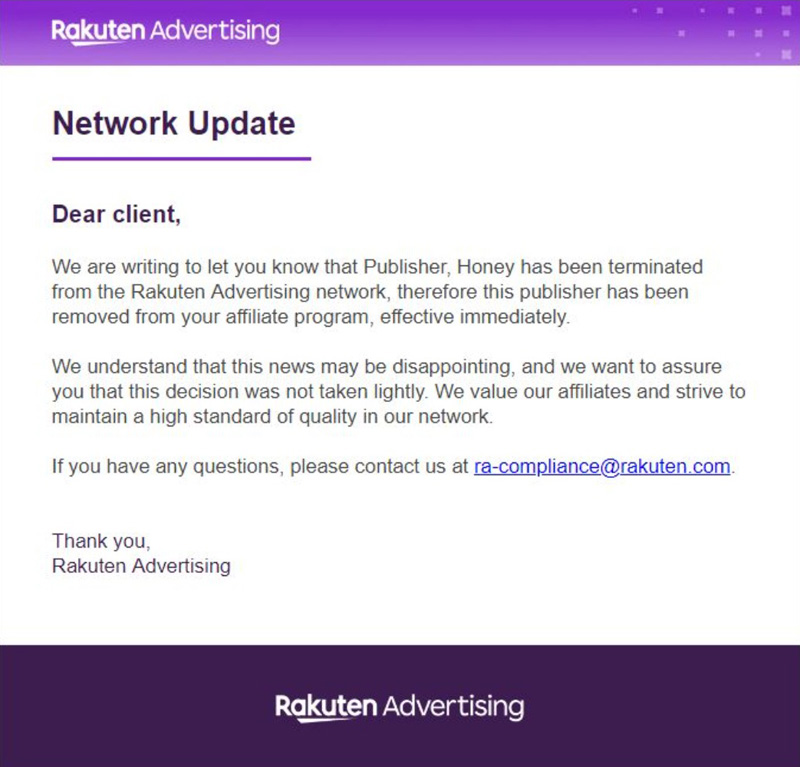
The affiliate marketing landscape experienced a seismic shift this week as two of the industry’s most prominent networks, Rakuten Advertising and impact.com, took decisive disciplinary action against PayPal Honey. The platform, which was acquired by PayPal in early 2020 for a record-breaking $4 billion, has been removed from Rakuten’s network and suspended from impact.com’s Discovery Marketplace. These actions follow a series of high-profile investigations into the browser extension’s technical practices, specifically regarding "attribution manipulation" and violations of "stand-down" rules.
The fallout began on Monday, January 12, when Rakuten Advertising officially announced that Honey had been "terminated from the network." In a statement released to its partners, Rakuten framed the move as a necessary measure to uphold "a high standard of quality" within its ecosystem. Just days later, on Friday, January 16, impact.com followed suit, revealing that Honey was "out of compliance" with platform policies. While Rakuten’s move appears to be a permanent termination, impact.com’s leadership characterized their action as a temporary suspension, pending further review. David Yovanno, CEO of impact.com, explicitly cited behavior that "undermines trust in the partnership economy" as the catalyst for the suspension.
A Chronology of the Controversy
To understand the gravity of these terminations, one must look back at the trajectory of Honey Science Corp. Founded in 2012, the company grew rapidly by offering a browser extension that automatically discovered and applied coupon codes at checkout. By 2019, it boasted over 17 million monthly active users and partnerships with approximately 30,000 retailers.
The current crisis was precipitated by two major external investigations. The first was a technical exposé by the YouTube creator known as MegaLag, whose video documented inconsistencies in how the extension interacted with affiliate links. This was followed by a rigorous investigation by Ben Edelman, a well-known expert in online advertising fraud and a computer scientist at Harvard Business School. Edelman’s findings suggested that Honey was engaging in "intentional stand-down violations and concealment."
The timing of the network removals coincided with Affiliate Summit West, the largest affiliate marketing conference in the United States. As thousands of industry professionals gathered in Las Vegas, the news of Rakuten’s termination of Honey became the primary topic of discussion on the conference floor and across social media platforms. The synchronization of the announcement with the industry’s premiere event is viewed by many analysts as a strategic move by the networks to signal a new era of strict enforcement regarding affiliate compliance.
Technical Breakdown: Stand-Down Rules and Attribution Manipulation
At the heart of the dispute is the "stand-down" rule, a critical technical protocol in the affiliate marketing industry. Most affiliate programs operate on a "last-touch" attribution model, meaning the affiliate who facilitates the final click before a purchase receives the full commission. However, browser extensions—which are often activated only when a user is already on a merchant’s checkout page—have the potential to "overwrite" the cookies of previous affiliates who may have done the actual work of introducing the customer to the brand.
To prevent this, industry standards require extensions to "stand down" if they detect that another affiliate’s cookie is already present. The investigations into Honey alleged that the extension was bypassing these safeguards. By firing its own affiliate link even when it was supposed to remain dormant, Honey was effectively "hijacking" the attribution. This practice ensures that Honey receives the commission, while the original content creator, influencer, or publisher who drove the traffic is deprived of their earnings.

Furthermore, the allegations included "concealment," suggesting that the extension used technical obfuscation to hide these violations from the monitoring tools used by networks and affiliate managers. This breach of transparency is what led to the harsh "non-compliance" labels from Rakuten and impact.com.
Supporting Data and Industry Impact
The affiliate marketing industry is a multi-billion dollar sector, with spending in the United States alone estimated to exceed $8.2 billion annually. For major brands, affiliate programs can account for 10% to 30% of total e-commerce revenue. When a massive player like Honey—which manages a significant portion of this traffic—is found to be manipulating attribution, the financial implications for other publishers are profound.
According to data from the Performance Marketing Association (PMA), the "last-click" model remains the dominant form of compensation. When "bottom-of-the-funnel" tools like browser extensions engage in unauthorized cookie-stuffing or stand-down violations, they cannibalize the margins of "top-of-the-funnel" publishers, such as bloggers and review sites. This creates a hostile environment where high-quality content creators may abandon a merchant’s program if they feel their commissions are being unfairly diverted to software extensions.
The removal of Honey from these networks also raises questions about the valuation of PayPal’s $4 billion acquisition. If Honey is unable to access major affiliate networks, its primary revenue stream—commissions from merchant sales—could be severely hampered. PayPal’s stock and investor sentiment regarding its "shopping" segment may face scrutiny as the company navigates these compliance hurdles.
Official Responses and Market Reactions
While PayPal has not released a comprehensive public rebuttal to the specific technical allegations at the time of writing, the industry reaction has been swift. David Yovanno of impact.com emphasized that the "partnership economy" relies entirely on trust and fair play. He noted that attribution manipulation is not merely a technical glitch but a fundamental violation of the contract between publishers and advertisers.
Industry analysts suggest that these removals mark a turning point for Downloadable Software Publishers (DSPs). For years, many networks were accused of "looking the other way" when large affiliates violated minor rules, simply because those affiliates drove such high volumes of sales. The decisive action by Rakuten and impact.com suggests that the "too big to fail" era of affiliate marketing may be coming to an end, replaced by a more rigorous focus on brand safety and ethical attribution.
Strategic Implications for Affiliate Program Managers
The Honey controversy provides a blueprint for how affiliate managers should approach program health in the future. Experts suggest five key takeaways for brands currently managing affiliate partnerships:
1. The "Bad Apple" Effect on Recruitment
A program that allows rule-violating affiliates to persist will eventually lose its most valuable partners. Savvy publishers use policing tools to see which other affiliates are in a program. If they see a known "cookie-dropper" or an extension that ignores stand-down rules, they will often decline to promote that brand, fearing their efforts will never result in a commission.
2. The Necessity of Independent Policing
Brands cannot rely solely on network-level compliance departments. While networks monitor for broad violations of their own terms, they may not catch nuances specific to an individual brand’s Terms and Conditions (Ts & Cs). Managers must proactively use third-party monitoring software to ensure all partners are adhering to the specific rules agreed upon during onboarding.
3. Deep Technical Understanding
The Honey case highlights the complexity of modern affiliate technology. Managers need to understand the difference between "soft clicks," "stand-down rules," and "attribution hijacking." Resources like the Affiliate & Partner Marketing Association (APMA) audit and the PMA’s DSP policy comparisons are becoming essential reading for those in the field.
4. Avoiding Generalization
While Honey has been penalized, industry experts warn against banning all browser extensions or software publishers. Not all extensions violate rules; many provide legitimate value by increasing conversion rates and average order values. Each affiliate should be evaluated on its individual technical behavior rather than being dismissed based on its category.
5. The Critical Need for Diversification
The most significant risk identified in the wake of Honey’s removal is the lack of diversification in many affiliate programs. Audits frequently reveal that a staggering 80% of a program’s revenue is often driven by a tiny handful of affiliates, frequently all from the same category (e.g., coupons and deals).
To build a resilient program, managers are encouraged to explore a broader range of affiliate types. A truly diversified base should include:
- Content producers and mass media outlets.
- Social media influencers and podcasters.
- Card-linked offers and loyalty/cashback sites.
- Niche educators and consultants.
- Charities, fundraisers, and affinity groups.
- Post-checkout and cart-abandonment solutions.
- Connected TV (CTV) and video marketers.
Conclusion and Future Outlook
The termination and suspension of PayPal Honey serve as a stark reminder that no entity is above the rules of the affiliate ecosystem. As the industry moves into 2026, the focus is expected to shift toward "holistic" marketing strategies where transparency and fair attribution are prioritized over raw volume.
For merchants, the lesson is clear: protecting the integrity of the clickstream is essential for long-term growth. For networks, the move signals a commitment to quality that may help restore the trust of smaller publishers. As for PayPal Honey, the path forward will likely involve significant technical overhauls and a rigorous auditing process if it hopes to regain its standing in the world’s leading affiliate marketplaces. The coming months will determine whether this is a temporary setback for the $4 billion platform or the beginning of a permanent shift in how browser-based affiliate tools are permitted to operate.