The primary objective of a Voice of Customer audit is to quantify the disparity between perceived and actual customer friction, converting abstract dissatisfaction into actionable strategic insights. For the majority of modern enterprises, the first execution of a comprehensive audit reveals a sobering reality: the friction visible in support tickets and traditional survey responses represents only a marginal fraction of the actual challenges customers face. According to Gartner’s Effortless Experience research, a staggering 96% of customers who encounter high-effort interactions eventually become disloyal. In stark contrast, only 9% of those who experience low-effort interactions demonstrate similar disloyalty. Most critically, this disloyalty remains largely invisible to the organization until it manifests as churn, with data indicating that approximately 43% of customers who leave never voiced a single concern prior to their departure.
This phenomenon, often referred to as "silent churn," has been a cornerstone of customer experience (CX) literature since the classic Kolsky/thinkJar research established that dissatisfied customers overwhelmingly opt for silence over confrontation. They do not complain; they simply exit. This silence creates a dangerous "blind spot" for companies that rely solely on reactive data. A Voice of Customer (VoC) audit serves as the structural diagnostic required to identify these gaps and determine the specific revenue being lost to unaddressed friction.
Defining the Voice of Customer Audit vs. VoC Analysis
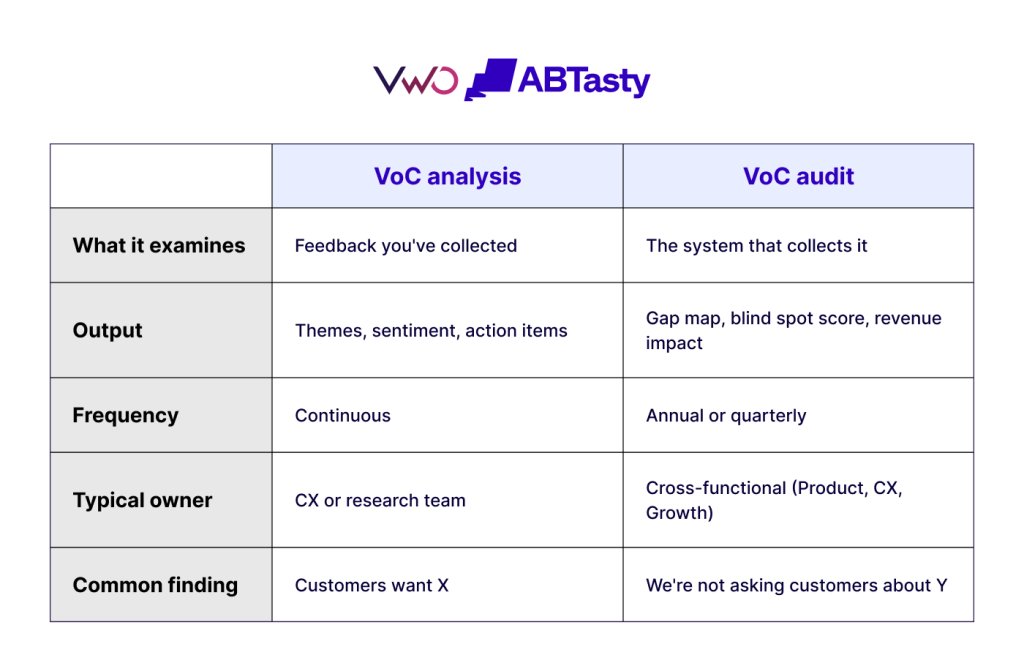
To understand the necessity of an audit, one must distinguish it from a standard VoC analysis. While most organizations maintain some form of analysis process, few have ever conducted a formal audit. A VoC analysis is an interpretive exercise; it examines the feedback already collected to identify themes, sentiment, and required actions. However, it is inherently limited by the quality and scope of the data it receives.
In contrast, a VoC audit is a diagnostic evaluation of the system itself. It assesses four critical pillars: the measurement of customer sentiment, the identification of unmeasured areas, the quantification of "blind spots," and the financial impact of those gaps. The distinction is vital because most customer friction is invisible to a standard analysis. If a survey fails to ask the right question at the precise moment of frustration, the resulting data point never enters the set for analysis. An audit identifies these structural failures before they translate into another quarter of unexamined revenue loss.
The Financial Implications of the Ticket Iceberg
The "Ticket Iceberg" is a conceptual model used by CX professionals to describe the relationship between visible complaints and underlying dissatisfaction. Research from organizations such as TARP and Lee Resources suggests that for every customer who takes the time to submit a support ticket, approximately 24 others experience the same issue but remain silent. These silent users do not seek resolution; they simply disengage.
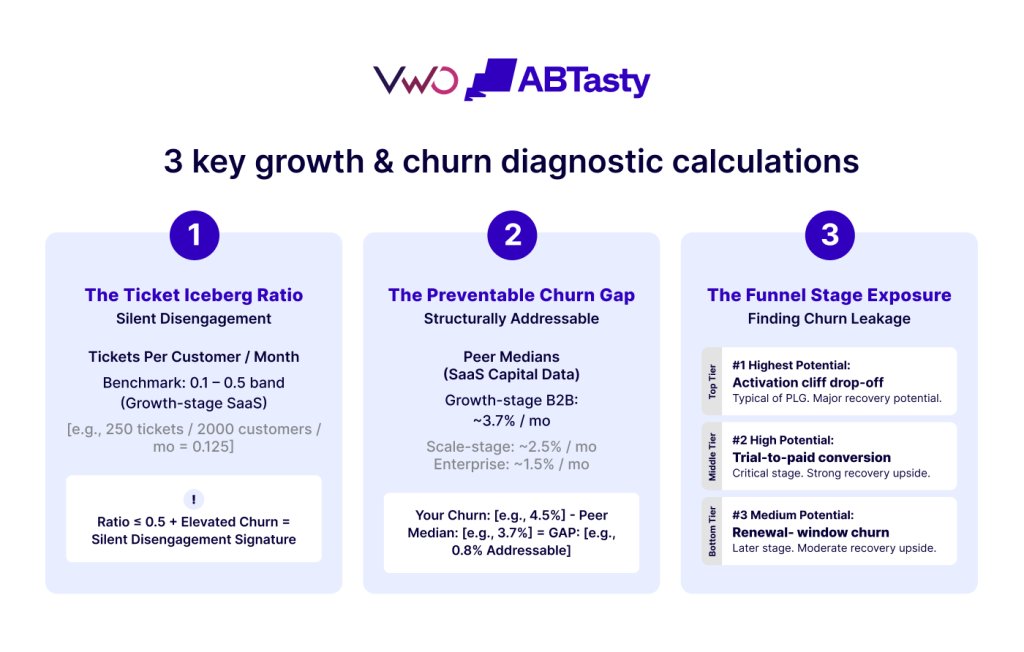
When support tickets serve as the primary signal for customer health, a company can mistakenly believe its product is performing well even as retention rates plummet. This is particularly prevalent in growth-stage SaaS companies, where a healthy ticket queue may coexist with a systemic churn problem. The audit process forces an organization to calculate its "Ticket Iceberg Ratio"—the number of tickets per customer per month—and benchmark it against industry standards, typically between 0.1 and 0.5 for growth-stage entities. A ratio that falls significantly below this band while churn remains high is a definitive signature of silent disengagement.
A Six-Step Framework for Executing a VoC Audit
A comprehensive VoC audit typically requires between two and six weeks to complete, depending on the scale and complexity of the organization. The following six-step framework provides a roadmap for identifying and closing measurement gaps.
Step 1: Mapping the Feedback Ecosystem
The first phase involves cataloging every active channel where customer feedback is currently captured. This includes obvious sources like support tickets and NPS surveys, but also less centralized data such as G2 reviews, app store ratings, sales call notes, Customer Success Quarterly Business Reviews (QBRs), and social media mentions. Most teams discover they have either too few channels (fewer than seven), indicating significant blind spots, or too many (more than fifteen), suggesting a lack of clear ownership and data consolidation.
Step 2: Evaluating Structural Strengths and Weaknesses
Every feedback mechanism has inherent biases. NPS provides a high-level sentiment trend but lacks the "why" behind the score. Support tickets highlight severe technical issues but ignore the "quiet" users. Session recordings show user behavior but fail to capture intent. This step involves mapping each channel against the core questions the business needs to answer: Why are users dropping off? What are they comparing the product to? Why are promoters not expanding their accounts?
Step 3: Quantitative Measurement of the Blind Spot
This is the most critical phase of the audit, where the "gap" is assigned a numerical value. Organizations must calculate three core metrics:
- Preventable Churn Gap: The difference between current churn and the peer median for the company’s specific stage and vertical. (For instance, scale-stage B2B SaaS typically sees 2.5% monthly churn).
- Ticket Iceberg Ratio: As discussed, this measures the volume of complaints against the customer base.
- Funnel Stage Exposure: Identifying which stage of the customer journey—activation, trial-to-paid, or renewal—concentrates the most leakage.
Step 4: Diagnosing Friction Patterns
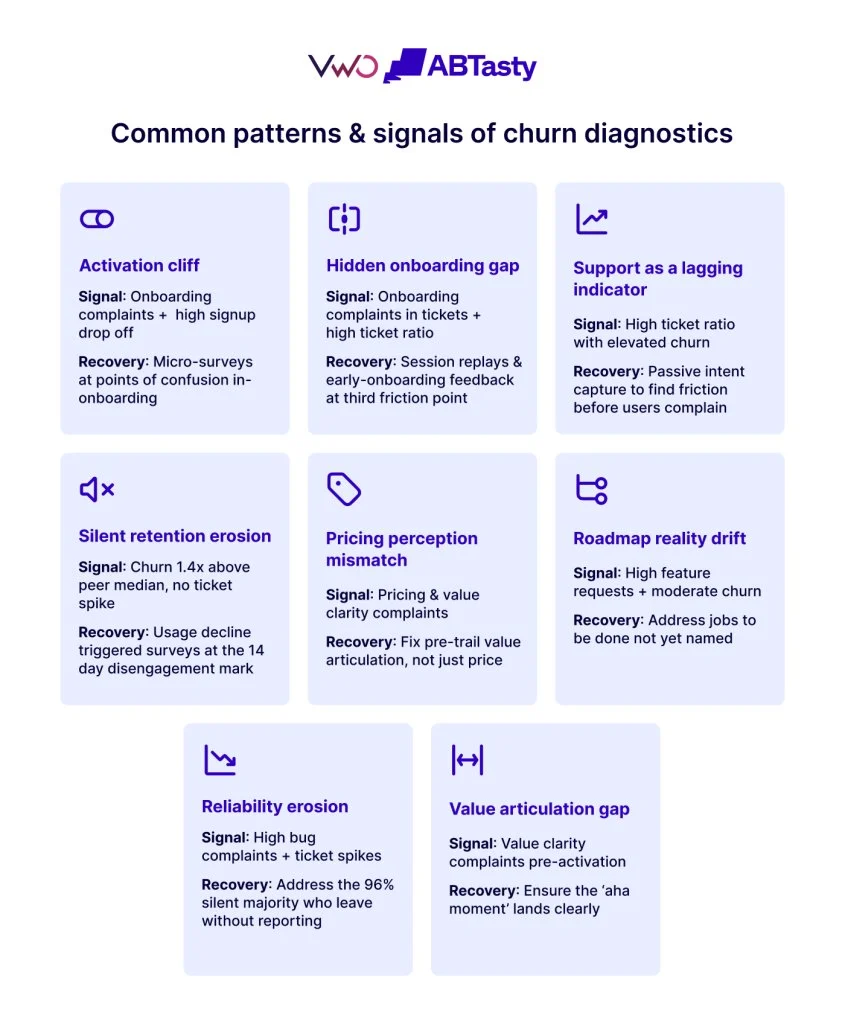
Once the score is established, the audit must identify the specific patterns causing friction. Common patterns include the "Activation Cliff" (where users fail to reach the first "Aha!" moment), "Value Lag" (where the time-to-value is too long), and "Administrative Friction" (where billing or account management hurdles drive users away).
Step 5: Prioritizing by Leverage
The instinct to fix the most severe problem first is often counterproductive. Instead, organizations should prioritize based on leverage. For most SaaS companies, the "Activation Cliff" offers the highest leverage; a 5% lift in activation compounds across every future cohort, whereas a 10% reduction in churn only impacts the existing customer base.
Step 6: Closing the Loop with Experimentation
An audit is only effective if it leads to action. Every identified friction pattern must be treated as a hypothesis to be tested. This turns the audit from a one-time diagnostic into an operational rhythm. Teams that conduct these audits quarterly tend to see compounding gains, while those who treat it as a one-off exercise often see their initial improvements erode within six months.
Revenue Leakage and the CFO’s Perspective
To gain executive buy-in, the findings of a VoC audit must be translated into the language of the finance department: dollars. Revenue leakage is calculated by combining conversion loss (traffic multiplied by stage-leak coefficients and Average Revenue Per User) and preventable retention loss (customer base multiplied by the preventable churn gap, ARPU, and Lifetime Value horizon).
When presented with a clear dollar figure representing monthly revenue lost to addressable friction, the VoC program shifts from being viewed as a "cost center" or a "soft" initiative to a measurable revenue lever. This financial modeling allows the organization to position its VoC efforts as a direct contributor to the bottom line.
The Role of Modern Platforms in Closing the Gap
The maturity of Voice of Customer platforms has significantly advanced, allowing companies to move away from generic feedback collection toward contextual, behaviorally-triggered data capture. Tools such as VWO Pulse are designed to address the specific blind spots identified during an audit.
For example, cadence-based surveys (like a quarterly NPS) often miss the "moment that matters." Modern platforms allow for micro-surveys triggered by specific user behaviors—such as a user getting stuck during onboarding or a sudden decline in feature usage. Furthermore, the integration of AI-driven open-text categorization allows companies to process vast amounts of qualitative feedback in real-time, surfacing patterns that would take human analysts weeks to identify.
Industry Chronology and the Shift Toward Contextual Feedback
The evolution of the VoC category has followed a clear timeline. In the early 2010s, the focus was primarily on NPS and CSAT scores as the "north star" of customer health. By the mid-2010s, the rise of journey mapping and CX audits introduced a more qualitative understanding of the customer experience. However, as the SaaS market became more crowded and the cost of customer acquisition (CAC) rose, the focus shifted toward retention and the "leaky bucket" problem.
In the current landscape, the most successful companies have moved beyond simple "feedback collection." They now treat Voice of Customer as a systematic practice of capturing and acting on intent in the moment. The audit framing has emerged as the necessary corrective to the over-instrumentation and data fragmentation that occurred during the rapid growth of the last decade.
Conclusion and Broader Impact
A Voice of Customer audit is no longer a luxury for high-growth companies; it is a strategic necessity. By identifying the silent churners and quantifying the revenue leaking through structural gaps, organizations can move from a reactive support model to a proactive growth model. The broader implication for the industry is a shift in how "customer success" is measured—moving away from subjective sentiment and toward a rigorous, data-driven understanding of the customer journey.
As companies look toward the next fiscal year, the ability to close the measurement gap between what customers experience and what the company sees will be the primary differentiator between those who merely survive churn and those who thrive through customer loyalty. Running an initial audit, even a brief directional one, provides the clarity needed to stop the silent exit of customers and the accompanying loss of revenue.