The landscape of artificial intelligence has reached a critical inflection point as OpenAI’s GPT-5.6 Sol and Anthropic’s Claude Fable 5 emerge as the two primary contenders for the "frontier-model crown." This rivalry represents more than just a clash of brands; it signifies a divergence in architectural philosophy, pricing strategy, and the very definition of machine intelligence. While Claude Fable 5 currently maintains a marginal lead in raw general intelligence and abstract reasoning, GPT-5.6 Sol has positioned itself as the pragmatic powerhouse, offering superior coding performance, faster execution, and a significantly lower cost of entry. In a market increasingly concerned with the ROI of AI integration, the pricing of GPT-5.6 Sol—which mirrors the mid-tier Claude Opus 4.8 rather than the premium Fable 5—has fundamentally shifted the competitive dynamics of the industry.
The Architectural Divide: Specialized Reasoning vs. Autonomous Agency
To understand the current conflict, one must first examine the technical foundations of both models. GPT-5.6 Sol is the flagship of OpenAI’s latest series, designed specifically for high-intensity professional workflows involving research, tool manipulation, and complex software engineering. Sol is not merely a singular model but a system capable of "Max Reasoning," a feature that allows the model to allocate additional compute resources to solve particularly opaque problems. Furthermore, its "Ultra Mode" represents a breakthrough in parallel processing, deploying multiple agents simultaneously to tackle large-scale coding repositories and multi-step project management.
Conversely, Claude Fable 5 represents the pinnacle of Anthropic’s "Constitutional AI" evolution. It is built for deep, long-running agentic work where human supervision is minimal. Within ecosystems like Claude Code or Managed Agents, Fable 5 excels at high-level planning. It does not just follow instructions; it delegates sub-tasks to smaller models, reviews intermediate outputs for errors, and self-corrects before presenting a final result. This "managerial" approach to AI makes it the preferred choice for enterprises looking to automate entire departments rather than individual tasks.
Economic Analysis: The Token Price War
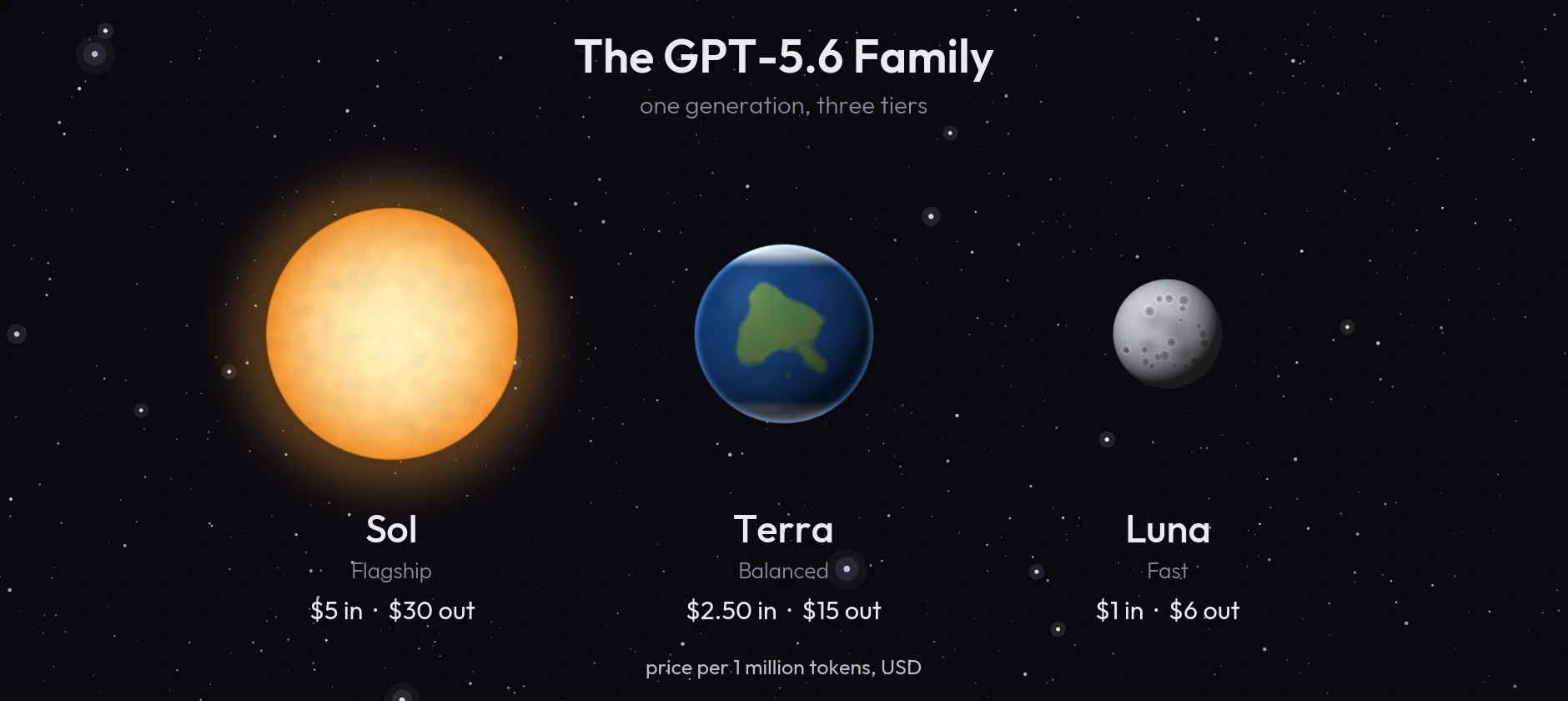
One of the most startling aspects of this comparison is the pricing disparity. In the high-stakes world of API-integrated business, the cost per million tokens often dictates which model sees mass adoption.
| Model | Input (per 1M tokens) | Cached Input (per 1M tokens) | Output (per 1M tokens) |
|---|---|---|---|
| GPT-5.6 Sol | $5.00 | $0.50 | $30.00 |
| Claude Fable 5 | $10.00 | $1.00 | $50.00 |
The data reveals that GPT-5.6 Sol is approximately 50% cheaper for input and 40% cheaper for output than its Anthropic counterpart. For developers running high-volume agents that process millions of lines of code or massive datasets daily, this price gap is insurmountable for Anthropic unless Fable 5 can prove a proportional increase in productivity. Furthermore, OpenAI has introduced a competitive "token reset" policy for its paid tiers, occasionally granting users free usage spikes—a move seen by analysts as a direct attempt to drain Anthropic’s user base.

However, OpenAI’s pricing model does contain a notable "cliff": any request exceeding 272,000 input tokens triggers a higher pricing tier for the entire request. While Sol offers a slightly larger context window at 1.05 million tokens compared to Fable’s 1 million, users must carefully manage their prompt length to remain within the most cost-effective bracket.
Benchmark Performance and Coding Proficiency
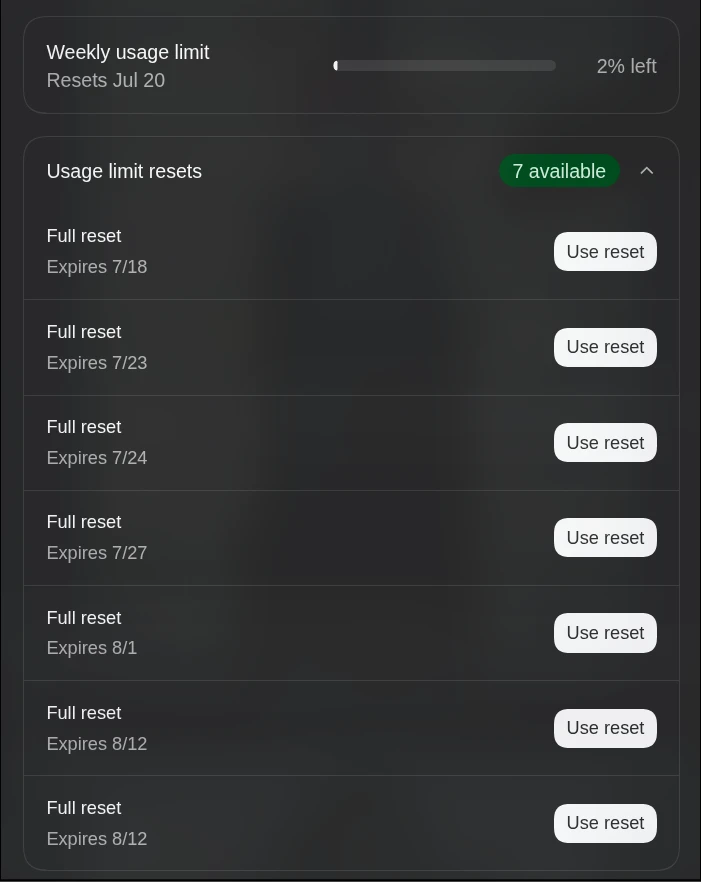
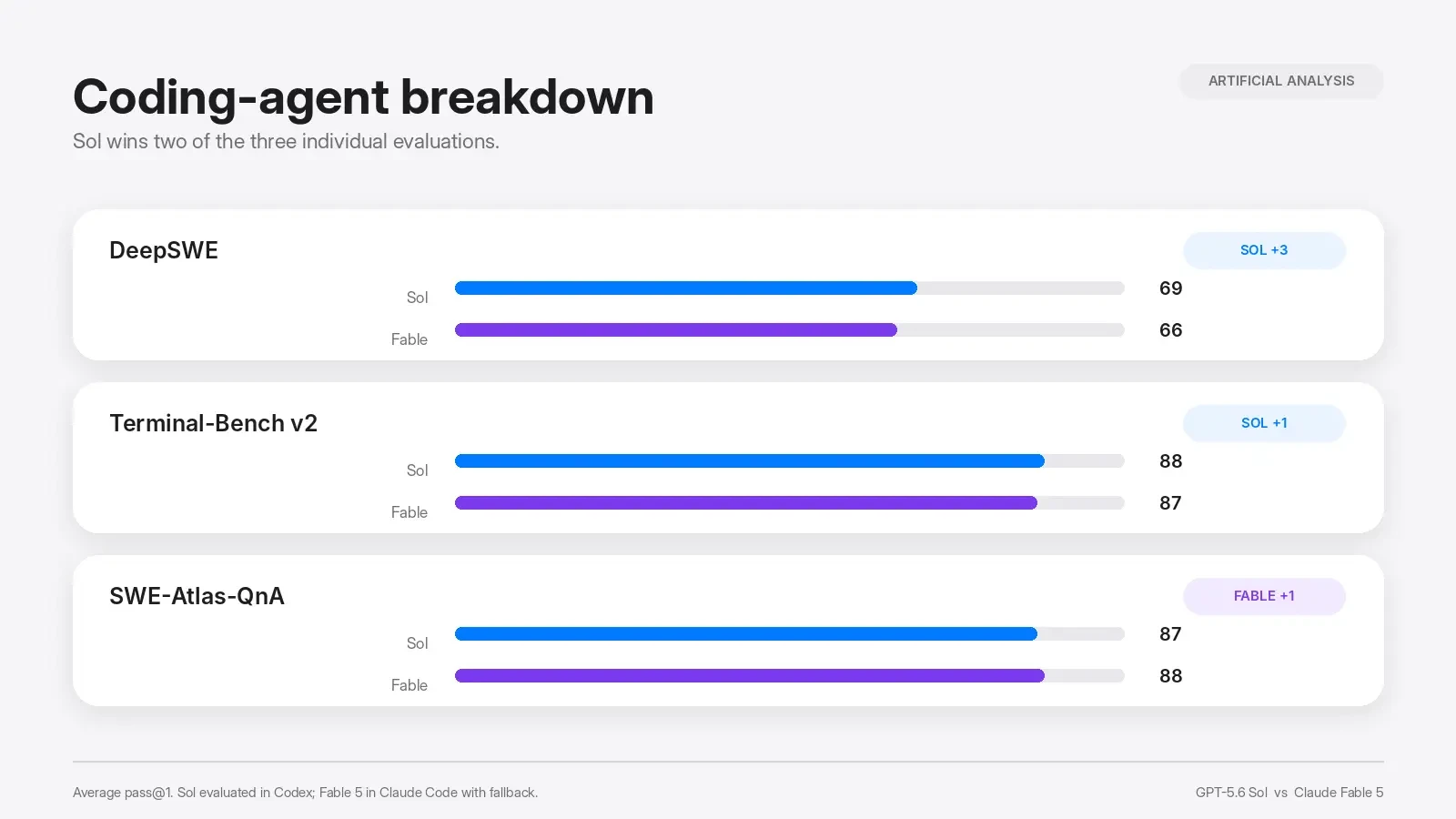
Independent evaluations have split the victory between the two titans. According to the latest Artificial Analysis Intelligence Index, Claude Fable 5 holds a one-point lead in general reasoning tasks, particularly those involving linguistic nuance and creative synthesis. However, the Coding Agent Index tells a different story, where GPT-5.6 Sol maintains a firm three-point lead.
In specific technical evaluations, the results were as follows:
- DeepSWE: Sol outperformed Fable 5, demonstrating a more robust ability to navigate large codebases and identify subtle logic errors.
- Terminal-Bench v2: Sol again took the lead, showcasing superior command-line proficiency and environment-aware problem solving.
- SWE-Atlas-QnA: Fable 5 secured a narrow one-point victory, suggesting it remains slightly better at explaining architectural decisions and answering theoretical engineering questions.
The "AA-Briefcase" metric, which measures how models handle complex business briefs, highlighted a fascinating nuance: while Fable 5 earned a higher Elo score for its analytical depth, Sol scored significantly higher in "presentation quality." This suggests that while Fable may think more deeply, Sol is better at formatting its thoughts into actionable, professional-grade reports.

Comparative Field Testing: Efficiency vs. Depth
To assess real-world utility, both models were subjected to a battery of identical tests. The results highlighted a trade-off between speed and autonomy.
Test 1: Full-Stack Web Development
When tasked with building a responsive personal finance dashboard in a single HTML file—including interactive charts, dark mode, and transaction filters—the results were revealing. Claude Fable 5 completed the task in 3 minutes and 10 seconds. GPT-5.6 Sol took significantly longer, at 6 minutes and 30 seconds. Despite the time difference, Sol’s code was noted for having slightly better "vanilla" JavaScript optimizations, whereas Fable’s code was more visually polished out of the gate.
Test 2: Strategic Data Analysis
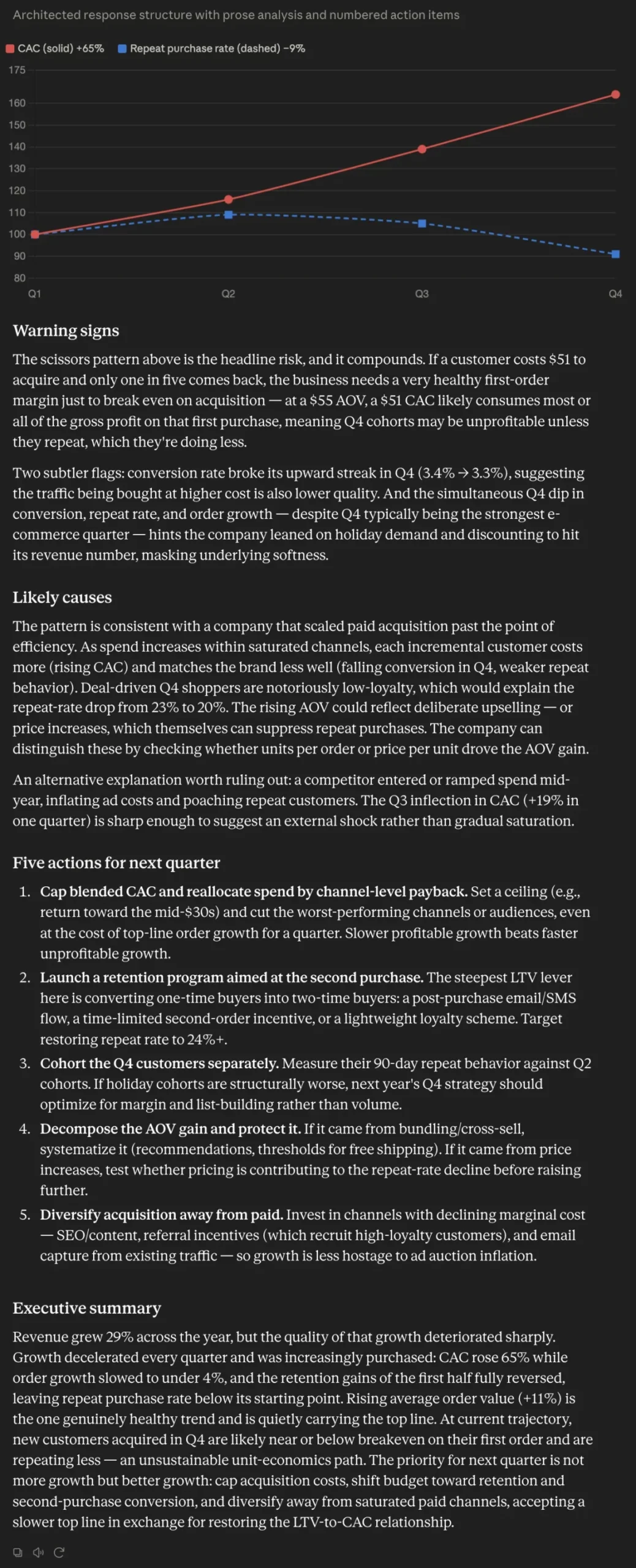
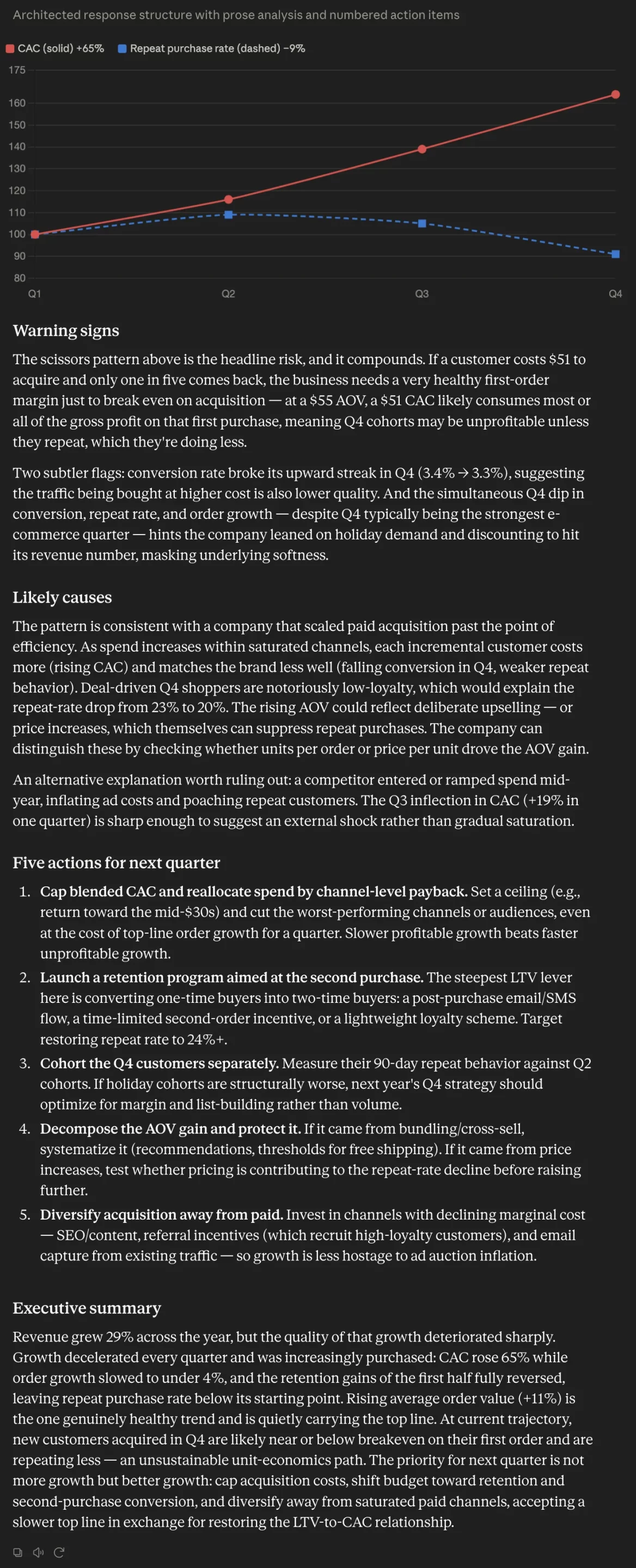
The models acted as senior data analysts reviewing a year of e-commerce performance. Fable 5’s response was nearly instantaneous (1 minute) and provided a masterclass in identifying warning signs, such as the rising Customer Acquisition Cost (CAC) and the declining Repeat Purchase Rate in Q4. Sol took 1 minute and 20 seconds, producing a similar level of insight but with a more structured executive summary that was deemed "ready for the boardroom" without further editing.
Test 3: Professional Deliverables
In creating an eight-slide investor deck, Fable 5 again proved faster (2 minutes and 30 seconds) compared to Sol (4 minutes and 38 seconds). However, the bottleneck for Fable 5 became apparent not in its speed, but in its availability. During intensive testing, Fable 5 frequently hit usage limits after just three or four complex conversations, whereas Sol remained available throughout the day for paid subscribers.

Industry Implications and User Sentiment
The reaction from the developer community has been polarized. For individual developers and startups, the "Sol is the model you work with" mantra has taken hold. Its lower cost and high reliability make it the ideal "co-pilot" for active coding sessions. On the other hand, project managers and enterprise architects are leaning toward the "Fable is the model you hand work to" philosophy. The consensus is that if a task requires two hours of autonomous research and multi-step execution, Fable’s higher cost is a worthwhile investment to save human labor hours.
Market analysts suggest that Anthropic may be facing a "scaling wall" regarding its inference costs, which explains the higher pricing and stricter usage limits. OpenAI, bolstered by its partnership with Microsoft and massive infrastructure investments, appears to be subsidizing Sol’s pricing to achieve market dominance.
Chronology of the Frontier Race
- January 2026: OpenAI announces the "Sol" project, focusing on specialized reasoning kernels.
- March 2026: Anthropic previews "Fable," claiming a breakthrough in autonomous planning.
- June 2026: Claude Fable 5 is released to public beta with high acclaim for its "Claude Code" integration.
- July 2026: GPT-5.6 Sol is deployed globally, immediately undercutting Fable 5 on price and offering a higher output token limit.
- Current Status: Both models are in a state of continuous iterative improvement, with weekly updates to their underlying weights.
Conclusion: Choosing the Right Tool
The verdict for 2026 is clear: the "best" model depends entirely on the user’s operational goals and budget. For the majority of professional users, GPT-5.6 Sol is the superior choice. It offers near-frontier intelligence, class-leading coding capabilities, and an economic profile that allows for constant use without fear of astronomical API bills or usage lockouts. It is the workhorse of the modern AI era.
Claude Fable 5 remains the "prestige" model. It is the correct choice for high-stakes projects that require a level of autonomy and planning that GPT-5.6 Sol cannot yet match. If the goal is to have an AI "hire" sub-agents and manage a project from start to finish with minimal check-ins, the $10 per million input tokens is a price many enterprises will be willing to pay.
As the AI arms race continues, the gap between "working with" an AI and "delegating to" an AI is narrowing. For now, Sol and Fable represent the two sides of that coin, each carving out a distinct territory in the future of work.