A comprehensive new report, drawing insights from 300 e-commerce business owners representing a staggering $3.5 billion in combined revenue, has unveiled a series of profound shifts and challenges reshaping the online retail industry. The sixth annual Trends Report, compiled by eComFuel in collaboration with the eComFuel Community and the Operators Network, challenges long-held conventional wisdom in critical areas such as paid traffic reliance, the effectiveness of Amazon as a growth engine, the perceived benefits of Artificial Intelligence (AI), and the fundamental economics of profit margins. The findings suggest that businesses that adapt to these evolving dynamics, particularly by focusing on lean operations, robust financial literacy, and strategic business model adjustments, are best positioned for success in the coming years.
The report, released in early 2026, highlights that many established strategies are no longer yielding the expected returns, necessitating a re-evaluation of operational priorities and investment strategies. One of the most significant revelations concerns the perception and utilization of paid traffic. Historically viewed with skepticism due to its potential to erode profit margins, the data now indicates that businesses heavily invested in paid traffic are, in fact, outperforming their peers in net income growth. This paradigm shift, according to the report’s authors, is not driven by superior Return on Ad Spend (ROAS), but rather by underlying business model efficiencies.
Paid Traffic: A New Foundation for Growth, Not a Margin Trap
For years, the prevailing narrative in e-commerce emphasized diversifying away from paid advertising, viewing it as a volatile and potentially margin-eroding channel. The conventional wisdom suggested that "free" organic traffic was the sustainable path to long-term success. However, the 2026 Trends Report fundamentally challenges this assumption. The study found that 97% of e-commerce businesses now utilize paid traffic, with many unable to sustain operations without it.
Contrary to expectations, businesses that lean most heavily into paid traffic are demonstrating significantly higher net income growth – a remarkable 71.7% compared to 18.0% for other businesses. This surge in profitability is not a result of exceptional ROAS, which is, on average, lower among these high-performing businesses (2.5x) compared to the survey-wide average of 4.0x. Instead, the success is rooted in superior gross margins (63.7%) and significantly leaner overhead costs (16.6%).
Analysis of the Profit and Loss (P&L) statements reveals that businesses excelling in paid traffic management maintain Cost of Goods Sold (COGS) at 39.1% of revenue and overhead at 16.6%. In stark contrast, other businesses incur COGS at 55.1% and overhead at 21.7%. This substantial difference in underlying cost structures, rather than ad account performance, is identified as the true competitive edge. The report concludes that in today’s e-commerce landscape, a business model built on high margins and low overhead is crucial for profitably navigating the pervasive use of paid traffic.
Amazon’s Diminishing Dominance and the Rise of Direct-to-Consumer (DTC)
The report also signals a notable decline in Amazon’s role as a primary growth engine for U.S. sellers. Despite a record number of sellers utilizing the platform (63%), Amazon’s share of community revenue has reverted to 20.1%, mirroring levels seen in 2017. This suggests that Amazon has transitioned from a powerful growth accelerator to a more supplemental sales channel.
In parallel, Direct-to-Consumer (DTC) strategies are demonstrating superior performance across key metrics. DTC-primary businesses are experiencing revenue growth rates 65% higher than their Amazon-primary counterparts (30.2% versus 18.3%) and maintain considerably higher gross margins (52.7% versus 41.9%). The sentiment surrounding DTC is overwhelmingly positive, with 91% of operators expressing satisfaction, whereas only 17% feel the same about Amazon, and a significant 39% actively dislike it.
This trend is further amplified by emerging e-commerce entrepreneurs. Newer businesses, those with fewer than six years of experience, are less inclined to prioritize Amazon as their primary sales channel, opting instead for a DTC-first approach from inception. While acknowledging Amazon’s customer-centric philosophy, the report attributes this shift to years of escalating fees and a perceived indifference from the platform towards seller concerns, prompting brand owners to seek alternative avenues for growth and control.
AI’s Untapped Potential: Excitement Outpaces Return on Investment
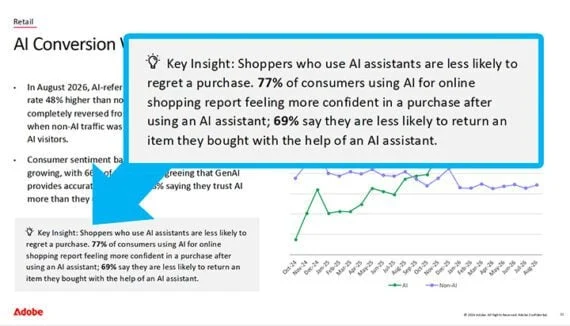
The advent of Artificial Intelligence (AI) has generated immense excitement within the e-commerce sector, with 72% of store owners reporting adoption of AI tools. Capabilities ranging from conversational interfaces to code generation and image creation are transforming operational possibilities. However, the report’s findings indicate that this technological adoption has not yet translated into tangible financial gains.
Revenue growth rates for AI adopters and non-adopters are virtually identical, at 26.7% and 27.8%, respectively. Similarly, net margins and team sizes show no significant disparity. Intriguingly, non-adopters are currently experiencing faster profit growth, with a 55.3% net income increase compared to 32.7% for adopters. While the technology itself is rapidly advancing, the time and effort required to stay abreast of developments, learn, adopt, and integrate AI tools into existing workflows appear to be negating any immediate financial benefits.
An unexpected observation is that AI adoption is not exclusively a domain for younger entrepreneurs. Operators in their 50s are adopting AI at higher rates (80%) than those in their 30s (66%). Furthermore, individuals aged 40-55 are more likely to be utilizing AI for code generation than their younger counterparts. This suggests that businesses grappling with greater operational complexity may perceive clearer use cases for AI, even if a direct ROI has not yet materialized. The report anticipates that AI will eventually provide a competitive edge, but its impact has not been evident in the past twelve months.
The Paradox of Rising Gross Margins and Shrinking Net Profits
A persistent concern in e-commerce has been the impact of rising advertising costs on profit margins. While this remains a factor, the 2026 Trends Report identifies a more significant disconnect: businesses are achieving historically high gross margins (49.5%), yet net profit margins have reached their lowest point at 10.6%. This represents a widening gap of nearly 39 percentage points since tracking began in 2017.
The report posits that advertising is not the sole culprit. Even when controlling for advertising spend, profitability remains remarkably consistent. The primary drivers of this margin squeeze are identified as product economics and overhead. Businesses achieving net margins of 20% or higher spend significantly less on COGS (38% less) and fixed costs (30% less) compared to those with profit margins below 5%.

The escalating costs associated with modern e-commerce, including tariff pressures, intensified global competition, and the sheer operational complexity of running a brand in 2025, are collectively compressing profit margins from the bottom up. A notable exception is the $25-$50 million revenue tier, which emerges as a profitability sweet spot, netting 13.8% compared to approximately 10% for other revenue brackets. This segment is characterized by well-managed manufacturers that have achieved scale without succumbing to the complexity tax that appears to affect businesses exceeding $50 million in revenue.
The Warehouse Myth: Ownership Hinders Growth and Efficiency
The traditional playbook for scaling e-commerce businesses often involved acquiring physical warehouse space and building an in-house team to manage inventory and fulfillment. However, this strategy is showing signs of obsolescence. Businesses that own their warehouses experienced significantly slower revenue growth, averaging just 3.9%, compared to 33.5% for those leasing facilities and 22.2% for those outsourcing fulfillment entirely. This trend persists even when controlling for business size within the $1 million to $10 million revenue bracket.
Warehouse owners tend to carry a heavier inventory burden, maintain less remote teams, and express lower optimism about the future compared to their counterparts. Reinforcing this point, data on remote work indicates that remote-first teams (over 75% remote) saw net income grow by 51.8%, compared to 26.9% for in-office teams. These remote teams also operated with leaner staffing levels, averaging 10.5 employees versus 30.5, and achieved nearly double the median revenue per employee ($1.25 million versus $583,000).
While owning a warehouse may offer certain unquantifiable advantages, such as enhanced business durability and deep SKU selection for niche leaders, the measurable data strongly suggests that operators who minimize physical asset ownership are achieving greater success.
A Fundamental Shift Towards Manufacturing and Increased Financial Acumen
Beyond operational strategies, the report highlights significant shifts in business models and operator realities. The trend towards manufacturing has accelerated dramatically, with the proportion of store owners producing their own products increasing by nearly 50% in the last three years, from 41% to 58%. This rise correlates with an increase in "proprietary product" being cited as the number one competitive advantage. Conversely, reselling, drop shipping, and a focus on the lowest cost models are contracting, driven by intense foreign competition and rising customer acquisition costs that necessitate higher margins.
International businesses are performing on par with or even exceeding their U.S. counterparts across most metrics, despite the majority of respondents (74%) being U.S.-based. The competitive pressures within the vast U.S. consumer market appear to be a significant factor. Smaller businesses, those under $1 million in revenue, are disproportionately struggling, indicating a structural disadvantage due to economies of scale and rising customer acquisition costs.
Tariffs: Brands Absorb Costs, Domestic Relocation Remains Slow
Brands have shouldered a substantial portion of tariff-related costs. For businesses reporting income decline due to tariffs, only 42% of these costs were passed on to consumers through price increases, with the remaining 58% absorbed as a direct hit to profit margins. A significant 40% of U.S. brands did not implement any price increases. The stated goal of repatriating manufacturing to the U.S. is experiencing slow progress; only 4% of brands not already manufacturing domestically have decided to actively shift their supply chains.
Interestingly, tariffs ranked as only the fourth biggest struggle for business owners, trailing behind margins and rising costs, growth and scaling challenges, and hiring and talent acquisition. While e-commerce brands are proving resilient to tariffs, the inherent difficulties of the industry mean that tariffs do not represent the top three existential threats.
Financial Fluency: The Underrated Competitive Edge
The report strongly emphasizes the critical importance of financial literacy. Businesses where owners self-rate their financial expertise at the highest level (5 out of 5) demonstrate significantly higher net margins, greater cash reserves, faster income growth, and higher rates of capital extraction. The difference between a rating of 4/5 and 5/5 is substantial, translating to a 37% increase in net margins (from 9.4% to 12.9%), nearly double the financial runway (48 months to 109 months), and considerably faster income growth.
A surprising 80% of owners rated themselves below a 5/5, indicating a vast opportunity for improvement and significant potential payoff from enhanced financial education. This pattern holds true regardless of business size, suggesting that financial knowledge is an independent predictor of better outcomes.
Capital Extraction: Balancing Growth with Owner Compensation
The report notes that most e-commerce owners do not see substantial financial rewards until their businesses reach mid-seven figures in revenue. A significant 53% of owners opt for modest salaries or no compensation at all. Capital extraction becomes particularly challenging for fast-growing businesses or those under $1 million in revenue. Among companies experiencing 50%+ growth, only 13% take substantial dividends, and for sub-$1 million fast growers, this figure drops to zero. These businesses are typically reinvesting all profits into working capital and infrastructure development.
A balanced approach of salary combined with small distributions appears to be the most effective strategy for both growth and owner compensation. This cohort exhibits the highest net income growth (+45.3%), above-average margins (12.0%), and the highest levels of optimism. These modest, consistent distributions do not appear to impede growth; instead, they diversify wealth, foster operational discipline, and contribute to owner well-being. The report concludes that aggressive capital extraction and rapid growth are mutually exclusive, but small, habitual distributions offer a triple win.
The Future Outlook: Optimism Tempered by Lean Operations and AI Investment
Despite facing numerous headwinds, including tariffs, the evolving AI landscape, and margin compression, an impressive 80% of e-commerce owners remain optimistic about the future of their businesses, with an average hopefulness score of 7.8 out of 10. This optimism is strongly correlated with operational leanness. Optimistic business owners exhibit lower fixed overhead (19% versus 24% of revenue), carry lighter inventory (11.9% versus 14.6% of revenue), and are more likely to lease rather than own warehouse facilities.
Looking ahead to 2026, AI and automation are identified as the top investment priority, cited by more owners than any other category. Marketing and advertising follow as the second priority, with simplifying operations and reducing SKU count ranking third. This signals a clear understanding among operators of the importance of maintaining lean business practices. Younger founders and larger, more established businesses tend to be more optimistic, likely due to fewer early-stage challenges and greater resources and resilience, respectively. The report underscores the remarkable resilience of the e-commerce community despite significant industry pressures.