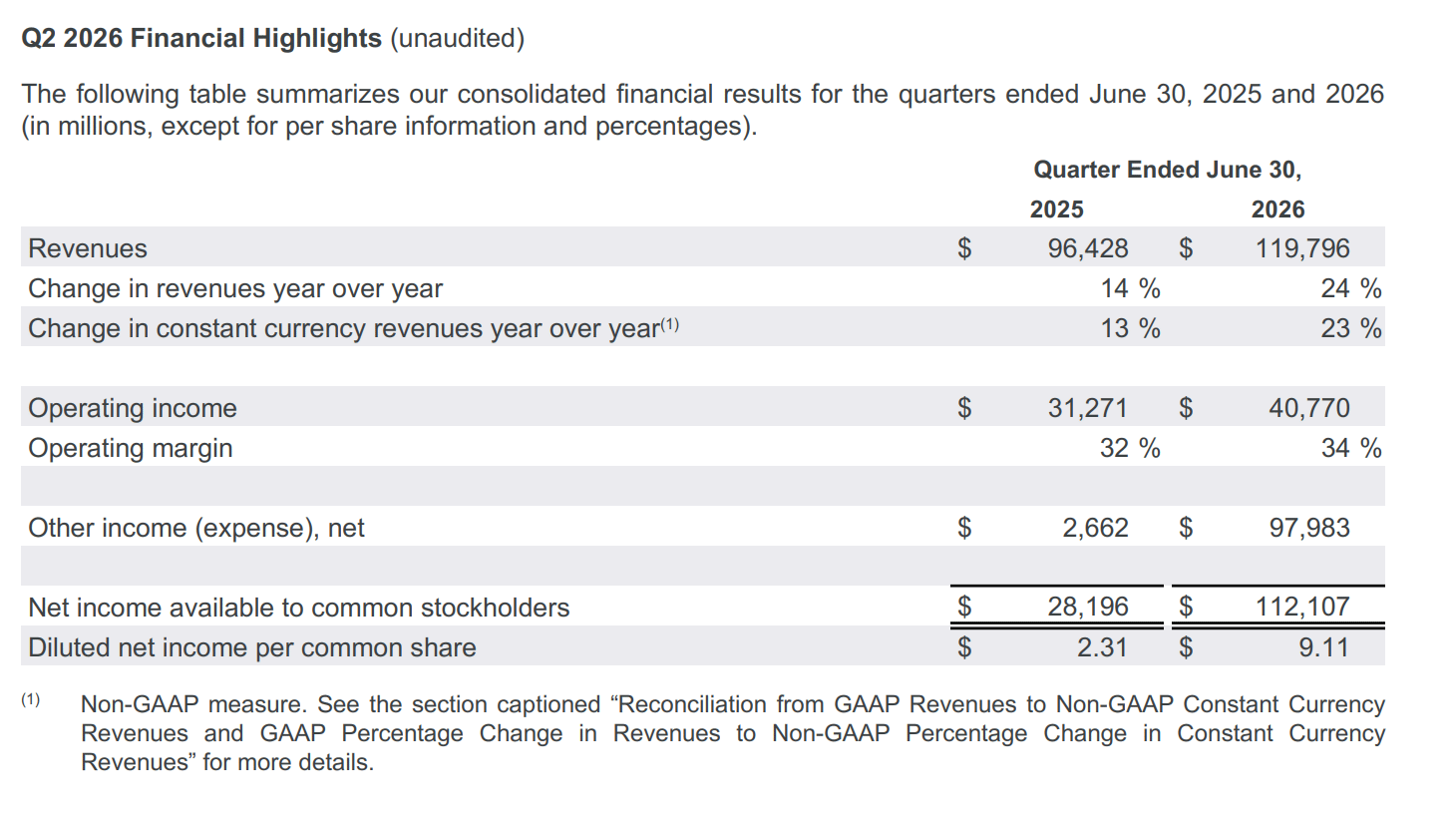
Alphabet Inc. (NASDAQ: GOOG, GOOGL), the parent company of Google, announced its second-quarter 2026 earnings today, revealing a period of exceptional growth that culminated in its largest quarter ever by overall revenue. The technology giant reported a staggering 24% year-over-year increase in total revenue, reaching an impressive $119.8 billion. This robust performance was significantly bolstered by a strong showing in its core advertising business, with Google Ads revenue climbing 14.5% to $81.6 billion, and specifically, its Search and Other segment revenue surging 17% to $63.3 billion, surpassing analyst estimates.
Alphabet’s Strategic Position and Core Businesses
Alphabet operates as a diversified technology conglomerate, with its revenue primarily driven by Google’s various segments: Search and Other, YouTube Ads, Google Network, Google Cloud, and Other Bets. The Search and Other segment, which encompasses advertising on Google Search and other owned-and-operated properties, remains the company’s financial bedrock. Its dominant position in the global digital advertising market grants it significant leverage, making its quarterly performance a key indicator for the broader health of online advertising. This quarter’s results underscore the enduring strength of Google’s advertising ecosystem, even amidst evolving market dynamics and increasing competition. The company’s continued investment in artificial intelligence (AI) has emerged as a central pillar of its growth strategy, with AI advancements now deeply integrated across its product portfolio, from search to cloud services.
Detailed Financial Performance for Q2 2026
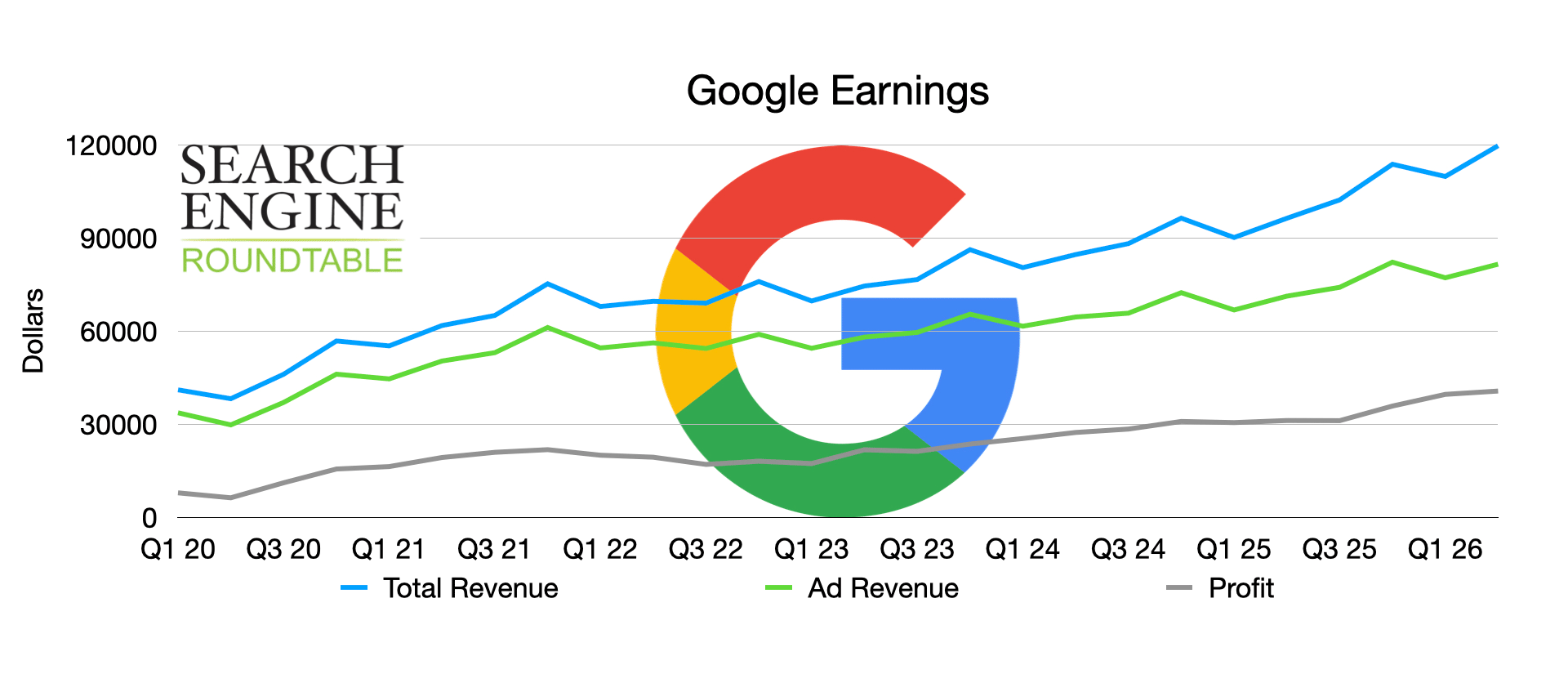
The second quarter of 2026 proved to be a banner period for Alphabet. The reported overall revenue of $119.8 billion represents a substantial increase from the previous year, demonstrating accelerated growth across multiple segments.
- Google Ads Revenue: The total Google Ads segment, which includes Search, YouTube, and Network revenues, recorded $81.6 billion, a robust 14.5% increase year-over-year. This growth indicates strong demand from advertisers who continue to leverage Google’s vast reach and targeting capabilities.
- Search and Other Revenue: Within the advertising portfolio, the Search and Other segment, the largest contributor, saw its revenue jump 17% to $63.3 billion. This figure was notably in line with StreetAccount’s estimate of $63.4 billion, reflecting a healthy and predictable trajectory for Google’s core search advertising business. The sustained double-digit growth in search underscores the continued efficacy and user engagement with Google’s search products.
- YouTube Ads Revenue: YouTube, Google’s video platform, also contributed significantly to the advertising uplift, with its ad revenue growing 13% year-over-year. This indicates a steady recovery and expansion of advertising spend on the platform, driven by increased viewership and engagement with diverse content formats, including short-form video and long-form premium content.
- Google Cloud Revenue: Beyond advertising, Google Cloud demonstrated remarkable acceleration, with its revenue surging by 82%. This impressive growth was primarily fueled by escalating demand for AI infrastructure and advanced AI solutions, indicating that enterprises are increasingly turning to Google Cloud for their AI transformation initiatives. Sundar Pichai highlighted the wide adoption of Gemini Enterprise, noting that nearly 90% of the Fortune 100 companies are now utilizing it, underscoring the platform’s enterprise appeal and market penetration.
Sequential Performance and Trends
Comparing the second quarter of 2026 to the first quarter of 2026 provides additional context on the company’s momentum. Sequentially, Google’s overall ad revenue was up 5.6%. While overall revenue was down 9% quarter-over-quarter (a typical seasonal pattern following a strong holiday-influenced Q4 and often a slightly slower Q1), profit saw a modest increase of 2.7%. This sequential analysis suggests a healthy underlying trend in the advertising business, even as overall revenue might fluctuate based on seasonal spending patterns in other areas. The ability to increase profit quarter-over-quarter, even with a dip in overall revenue, points to effective cost management and operational efficiencies.
The AI Imperative: A Chronology of Integration and Impact
Artificial intelligence has moved from a strategic priority to a foundational element of Google’s product development and financial performance. This quarter’s earnings report provided ample evidence of AI’s tangible impact.
- Early AI Overviews and AI Mode Rollout: Google began integrating AI-powered features into its Search experience with the introduction of AI Overviews and subsequently, AI Mode. These features, designed to provide more comprehensive and conversational search results, represented a significant evolution in how users interact with the search engine.
- Global Expansion and User Adoption: The global expansion of AI Mode, initiated in October of the previous year (Q4 2025), has been a critical driver of increased user engagement. Sundar Pichai reported that since its global rollout, AI Mode has surpassed 1 billion monthly active users. This widespread adoption underscores the resonance of AI-enhanced search experiences with a vast global audience.
- Driving Search Query Growth: The integration of AI Overviews and AI Mode into a "seamless Search experience" has directly led to an incremental increase in Search queries overall. This is a crucial metric, as higher query volume translates to more opportunities for ad impressions and clicks. Google is now sending billions of clicks to websites every week through these AI features, demonstrating that while AI enhances information retrieval, it also continues to serve as a vital traffic driver for the broader web ecosystem.
- Efficiency Gains in AI Operations: Beyond user-facing features, Google has made significant strides in optimizing the underlying infrastructure for AI. Thanks to advanced engineering and hardware optimizations, the cost of AI Mode responses reached its lowest level since launch this quarter. This efficiency gain is critical for scalability and profitability, especially as Google continues to integrate more advanced AI capabilities into its services.
- Broader Gemini Ecosystem Adoption: The impact of AI extends far beyond Search. Google’s Gemini models are seeing massive adoption, processing an astounding 22 billion API tokens per minute. The Gemini App itself boasts 950 million monthly active users, highlighting the success of Google’s multi-modal AI strategy across various applications. The introduction of Gemini 3.5 Flash Cyber also showcases Google’s push into specialized, highly cost-efficient AI solutions for critical domains like cybersecurity.
Official Responses and Strategic Vision from Leadership
Sundar Pichai, CEO of Alphabet and Google, articulated a clear vision for the company, emphasizing the transformative power of AI across all business segments. His statements during the earnings call highlighted the symbiotic relationship between AI investments and financial performance.
Pichai remarked, "Our AI investments are redefining what’s possible across every part of our business. Q2 was an amazing quarter, with Alphabet revenues growing 24% year-over-year and Google Cloud revenues accelerating to 82% growth, driven by demand for AI infrastructure and AI solutions. It’s great to see wide adoption of Gemini Enterprise, with nearly 90% of the Fortune 100 using it." This statement underscores the strategic imperative of AI, not just as a product enhancement but as a fundamental driver of enterprise growth and innovation.
He continued, "We have exciting momentum across the board. Our popular AI features are driving Search query growth. Gemini models now process 22 billion API tokens per minute and the Gemini App has 950 million monthly active users. We are seeing strong demand for our security solutions, and our new Gemini 3.5 Flash Cyber delivers highly cost efficient performance at the frontier. And month over month, people turn to YouTube for major world events, with over 1.7 billion unique viewers watching World Cup-related videos during the FIFA World Cup 2026TM." Pichai’s remarks painted a picture of broad-based success, connecting AI advancements directly to user engagement and significant cultural moments like the World Cup, which saw record Search usage.
Focusing specifically on Google Search, Pichai elaborated, "Starting with Search. AI continues to drive an expansionary moment, with new experiences resonating with users and driving growth in queries. As a big football fan, I was particularly excited to see Search usage hit an all-time high during the World Cup this year. This really highlights how much people turn to Google in moments that matter." This anecdotal evidence, tied to a global event, effectively illustrates the increased reliance on Google Search for real-time information and engagement.
He further detailed the evolution of Search: "We continue to make Search more helpful and intuitive. We recently brought together AI Overviews and AI Mode into one seamless Search experience that combines our frontier capabilities with the best of the web. And we’re continuing to incorporate more frontier capabilities into Search with agents, personal intelligence, and notebooks." This vision outlines a future where Search becomes an even more intelligent and personalized assistant, moving beyond simple information retrieval to proactive support and personalized insights.
Pichai reiterated the positive impact of AI on user behavior and the broader ecosystem: "Our AI-powered features are driving increased Search usage. Since expanding AI Mode globally last October, we’ve surpassed 1 billion monthly active users. And just like AI Overviews, AI Mode is driving an incremental increase in Search queries overall, and we’re now sending billions of clicks to websites every week through AI features in Search." He also highlighted the operational triumphs: "As we serve more of these queries, we’ve continued to drive efficiencies. Thanks to our engineering and hardware optimizations, this quarter we reduced the cost of AI Mode responses to its lowest level since launch, even as we’ve brought more advanced AI capabilities." These statements collectively underscore Google’s confidence in its AI strategy as both a growth engine and an efficiency driver.
Broader Impact and Implications
The Q2 2026 earnings report from Alphabet carries significant implications for various stakeholders, from investors to advertisers and the broader tech industry.
- Investor Confidence: The "biggest quarter ever" in terms of overall revenue, coupled with robust growth in core advertising and accelerating performance in Google Cloud, is likely to instill strong investor confidence. The market often views Google’s ad revenue as a proxy for the health of the digital economy, and these results suggest a vibrant and expanding landscape for online advertising spending. Analysts are expected to react favorably, potentially leading to positive stock performance for Alphabet.
- Competitive Landscape: Google’s strong performance solidifies its dominant position in the digital advertising market against rivals like Meta Platforms and Amazon. The aggressive push into AI and its successful integration into core products also puts pressure on competitors in the cloud computing space, such as Amazon Web Services (AWS) and Microsoft Azure, to innovate rapidly in AI infrastructure and solutions. The widespread adoption of Gemini Enterprise by Fortune 100 companies highlights Google Cloud’s growing competitive edge.
- Future of Search and Advertising: The continued success of AI-powered Search features like AI Overviews and AI Mode suggests a fundamental shift in user behavior and the future of information discovery. While driving query growth, Google is also actively addressing concerns from content creators and advertisers by emphasizing that AI features are still generating billions of clicks to websites. This balanced approach is crucial for maintaining the health of the open web and ensuring a symbiotic relationship between Google and its ecosystem partners. Advertisers will need to adapt their strategies to optimize for AI-driven search results and leverage new formats emerging from these advancements.
- Economic Bellwether: As a leading indicator of global digital advertising spend, Google’s strong revenue growth suggests underlying economic resilience and robust corporate marketing budgets. This performance could be interpreted as a positive sign for the broader economy, indicating sustained business activity and consumer engagement online.
- Regulatory Scrutiny: While strong financial results are positive for shareholders, Google’s dominant market position and impressive growth figures may also attract continued attention from regulatory bodies globally. Antitrust concerns and debates around market power are ongoing, and a record-breaking quarter could potentially fuel these discussions, particularly regarding its advertising practices and search dominance. However, the company’s emphasis on delivering value to users and driving traffic to the web may serve as a counterpoint in these discussions.
In conclusion, Alphabet’s Q2 2026 earnings represent a pivotal moment, showcasing the successful execution of its AI-first strategy across its diverse portfolio. The record-breaking revenue, fueled by resilient advertising growth and an accelerating cloud business, positions Google strongly for continued leadership in the evolving digital landscape, with artificial intelligence serving as the undeniable catalyst for its future trajectory.