The rapid proliferation of digital video content across social media, streaming platforms, and enterprise databases has necessitated the development of robust automated systems for content retrieval, duplicate detection, and semantic analysis. Determining the similarity between two video clips, while seemingly straightforward to the human eye, presents a significant computational challenge. Traditional methods relying on pixel-level comparisons frequently fail when faced with variations in lighting, framing, or compression. Consequently, developers and data scientists are increasingly turning to advanced machine learning architectures, ranging from local neural networks to massive multimodal large language models (LLMs). This report details a rigorous benchmarking study of six prominent video similarity techniques, evaluating them based on accuracy, latency, and cost-effectiveness.
The Technical Evolution of Visual Content Matching
Historically, video similarity was determined through basic computer vision signals. These "old-school" methods focused on mathematical representations of color distributions and edge densities. While computationally inexpensive, they lacked the semantic "understanding" required to distinguish between two different objects of the same color. The shift toward deep learning introduced "embeddings"—vector representations of data where distance correlates with semantic meaning.
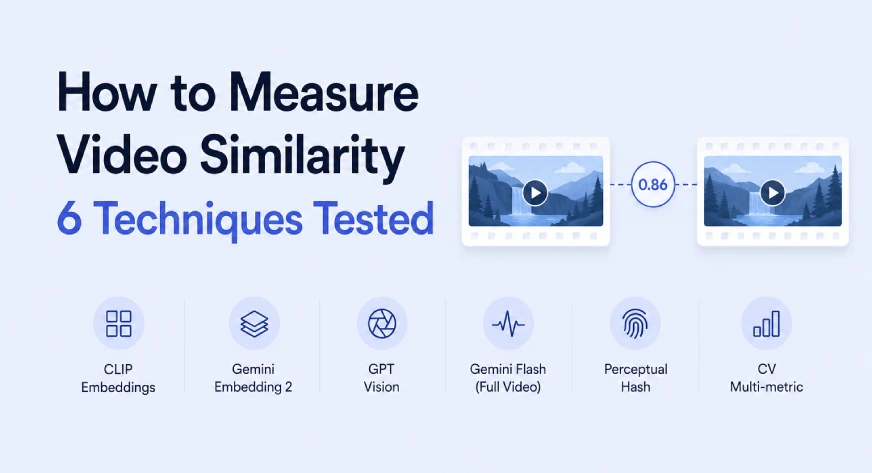
The modern landscape of video analysis is divided into three primary categories:
- Fingerprinting (Hashing): Reducing frames to tiny binary codes. These are nearly instantaneous but lack depth.
- Embeddings: Passing frames through neural networks (like CLIP) to generate high-dimensional vectors. This offers a balance between speed and semantic depth.
- Multimodal LLMs: Utilizing models like GPT-4o or Gemini 1.5 Flash to "watch" and describe video content. These provide the highest level of context but at the cost of high latency and API expenses.
Benchmarking Methodology: The Waterfall Dataset
To stress-test these methodologies, researchers utilized a "homogeneous" dataset designed to expose the weaknesses of shallow analysis. The reference video featured a tropical waterfall surrounded by lush greenery and sunlight. The test set consisted of eight different waterfall videos. By selecting videos within the same category, the benchmark forced the models to look beyond broad labels (e.g., "water") and instead focus on fine-grained details such as the direction of water flow, the specific hue of the foliage, and the camera’s motion profile.
The input parameters were standardized across all tests:
- Sampling: Six frames per clip, evenly spaced.
- Resolution: Shrunk to 384×216 pixels to ensure compatibility with various model input requirements.
- Consensus Scoring: In the absence of manual human labeling, a "fair consensus" was established by averaging the scores of five independent methods to identify the most likely matches.
Evaluation of the Six Contenders
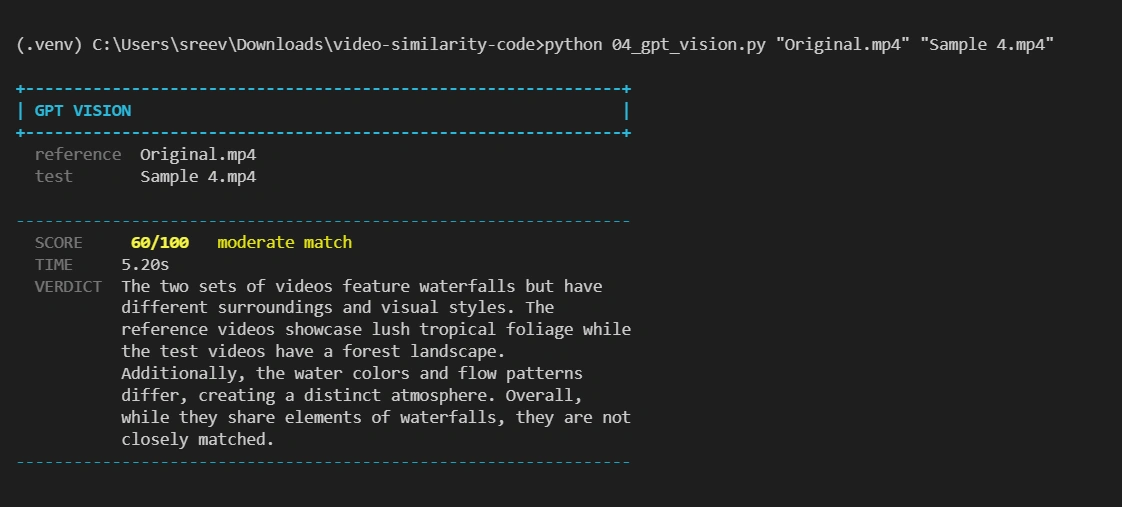
1. GPT Vision (OpenAI)
GPT Vision represents the "analytical" approach. When provided with frames, the model returns both a numerical score and a natural language justification. While the qualitative feedback—such as identifying shifts in "visual theme" or "mood"—is superior for user-facing applications, the quantitative output proved inconsistent. In repeated trials, scores for near-identical clips fluctuated significantly, making it a poor choice for high-precision ranking tasks.
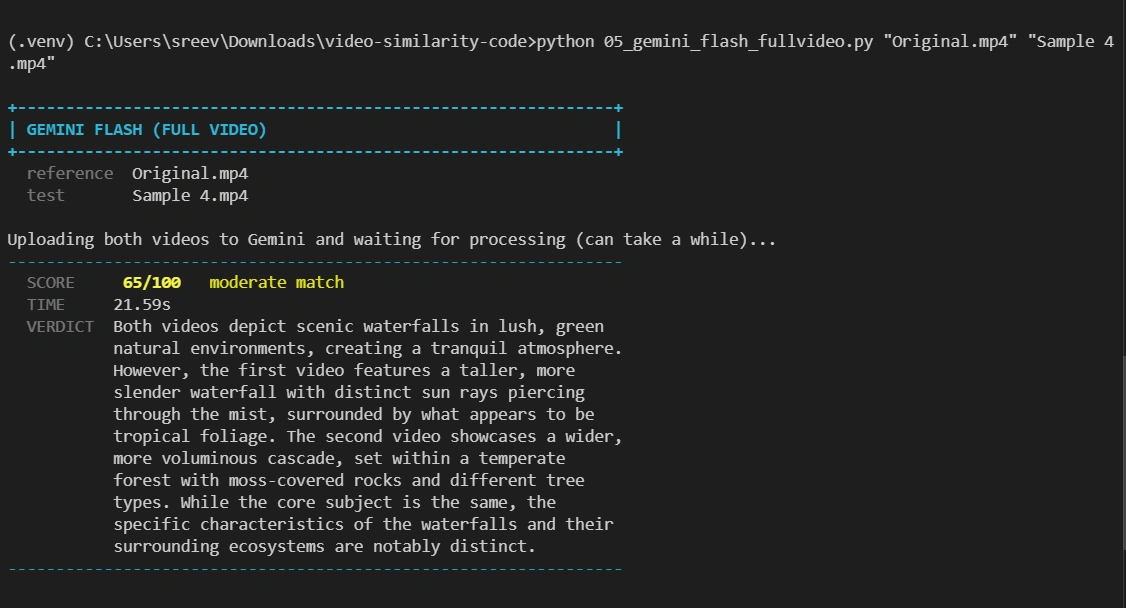
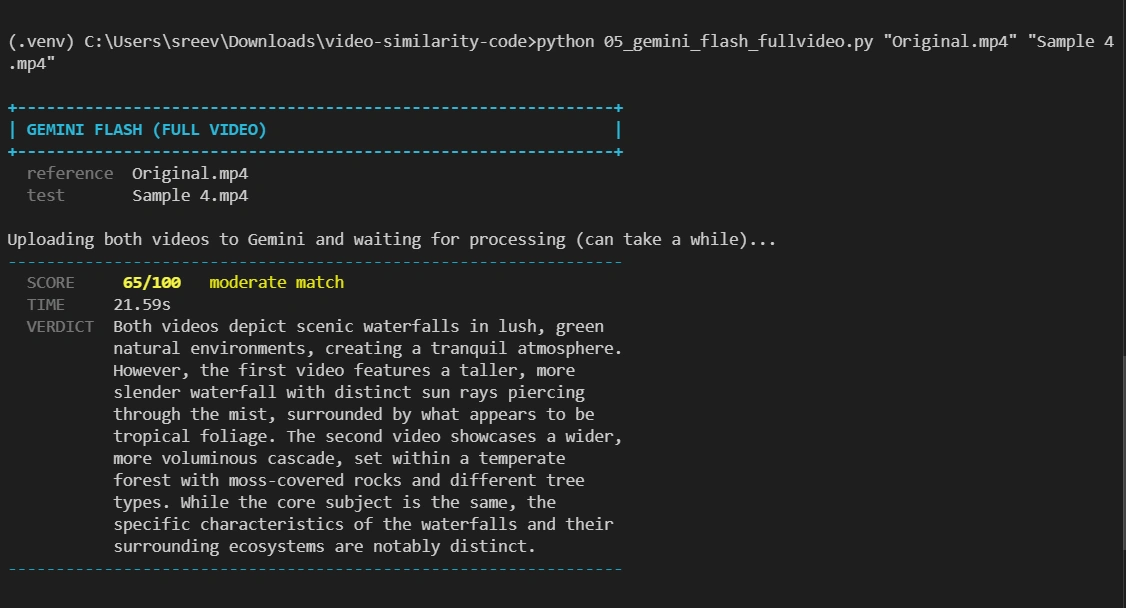
2. Gemini 1.5 Flash (Google)
As a multimodal LLM, Gemini Flash is unique in its ability to process full video files rather than just sampled stills. This allows the model to account for temporal dynamics, such as camera drift and the pacing of motion. However, this depth comes with operational risks. During testing, the model exhibited the highest latency and was prone to API errors (503 and 429 status codes), rendering it unreliable for real-time or high-volume production environments.
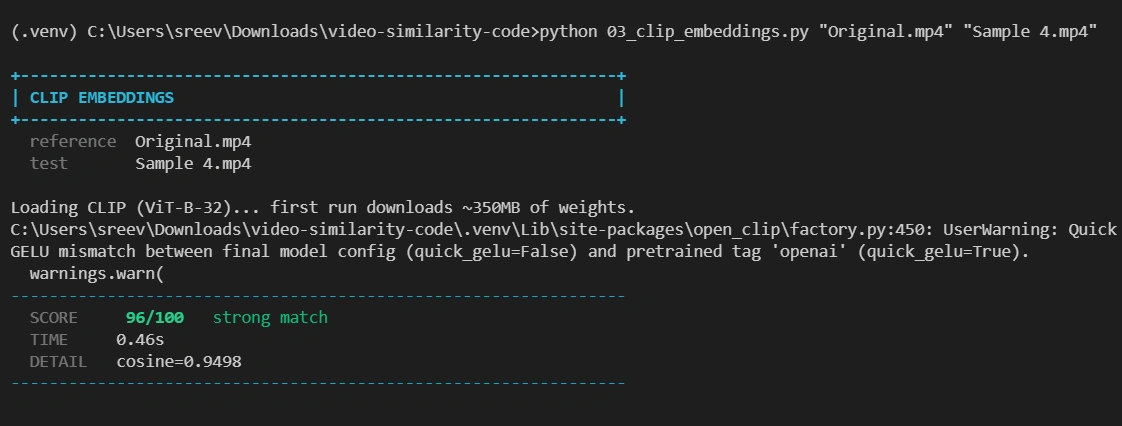
3. CLIP Embeddings (OpenAI/Local)
The Contrastive Language-Image Pre-training (CLIP) model remains a staple for local implementations. By converting each frame into a vector and calculating the cosine similarity, CLIP offers a stable, "free" (local) alternative to cloud APIs. It consistently ranked videos accurately, though its scores tended to cluster in a narrow range (88% to 92%), making it difficult to distinguish between "very similar" and "nearly identical" content without careful calibration.
4. Perceptual Hashing (pHash)
Perceptual hashing is the most efficient method tested, running approximately 1,400 times faster than the slowest LLM. It functions by creating a 64-bit fingerprint of each frame and measuring bitwise differences. However, the benchmark revealed a critical failure: pHash showed a -8% correlation with the consensus. In a dataset of similar subjects (waterfalls), the bit-counting approach was unable to perceive any meaningful relationship between clips, performing worse than a random coin flip.
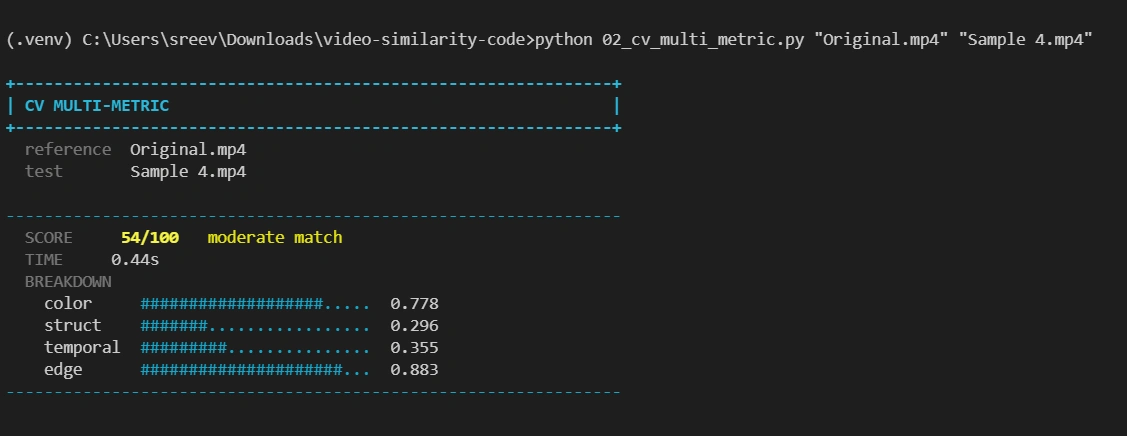
5. Computer Vision Multi-Metric (CV-MM)
This "white-box" approach uses a weighted blend of four classic signals:
- HSV Histograms (30%): Comparing color distributions.
- Structural Similarity Index (SSIM) (35%): Analyzing texture and luminance.
- Temporal Color Profile (20%): Tracking color shifts over time.
- Edge Density (15%): Identifying shapes and outlines.
While transparent, this method is highly sensitive to framing shifts. A slight zoom or camera pan can cause the SSIM score to plummet, even if the subject remains identical.
6. Gemini Embedding 2 (Google)
Gemini Embedding 2 emerged as the most accurate model in the study. Unlike the Flash model, which generates text, this model generates 3,072-dimensional vectors. It achieved a 93% correlation with the consensus, effectively capturing the nuances of the waterfall dataset. While it requires a cloud API call and carries a latency of roughly seven seconds per video, its accuracy-to-speed ratio was deemed the most favorable for enterprise-grade applications.
Comparative Data Analysis
The following table summarizes the performance metrics observed during the benchmarking process:
| Technique | Accuracy vs. Consensus | Avg. Time per Video | Local Capability |
|---|---|---|---|
| Gemini Embedding 2 | 93% (Excellent) | ~7.2s | No |
| Gemini Flash | 88% (Very Good) | 21.5s | No |
| GPT Vision | 77% (Good) | 2.9s | No |
| CV Multi-metric | 75% (Good) | 0.08s | Yes |
| CLIP Embeddings | 74% (Good) | 0.78s | Yes |
| Perceptual Hash | -8% (Fail) | 0.015s | Yes |
The "Sampling vs. Full Video" Paradox
A secondary test was conducted to determine if processing every frame of a video yielded better results than sampling. Testing Gemini’s embedding model at various intervals (4, 8, 16, 32, and 64 frames) showed that accuracy gains plateaued after 32 frames. Interestingly, sending the "Full Video" blob to the Gemini API was not only more accurate (scoring 73 vs. 70 for 32 frames) but also faster than processing 64 individual frames. This suggests that native video encoders are optimized for holistic file processing rather than frame-by-frame decomposition.
The Calibration Trap: Understanding Cosine Similarity
A critical finding of the study involves the "normalization" of scores. Most embedding models use cosine similarity, where a score of 1.0 indicates identity and 0 indicates no relation. However, the "floor" of these scores varies by model.

- CLIP typically places unrelated images at a 0.20 cosine similarity.
- Gemini Embedding 2 crams almost all visual data into a tighter range, where even unrelated clips might score 0.75.
If a developer migrates from CLIP to Gemini without adjusting their scoring "floor," every result will appear as a 90% match. This "calibration trap" is a common source of error in production systems. The study emphasizes that "borrowed numbers lie"—each model requires its own unique stretching of the 0-to-100 scale based on its specific vector space distribution.
Broader Implications and Industry Trends
The shift from discrete frame analysis to temporal, video-native embeddings marks a turning point in the field. As of 2024 and looking toward 2026, several emerging technologies are poised to refine these benchmarks:
- DINOv3 and SigLIP 2: These models are pushing the boundaries of image-level retrieval, often outperforming CLIP on fine-grained visual tasks.
- V-JEPA and VideoPrism: These native video encoders bake "temporal structure" into the embedding, allowing the system to understand the difference between a video played forward and one played in reverse—a feat impossible for frame-averaging methods.
For businesses, the choice of model is a strategic decision. A "search box" requiring sub-second responses must rely on local CLIP or optimized CV signals. Conversely, a content moderation system or a copyright detection engine, where accuracy is paramount and a five-second delay is acceptable, should utilize high-dimension multimodal embeddings like Gemini Embedding 2.
Conclusion and Strategic Recommendations
The benchmarking study concludes that there is no universal "best" method for video similarity. Instead, the optimal solution depends on the specific constraints of the use case.
- For Maximum Accuracy: Gemini Embedding 2 is the current leader, providing a 93% consensus-match.
- For High-Speed/Local Processing: CLIP remains the industry standard, offering solid ranking capabilities for free.
- For Large-Scale Filtering: A "stacked" approach is recommended. Use Perceptual Hashing or CLIP as a "bouncer" to discard 99% of obvious mismatches, then pass the remaining candidates to a high-accuracy model like Gemini for final judgment.
As the AI landscape continues to evolve, the study advises developers to maintain a modular architecture. By wrapping embedding logic in a way that allows for easy model swapping, organizations can stay at the forefront of visual search technology without rebuilding their entire data pipeline every quarter. The fundamental workflow—extracting features, pooling them into a vector, and calculating calibrated similarity—remains the constant in an ever-changing field.