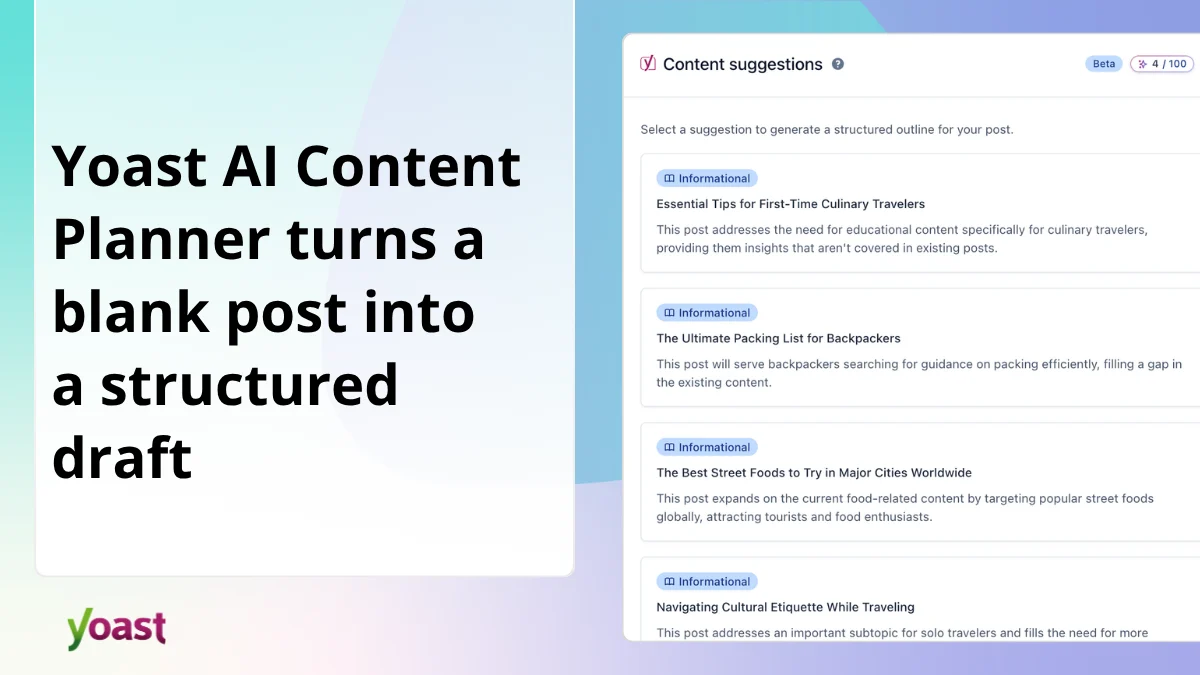
Yoast, a leading name in search engine optimization (SEO) tools for WordPress, has officially launched its AI Content Planner, a significant new feature designed to combat writer’s block and streamline the content creation process for its Premium users. This innovative tool integrates directly into the WordPress editor, offering a solution to the common challenge faced by content creators: staring at a blank page with no clear direction. By leveraging artificial intelligence to analyze existing site content, the Yoast AI Content Planner generates relevant post ideas and structured drafts, aiming to transform the ideation-to-drafting workflow for millions of websites.
The core functionality of the Yoast AI Content Planner is straightforward yet powerful. Upon opening a new post in the WordPress editor, users are presented with five relevant post ideas, intelligently derived from their website’s existing published content. This contextual analysis allows the AI to identify content gaps, potential evergreen topics, or areas where further elaboration could benefit the site’s overall SEO strategy. Once a user selects an idea, the planner doesn’t stop there; it proceeds to construct a comprehensive starter draft. This draft includes a suggested title, a logical outline, a primary focus keyphrase, a meta description, and specific content notes for each section, guiding the user through the writing process. This rapid transition from an empty canvas to a ready-to-write structure is poised to save considerable time and mental effort for content professionals and casual bloggers alike.
Addressing the "Blank Page Syndrome": The Genesis of the Tool
The "blank page syndrome" is a universal hurdle for anyone involved in content creation. Whether it’s a seasoned content strategist, a small business owner managing their blog, or an individual blogger, the initial step of generating a compelling idea and structuring it effectively can be daunting. Research from various marketing studies consistently highlights content creation as one of the most time-consuming aspects of digital marketing. A HubSpot report, for instance, often indicates that marketers spend a significant portion of their week creating content, with ideation and outlining consuming valuable hours. The introduction of tools like the Yoast AI Content Planner directly addresses this pain point, promising to accelerate the initial phases of content production.
Yoast’s decision to integrate AI capabilities into its content planning reflects a broader industry trend where artificial intelligence is increasingly being deployed to augment human creativity and efficiency in digital marketing. From AI-powered keyword research to automated content generation and optimization, the landscape of SEO and content marketing is rapidly evolving. Yoast, with its long-standing commitment to making SEO accessible, is now extending this philosophy to content ideation, ensuring its users remain at the forefront of technological advancements. The development of this tool is a natural progression for a company that has consistently aimed to empower users with practical, in-editor solutions for complex SEO challenges.
Deep Dive into Functionality: How the AI Content Planner Works
The intelligence behind the Yoast AI Content Planner lies in its sophisticated scanning capabilities. When a user activates the feature, the AI algorithm meticulously analyzes all published content on their website. This analysis goes beyond simple keyword extraction; it involves understanding the semantic relationships between topics, identifying clusters of related content, and pinpointing areas where the site could expand its authority or fill knowledge gaps. For example, if a website frequently publishes articles about "sustainable gardening practices," the AI might suggest a post on "the best eco-friendly pest control methods" or "how to start a composting system for beginners," recognizing these as logical extensions of the existing content ecosystem.
The generation of five distinct post ideas is a crucial aspect, offering users choice and flexibility. Instead of a single, prescriptive suggestion, the variety allows content creators to pick the idea that best aligns with their current editorial calendar, audience interest, or strategic goals. This curated list helps to maintain editorial control while still benefiting from AI-driven insights. The suggestions are not random; they are tailored to the specific context of the user’s website, ensuring relevance and a higher likelihood of successful engagement.
The Architecture of an AI-Generated Draft
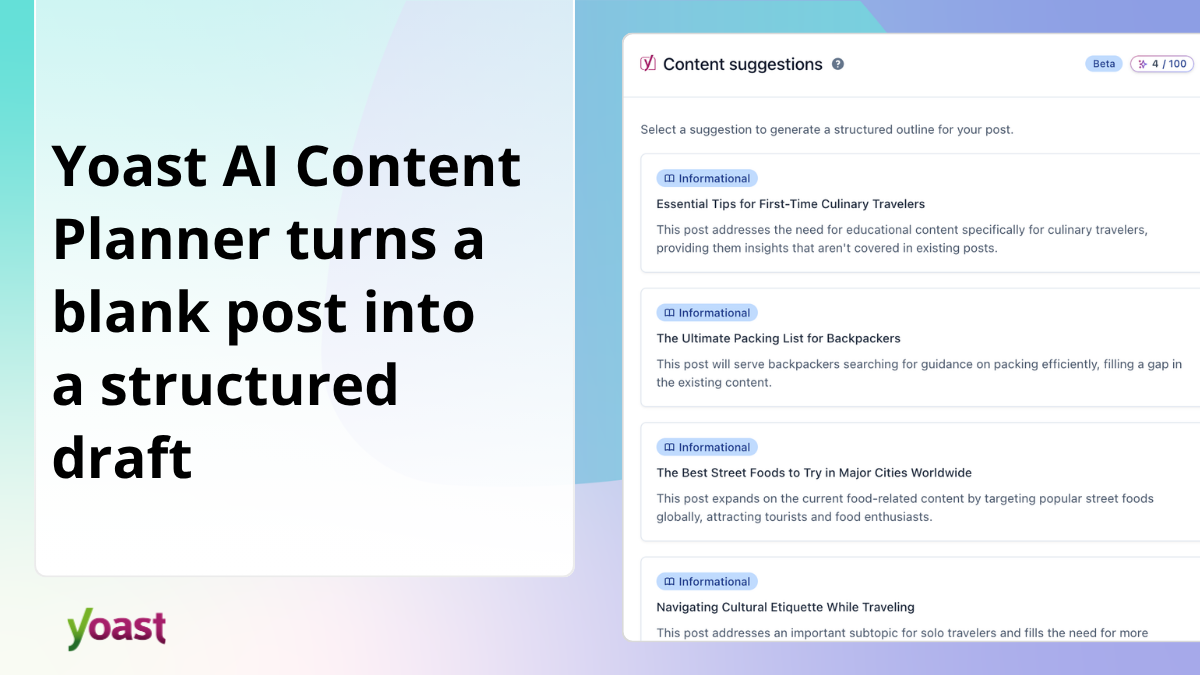
Once an idea is chosen, the Yoast AI Content Planner constructs a comprehensive draft, serving as a robust foundation for the writer. Each element of this draft is strategically chosen to optimize the content for both readers and search engines:
- Suggested The AI proposes a title that is both engaging and SEO-friendly, often incorporating relevant keywords and promising clear value to the reader. A good title is crucial for click-through rates (CTR) from search results.
- Structured Outline: Perhaps the most valuable component, the outline breaks down the chosen topic into logical sections and sub-sections. This not only provides a roadmap for the writer but also ensures the article covers the topic comprehensively and in an organized manner, which is favored by search engines for readability and user experience.
- Focus Keyphrase: The AI identifies a primary focus keyphrase for the article, crucial for guiding the content’s SEO optimization. This keyphrase is typically derived from the chosen topic and its relevance to existing content, ensuring targeted optimization.
- Meta Description: A concise, compelling meta description is generated, designed to entice users to click on the search result. This brief summary often includes the focus keyphrase and highlights the article’s core benefit or information.
- Content Notes for Each Section: These are contextual prompts or brief instructions for the writer within each section of the outline. They might suggest specific points to cover, questions to answer, or related concepts to explore, further guiding the content creation process and ensuring depth.
This structured approach significantly reduces the time spent on initial research and organization, allowing content creators to focus their energy on crafting high-quality, engaging prose. The shift from "what should I write?" to "how can I best articulate these points?" represents a fundamental change in workflow efficiency.
The Strategic Advantages for Content Creators
The implications of the Yoast AI Content Planner extend beyond mere convenience. For content creators and digital marketers, the strategic advantages are manifold:
- Consistency and Cadence: By simplifying ideation, the tool helps maintain a consistent publishing schedule, which is vital for SEO and audience engagement. Regular, high-quality content signals to search engines that a site is active and authoritative.
- Improved Content Strategy: The AI’s ability to identify content gaps and related topics allows for a more cohesive and comprehensive content strategy, building topical authority around specific niches. This is increasingly important in modern SEO, where search engines reward sites that demonstrate expertise and depth across a subject.
- Enhanced SEO Performance: With pre-defined titles, outlines, and focus keyphrases, articles are inherently better structured and optimized from the outset. This foundational SEO ensures that content has a stronger chance of ranking well in search results.
- Scalability: For agencies or larger content teams, the AI Content Planner can significantly scale content production without sacrificing quality in the planning stages. It allows writers to pick up drafts and immediately begin working, reducing onboarding time for new topics.
- Empowerment for Non-Experts: Small business owners or individuals without dedicated marketing teams can leverage this tool to produce professional-grade content plans, democratizing access to advanced content strategy.
Yoast’s Legacy of Innovation: A Brief History
Yoast has been a pivotal player in the WordPress ecosystem since its inception. Founded by Joost de Valk in 2010, Yoast SEO quickly became the go-to plugin for optimizing WordPress websites. Its mission has always been to make SEO accessible to everyone, regardless of their technical expertise. Over the years, Yoast SEO has evolved from a basic on-page optimization tool to a comprehensive suite offering readability analysis, schema markup integration, internal linking suggestions, and robust technical SEO features.
The introduction of the AI Content Planner marks another significant milestone in Yoast’s journey. It underscores the company’s commitment to continuous innovation and its responsiveness to the evolving needs of content creators and digital marketers. This move also places Yoast firmly within the vanguard of companies integrating advanced AI capabilities directly into widely used platforms, reinforcing its leadership position in the SEO software market. The development of such a feature likely involved substantial investment in natural language processing (NLP) and machine learning research, building on years of data accumulated from millions of websites using the Yoast plugin.
The Broader Landscape: AI’s Growing Role in Content and SEO
The integration of AI into content planning by Yoast is not an isolated event but rather a reflection of a larger paradigm shift in the digital marketing industry. Generative AI models, powered by advancements in neural networks and large language models (LLMs), have dramatically improved their ability to understand, generate, and summarize human language. This has led to an explosion of AI tools catering to various aspects of content creation, from brainstorming ideas to drafting entire articles, optimizing for SEO, and even translating content.
According to market reports, the global AI in marketing market size is projected to grow significantly in the coming years, driven by the increasing demand for personalized content, automated processes, and data-driven insights. Studies indicate that companies adopting AI tools in their marketing efforts often report higher ROI and improved efficiency. For instance, a survey by Statista in 2023 showed that a substantial percentage of marketers were already using AI for content creation and optimization, with many planning to increase their adoption. Yoast’s offering is unique in its deep integration within the WordPress environment, providing an immediate, contextual solution that stands apart from standalone AI writing assistants.
Industry Perspectives and Yoast’s Vision
While Yoast has not provided direct quotes from external industry analysts for this launch, it is possible to infer the general positive reception such a tool would receive. SEO experts often emphasize the importance of topical authority, consistent content, and user experience. An AI tool that assists in achieving these goals efficiently would likely be viewed as a valuable asset. The fact that Yoast’s AI Content Planner provides a draft and ideas rather than fully finished articles is crucial; it positions the AI as an assistant, enhancing human creativity rather than replacing it. This approach maintains the essential human element of writing, ensuring originality, tone, and nuanced understanding that AI currently struggles to replicate entirely.
From Yoast’s perspective, as inferred from statements by its product marketing manager, Beth Parker, and the company’s overall philosophy, the tool represents a commitment to empowering users. "If you’ve ever opened a new post and immediately closed it again because you had no idea what to write, this one’s for you," the announcement states, directly addressing a core user frustration. The vision is clear: to remove barriers to content creation, allowing users to focus on what they do best – writing compelling stories and providing valuable information to their audiences. This aligns with Yoast’s long-standing goal of making SEO simple and accessible, now extending to the entire content lifecycle.
Prerequisites and Accessibility: Getting Started
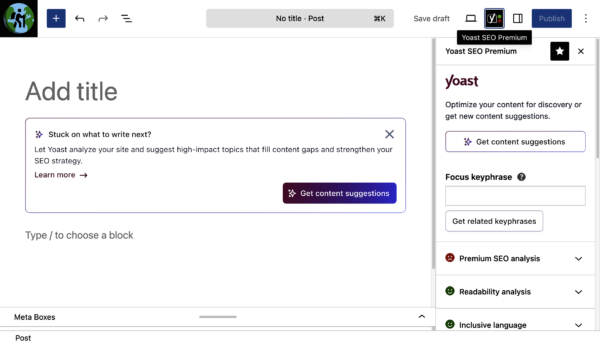
The Yoast AI Content Planner is designed for seamless integration into the existing workflow of Yoast SEO Premium users. There are no additional installations, separate logins, or complex setup procedures required. Users simply open a new, empty post in their WordPress editor, and the feature presents itself. This ease of access is a significant benefit, minimizing any friction associated with adopting new tools.
However, for the AI Content Planner to function optimally, a crucial prerequisite exists: the website must have a sufficient volume of published content. The AI relies on this existing content to build a meaningful picture of the site’s topics, authority, and potential content gaps. If a site is new or has very little published material, the AI may not be able to generate high-confidence suggestions, and users might see a low-confidence warning instead of ideas. This requirement underscores the data-driven nature of the tool and ensures the quality and relevance of the generated ideas. For established websites with a substantial content library, the feature is immediately ready to provide valuable insights.
The Future of Content Creation: Implications for the Industry
The launch of the Yoast AI Content Planner heralds a future where AI and human collaboration in content creation becomes increasingly intertwined. This development signifies a shift towards more intelligent tools embedded directly within content management systems, moving beyond standalone applications. For the WordPress ecosystem, it further solidifies its position as a robust platform that continually integrates cutting-edge technology to support its vast user base.
The broader implication for the content industry is a potential increase in content volume, efficiency, and potentially, quality. By automating the laborious initial stages of content planning, content creators can dedicate more time to research, refining their arguments, crafting compelling narratives, and optimizing for unique reader experiences. This could lead to a higher standard of content across the web, as the baseline for structured and relevant articles is raised. As AI continues to evolve, we can anticipate even more sophisticated features from Yoast and other SEO tool providers, further blurring the lines between intelligent assistance and creative output, while always aiming to empower the human element at its core. This represents not an end to human creativity, but an amplification of it, making quality content creation more accessible and efficient than ever before.