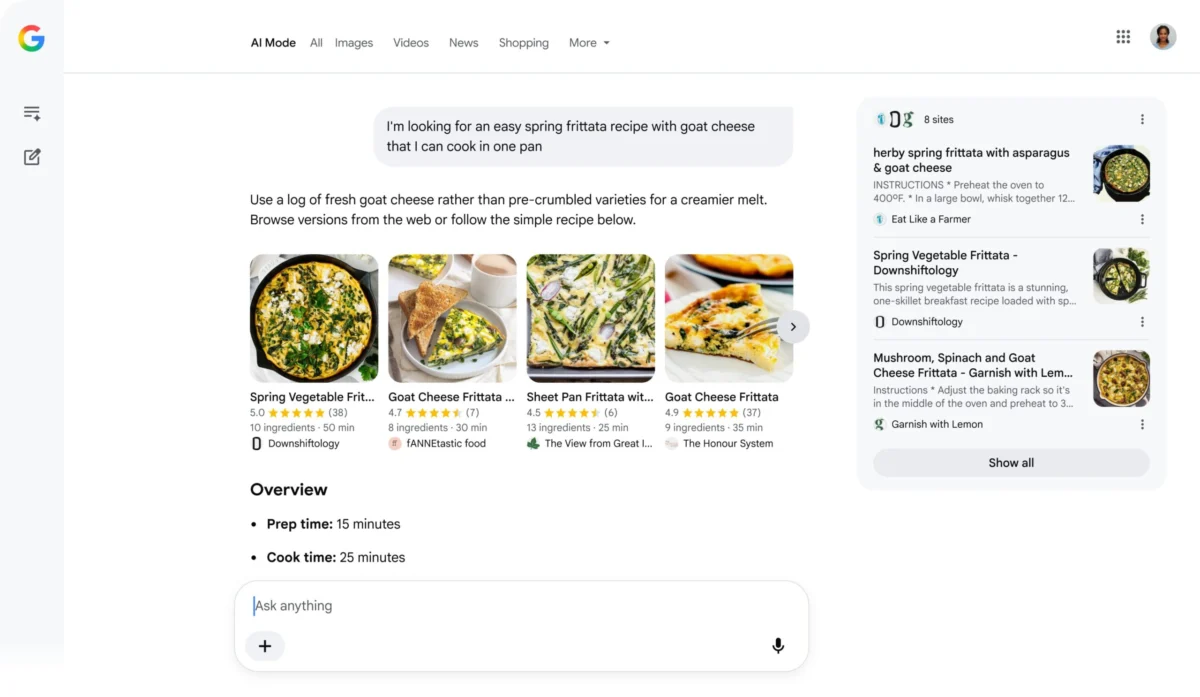
Google has rolled out its latest update to AI Mode recipe results, introducing a “new visual treatment” designed to improve the discoverability and navigation to original recipe pages. This marks a continuation of Google’s iterative efforts to refine its AI-powered search features, particularly in content-rich verticals like culinary arts, following previous adjustments and widespread feedback from the creator community. The announcement, made by Google’s Robby Stein on X (formerly Twitter), highlights the inclusion of more prominent links at the top of AI-generated responses, featuring critical details such as the creator’s name, recipe ratings, and the number of ingredients. This move aims to provide users with quick, actionable information while theoretically driving traffic back to the source creators.
Google’s Latest Iteration: Enhancing Discoverability
The recent update, unveiled on June 30, 2026, directly addresses concerns about attribution and user experience within AI Mode. Robby Stein’s announcement detailed a significant visual overhaul. “We’ve launched a new visual treatment making it even easier to discover and visit recipe pages with AI Mode,” Stein posted. He further elaborated, “There are now prominent links at the top of responses with useful details and images – like the creator name, recipe ratings, and number of ingredients.” This visual enhancement is reminiscent of the “top stories” test observed in AI Overviews earlier in the week, indicating a consistent design philosophy across Google’s generative AI features. The explicit goal is to make the jump from a summarized AI response to the original content source more intuitive and appealing for users.
This development is not an isolated incident but rather the latest step in an ongoing dialogue between Google and the vast ecosystem of online content creators. Stein himself acknowledged this continuum, stating, “As I mentioned in March, this is something we’re continuing to work on – thanks for everyone’s feedback here.” This reiterates Google’s position that its AI features are in a constant state of evolution, shaped by user data and, crucially, by the feedback from publishers and webmasters whose content forms the bedrock of the internet. The implicit message is that Google is listening and attempting to adapt its AI interfaces to better serve both searchers and creators, though the efficacy of these changes remains a subject of intense debate.
A Chronology of AI in Recipe Search: From “Frankenstein” to Refinement
Google’s journey with integrating artificial intelligence into recipe search has been marked by both innovation and significant challenges, reflecting the broader complexities of AI’s role in content summarization. The earliest iterations of AI-generated recipes, particularly within the nascent stages of AI Overviews, faced considerable criticism. Termed “Frankensteined recipes” by some in the SEO community, these early summaries often combined disparate elements from various sources, sometimes resulting in nonsensical or even dangerous culinary instructions. This period highlighted the critical need for accuracy, coherence, and proper attribution when AI synthesizes information, especially in practical domains like cooking.
The backlash from content creators during these early phases was immediate and widespread. Recipe bloggers, who often invest heavily in testing, photography, and detailed instructions, expressed alarm over AI potentially misrepresenting their work, stripping context, and, most importantly, diverting valuable organic traffic away from their sites. For many, these websites are their primary source of income, sustained by advertising revenue, affiliate links, and direct product sales.
In response to this feedback, Google began to make adjustments. The March update, referenced by Robby Stein, was one such pivotal moment, signaling Google’s recognition of the need for improved linking and attribution. This earlier update aimed to integrate clearer pathways back to original sources, though the specific visual treatments and prominence might not have been as developed as the current iteration. The consistent thread through these updates has been Google’s stated intention to empower users with quick answers while also supporting the “open web” and its content creators. However, the implementation has proven to be a delicate balancing act, often perceived by creators as leaning too heavily towards summarization at the expense of source traffic. The current update can be seen as Google’s latest attempt to strike this balance, making links more visually appealing and informative to entice users to click through.
The Content Creator’s Perspective: A Mixed Reception and Ongoing Concerns
Despite Google’s latest efforts, the response from the recipe blogging community remains mixed, with significant reservations persisting. The popular food blog “Inspired Taste” offered a candid and detailed critique, acknowledging the positive step but underscoring the substantial work yet to be done. “We sincerely appreciate this update. But there is a lot more work to be done,” stated Inspired Taste on X. Their primary concern revolves around the continued presence and problematic nature of the “full default AI recipe” that often appears below the newly enhanced recipe card UX.
Inspired Taste elaborated on the core issues: “The full default AI recipe below the recipe card UX in many cases boldly instructs users that the full AI recipe is our official recipe. Google says to follow our recipe below which isn’t sustainable.” This assertion points to a fundamental conflict: Google’s AI, in its attempt to provide a complete answer, is effectively presenting a summarized or synthesized version as the authoritative “official recipe,” even when it deviates significantly from the original. This poses a severe problem for creators, not just in terms of attribution but also accuracy and brand integrity.
The blog highlighted two critical problems with these AI-generated “official” recipes: “The full AI recipe ranges from verbatim plagiarism to wildly inaccurate representations of our recipes, videos, and photos. This misrepresentation needs to stop.” Plagiarism, even if unintentional or algorithmically derived, is a direct assault on intellectual property and creative effort. Inaccuracies, on the other hand, can lead to failed dishes, wasted ingredients, and ultimately, a diminished reputation for the original creator, especially if users attribute the poor outcome to the source identified by Google. The implication that users should “follow our recipe below” (referring to the AI summary) directly undermines the creator’s authority and the necessity of visiting their site for the complete, accurate, and often nuanced instructions.
Inspired Taste’s unequivocal demand is clear: “The full default AI recipe below really needs to go. This is a big step in the right direction.” They provided an example where the AI recipe was presented as an “overview,” with the full AI recipe nowhere in sight, deeming it “useful to searchers and will be much better for the ecosystem.” This sentiment underscores a desire for AI to act as a discovery tool or a brief summary, rather than a comprehensive replacement for original content.
The economic model of recipe blogs further amplifies these concerns. These websites typically rely on a combination of display advertising, affiliate marketing (linking to specific ingredients or kitchen tools), and direct sales of cookbooks or digital products. Each page view and user interaction on their site contributes to this revenue. When AI Overviews or AI Mode summarize content and present it as a complete answer, it drastically reduces the incentive for users to click through to the original site. This “zero-click” phenomenon, while potentially convenient for users seeking quick answers, can be devastating for creators whose livelihoods depend on those clicks. A significant drop in traffic translates directly to a loss of ad revenue, diminished affiliate sales, and reduced engagement with their brand, threatening the sustainability of their operations. For many, maintaining a high-quality, frequently updated blog is a full-time job, requiring substantial investment in ingredients, photography equipment, web hosting, and content creation tools. The perceived threat of AI eroding their traffic base is therefore not merely an abstract concern but an existential one.
The Broader Landscape of AI Overviews and Publisher Relations
The specific challenges faced by recipe bloggers are emblematic of a broader tension permeating the entire content creation ecosystem in the age of generative AI. Google’s AI Overviews, which integrate AI-generated summaries directly into search results, represent a fundamental shift in how information is presented to users. While Google positions these as enhancements to user experience, providing quick and comprehensive answers, many publishers view them as a direct threat to their traffic and business models.
The debate centers on Google’s role: Is it an “answer engine” or a “discovery engine”? Traditionally, Google functioned as a discovery engine, directing users to relevant websites where they could find answers. With AI Overviews, it increasingly acts as an answer engine, attempting to provide the answer directly on the search results page. This paradigm shift has profound implications for how content is created, monetized, and consumed. Various reports from SEO analytics firms and individual webmasters have indicated noticeable drops in traffic for certain queries following the wider rollout of AI Overviews. While definitive, large-scale data is still emerging, the anecdotal evidence and initial analyses suggest a measurable impact on organic search traffic, particularly for informational queries that AI is well-suited to summarize.
The digital publishing industry, already grappling with evolving advertising models and the dominance of social media platforms, now faces another significant challenge in adapting to an AI-first search environment. Publishers are forced to re-evaluate their content strategies, potentially focusing on content that is harder for AI to summarize or offers unique interactive elements that necessitate a site visit. The very definition of “useful content” from Google’s perspective is also evolving, creating uncertainty for those who have built their businesses on traditional SEO best practices.
Data and Market Context: The Digital Recipe Economy
The digital recipe market is a vast and vibrant segment of the online content landscape. Estimates suggest there are hundreds of thousands, if not millions, of active food blogs and recipe websites globally, ranging from individual hobbyists to large media conglomerates. This ecosystem generates billions of page views annually, driven by a universal human need and interest in food. The revenue generated by this sector, through advertising, e-commerce, and other ventures, runs into hundreds of millions, if not billions, of dollars.
Search engines, primarily Google, are the lifeblood of this economy, acting as the primary referral source for a significant majority of recipe blog traffic. According to various industry analyses, organic search can account for anywhere from 50% to 80% of a typical recipe blog’s traffic. This reliance makes any significant change in search engine behavior, especially one that reduces click-through rates, a matter of paramount importance. User engagement metrics, such as time on page, bounce rate, and page depth, are also crucial for advertisers, influencing ad rates and overall revenue. If AI summaries reduce the need for users to spend time on the original sites, these metrics could decline, further impacting the financial viability of these platforms.
Moreover, recipe content often involves a strong visual component and detailed, step-by-step instructions that can be challenging for AI to perfectly replicate without loss of fidelity. The personal touch, storytelling, and unique voice of a creator are also integral to many successful recipe blogs, elements that a generic AI summary struggles to convey. The current Google update attempts to reintroduce some of these human elements by prominently displaying the creator’s name and ratings, but whether this will be sufficient to overcome the convenience of an immediate AI answer remains to be seen.
Google’s Stated Commitment and Ongoing Dialogue
Google’s official responses indicate an awareness of the ongoing challenges and a commitment to continuous improvement. Rajan Patel, another prominent figure at Google, directly addressed the feedback, stating, “Appreciate all the feedback… we’re listening and continuing to improve our AI experiences to help people connect to the best of the web.” This statement reflects Google’s stated mission to organize the world’s information and make it universally accessible and useful, now with an AI lens.
However, the definition of “best of the web” and “connecting” to it is where the contention lies. For Google, “best of the web” might imply efficiently summarized, quickly digestible information. For content creators, it often means the original, comprehensive, and contextually rich source that provides the fullest experience and supports their creative endeavors. The challenge for Google is to reconcile these two perspectives. The iterative nature of these updates suggests that Google is attempting to find a middle ground, but the speed and scope of AI’s integration into search are pushing the boundaries faster than many publishers can adapt. The dialogue between Google and the creator community is therefore not just ongoing but intensifying, as both sides seek to define the future of information discovery and content value.
Implications for the Future of Online Content and SEO
The trajectory of Google’s AI Mode for recipes and the broader AI Overviews initiative holds significant implications for the future of online content creation and search engine optimization. For content creators, particularly those in niches susceptible to summarization, the imperative to differentiate and provide unique value will only grow. This could mean focusing on more experiential content, interactive features, community building, or highly specialized expertise that AI struggles to replicate. The traditional SEO strategy of simply providing comprehensive, keyword-rich articles might need to evolve towards creating content that actively encourages direct engagement and deep dives, rather than just quick answers.
For SEO professionals, the landscape is shifting from optimizing for snippets to understanding how to influence AI-generated summaries and, crucially, how to drive clicks even when an AI answer is present. This may involve optimizing for specific data points that appear in the prominent links (like ratings and ingredient counts), ensuring brand visibility, and potentially exploring new forms of structured data that better inform AI models about the unique value of a piece of content. The importance of a strong brand identity and direct audience connection, independent of search engines, will also likely increase.
For Google, the challenge lies in balancing its innovative drive with its role as the gatekeeper of the internet’s information flow. Alienating a significant portion of content creators could lead to a decline in the quality and diversity of content available online, which would ultimately diminish the value of Google’s own search results. The company’s ongoing updates demonstrate an awareness of these stakes, but the path forward is complex. The evolution of AI in search is not just a technological advancement; it’s a fundamental reordering of the relationship between users, search engines, and the creators who populate the digital world. The current updates to AI Mode recipe links are a testament to this ongoing evolution, a small but significant step in a much larger, unfolding narrative.