

The digital marketing landscape is undergoing a profound transformation, driven by the rapid evolution of artificial intelligence and its integration into search mechanisms. Answer Engine Optimization (AEO), once a theoretical concept, has rapidly matured into a measurable and indispensable strategy for marketing leaders seeking to maintain relevance and drive conversions in an AI-first world. As a growing number of consumers turn to generative AI tools like ChatGPT, Google AI Overviews, and Perplexity for direct answers, brands that proactively invest in AEO are reporting tangible returns in terms of enhanced visibility, improved lead quality, and long-term authority. This strategic shift marks a critical divergence from traditional SEO, emphasizing direct, structured answers over mere page rankings.
The Genesis of AEO: A Paradigm Shift in Information Retrieval
For decades, Search Engine Optimization (SEO) focused on optimizing content to rank highly in a list of “blue links” on traditional search engine results pages (SERPs). The goal was to attract clicks by matching keywords and demonstrating topical relevance. However, the advent of large language models (LLMs) and generative AI has introduced a new dimension to information retrieval. These sophisticated AI systems are designed not just to point users to information, but to synthesize, summarize, and present direct answers to complex queries, often citing sources within their generated responses.
This technological leap created a new challenge and opportunity: how do brands ensure their content is not only discoverable but also extractable and citable by these intelligent systems? AEO emerged as the answer. It is the specialized practice of structuring and optimizing content so that AI-powered search engines can accurately extract, understand, and attribute a brand’s information as the authoritative response to a user’s question. Unlike traditional SEO’s emphasis on page rankings, AEO prioritizes:
- Direct Answer Eligibility: Crafting content to directly answer specific user questions.
- Entity Recognition: Clearly defining key entities (people, places, organizations, concepts) within content.
- Structured Data Implementation: Using schema markup to explicitly signal the meaning and relationships within content to AI.
- Authoritative Sourcing: Ensuring content is perceived as credible and well-sourced, enhancing its likelihood of being cited.
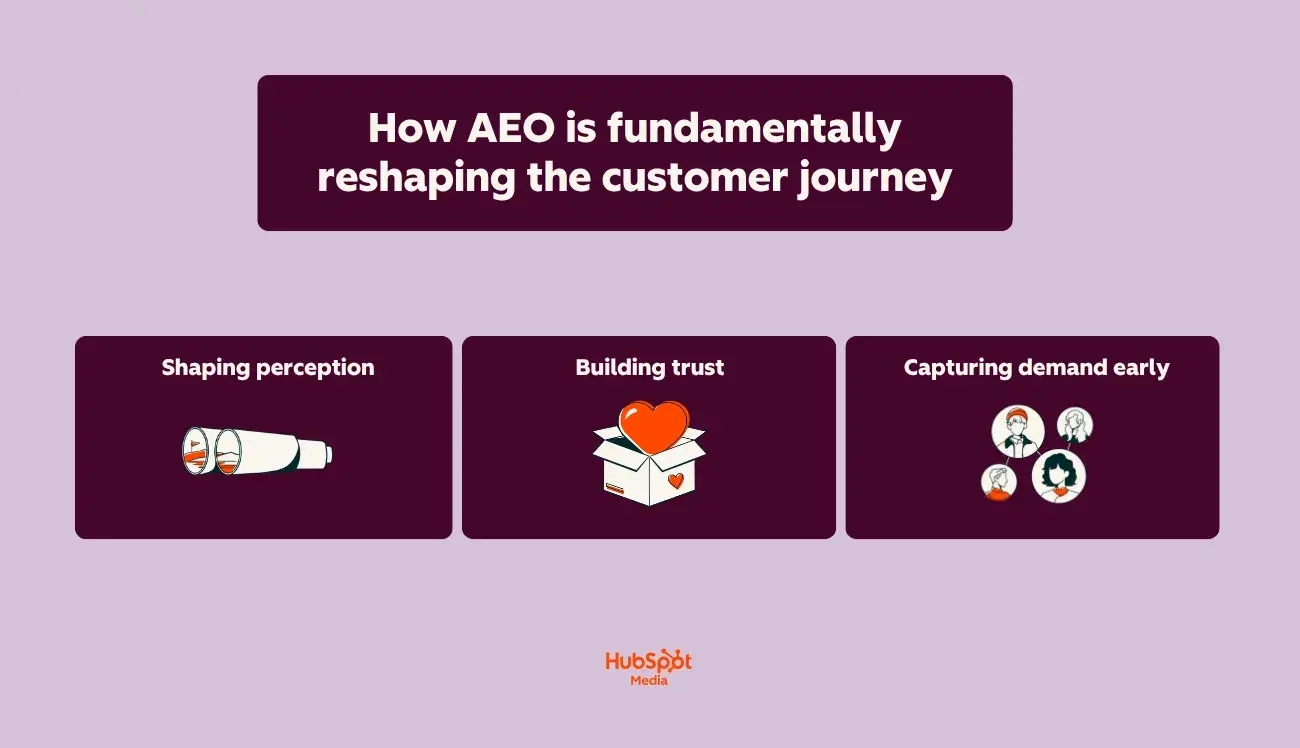
This evolution signifies a shift in the fundamental customer journey. Buyers are increasingly receiving answers before ever clicking through to a website, meaning the brands that appear in AI-generated responses are capturing demand at the critical moment of intent formation.
The Measurable Benefits of Strategic AEO Implementation
The early skepticism surrounding AEO’s tangible benefits has dissipated, replaced by concrete evidence of its impact on key business metrics. For marketing leaders, AEO delivers compounding advantages across the entire marketing funnel, making it harder for competitors to replicate over time.
-
Higher-Intent Traffic and Improved Lead Quality:
AEO fundamentally enhances lead quality and accelerates the time to value. When a user clicks through to a brand’s website from an AI-generated answer, they arrive with pre-qualified intent. The AI has already explained the topic, matched their query, and positioned the brand’s content as a relevant authority. This pre-validation means visitors are often further along in their buyer’s journey, leading to:- Reduced bounce rates due to better alignment between user expectation and content.
- Higher conversion rates as users are already primed for the solution offered.
- Shorter sales cycles because initial informational hurdles have already been cleared by the AI.
-
Enhanced Brand Visibility at the Moment of Intent:
AEO secures brand visibility precisely where buyers are initiating their research—within AI-powered search results. This is crucial given the undeniable shift in consumer behavior. Data from HubSpot’s 2026 State of Marketing Report underscores this trend, revealing that nearly half (49%) of marketers observe a decrease in web traffic from traditional search due to AI answers. Concurrently, a significant 58% report that AI referral traffic exhibits much higher intent than conventional organic search. By appearing in these AI-generated responses, brands capture demand at its inception, establishing authority and presence early in the decision-making process. -
Strengthening E-E-A-T and Long-Term Authority:
The optimization efforts inherent in AEO directly reinforce E-E-A-T (Experience, Expertise, Authoritativeness, and Trustworthiness), which is a critical ranking factor for both traditional and answer engines. The process of defining entities, adding structured data, and publishing clear, well-sourced answers signals to AI systems that the content is reliable and credible. Each piece of answer-optimized content contributes to a brand’s entity profile across LLMs, increasing the probability of future citations and cementing its reputation as a trusted source. This creates a virtuous cycle of authority that is difficult for competitors to challenge. -
Quantifiable Performance through Specialized Tools:
Historically, a major hurdle for AEO adoption was the difficulty in proving ROI, as legacy SEO tools were not designed to track AI citations. This challenge is now being addressed by purpose-built AEO measurement tools. Platforms like HubSpot’s AEO Grader and HubSpot AEO provide concrete baselines, identify content gaps, and offer prioritized recommendations. These tools allow marketing teams to:- Measure AEO visibility and performance across various answer engines.
- Track AI citation presence with the same rigor applied to organic traffic.
- Connect optimization efforts directly to measurable outcomes, moving beyond intuition to data-driven decisions.
-
Synergistic Extension of Existing SEO Investments:
AEO is not a replacement for SEO but rather a powerful, complementary layer. The benefits of AEO tools are most pronounced when integrated with existing SEO strategies. Content that ranks highly in traditional search often already possesses topical authority, making it prime for AEO optimization. Structured data added for AI citation eligibility simultaneously improves traditional rich results and featured snippets. Furthermore, established topic clusters, vital for SEO, provide the interconnected entity relationships that LLMs require for comprehensive understanding. This integration allows teams to adopt AEO incrementally, leveraging existing content programs without needing a complete overhaul. -
Future-Proofing Content Architecture:
The foundational principles of AEO—clarity, conciseness, entity definition, and structured data—are universal requirements for emerging AI-driven interfaces. Voice search, multimodal AI, agent-driven commerce, and zero-click interfaces all rely on content that is:
- Clearly structured for direct answers.
- Semantically rich with well-defined entities.
- Marked up with robust structured data.
Investing in AEO now means building a content infrastructure that is inherently scalable across every evolving AI channel, providing a durable competitive advantage as the digital landscape continues to transform.
Navigating the Challenges of AEO Implementation
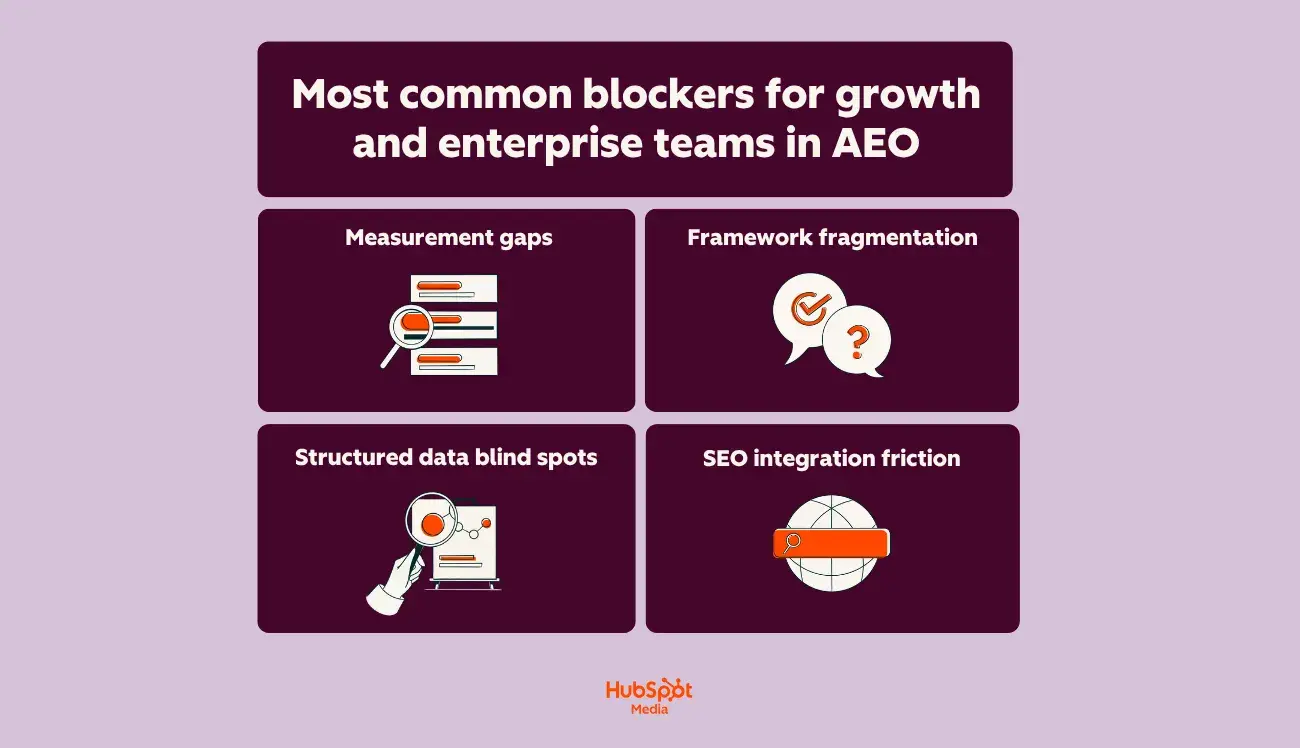
Despite its clear advantages, the journey to full AEO adoption is not without its obstacles. Marketing teams often encounter common blockers when attempting to transition from experimental initiatives to a scalable, operational program.
-
Measuring AEO ROI with Traditional Tools: The inability of legacy SEO tools to monitor AI citations creates a significant barrier to justifying budget and demonstrating impact to leadership.
- Solution: Implement purpose-built AEO measurement tools. Tools like HubSpot’s AEO Grader provide baseline scores, gap analyses, and actionable insights, enabling rigorous reporting on AI citation presence and progress over time. Continuous monitoring with platforms like HubSpot AEO ensures real-time tracking of visibility gains or drops.
-
Lack of a Repeatable Framework for LLM Optimization: Many teams approach AEO ad hoc, leading to inconsistent results and scalability issues.
- Solution: Develop a standardized AEO content workflow. This involves conducting an initial AEO audit, prioritizing content based on impact, creating content templates optimized for direct answers, implementing a structured data strategy, and establishing a regular review cycle. Automating content audits with tools like AirOps can streamline this process significantly.
-
Perceived Conflict with Existing SEO Strategy: Teams often worry about duplicate efforts, conflicting priorities, or cannibalizing existing organic traffic.
- Solution: Frame AEO as an enhancement layer to SEO. High-ranking pages are ideal AEO candidates as they already possess topical authority. Structured data benefits both AI citation and traditional rich results. AEO should be seen as reinforcing, rather than competing with, existing SEO investments.
-
Technical Hurdles of Structured Data Implementation: The technical complexity of implementing schema markup across a large content library can overwhelm marketing teams lacking dedicated developer resources.
- Solution: Begin with high-impact, low-effort schema types. FAQPage, HowTo, and Article schema are relatively straightforward to implement and yield significant AEO benefits. Many CMS platforms support schema plugins, and modern content hubs like HubSpot’s Content Hub offer native structured data support.
-
Gaining Leadership Buy-in: Even when practitioners understand AEO’s value, securing approval from VP- and C-level stakeholders requires tying it to established business outcomes like pipeline influence, customer acquisition costs, and brand authority.
- Solution: Position AEO as both risk mitigation and a competitive advantage. Highlight that as AI handles more queries, brands not cited risk losing hard-won visibility. Use AEO Grader scores as benchmarks, demonstrating progress alongside pipeline metrics to show tangible business impact.
-
Ambiguity of Diverse Answer Engines: The varying retrieval behaviors of different LLMs (ChatGPT, Google AI Overviews, Perplexity, Claude) can lead to paralysis regarding where to focus optimization efforts.
- Solution: Prioritize shared fundamental principles rather than platform-specific quirks. Focus on making content clear, well-structured, and the most authoritative answer to audience queries. This consistency will yield benefits across all major answer engines.
A Strategic Roadmap for AEO Adoption
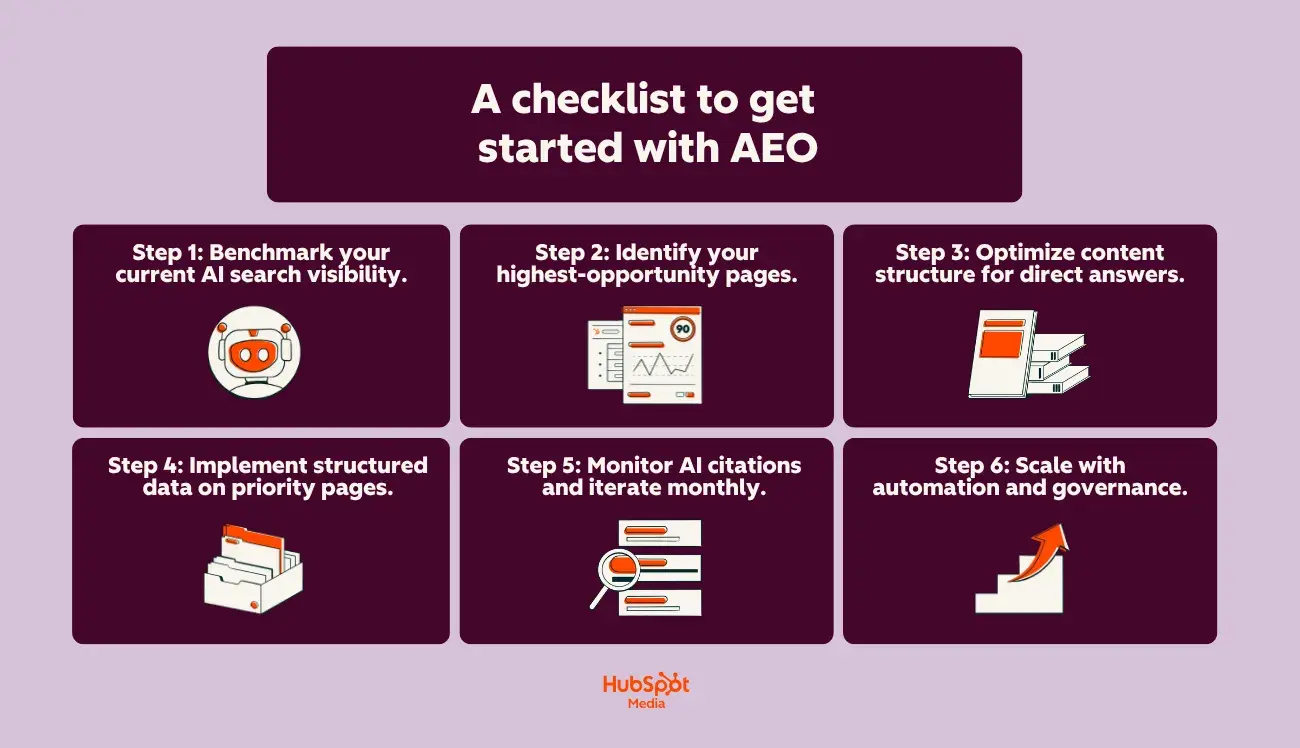
Overcoming these challenges requires a systematic approach. The most successful teams treat AEO as an ongoing operational capability rather than a one-time experiment. Here’s a checklist to guide the initial stages of AEO implementation:
-
Benchmark Current AI Search Visibility: Before any optimization, establish a baseline. Use tools like HubSpot’s AEO Grader to measure current visibility and performance across major answer engines, providing a score, a gap analysis, and prioritized actions. This initial assessment provides a concrete starting point against which all future improvements can be tracked.
-
Identify High-Opportunity Content Assets: Focus on content that already possesses topical authority and organic traffic. These pages are more likely to be recognized by LLMs. Prioritize pages that answer common customer questions, support key product features, or address high-volume informational queries. Tools like AirOps can automate content audits at scale, evaluating pages for answer-readiness and structured data gaps.
-
Optimize Content Structure for Direct Answer Extraction: AI systems extract information most effectively from clearly structured content with explicitly stated relationships.
- Restructure introductory paragraphs to directly answer the main query.
- Use clear headings (H2, H3) to break down complex topics into digestible sections.
- Incorporate “What is X?”, “How to Y?”, and “Why Z?” sections.
- Ensure each section provides a concise, unambiguous answer.
- Utilize HubSpot’s Content Hub to create and manage answer-friendly content formats with built-in structured data support.
-
Implement Strategic Structured Data: Begin with high-impact schema types that provide clear signals to AI systems.
- FAQPage Schema: For pages addressing multiple questions, explicitly mark up questions and answers.
- HowTo Schema: For instructional content, outline steps and materials.
- Article Schema: For blog posts and informational articles, define author, publication date, and key sections.
Many CMS platforms and tools like Content Hub simplify this process, reducing the need for extensive developer intervention.
-
Continuous Monitoring and Iteration: AEO is an ongoing process. Set up monitoring to track AI citations, content summaries, and competing sources. Review results monthly, re-run AEO Grader assessments quarterly, and use these insights to prioritize subsequent optimization batches. Tools like Perplexity can serve as testing surfaces to see how content is cited and summarized in real-time.
-
Scale with Automation and Governance: Once initial successes are achieved, leverage automation to scale efforts without compromising quality.
- Automate content audits to identify new optimization opportunities.
- Utilize AI-assisted tools for bulk schema generation and content optimization recommendations.
- Establish clear governance rules for AEO content creation and updates.
AirOps, for example, can build automated AEO workflows, including programmatic audits and AI-assisted optimization across large content libraries.
Frequently Asked Questions and Broader Implications
-
How long does AEO take to show results?
Most teams observe measurable changes in AI citation visibility within 30 to 90 days of implementing structured optimizations. The timeline varies based on content authority, update frequency, and the specific answer engine. Quick wins, such as FAQ schema or direct answer rewrites, can appear in AI responses relatively quickly, as LLMs frequently recrawl and reindex authoritative content. The long-term advantages, however, compound over time as AI systems build stronger entity associations with your brand. -
Does AEO risk cannibalizing existing rankings?
No, AEO optimizations reinforce traditional ranking signals. By making content clearer and more semantically rich, AEO can actually improve traditional SEO performance. Structured data, clearer entity definitions, and improved topical authority benefit both AI and traditional search algorithms. AEO acts as a complementary layer, enhancing, not competing with, existing SEO investments. -
Should I change my site architecture specifically for AEO?
A complete architectural overhaul is rarely necessary. If your site already employs a logical topic cluster structure with clear internal linking, you have a strong foundation. For AEO, focus on making this structure more explicit for LLMs by:- Ensuring clear hierarchies of information.
- Using semantic HTML5 elements.
- Implementing schema markup to define relationships between pages.
HubSpot’s Content Hub can facilitate these changes without requiring a full re-platforming.
-
How does AEO impact voice assistants and smart devices?
AEO capabilities directly extend to voice search. Voice assistants like Siri, Alexa, and Google Assistant draw answers from the same AI retrieval infrastructure powering text-based answer engines. When content is structured as a concise, direct answer with strong entity definitions, it becomes eligible for voice responses, which is crucial as voice queries are inherently conversational and question-based.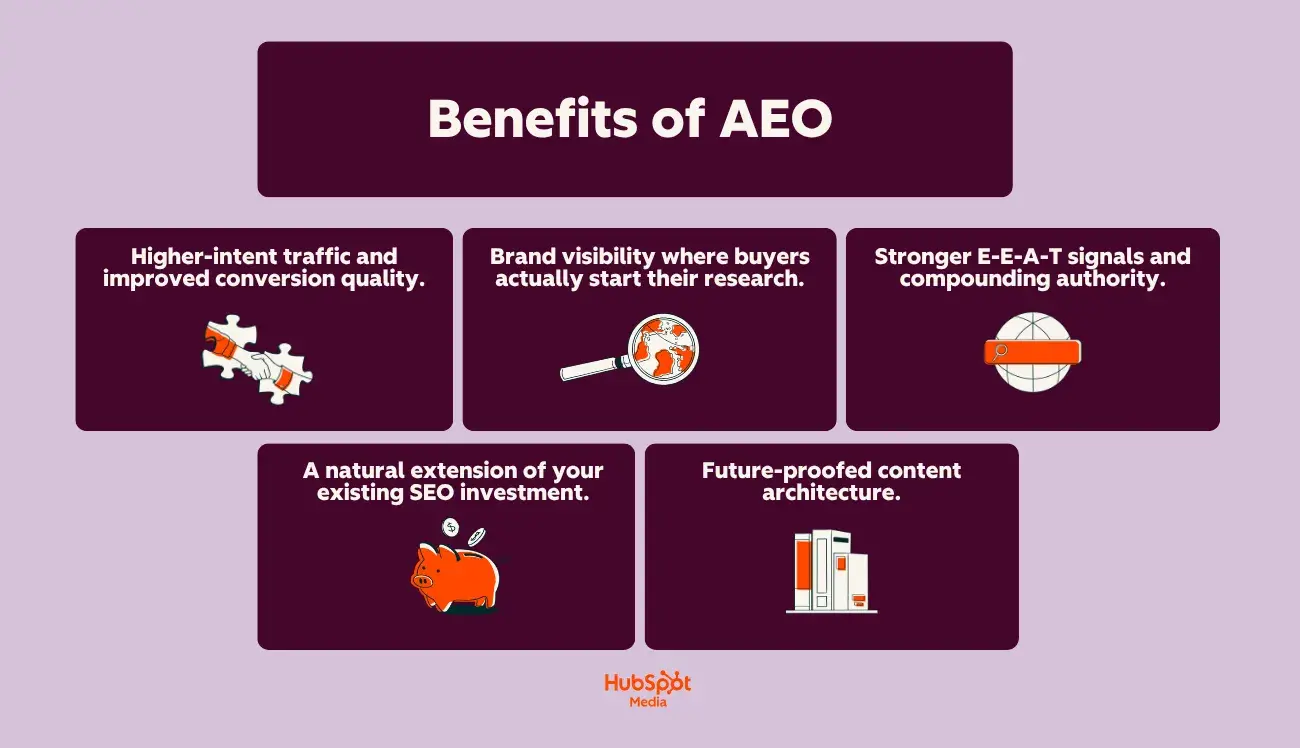
-
Do I need developer resources to start AEO?
Not for initial implementation. Many high-impact AEO optimizations are content-level changes that marketers can execute directly, such as rewriting introductions, restructuring content with clear headings, and adding simple schema using CMS plugins. Developer support becomes more valuable for scaling efforts, particularly for custom schema generation across thousands of pages or integrating AEO data with broader analytics platforms. Purpose-built AEO tools significantly reduce this technical dependency.
The Future is Answer-Centric
The shift towards answer-centric search is undeniable and accelerating. What was once an emerging trend is now a core operational capability for leading marketing teams. The teams currently excelling in AI search are not waiting for the landscape to stabilize; they are proactively measuring progress, iterating monthly, and treating AEO as a fundamental aspect of their digital strategy. As AI systems continue to handle a larger share of the discovery journey, the competitive advantage will decisively belong to brands that establish their AEO foundations now. Embracing AEO is no longer optional; it is imperative for building defensible brand authority and securing pipeline influence in the evolving digital ecosystem.








