Facebook advertising, a cornerstone of modern digital marketing, empowers businesses of all sizes to execute paid promotional campaigns across Meta’s expansive ecosystem, encompassing Facebook, Instagram, Messenger, and the Audience Network. This strategic capability allows advertisers to precisely target vast audiences with diverse creative formats, including text, image, and video, ensuring their message reaches the most receptive demographics at scale and with measurable outcomes. The platform’s unparalleled reach, with Meta reporting billions of users interacting across its applications monthly, positions it as a critical channel for driving growth and engagement in the global marketplace.
Understanding the Advertising Ecosystem: What is Facebook Advertising?

At its core, Facebook advertising operates through a sophisticated auction system designed to deliver optimal results for advertisers while maintaining a positive user experience. When an advertiser initiates a campaign, they specify their objectives, target audience, and allocated budget. Meta’s proprietary algorithm then dynamically assesses various factors—including the advertiser’s bid, the estimated action rate (likelihood of a user taking the desired action), and the overall quality and relevance of the ad—to determine which advertisements are shown to individual users. This system ensures that advertisers only pay what is necessary to secure their placement, while simultaneously working to connect ads with users most inclined to respond, making it a highly efficient and data-driven advertising mechanism. This fusion of immense audience reach with granular control over targeting and delivery positions Facebook advertising as an indispensable tool for marketers across virtually every industry.
Navigating Costs: How Much Does Facebook Advertising Truly Cost?
The financial outlay for Facebook advertising is subject to significant variability, influenced by a multitude of factors. In 2026, the typical Cost Per Click (CPC) is projected to range between $0.50 and $2.00. This benchmark, however, fluctuates considerably based on the advertiser’s specific industry, the competitiveness of their target audience, the chosen campaign objective, the quality of the ad creative, and the time of year. Highly competitive sectors or peak advertising seasons (e.g., holiday periods) generally command higher costs.

Industry benchmark data provides a general overview of typical costs associated with different campaign objectives:
| Campaign Objective | Typical Cost Per Click (CPC) | Typical Cost Per 1,000 Impressions (CPM) | Typical Cost Per Lead (CPL) |
|---|---|---|---|
| Awareness | $0.40 to $0.90 | $5 to $9 | N/A |
| Traffic | $0.50 to $1.50 | $7 to $12 | N/A |
| Engagement | $0.30 to $1.00 | $6 to $10 | N/A |
| Leads | $1.00 to $2.50 | $9 to $15 | $5 to $25 |
| Sales | $0.80 to $2.00 | $10 to $18 | $10 to $40 |
These figures serve as general guidelines, not definitive guarantees, as actual costs are inherently tied to the unique dynamics of each advertising account and its target audience. Factors such as ad relevance, bid strategy, and audience saturation further influence these costs. Consequently, a flexible budgeting approach that prioritizes testing and iterative optimization is crucial for identifying cost-effective strategies.
For businesses contemplating initial investments, a daily budget of $5 or $10 is often sufficient to commence advertising efforts. A $5 daily allocation can facilitate small-scale testing, localized campaigns, or the initial collection of audience data. Increasing this to $10 daily provides Meta’s algorithm with a greater volume of data for optimization, enabling more substantial results for small-to-mid-sized campaigns. Enterprise-level campaigns, however, typically necessitate significantly larger budgets to achieve extensive reach and conversion targets, with the overarching principle being to allocate enough funds to gather actionable data for continuous optimization and scalable growth.
The Strategic Imperative: Why Businesses Advertise on Facebook
Advertising on Meta’s platforms offers a compelling value proposition for businesses seeking to achieve measurable growth. The combination of vast audience reach, sophisticated targeting capabilities, flexible budgeting, and robust performance analytics makes it one of the most efficient digital marketing channels available. Key benefits include:
- Unrivaled Audience Reach: With billions of global users, Meta provides access to an audience pool unmatched by most other digital platforms, allowing businesses to connect with potential customers on an unprecedented scale.
- Precision Targeting: Advertisers can define their audience with exceptional granularity, leveraging demographics, interests, behaviors, custom audiences, and lookalike audiences to ensure messages resonate with the most relevant segments.
- Flexible Budgeting: The platform accommodates a wide range of budgets, from modest daily spends suitable for small businesses to extensive campaigns for large enterprises, offering cost control and scalability.
- Diverse Ad Formats: A rich array of ad types—including images, videos, carousels, stories, and collections—enables creative flexibility to convey messages effectively across different stages of the customer journey.
- Measurable Results: Comprehensive analytics tools within Meta Ads Manager provide real-time data on campaign performance, allowing for precise tracking of impressions, clicks, conversions, and return on ad spend (ROAS).
- Retargeting Capabilities: The ability to retarget users who have previously interacted with a brand’s website or content significantly boosts conversion rates by re-engaging interested prospects.
- Cross-Platform Integration: Campaigns can seamlessly span Facebook, Instagram, and Messenger, providing consistent brand exposure across multiple touchpoints where audiences spend their time.
- AI-Powered Optimization (Advantage+): Meta’s advanced AI tools automate campaign elements, from audience selection to creative optimization, driving efficiency and often achieving lower costs per result.
These benefits collectively empower marketing leaders to craft highly effective campaigns that deliver tangible business outcomes, making Facebook advertising a strategic imperative for modern enterprises.
Choosing Your Canvas: A Deep Dive into Facebook Ad Formats
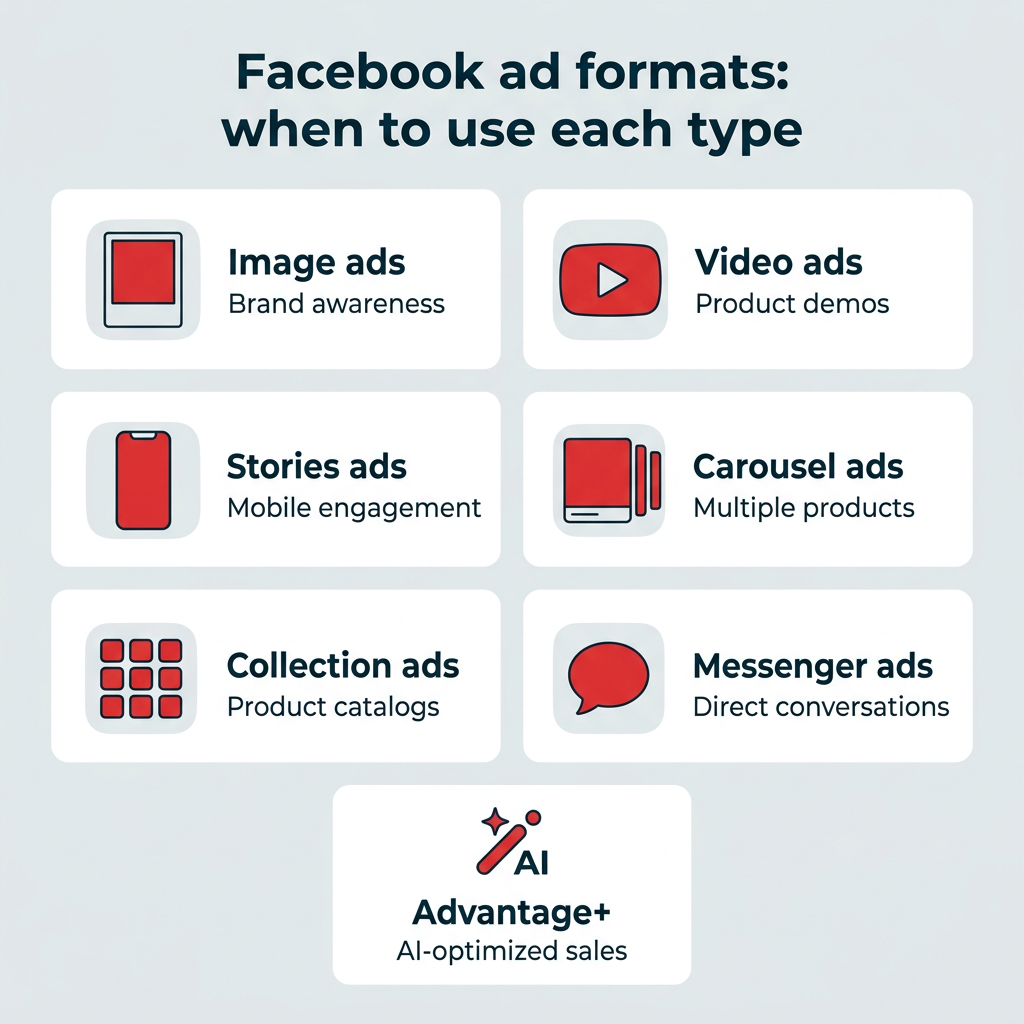
Meta offers a versatile suite of ad formats, each designed to serve different campaign objectives and stages of the marketing funnel. Selecting the appropriate format is crucial for maximizing impact.
-
Image Ads: The simplest and most fundamental format, image ads utilize a single static image to promote products, services, or brands. They are highly adaptable across various placements and aspect ratios, making them ideal for campaigns with strong, singular visual content like product photography, illustrations, or graphic designs. Their ease of creation, often by boosting an existing Facebook Page post, makes them an excellent entry point for beginners, suitable for driving brand awareness or promoting specific product launches. While effective for direct messaging, their single-image nature can be limiting for complex narratives or showcasing multiple products.
-
Video Ads: Leveraging the power of motion, video ads allow businesses to showcase products, demonstrate services, or tell brand stories through a single video. They are particularly effective for product tutorials, demonstrations, and highlighting dynamic features. While videos can be up to 241 minutes long, Meta recommends keeping them under 15 seconds for optimal engagement, reflecting user consumption habits on mobile devices. The primary drawback is the higher investment in time and resources required for production, making them less suitable for simple messages where an image or carousel ad might suffice.
-
Stories Ads: Designed for the mobile-first user, Stories ads offer an immersive, full-screen vertical format that maximizes screen real estate without requiring users to rotate their devices. Data from the US indicates that 62% of users report increased interest in a brand after viewing its Story, underscoring their effectiveness. With four million advertisers utilizing Stories monthly, they offer significant creative freedom, allowing for the integration of emojis, stickers, filters, and augmented reality effects, fostering a more personal and engaging brand interaction.
-
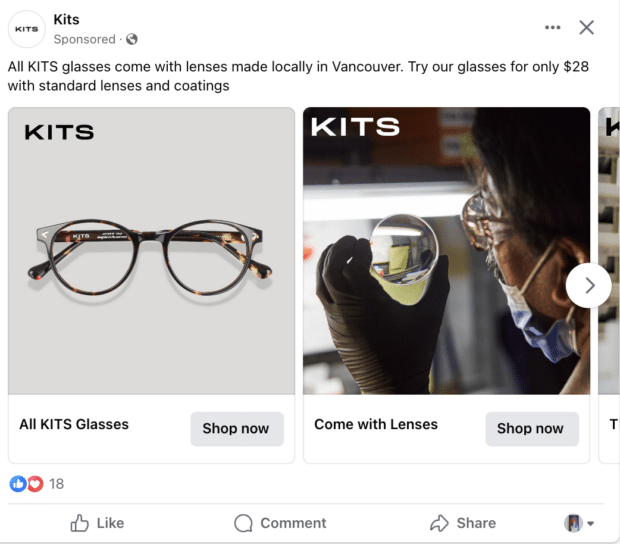
Carousel Ads: This dynamic format allows advertisers to display up to ten images or videos within a single ad unit, which users can swipe through. Each card in the carousel can feature its own headline, description, and unique link, making it highly versatile. Carousel ads are exceptionally well-suited for showcasing multiple products, highlighting different features of a single product, or guiding users through a sequential process or story. The ability to link each card to a specific landing page further enhances their utility for diverse marketing objectives.
-
Collection Ads: Representing an advanced, immersive evolution of the carousel, Collection ads create a mobile window-shopping experience. When a user taps on a Collection ad, they are seamlessly transported to an Instant Experience—a full-screen, mobile-only landing page (formerly known as Canvas). Within this experience, users can interact with multiple images and videos, zoom in on content, and often purchase products directly without leaving the Meta ecosystem. Advertisers can even allow Meta’s algorithms to dynamically select products from their catalog for each user, personalizing the experience. Collection ads are particularly powerful for large businesses with extensive product lines, offering a rich, interactive browsing and purchasing journey.
-
Messenger Ads: Integrated within Facebook Messenger, these ads appear within users’ chat feeds, offering a more personal and direct form of engagement. Users encountering a Messenger ad can tap to initiate a conversation with the brand, making this format ideal for fostering direct interaction, customer service, lead generation, or promoting local products and services through a conversational interface.
-
Advantage+ Shopping Campaigns: Meta’s AI-driven Advantage+ Shopping campaigns represent a significant step towards automated advertising optimization. These campaigns simplify setup by automating creative selection, audience targeting, and ad placements based on advertiser goals and assets. Instead of manual configuration, Meta’s machine learning continuously tests various combinations of creative and audiences, reallocating budget in real-time to the highest-performing elements. This automation can lead to a 20% lower cost per result on average, freeing up significant time for strategic planning, especially for enterprise teams managing large product catalogs across multiple regions. Advantage+ is most effective for campaigns with clear conversion objectives and sufficient budget for rapid algorithmic learning.
Crafting Compelling Narratives: The Art of Effective Facebook Ad Copy
Effective Facebook ad copy is crucial for capturing audience attention and driving desired actions. It must be concise, benefit-oriented, and directly address the target audience, always working in concert with the accompanying visual creative. The best copy leads with a clear advantage for the user and culminates in a compelling call to action.
Key best practices for writing impactful ad copy include:
- Lead with Value: Immediately highlight the core benefit or solution your product or service offers.
- Be Concise: Given that most users scan content, prioritize brevity and clarity to convey the message quickly.
- Speak Directly: Use “you” and “your” to create a personal connection with the reader.
- Match Visuals: Ensure the copy complements and reinforces the message conveyed by the image or video.
- Strong Call to Action (CTA): Clearly instruct the audience on the next desired step (e.g., “Shop Now,” “Learn More,” “Sign Up”).
- Test and Iterate: Experiment with different headlines, body text, and CTAs to identify what resonates most effectively with your audience.
- Leverage Emojis (Judiciously): Emojis can add personality and break up text, but use them sparingly and appropriately for your brand voice.
- Create Urgency/Scarcity: Where appropriate, subtle hints of limited-time offers or availability can encourage quicker action.
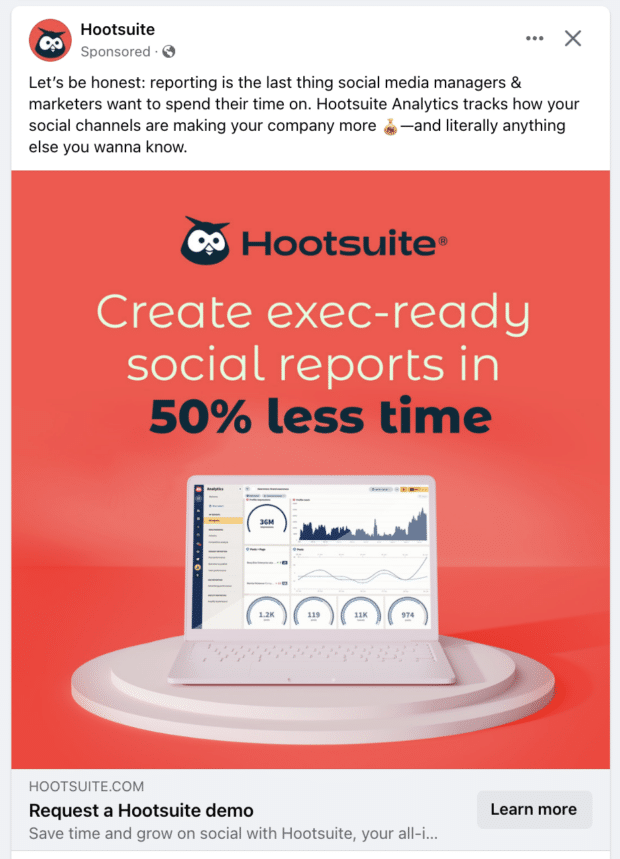
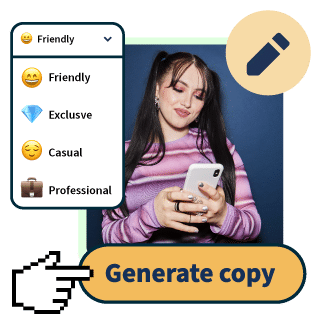
For instance, rather than stating, “We offer great software for businesses of all sizes,” strong copy would articulate a direct benefit and a clear next step: “Respond to customers 2x faster. Try Hootsuite free for 30 days.” Tools like Hootsuite’s OwlyWriter AI can also assist in generating multiple ad copy variations, providing a valuable starting point for refinement and optimization.
Executing Campaigns: A Step-by-Step Guide to Meta Ads Manager
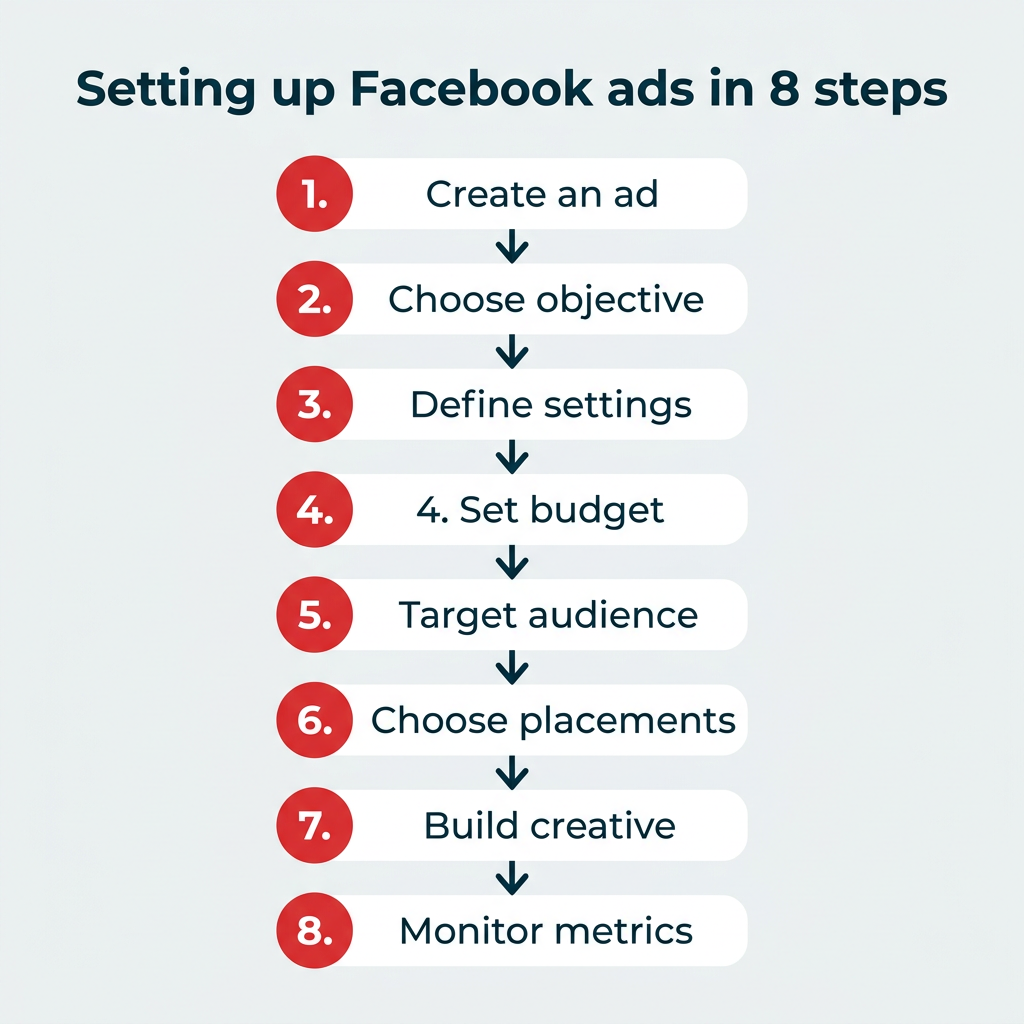
Setting up a Facebook ad campaign through Meta Ads Manager is an organized process that involves several critical steps, ensuring optimal targeting and budget allocation. This integrated tool suite serves as the central hub for creating, managing, and tracking ad performance across Meta’s platforms.
-
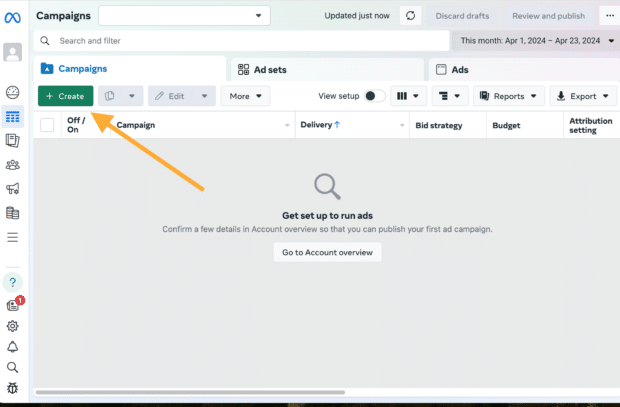
Start Creating an Ad: After logging into Ads Manager, the primary dashboard will display existing campaigns. To initiate a new campaign, ad set, or individual ad, click the “Create” button, which typically appears prominently on the interface.
-
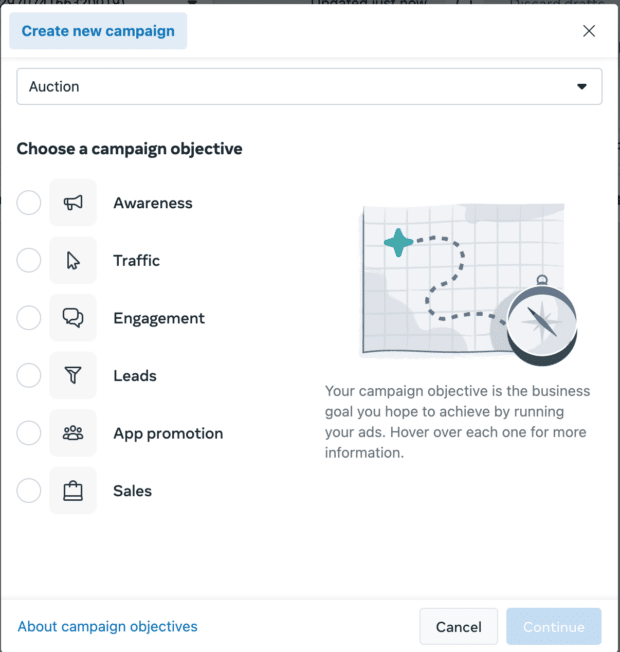
Choose Your Campaign Objective: Meta presents six primary campaign objectives, each aligned with distinct business goals. These include Awareness (for brand visibility), Traffic (for website visits), Engagement (for interactions), Leads (for capturing customer information), App Promotion (for app installs/usage), and Sales (for direct conversions). The selection here dictates the optimization strategy Meta’s algorithm will employ throughout the campaign.
-
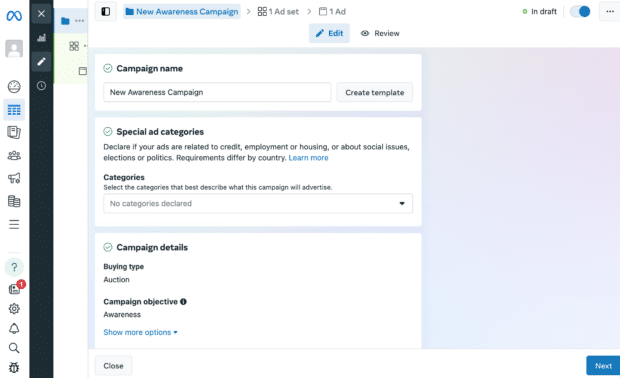
Define Your Campaign Settings: This step involves naming the campaign for easy identification and specifying any “Special Ad Categories” it might fall under (e.g., housing, employment, credit, social issues, elections, or politics), which carry specific targeting restrictions. Additionally, options for setting up A/B split tests are available, allowing for controlled experimentation of different ad versions.
-
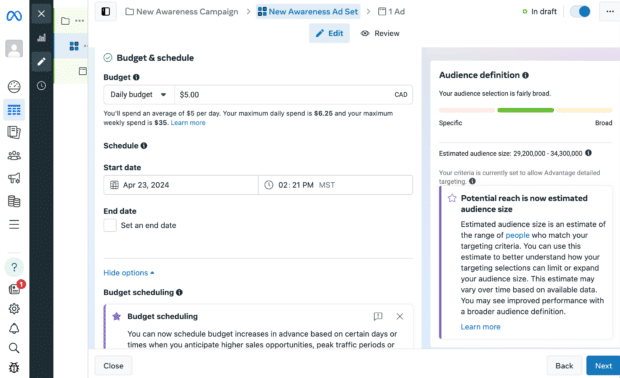
Set Your Budget: Within the “Ad set” section, advertisers define their specific performance goal (e.g., conversions, clicks) and allocate the budget. Options include a “Daily Budget” (a minimum of $1.00 per day for continuous running) or a “Lifetime Budget” (a fixed amount for a specified campaign duration). Advertisers also set start and end dates, with the flexibility to schedule ads for future launch or immediate activation, and to adjust spending patterns for peak traffic times.
-
Target Your Audience: Audience targeting is paramount for campaign success. Advertisers can leverage Meta’s “Advantage+ audience” for AI-driven targeting, which Meta reports can offer “28% lower average cost per click, lead or landing page view” compared to manual methods. Alternatively, manual “Detailed Targeting” allows for granular control based on demographics, interests, and behaviors. Advanced options include “Custom Audiences” (built from website visitors, email lists, or app users for retargeting) and “Lookalike Audiences” (finding new users resembling existing high-value customers), crucial for scaling successful campaigns.
-
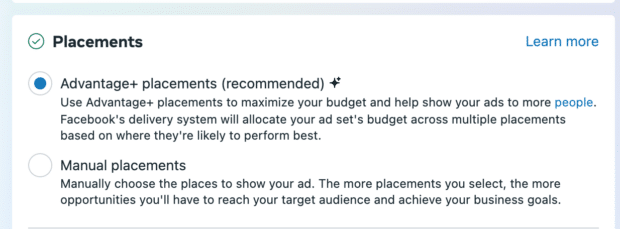
Choose Your Facebook Ad Placements: This step determines where the ad will appear across Meta’s network. “Advantage+ Placements” (automatic) are recommended for beginners, allowing Meta’s AI to optimize delivery across Facebook, Instagram, Messenger, and the Audience Network. More experienced advertisers can opt for “Manual Placements” to specifically select feeds, stories, in-stream videos, or search results based on performance data and creative compatibility.
-
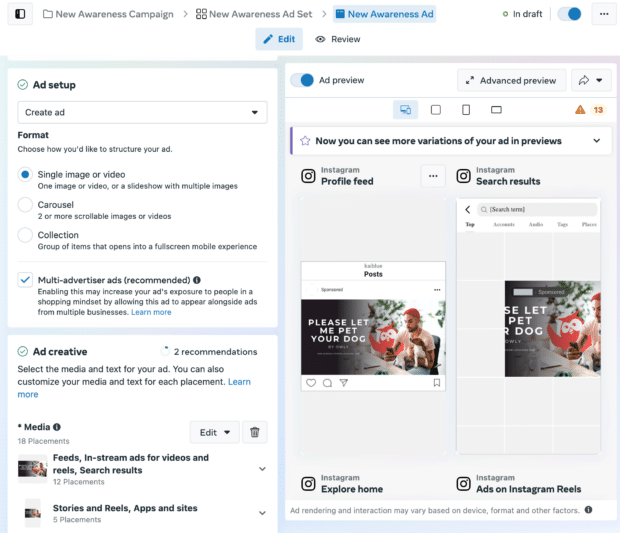
Create Your Ad: The penultimate stage involves designing the ad creative. Advertisers select the appropriate ad format (e.g., single image, video, carousel) based on their campaign objective and input the ad copy, headlines, descriptions, and media components. Facebook provides design recommendations and a live preview tool to ensure the ad appears optimally across all chosen placements. Once satisfied, clicking the “Publish” button initiates the ad launch process.
-
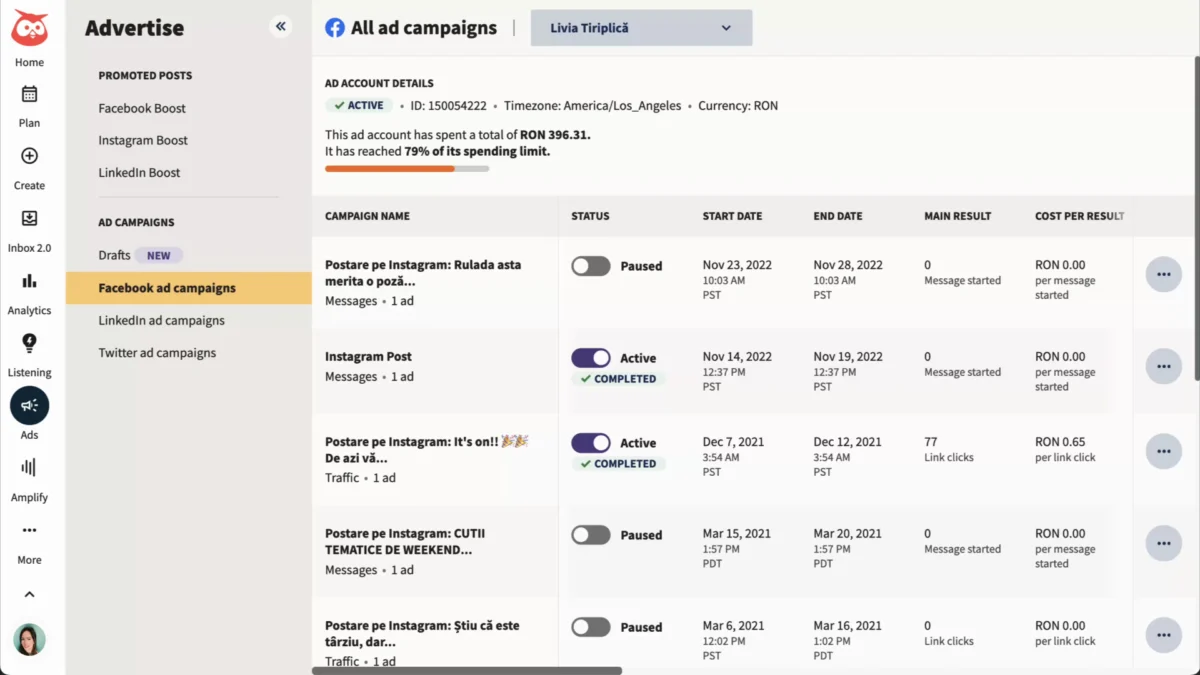
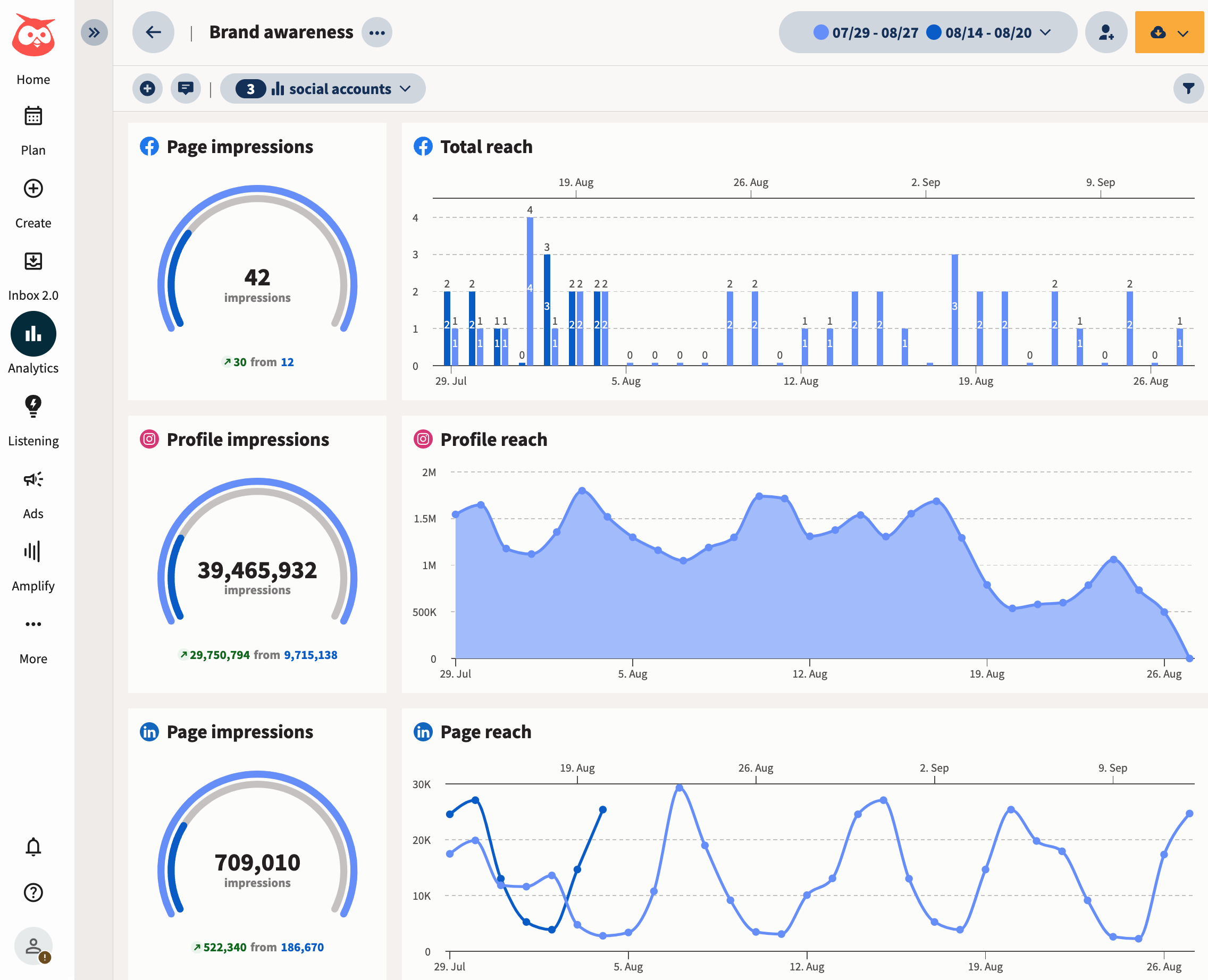
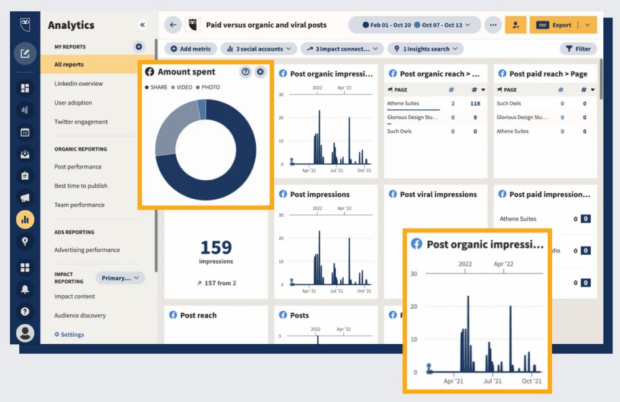
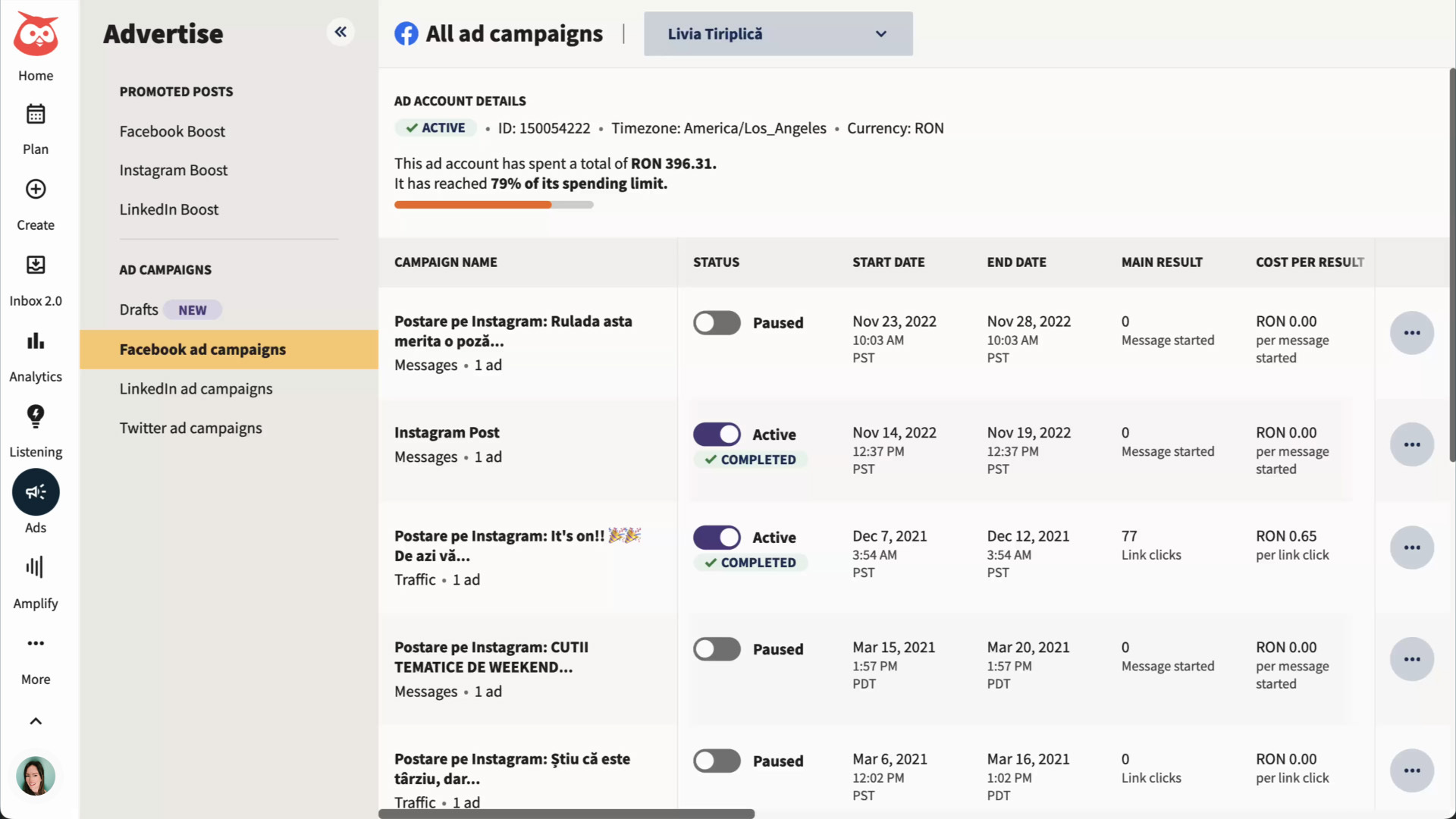
Monitor Your Ad’s Performance Metrics: Post-launch, continuous monitoring of ad performance in Ads Manager is critical. Key metrics to track include results (e.g., conversions, leads), reach, engagement, video views, and website actions. Enterprise teams should prioritize Return on Ad Spend (ROAS), Cost Per Acquisition (CPA), and frequency to assess direct business impact and prevent audience fatigue. Utilizing integrated dashboards like Hootsuite’s social advertising platform can provide a consolidated view of paid and organic performance, facilitating comprehensive analysis and budget allocation across multiple channels.
Streamlining Operations: Leveraging Third-Party Platforms like Hootsuite
For businesses, particularly enterprise-level teams, managing paid and organic social media campaigns across multiple platforms like Facebook, Instagram, X (formerly Twitter), and LinkedIn can be complex. An all-in-one solution such as Hootsuite Social Advertising offers a centralized dashboard to streamline these operations, providing a unified view of performance and simplifying the demonstration of Return on Investment (ROI).
Here’s a simplified overview of setting up Facebook ads using Hootsuite:
-
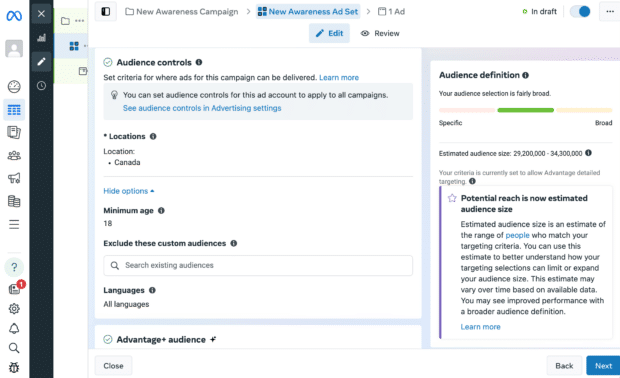
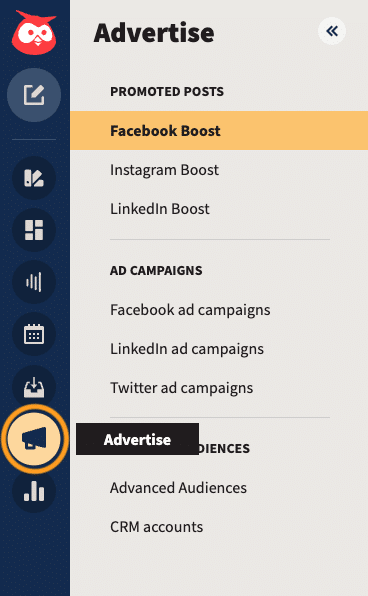
Set Up Your Facebook Campaign: Navigate to the “Advertise” section in the Hootsuite dashboard and select “Facebook Boost.” From there, choose “Set up an automated boost,” link your Facebook Page and ad account, and assign a campaign name.
-
Choose Your Campaign Objective and Settings: Select from objectives such as Brand Awareness, Reach, Engagement, Traffic, Leads, or Sales. Similar to Meta Ads Manager, specify any Special Ad Categories and complete other campaign details.
-
Choose Your Target Audience and Set Your Budget: Hootsuite allows for both custom audience building (refining by demographics, interests, and behaviors) and importing existing saved or custom audiences from Facebook. While Meta automatically optimizes ad placements, users can override this for manual selection. Next, define your daily or total budget and campaign duration, allowing Meta to allocate spend until the budget is exhausted or the campaign concludes.
-
Create Your Facebook Ad: The creative elements vary by objective (e.g., a website URL for Traffic campaigns). Adhere to image and video restrictions (e.g., image aspect ratios, video length). Hootsuite provides a live preview across mobile, desktop, and Instagram to ensure visual consistency.
-
Publish Your Facebook Ad Campaign: Review all campaign details on the “Summary” screen. Once satisfied, select “Publish campaign.” Hootsuite submits the campaign to Facebook for approval, which typically occurs within 24 hours.
Hootsuite Social Advertising, available to Enterprise plan users, consolidates campaign management, offering unified reporting, budget management, and the ability to compare paid and organic performance, further enhancing strategic decision-making.
Precision Targeting: Reaching the Right Audience on Meta Platforms
Targeting the correct audience is fundamental to the success of any Facebook advertising campaign. Meta provides a sophisticated suite of tools that can be layered for maximum effectiveness, including Core targeting, Custom Audiences, Lookalike Audiences, and the AI-driven Advantage+ audience.
| Audience Type | Description | Best For | Data Required |
|---|---|---|---|
| Core | Targets people based on demographics, interests, and behaviors. | Reaching new audiences by profile. | None (built within Ads Manager). |
| Custom | Targets people who have already interacted with your brand. | Retargeting and re-engagement. | Website visitors, email lists, or app users. |
| Lookalike | Finds new people who share similar characteristics with an existing audience. | Scaling to similar high-value users. | A source custom audience of existing customers. |
| Advantage+ | Uses Meta’s AI to automatically identify and optimize for the best audience. | Efficiency and scale with less manual setup. | A starting audience signal (e.g., conversion event). |
For enterprise operations, these targeting options scale across diverse regions and brands. CRM data can inform the creation of granular custom audiences for each market, which then serve as seeds for lookalike audiences to expand into new territories. Continuous monitoring of audience response through analytics is crucial for refining targeting strategies over time, ensuring creative content resonates and engagement is consistently boosted.
Optimizing for Success: Advanced Tips for Enhanced Results
To maximize the effectiveness of Facebook ad spend, advertisers should integrate several best practices into their campaign strategy:
- Design for Mobile First: Given that the majority of social media consumption occurs on mobile devices, ads must be optimized for smaller screens. This involves using vertical aspect ratios for Stories and Reels, ensuring text is legible, and prioritizing quick loading times.
- Capture Attention in the First 3 Seconds: With rapid scrolling behavior, the opening seconds of an ad (especially video) are critical. Lead with your main message, strong branding, and a compelling visual hook to immediately engage viewers.
- Make Sound Optional: Many users watch videos with sound off. Incorporate captions, text overlays, and visually compelling narratives to ensure the message is understood without audio.
- Utilize the Pitch, Play, Plunge Method: This creative strategy, recommended by Facebook, involves combining different content types: a “Pitch” (a short, direct message), “Play” (engaging, entertaining content), and “Plunge” (an immersive, longer-form experience).
- Test Creative Variations with A/B Testing: Implement A/B testing to systematically compare different elements of your ads—headlines, images, CTAs—and identify which versions perform best. Test one variable at a time to isolate impact and allocate budget to the winning variations after sufficient data collection.
- Leverage Advantage+ AI Features: Embrace Meta’s Advantage+ tools for automated targeting, placements, and creative optimization. These AI-driven features can rapidly test combinations and dynamically shift budget to top performers, enhancing efficiency for lean teams and large campaigns.
- Implement Retargeting for Higher Conversions: Create custom audiences of users who have previously engaged with your brand (website visitors, video viewers, past purchasers) and serve them tailored ads. Retargeting campaigns typically yield higher conversion rates due to existing brand familiarity, thereby lowering the cost per acquisition.
- Base Ad Decisions on Analytics: Beyond vanity metrics, focus on key performance indicators (KPIs) such as Return on Ad Spend (ROAS), Cost Per Acquisition (CPA), and conversion rate. Utilize Meta Ads Manager’s built-in tools or third-party platforms like Hootsuite to gain deep insights, informing data-driven adjustments and continuous improvement of future campaigns.
Addressing Challenges: Troubleshooting Common Facebook Ad Problems
Even well-planned campaigns can encounter issues. Understanding common problems and their solutions is vital for maintaining smooth operations and protecting advertising budgets.
- Low Reach/Impressions: This often indicates a narrow audience, insufficient budget, or low bid. Broaden targeting, increase budget, or adjust bidding strategy.
- High Costs (CPC/CPA): High costs can stem from excessive audience competition, low ad relevance, or poor creative. Refine targeting, improve ad quality, or experiment with different bidding strategies.
- Low Click-Through Rate (CTR): A low CTR suggests the ad creative or copy isn’t resonating. Test new visuals, compelling headlines, or more benefit-driven copy.
- Ad Rejection: Ads are rejected for violating Meta’s advertising policies (e.g., prohibited content, misleading claims, discriminatory targeting). Review the rejection reason, edit the offending element, and resubmit.
- Poor Conversion Rate: This might point to an issue with the landing page experience, a disconnect between the ad and the offer, or targeting the wrong audience. Optimize the landing page, align ad messaging with the offer, or refine audience segmentation.
- Audience Fatigue: Running the same ad to the same audience for too long can lead to diminishing returns. Refresh creative, expand audience segments, or implement frequency capping.
Proactive troubleshooting ensures campaigns remain efficient and effective, safeguarding investment and driving consistent results.
Inspiration in Action: Notable Facebook Ad Examples
Examining successful campaigns can provide valuable insights for future advertising efforts.
-
Reddit for Business: This image ad effectively leveraged clear, benefit-driven text (“your best ROAS”) and a compelling incentive ($500 ad credit). The concise caption and straightforward Call to Action (“Ready to send ROAS soaring? Get Offer.”) directly addressed the target audience’s pain points and offered an immediate solution. The inclusion of a platform-specific tag like ‘r/LifeProTips’ subtly reinforced brand identity.
-
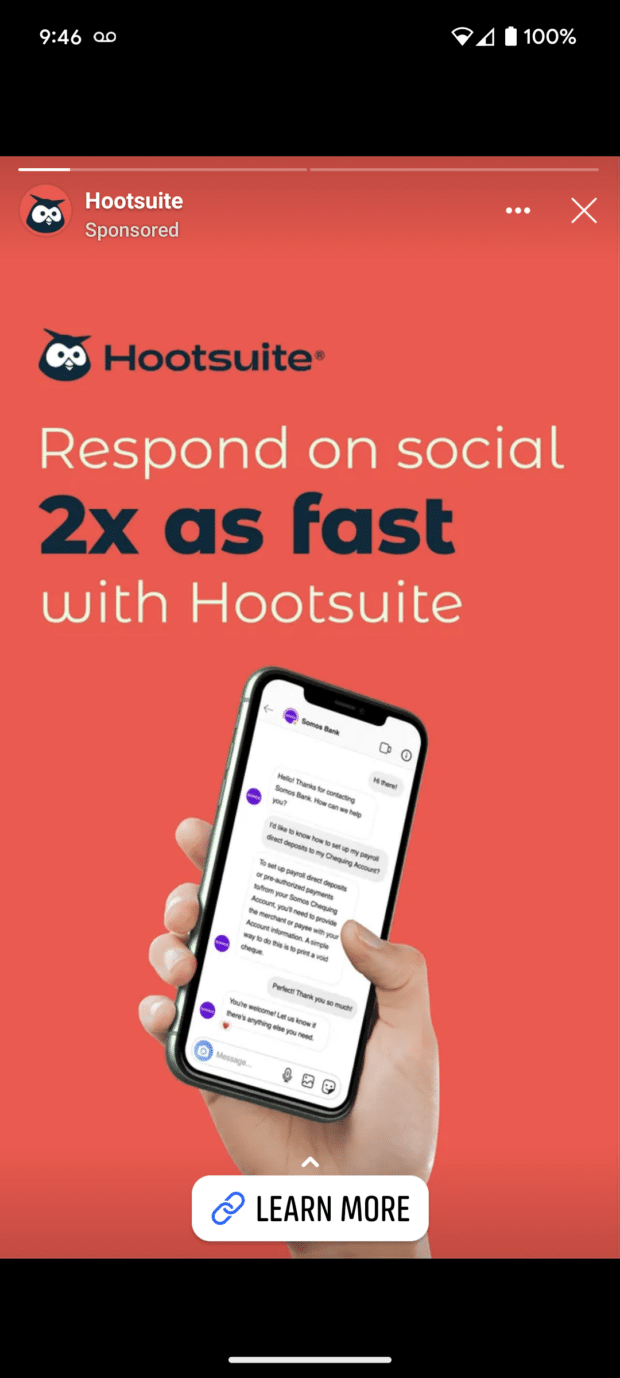
Hootsuite (Stories Ad): Hootsuite’s two-part Facebook Story ad exemplifies effective mobile-first creative. The initial Story grabbed marketers with a key product benefit (“Respond on social 2x as fast”), followed immediately by a second Story detailing the specific features that enable this benefit. This rapid, sequential storytelling is well-suited for the quick-tap nature of Stories consumption, ensuring key information is conveyed even to fast-scrolling users.
These examples demonstrate the power of clear value propositions, appropriate ad format selection, and strategic messaging in achieving advertising objectives on Meta’s platforms.
In conclusion, Facebook advertising remains a dynamic and powerful tool for businesses to connect with vast, targeted audiences. By understanding its underlying mechanics, strategically managing costs, leveraging diverse ad formats, crafting compelling copy, and continuously optimizing based on analytical insights, marketers can harness Meta’s ecosystem to drive significant and measurable growth in an ever-evolving digital landscape.