In the rapidly evolving landscape of digital marketing, effective email communication remains a cornerstone for businesses of all sizes. However, as customer expectations grow and technological capabilities advance, the demands on email marketing platforms have become increasingly sophisticated. While AWeber has long been a staple in the industry, particularly known for its user-friendliness and foundational features, many brands are now finding its capabilities insufficient for their strategic growth objectives, especially when it comes to advanced e-commerce functionality and integrated multichannel campaigns.
AWeber effectively covers the basics for email flows and newsletters, providing a solid entry point for many. Yet, its absence of native SMS functionality and its limited automation triggers—primarily restricted to opens, clicks, and tags—present significant hurdles for businesses aiming for more dynamic and personalized customer engagement. Modern marketing strategies often necessitate triggers based on granular data such as live cart value, product data, browsing history, or customer lifecycle stages. For these reasons, a growing number of businesses, from burgeoning e-commerce stores to established enterprise brands, are actively seeking alternatives that offer deeper integrations, more robust automation, and broader multichannel support.
This comprehensive guide delves into ten leading alternatives to AWeber, analyzing their strengths, pricing structures, automation depth, ease of use, and the scope of their integrations. The aim is to provide a fact-based analysis to help businesses identify the ideal platform to seamlessly integrate into their existing technology stack and propel their marketing efforts forward in 2026 and beyond.
The Evolving Digital Marketing Landscape: Why AWeber’s Limitations Matter
The digital marketing arena has undergone a significant transformation. What was once primarily an email-centric field has expanded into a complex ecosystem where customers interact with brands across multiple touchpoints—email, SMS, social media, web push notifications, and more. This shift necessitates marketing platforms that can orchestrate seamless, personalized experiences across these channels.
AWeber, an early pioneer in email marketing, emerged in an era where the primary goal was list building and broadcasting newsletters. While it has evolved, its core architecture and feature set have struggled to keep pace with the demands of modern, data-driven marketing. The lack of native SMS integration forces businesses to use third-party tools, creating siloed data and fragmented customer journeys. More critically, its automation capabilities, confined to basic engagement metrics, fall short for e-commerce brands that require real-time, behavioral triggers to recover abandoned carts, upsell products based on purchase history, or nurture leads through complex sales funnels.
Industry analysts suggest that the increasing demand for integrated, data-rich marketing ecosystems is a primary driver behind businesses moving away from older, less integrated platforms. E-commerce businesses, in particular, are prioritizing solutions that offer robust Customer Relationship Management (CRM) functionalities and real-time behavioral triggers to optimize customer journeys and maximize lifetime value. Meanwhile, creators and solopreneurs are seeking consolidated platforms that streamline both marketing and monetization efforts, moving beyond simple email lists to encompass subscriptions, digital product sales, and community building.
Top 10 AWeber Alternatives: A Detailed Examination
Here, we explore the leading alternatives, categorizing them by their primary strengths and target audiences, providing a detailed look at their offerings.
1. Omnisend: The E-commerce Powerhouse
Best for: E-commerce stores of all sizes, lifecycle marketers, and multichannel brands.
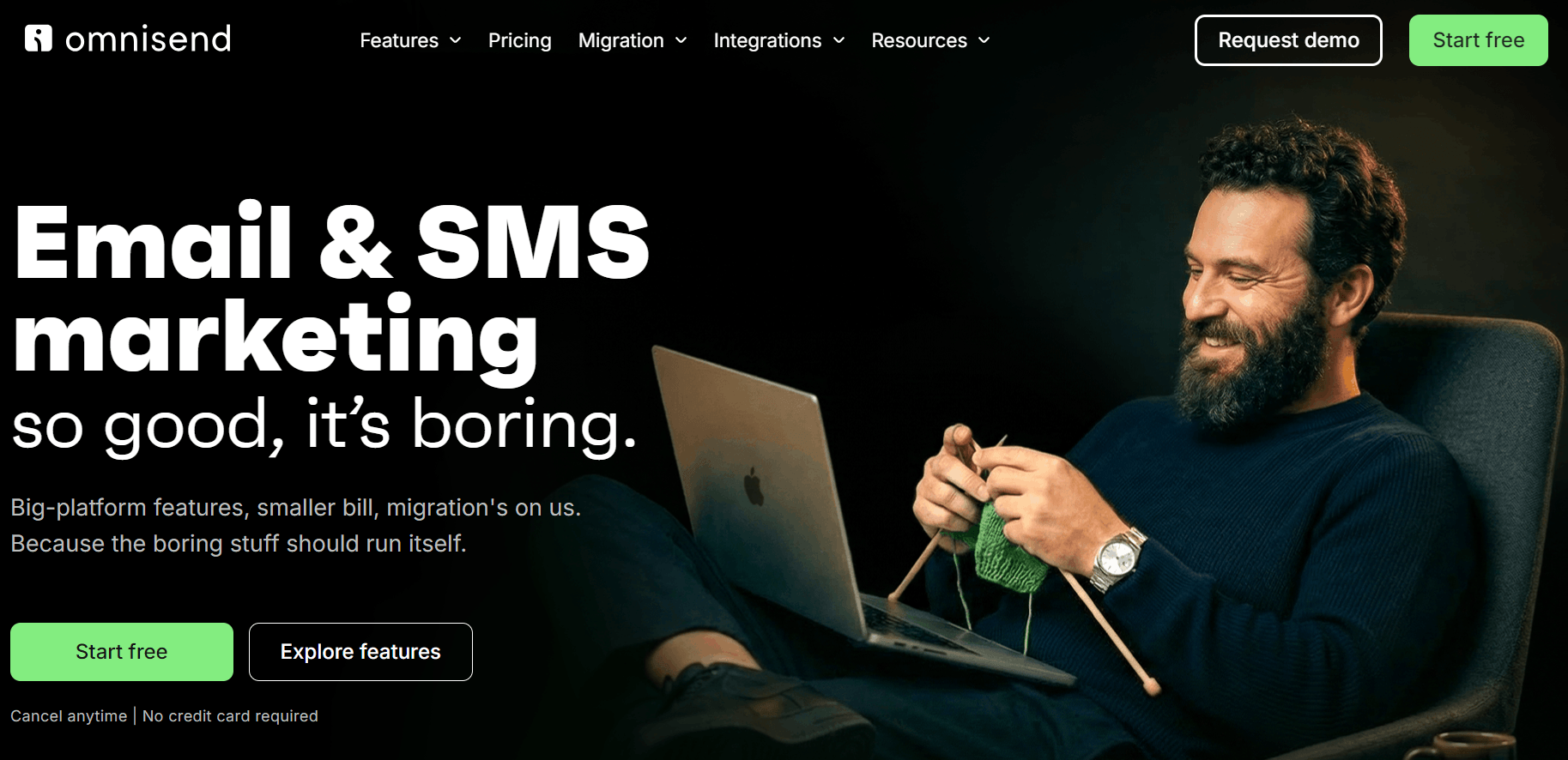
Omnisend stands out as a formidable alternative, deeply integrating with e-commerce platforms to offer highly personalized email, SMS, and web push notifications. Its true strength lies in its omnichannel approach, allowing marketers to weave all three channels into cohesive automation flows that engage customers at optimal moments based on their real-time behavior and purchase data.
Key Strengths:
- Deep E-commerce Integration: Provides more robust integration with popular e-commerce platforms like Shopify, BigCommerce, and WooCommerce than AWeber, enabling access to rich customer data.
- Omnichannel Automation: Seamlessly combines email, SMS, and web push notifications into automated workflows, a significant step up from AWeber’s email-only focus.
- Advanced Segmentation: Offers highly granular segmentation based on shopping behavior, purchase history, and demographic data, facilitating hyper-personalized campaigns.
- Strong ROI: Customers reportedly achieved a 79:1 ROI across email, SMS, and web push notifications in 2025, underscoring its effectiveness.
Pricing: Omnisend offers three contact-based plans, including a Free Forever plan. Its Standard plan’s entry point is competitive, often offering more features for a similar or slightly higher price than AWeber’s Lite plan. For instance, AWeber’s Plus plan at $30/month is necessary to match Omnisend’s unlimited landing pages, lists, email automations, and segments, while Omnisend’s equivalent tier can be more cost-effective for similar feature sets.
G2 rating: 4.6/5 based on 1,230+ reviews.
2. Mailchimp: Small Business & Basic Automation Champion
Best for: Small businesses and stores requiring basic automations and robust list-growth tools.
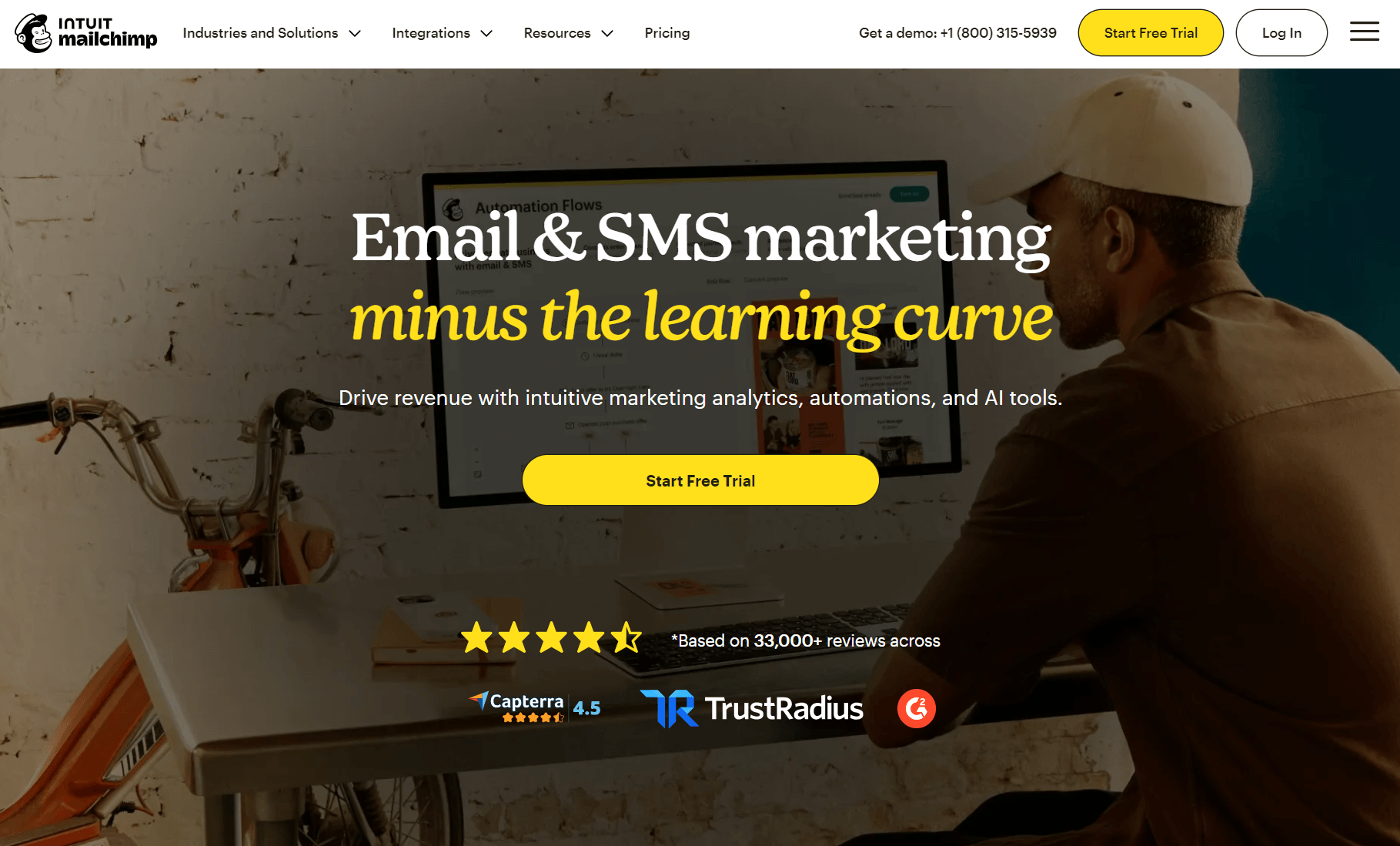
Mailchimp has evolved from a simple newsletter tool into a comprehensive marketing platform, making it an excellent AWeber alternative for small businesses prioritizing ease of use. Its multi-step customer journeys, which include starting points, branching rules, and delays, enable more complex automations than AWeber. Mailchimp also provides valuable revenue attribution, linking insights directly to connected store revenue.
Key Strengths:
- User-Friendly Interface: Known for its intuitive design and low learning curve, making it accessible for marketing beginners.
- Versatile Templates: Offers a wide array of customizable email templates and a drag-and-drop editor.
- Integrated Marketing: Beyond email, it provides landing pages, forms, and basic social media tools.
- Revenue Tracking: Offers insights into how email campaigns drive sales for connected stores.
Pricing: Mailchimp has four contact-based plans, including a free tier. While its free plan is generous for basic needs, scaling up can sometimes become pricier compared to other alternatives, depending on contact volume and feature requirements.
G2 rating: 4.3/5 based on 12,980+ reviews.
3. ActiveCampaign: CRM and Advanced Automation Specialist
Best for: E-commerce stores needing robust CRM capabilities and highly advanced email automation.
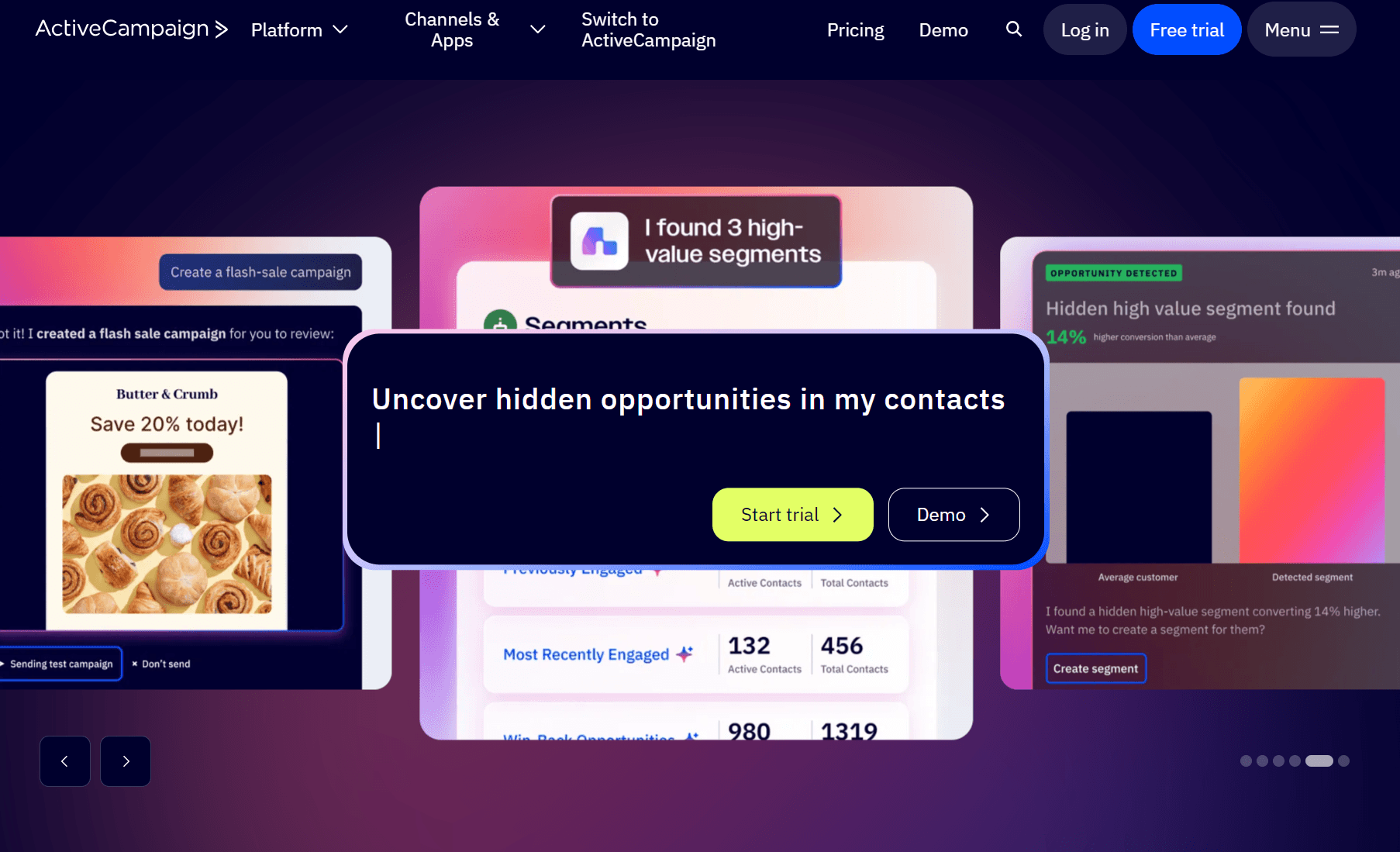
ActiveCampaign delivers the most advanced automation and sales pipeline features among the listed alternatives, making it ideal for enterprise-level e-commerce operations. While it presents a steeper learning curve than AWeber, its depth across customer data management, lead scoring, and complex automation flows is unmatched.
Key Strengths:
- Integrated CRM: A built-in CRM allows for comprehensive customer data management, including lead scoring and deal tracking.
- Sophisticated Automation: Offers highly customizable automation workflows with extensive triggers and actions, far surpassing AWeber’s capabilities.
- Personalization at Scale: Leverages deep customer data to enable hyper-personalized messaging across the customer journey.
- Sales Enablement: Tools for sales teams to manage leads and customer interactions efficiently.
Pricing: ActiveCampaign offers four contact-based plans, but notably, it does not provide a free plan. Pricing starts at 1,000 contacts, and costs can escalate quickly for higher contact volumes and premium features.
G2 rating: 4.4/5 based on 14,720+ reviews.
4. GetResponse: All-in-One for Marketers and Creators
Best for: Marketers and creators seeking a consolidated platform for email automation, landing pages, websites, and monetization.
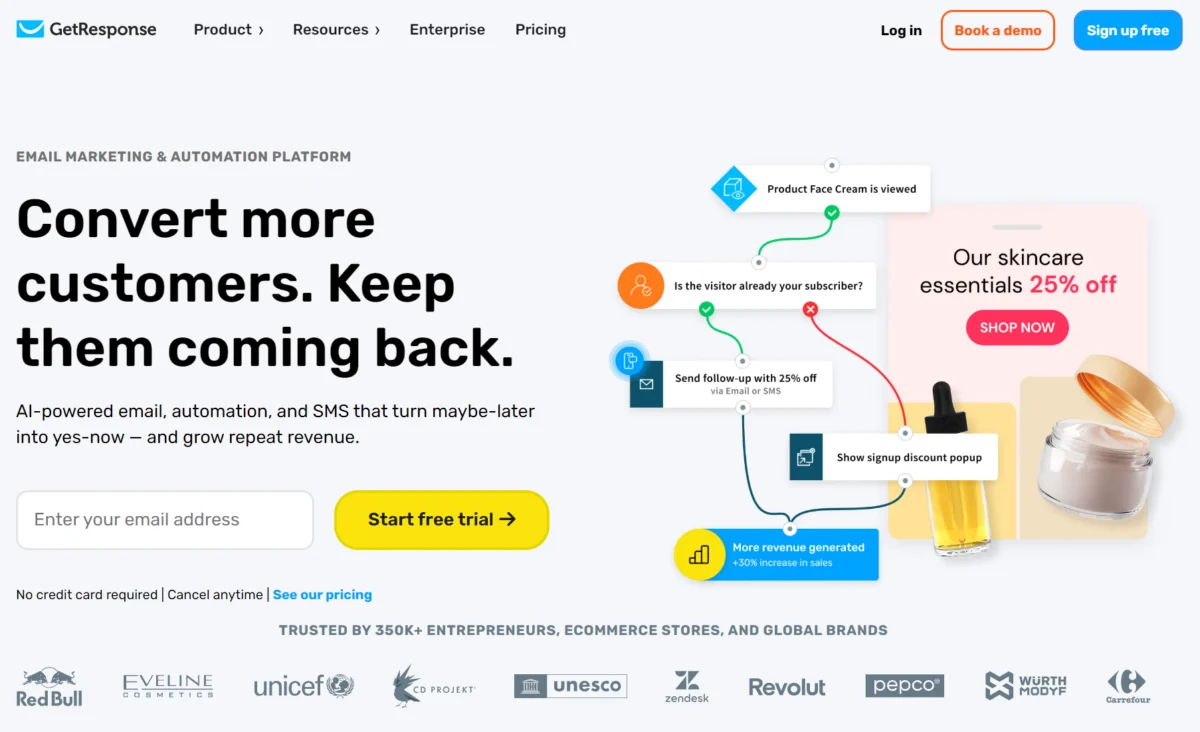
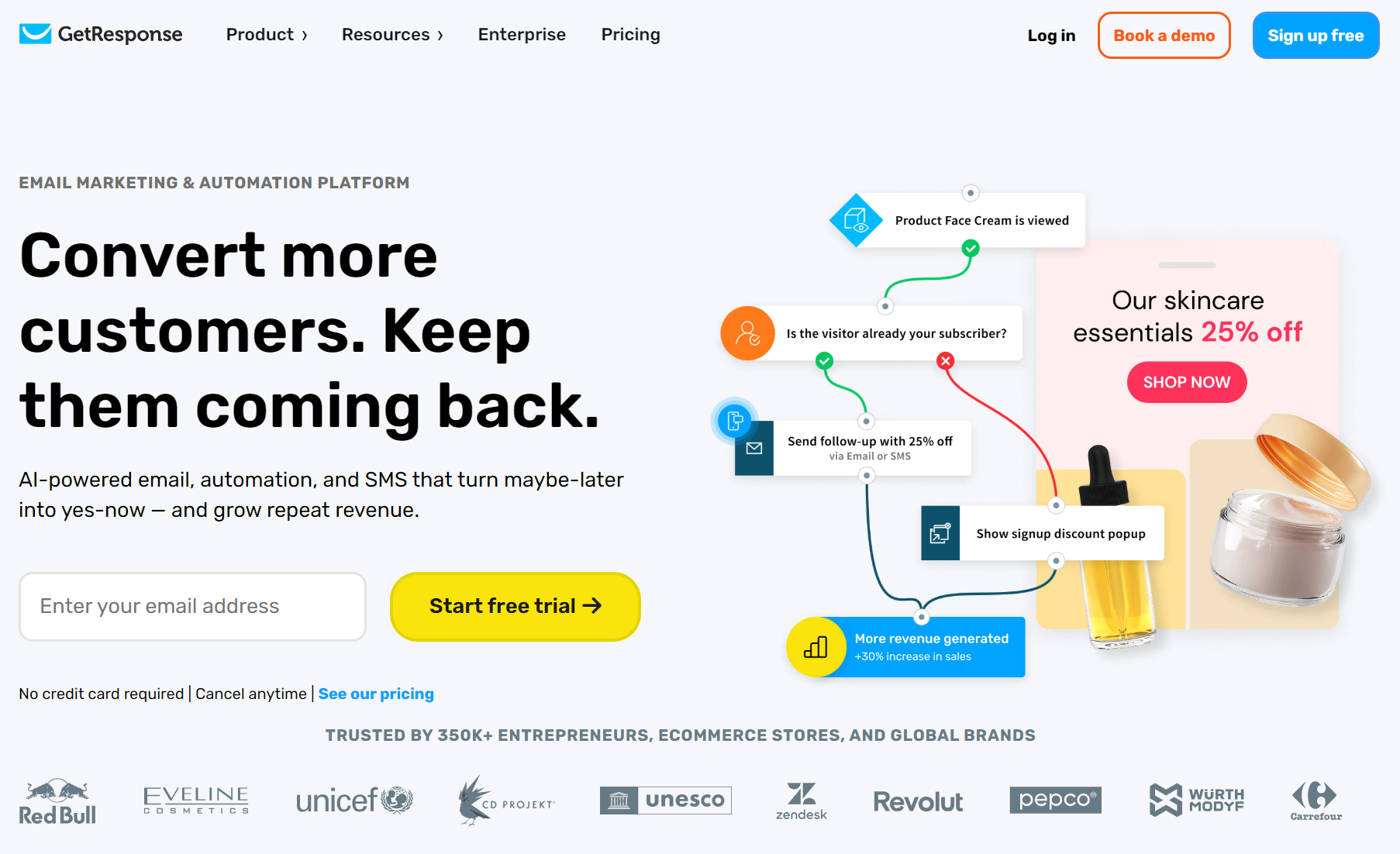
GetResponse excels as a contained platform for businesses looking to integrate sales, marketing, and creator features into one tool. It enables users to build websites, grow email lists, sell courses and memberships, host webinars, and market effectively to their audience to boost retention.
Key Strengths:
- Comprehensive Suite: Offers email marketing, marketing automation, landing pages, website builder, and webinar hosting in one platform.
- Monetization Tools: Ideal for creators to sell digital products, courses, and memberships directly.
- Advanced List Growth: Tools like pop-ups and forms integrated with landing pages for effective lead capture.
- Unlimited Email Sends: All plans include unlimited email sends, a benefit for high-volume communicators.
Pricing: GetResponse has four plans, all offering unlimited email sends. Pricing is based on contact volume and feature access, rather than send limits, providing predictability for active communicators.
G2 rating: 4.3/5 based on 1,130+ reviews.
5. Kit: The Creator’s Ecosystem for Paid Content
Best for: Creators with paid newsletters and recurring subscriptions seeking a single tool for marketing and sales.
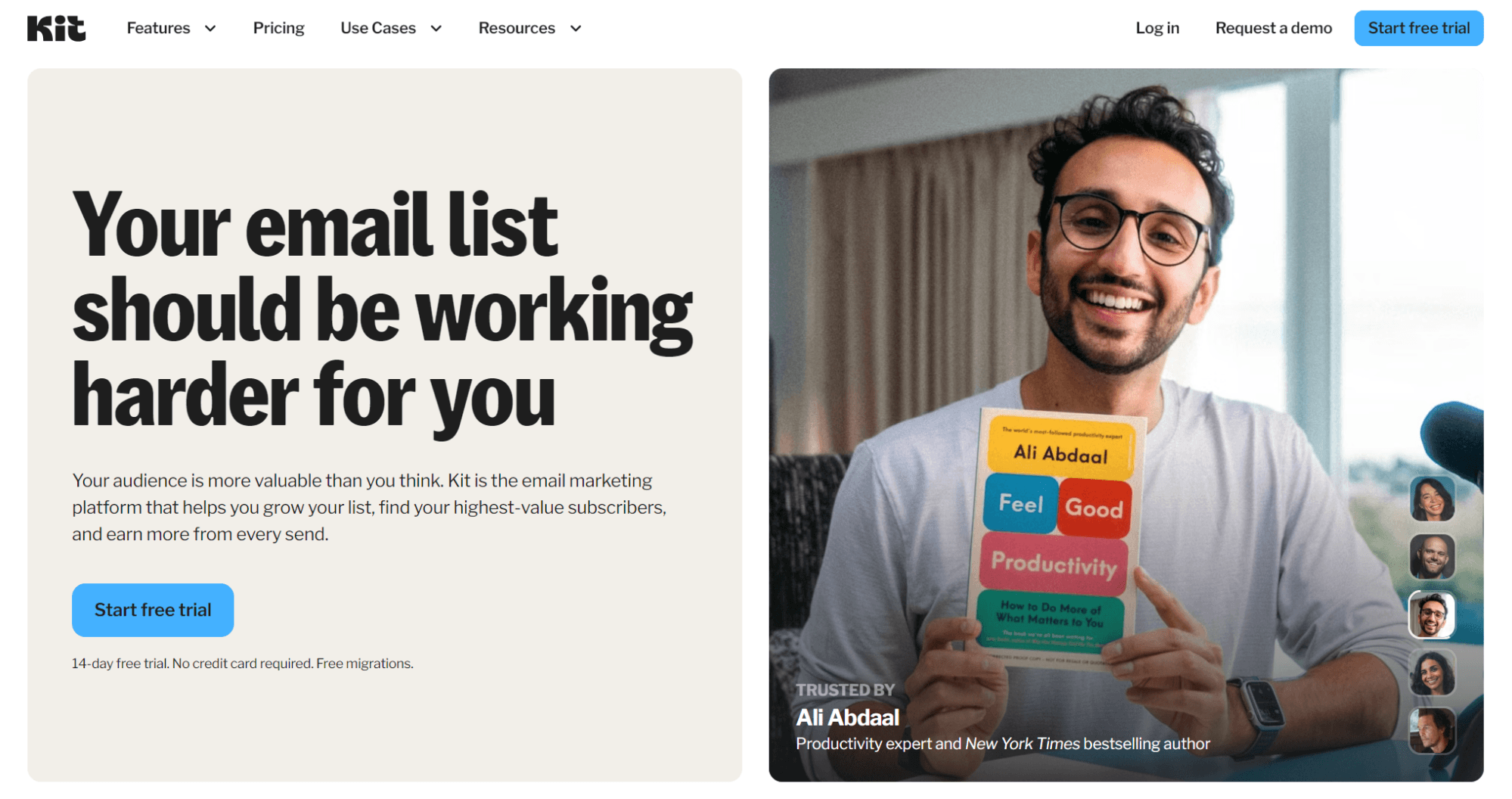
Kit offers a unique monetization ecosystem tailored specifically for creators. It provides everything needed to sell, including a website builder with sales pages and a checkout system, the ability to charge subscribers for access to paid newsletters, options to collect tips, and even earn through recommending others’ content.
Key Strengths:
- Creator-Centric Monetization: Built-in features for paid newsletters, subscriptions, and digital product sales.
- Integrated Website Builder: Allows creators to build sales pages and a complete website within the platform.
- Community Features: Supports building and nurturing a community around content.
- Simplified Sales Funnel: Streamlines the process from content creation to direct sales.
Pricing: Kit provides a free plan for newsletters and two paid plans designed for creators, offering flexibility depending on the scale of monetization.
G2 rating: 4.4/5 based on 230+ reviews.
6. Brevo (formerly Sendinblue): Budget-Friendly Send-Based Pricing
Best for: Businesses prioritizing send-based pricing for their sales and basic automation needs.
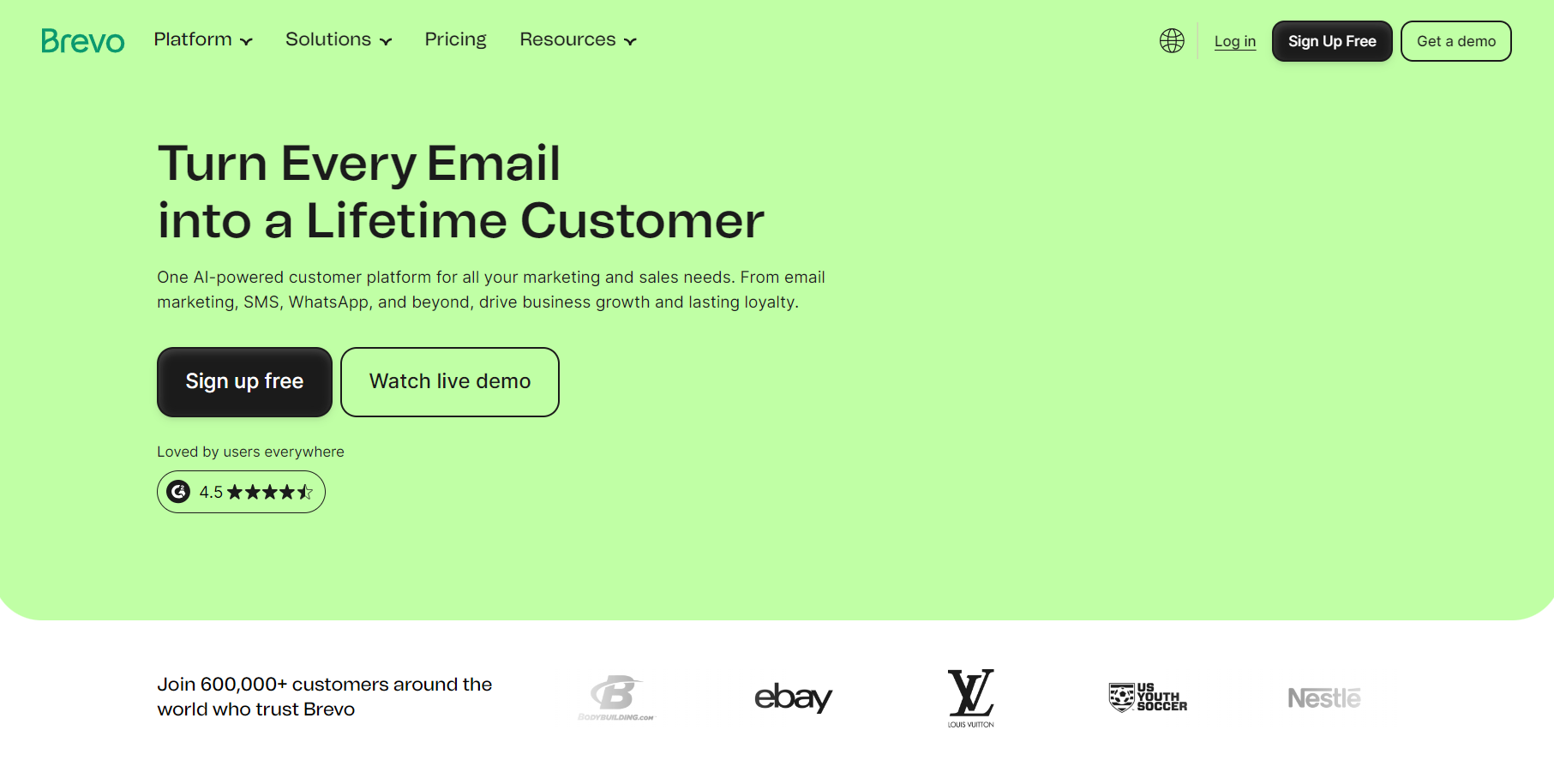
Brevo integrates email, SMS, and light sales tools into a single platform, offering a more e-commerce-focused approach than AWeber with a distinctive pricing model that caters to sending volume. Its robust features are available even on a tight budget.
Key Strengths:
- Send-Based Pricing: A unique pricing model that charges based on the number of emails sent per month, rather than contact count, which can be cost-effective for large lists with infrequent sends.
- SMS & Chat Integration: Offers native SMS marketing and a live chat feature, enhancing multichannel communication.
- CRM & Sales Tools: Includes a basic CRM and sales automation tools to manage customer relationships.
- Transactional Email: Strong capabilities for sending transactional emails, critical for e-commerce.
Pricing: Brevo features a free plan and four paid plans with send-based pricing. The contact limit increases with the selected email send tier, providing scalability. Its starting price of $9/month makes it one of the most budget-friendly options.
G2 rating: 4.5/5 based on 2,600+ reviews.
7. Drip: Lean E-commerce with Unlimited Sends
Best for: Lean e-commerce stores desiring an email marketing tool with unlimited sends and robust behavior-based flows.
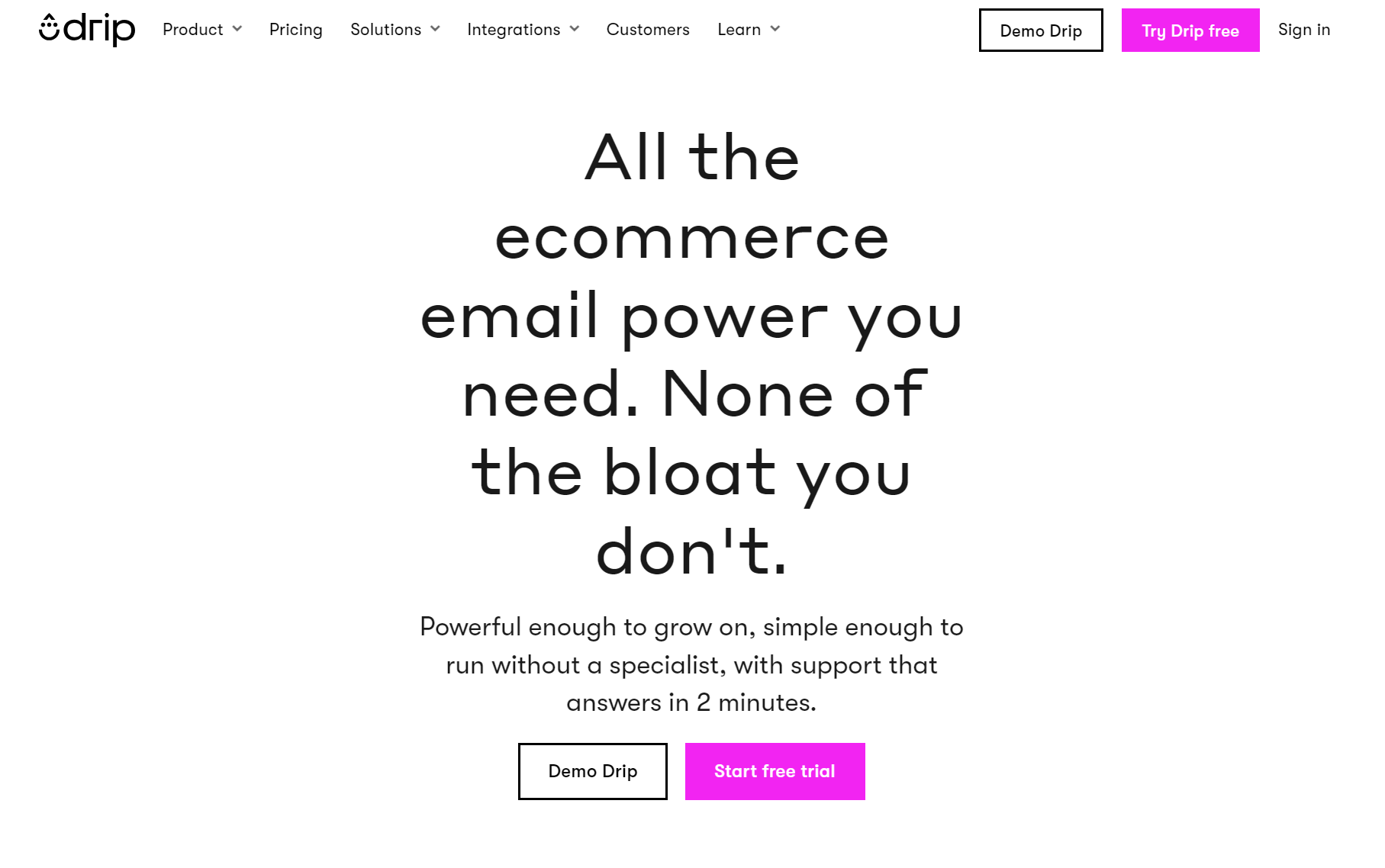
Drip is positioned as a pared-back yet powerful option for e-commerce, providing all its features within a single plan. While it may lack AWeber’s built-in selling tools, it compensates with superior handling of behavior-based flows and unlimited email sends, making it suitable for growing stores with high email volumes.
Key Strengths:
- Unlimited Email Sends: A significant advantage for businesses with large lists or frequent communication needs.
- Behavioral Automation: Specializes in advanced, behavior-driven automation workflows for e-commerce, such as abandoned cart sequences and post-purchase follow-ups.
- Customer Segmentation: Offers deep segmentation capabilities based on customer actions and attributes.
- Dedicated E-commerce Focus: Built specifically for e-commerce, with integrations for major platforms.
Pricing: Drip does not offer a free plan and provides one paid plan. Starting at $39/month, it positions itself as a premium, feature-rich option for serious e-commerce players.
G2 rating: 4.4/5 based on 480 reviews.
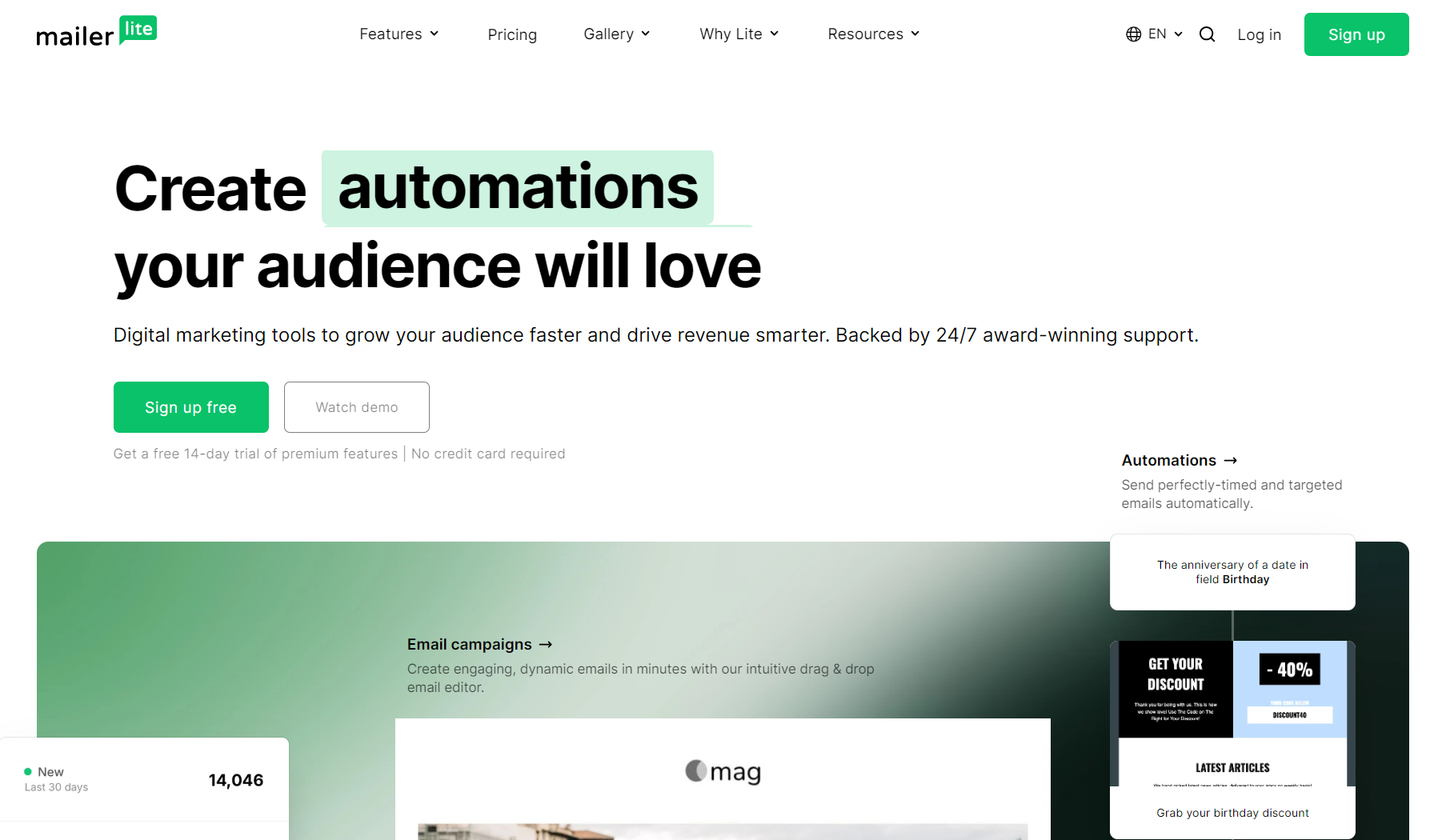
8. MailerLite: Easy Email & Digital Monetization for Small Stores
Best for: Small stores and businesses seeking a low learning curve for email features and monetization capabilities for digital goods.
MailerLite is a user-friendly AWeber alternative that excels in providing basic email flows and newsletter features, alongside monetization capabilities for digital content. It’s an excellent choice for businesses whose automation needs span welcome series, abandoned carts, and follow-ups, with newsletters as a core strategy.
Key Strengths:
- Ease of Use: Highly intuitive drag-and-drop editor and simple interface make it easy to learn and navigate.
- Digital Product Sales: Offers features to sell digital products directly within the platform.
- Landing Pages & Forms: Comprehensive tools for list growth, including customizable landing pages and signup forms.
- Affordable Scaling: Provides a generous free plan and competitive pricing for its paid tiers.
Pricing: MailerLite has a free plan, two marketing plans, and various transactional plans. The marketing plans provide access to campaigns and flows, with a free plan allowing 2,500 emails/month for up to 500 contacts, making it very accessible.
G2 rating: 4.6/5 based on 1,110+ reviews.
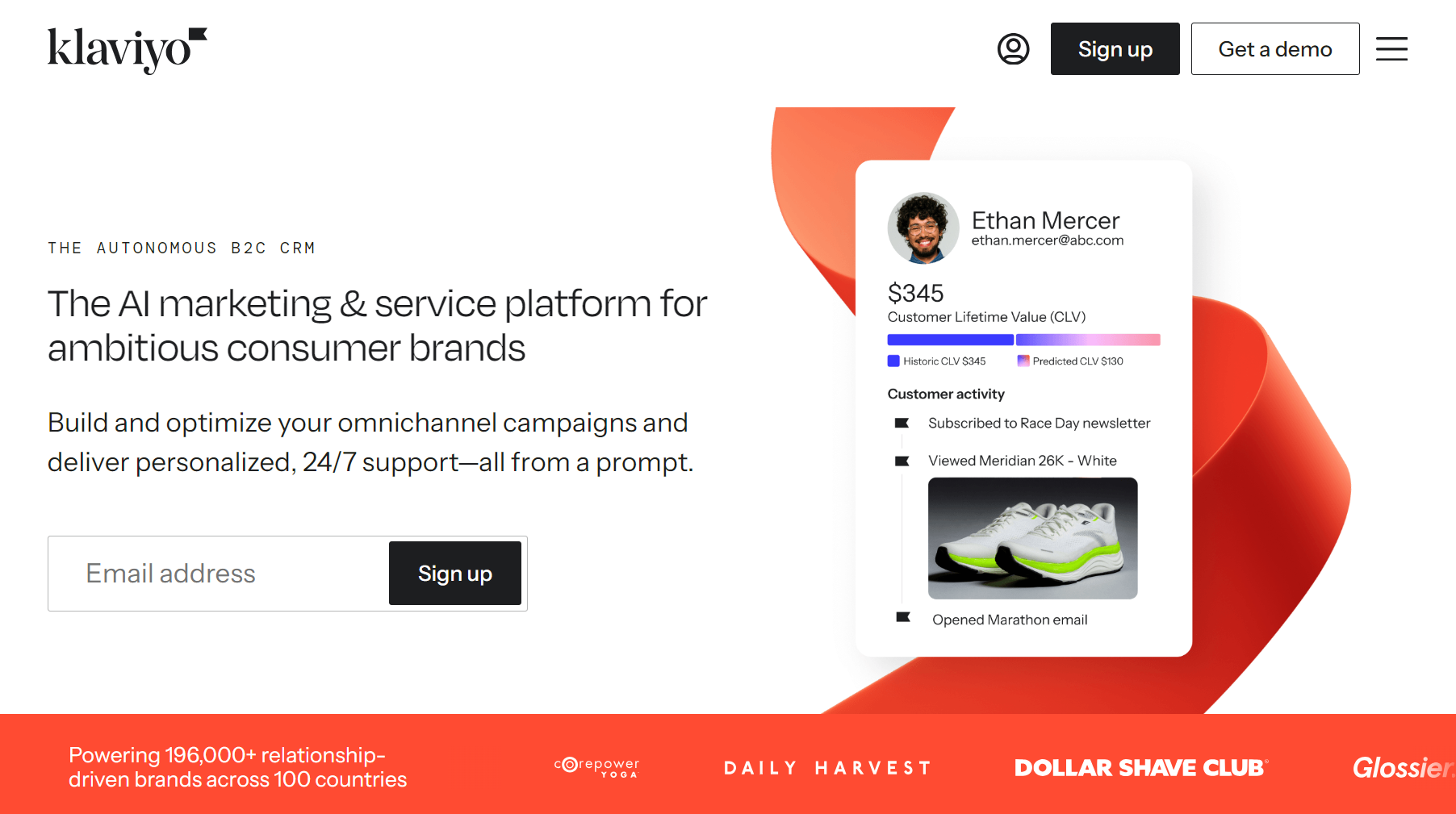
9. Klaviyo: Enterprise E-commerce & Data-Driven Personalization
Best for: Established e-commerce brands and enterprise stores requiring deep data analytics and predictive capabilities.
Klaviyo is a significantly more data-led platform than AWeber, featuring a powerful B2C CRM that drives personalization, complex flows, and advanced segmentation. It seamlessly combines email and SMS, offering predictive analytics and RFM (Recency, Frequency, Monetary) analysis for comprehensive customer lifecycle management.
Key Strengths:
- Advanced Data Analytics: Provides in-depth insights into customer behavior, purchase patterns, and lifecycle stages.
- Predictive Analytics & RFM: Uses data to predict future customer actions and segment based on customer value.
- Integrated Email & SMS: Robust multichannel capabilities for cohesive customer communication.
- Extensive Integrations: Connects with a vast array of e-commerce and marketing tools.
Pricing: Klaviyo offers a free plan and an email marketing plan with scalable pricing based on active profile count. Prices start around $20/month for a small number of contacts and can increase significantly with larger customer databases and added SMS usage.
G2 rating: 4.5/5 based on 1,350+ reviews.
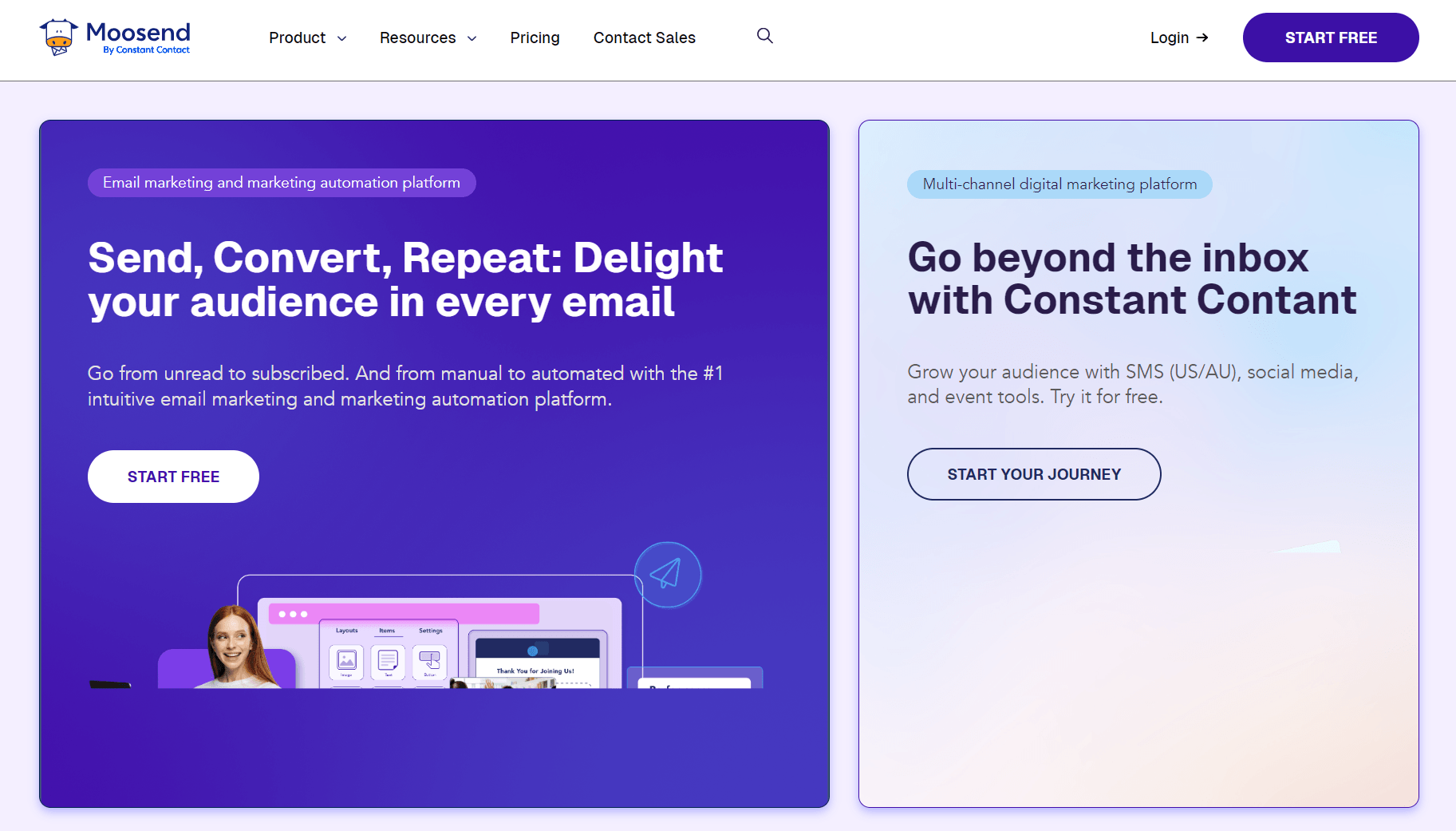
10. Moosend: Budget-Friendly with E-commerce Flows
Best for: Budget-conscious senders who need e-commerce-specific flows and segmentation.
Moosend provides robust list-growth and email marketing capabilities, encompassing newsletters, automations, and audience management. It offers a more e-commerce-focused feature set than AWeber, primarily due to its more extensive triggers and segmentation capabilities, all while maintaining a budget-friendly price point.
Key Strengths:
- Cost-Effective: Offers highly competitive pricing, often undercutting alternatives like AWeber for similar contact volumes.
- Multi-Step Workflows: Supports advanced automation sequences with various triggers and actions.
- E-commerce AI: Provides product recommendations and other AI-driven features for e-commerce.
- Landing Page Builder: Includes a drag-and-drop landing page builder to capture leads effectively.
Pricing: Moosend offers three paid plans but no free plan. Its cheapest paid plan for 500 subscribers starts at a lower price point than AWeber’s Lite plan, making it an attractive option for budget-conscious businesses.
G2 rating: 4.6/5 based on 740+ reviews.
Factors Driving the Shift: Why Businesses Seek Alternatives
The move away from platforms like AWeber is driven by several critical business needs and market trends:
- Multichannel Imperative: Modern customers expect consistent experiences across email, SMS, social media, and other digital channels. Platforms that offer native integration and orchestration across these channels are highly valued.
- Data-Driven Personalization: Generic mass emails are increasingly ineffective. Businesses need platforms that can collect, analyze, and act on granular customer data to deliver highly personalized messages at the right time.
- E-commerce Specificity: Online retailers require tools that deeply integrate with their store platforms, allowing for automation based on shopping cart activity, product views, purchase history, and customer lifecycle stages.
- Scalability and Complexity: As businesses grow, their marketing needs become more complex. They require platforms that can scale with them, offering advanced segmentation, A/B testing, and sophisticated automation workflows.
- Cost-Efficiency and Value: While budget is always a consideration, businesses are increasingly looking for platforms that offer the best value, balancing cost with a comprehensive feature set that drives measurable ROI.
Choosing the Right Platform: Key Considerations
Selecting the best AWeber alternative hinges on a clear understanding of your specific business needs and strategic objectives. Here are crucial factors to consider:
- Business Type and Goals: Are you an e-commerce store, a content creator, a small local business, or an enterprise? Each type has distinct marketing requirements.
- Automation Needs: Do you require simple welcome sequences, or complex, multi-channel, behavior-triggered workflows?
- Multichannel Strategy: Is SMS, web push, or social media integration a priority alongside email?
- Integration Ecosystem: How well does the platform integrate with your existing CRM, e-commerce platform, or other marketing tools?
- Budget and Pricing Model: Compare contact-based versus send-based pricing and understand what features are locked behind higher tiers.
- Ease of Use vs. Feature Depth: Are you willing to invest time in learning a more complex platform for advanced features, or do you prioritize a low learning curve?
- Customer Support and Resources: Assess the quality of support, documentation, and community resources available.
- Data Analytics and Reporting: Look for platforms that offer robust reporting and insights to measure campaign performance and inform future strategies.
Market Dynamics and Future Outlook
The email marketing software market is intensely competitive, reflecting its continued importance in the digital economy. The trend is clearly moving towards "all-in-one" platforms that consolidate various marketing functions, offering greater efficiency and a unified view of the customer. The integration of artificial intelligence (AI) for content generation, predictive analytics, and automation optimization is also a significant area of development, promising even more sophisticated capabilities in the coming years.
While AWeber remains a functional tool for basic email marketing, its position as a leading choice for growing businesses is being challenged by platforms that offer a richer, more integrated, and data-driven approach. The emphasis for businesses in 2026 and beyond will be on selecting tools that not only meet current needs but also anticipate future demands for hyper-personalization, multichannel engagement, and intelligent automation.
Conclusion: Switch from AWeber to a Platform Built for Growth
The journey from AWeber to an alternative platform is a strategic decision that can significantly impact a business’s growth trajectory. The "best" tool is inherently subjective, depending entirely on your specific business type, target audience, and channel strategy.
If your business relies heavily on AWeber’s built-in commerce features, then platforms like GetResponse, MailerLite, or Kit offer robust replacements that blend marketing with direct monetization. For e-commerce businesses, Omnisend emerges as a top contender, offering unparalleled multi-store support, comprehensive multichannel capabilities, global SMS, and enterprise-grade automation flows, all without an overly steep learning curve. Brands requiring a more data-rich approach, featuring advanced CRM and predictive analytics, will find strong solutions in Klaviyo or ActiveCampaign, though careful consideration of their pricing structures and potential for rapid cost escalation is advised. For budget-conscious senders, Brevo, MailerLite, and Moosend provide excellent entry points with low monthly costs, while Drip offers unlimited email sends on a competitive budget.
The critical next step for any business considering a switch is to leverage the free trials and free accounts offered by these platforms. This hands-on experience allows for a direct comparison of features, usability, and integration capabilities within your specific operational context. Remember to carefully manage any existing subscriptions and cancellation policies, especially for platforms that require credit card information during sign-up. By carefully evaluating these alternatives, businesses can move beyond AWeber’s foundational offerings to embrace a platform that truly empowers growth, enhances customer engagement, and drives superior return on investment in the dynamic digital landscape.
FAQs
What is the best AWeber alternative?
Omnisend is widely considered the best AWeber alternative for e-commerce integration and multichannel automations driven by behavior and purchase activity. Klaviyo is another excellent fit for enterprise brands that leverage extensive data. For creators, Kit and GetResponse offer more specialized features for monetization and content delivery.
Is Omnisend better than AWeber?
Yes, Omnisend generally outperforms AWeber for Shopify and other e-commerce stores focused on lifecycle marketing and integrating SMS alongside email. While AWeber remains suitable for basic customer journeys and digital commerce features for subscriptions, Omnisend provides deeper e-commerce integrations, more advanced automation triggers, and a comprehensive omnichannel approach.
What is the best free AWeber alternative?
Omnisend’s Free Forever plan is excellent for more advanced flows and segments, though it offers 250 contacts and 500 emails/month, which is less than AWeber’s free tier of 500 contacts and 3,000 emails. If sheer volume is paramount, MailerLite’s free plan allows sending up to 2,500 emails for up to 500 subscribers, making it a strong contender for high-volume, budget-friendly communication.
Why do people switch from AWeber?
Businesses typically switch from AWeber due to its lack of a native Shopify app for deep e-commerce integration, and its limited complex flows compared to dedicated e-commerce tools like Omnisend and Klaviyo. Additionally, while AWeber’s Lite plan appears inexpensive, it restricts access to crucial behavioral automation and email sales tracking, often necessitating an upgrade to the more costly Plus plan (minimum $30/month) to unlock essential features.

Is AWeber good for e-commerce?
AWeber is generally not considered the best option for e-commerce, especially as stores scale. While it can suffice for small stores with predictable customer journeys—such as basic welcome emails, follow-ups, newsletters, and landing pages for list growth—it quickly becomes insufficient. E-commerce businesses typically outgrow AWeber when they require advanced behavioral triggers based on real-time shopping activity, deeper customer data insights, and the ability to segment customers by lifecycle stages for highly personalized marketing.