The landscape of digital content discovery is undergoing a profound transformation, driven by the rapid evolution of artificial intelligence and large language models (LLMs) like OpenAI’s ChatGPT. For content creators and marketers navigating this new frontier, understanding the nuances of how their content is processed by these AI systems is paramount. A critical distinction often conflated in discussions is between “getting indexed by ChatGPT” and “showing up in ChatGPT.” While related, these are not synonymous. Getting indexed signifies that OpenAI’s proprietary search crawler has discovered and stored a webpage in its internal index, a foundational step for any future retrieval. Showing up, conversely, means the content has been presented as part of an answer generated by ChatGPT, which can occur via this index or through a live web fetch triggered by a user query. This guide aims to demystify both concepts, providing a robust framework for ensuring web content is discoverable by OpenAI’s crawlers, thereby enhancing a site’s overall answer engine optimization (AEO) efforts.
The Rise of AI Indexing: A New Frontier in Web Discovery
The shift from traditional keyword-based search engine optimization (SEO) to answer engine optimization (AEO) reflects the growing prominence of conversational AI. Users are increasingly seeking direct answers from AI models rather than lists of links. For content to be considered by these models, it must first be discoverable and digestible. Unlike conventional search engines like Google, which have extensively documented their indexing processes, OpenAI maintains a more opaque approach to its web index. This secrecy necessitates a reliance on official, albeit limited, documentation, combined with diligent independent experimentation by SEO and AEO professionals to deduce best practices. The ultimate objective of getting indexed is to enhance the likelihood of a website’s content being cited or referenced in an LLM’s generated responses, thereby driving authoritative visibility in the AI-driven information ecosystem.
OpenAI’s Emerging Web Index: A Chronology of Discovery
The existence and mechanics of OpenAI’s web index have gradually come into clearer focus through a series of observations and confirmations:
![How to get indexed by ChatGPT [2026]](https://53.fs1.hubspotusercontent-na1.net/hubfs/53/how-to-get-indexed-by-chatgpt-1-20260528-7065524.webp)
- Early Speculation (Pre-2025): For several years, technical SEOs and webmasters observed various OpenAI bots crawling the internet, leading to speculation about their purpose, including data collection for model training and potential indexing for future search capabilities.
- April 2025: Courtroom Confirmation: A pivotal moment occurred during the Google antitrust remedies trial. Court filings from April 2025 revealed testimony from OpenAI’s Nick Turley, who explicitly stated that the company was actively “building its own search index.” This testimony provided the first official, albeit indirect, confirmation from OpenAI regarding its ambitions in web indexing. This statement underscored OpenAI’s strategic move beyond purely generative AI, signaling a direct foray into web information retrieval, a domain traditionally dominated by Google and Bing.
- April 2026: Official Documentation Release: Further clarity emerged in April 2026, when OpenAI’s help center published documentation confirming the existence of its web index. This update detailed that eligible ChatGPT workspace accounts could enable “offline web search,” which leverages “OpenAI’s indexed and cached web content.” This feature served as a concrete indicator of a functional and actively maintained web index.
- Ongoing Independent Research and Experimentation: Parallel to official disclosures, independent researchers and SEO experts have conducted experiments providing further insights into OpenAI’s indexing behavior. Jérôme Salomon, a technical SEO expert, notably surfaced the
external_web_accessparameter on OpenAI’s Responses API web_search tool. By comparing answers generated withexternal_web_access: false(indicating cache-only retrieval) against those with live web access, Salomon demonstrated the existence of a cached layer. Building on this, James Berry of LLMrefs conducted dozens of follow-up tests, revealing that OpenAI’s cached index could rapidly absorb information about trending stories within hours of their occurrence. His experiments also indicated that pages remained accessible in cache-only mode for over 30 days after initial indexing, and suggested thatChatGPT-Usermight contribute to the cached index alongsideOAI-SearchBot, despite OpenAI’s documentation stating otherwise for search appearance.
These cumulative findings provide compelling evidence that OpenAI is indeed operating a sophisticated web indexing system, separate from its model training data acquisition. For content professionals, this implies a need to actively optimize for discoverability by OpenAI’s specific crawlers. A practical method for verifying if content is in OpenAI’s index, as suggested by Victor Pan, involves prompting ChatGPT with a specific URL while offline web search is enabled in eligible workspaces. If the model successfully returns content from that URL, it serves as a strong signal of indexing.
Understanding OpenAI’s Crawlers: GPTBot vs. OAI-SearchBot
OpenAI employs distinct web crawlers, each with a specific purpose. Unlike Google, which documents over 20 crawlers, OpenAI publicly lists four as of May 2026:
- OAI-SearchBot: This is the primary crawler relevant for content indexation and potential surfacing in ChatGPT search results. Its role is analogous to Googlebot for Google Search, discovering and evaluating web content for inclusion in OpenAI’s proprietary index.
- GPTBot: Primarily used for gathering data to train OpenAI’s large language models. Content crawled by GPTBot is integrated into the foundational knowledge base of models like GPT-4, influencing their generative capabilities.
- ChatGPT-User: This bot is associated with user-initiated web browsing features within ChatGPT, where the model performs a live web fetch based on a query. While it retrieves content, OpenAI’s documentation explicitly states it is not used to determine search appearance in the index.
- OAI-Crawler: A general-purpose crawler, less specific in its documented function than the others, but likely contributing to broader data collection efforts.
For marketers aiming for visibility within ChatGPT answers, OAI-SearchBot is the most critical crawler. Content strategists must ensure that this bot has unimpeded access to their web properties, while simultaneously deciding whether to allow or restrict GPTBot access based on their data privacy and training preferences.
Strategic Steps to Enhance ChatGPT Indexing
Given the limited official guidance from OpenAI, marketers must rely on a combination of established SEO principles adapted for AI systems and insights derived from independent research. The goal is to make content eligible for discovery, retrieval, and eventual citation by ChatGPT.
![How to get indexed by ChatGPT [2026]](https://no-cache.hubspot.com/cta/default/53/9dd5e54b-fbef-4dd0-bc44-1689feb1ea18.png)
1. Configure Your Robots.txt File to Allow OAI-SearchBot
The robots.txt file is the first line of communication between a website and web crawlers, dictating which parts of the site can be accessed. To ensure indexing by ChatGPT, verifying and configuring this file is essential.
- Initial Check: Inspect your
robots.txtfile for any blanketDisallow: /rules underUser-agent: *, which would block all crawlers, including OAI-SearchBot. If such a rule exists and is not intended, it must be removed or modified. - Explicitly Allow OAI-SearchBot: To guarantee that OAI-SearchBot can crawl your website for potential inclusion in ChatGPT’s search results, add the following directive:
User-agent: OAI-SearchBot Allow: / - GPTBot for Model Training: If you consent to your content being used for ChatGPT’s model training data, you can explicitly allow GPTBot:
User-agent: GPTBot Allow: / - Blocking GPTBot for Training: Conversely, if you wish to prevent your website’s content from being used for model training purposes while still allowing search visibility, you can specifically disallow GPTBot:
User-agent: GPTBot
Disallow: /
This nuanced control allows publishers to manage their data’s usage effectively, separating content indexing for search from content ingestion for AI model training.
2. Submit Your Sitemap to Bing
While OpenAI does not currently offer a direct sitemap submission tool for its index, a strategic indirect approach involves leveraging its relationship with Microsoft Bing. ChatGPT’s search capabilities sometimes integrate or utilize Bing’s index for generating answers, especially in contexts like enterprise and educational workspaces. Therefore, ensuring your sitemap is up-to-date and submitted to Bing Webmaster Tools can indirectly boost the chances of your content being discovered and re-indexed by systems that ChatGPT may rely on. This is a familiar practice for SEOs who routinely submit sitemaps to Google to expedite crawling and indexing of new or updated pages.
3. Submit to IndexNow to Speed Up Re-indexing
IndexNow is an open protocol designed to notify participating search engines instantly when content on a website is published, updated, or deleted. This eliminates the delay associated with waiting for crawlers to naturally discover changes. Microsoft Bing natively supports IndexNow, and because of Bing’s potential role in ChatGPT’s content retrieval, utilizing IndexNow can significantly accelerate the re-indexing process for content that ChatGPT might access via Bing. Many popular Content Management Systems (CMS) like WordPress (through SEO plugins such as Yoast or Rank Math) and Shopify (via apps like IndexNow Kit) offer native support or plugins for IndexNow, making implementation straightforward.
![How to get indexed by ChatGPT [2026]](https://53.fs1.hubspotusercontent-na1.net/hub/53/hubfs/how%20to%20get%20indexed%20by%20chatgpt%20-%20openai%20bots.webp?width=650&height=569&name=how%20to%20get%20indexed%20by%20chatgpt%20-%20openai%20bots.webp)
- Pro Tip for Rapid Re-indexing: When updating an existing page, three actions appear to help accelerate re-indexing by ChatGPT: submitting the page via IndexNow, updating the last modified date in the sitemap, and ensuring strong internal linking to the updated page from other authoritative pages on your site. Gus Pelogia, Senior SEO & AI Product Manager at Indeed, demonstrated this in a 2025 test where Bing indexed his homepage and a new blog post within minutes via IndexNow. Crucially, ChatGPT was able to answer a query about the new post approximately six hours later, not directly from Bing’s index (which hadn’t fully processed it yet), but by extracting the post’s title from an internal link on another page, highlighting the importance of internal linking for early AI visibility.
4. Avoid Hiding Essential Content Behind JavaScript
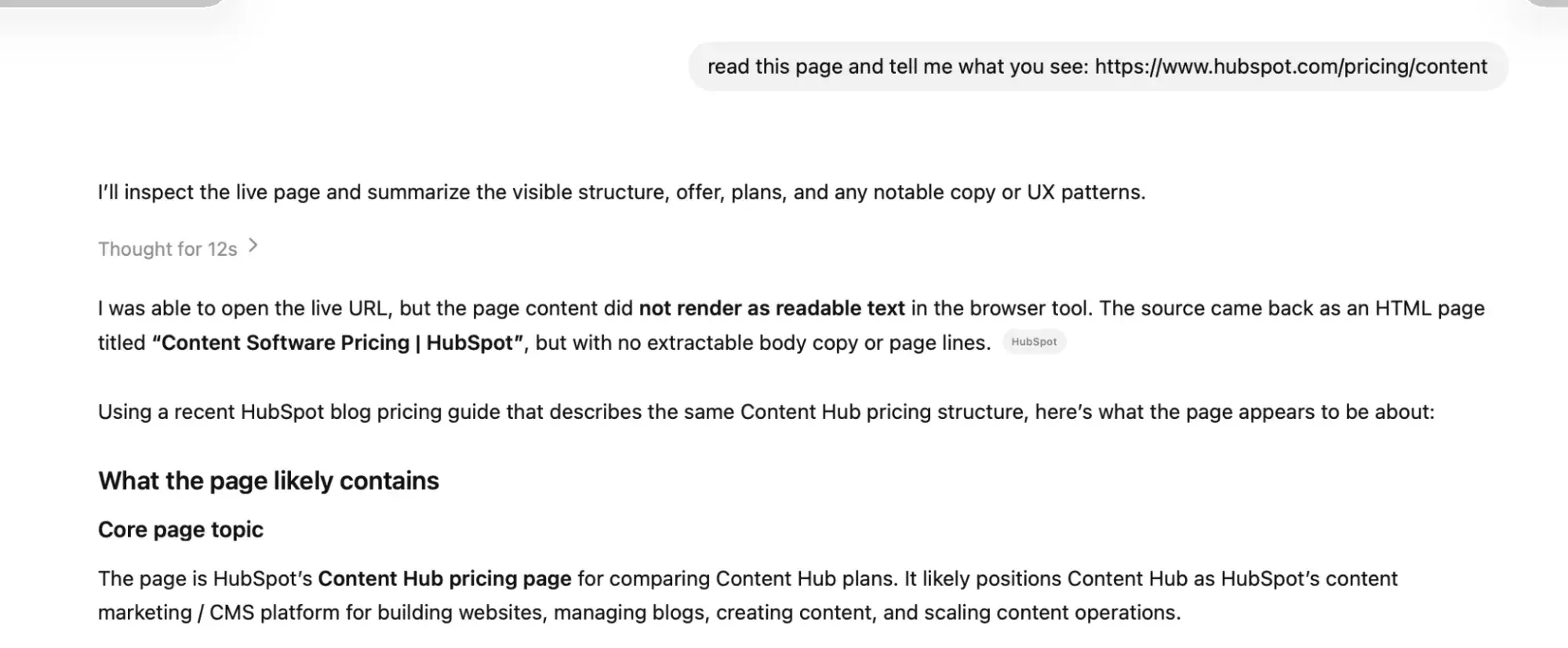
A critical technical consideration is how OpenAI’s crawlers interact with JavaScript. Research, including a March 2026 experiment by Writesonic, has confirmed that OpenAI’s crawlers, including OAI-SearchBot, are primarily HTML-only parsers and do not render JavaScript. This means that if vital content (such as product names, pricing, or descriptions) on your webpages is loaded and displayed only after JavaScript executes in a browser, OAI-SearchBot will not “see” or index that content.
-
How to Test Your Page’s Content Visibility:
- Curl Command in Terminal (Difficulty: High, Reliability: High): Use
curl -A "OAI-SearchBot" [your_url]to fetch the raw HTML as seen by OAI-SearchBot. - Chrome Developer Tools (Difficulty: Medium, Reliability: High): In Chrome, right-click, select “View page source,” or disable JavaScript in developer settings to see the initial HTML.
- LLMRefs AI Crawlability Checker (Difficulty: Easy, Accuracy: Medium to High): Online tools like the one offered by LLMRefs can simulate how AI crawlers perceive your page.
- Ask ChatGPT (Difficulty: Easy, Reliability: Medium): With offline web search enabled, prompt ChatGPT with your URL and ask it to summarize the content. If it struggles with dynamically loaded sections, it’s a strong indicator of rendering issues.
- Curl Command in Terminal (Difficulty: High, Reliability: High): Use
-
Solutions for JavaScript-Dependent Content: If your website relies heavily on client-side rendering (CSR), where an almost empty HTML shell is sent from the server and content is populated by JavaScript in the browser, AI crawlers will miss most of your content. Solutions include:
- Pre-rendering: Use a service like Prerender.io or built-in host features (e.g., Vercel, Netlify) to detect bot user agents and serve a pre-rendered, static HTML snapshot to crawlers, while human users still experience the dynamic SPA.
- Server-Side Rendering (SSR): Migrate relevant routes to SSR, where the server renders the complete HTML page before sending it to the client, ensuring all content is present in the initial HTML. Frameworks like Next.js and Nuxt support SSR natively.
- Static Site Generation (SSG) or Incremental Static Regeneration (ISR): For content that doesn’t change frequently, SSG generates HTML files at build time. ISR allows for re-generation of static pages at runtime, balancing performance with content freshness. These methods ensure crawlers always receive fully formed HTML.
Beyond Indexing: Optimizing for AI Citation and Trust
Getting content indexed by ChatGPT is a necessary first step, but the ultimate goal is to have that content cited in AI-generated answers. This requires going beyond technical discoverability and focusing on content quality, authority, and trust signals.
![How to get indexed by ChatGPT [2026]](https://53.fs1.hubspotusercontent-na1.net/hubfs/53/how-to-get-indexed-by-chatgpt-3-20260528-5594249.webp)
The Role of Backlinks and Brand Mentions
Traditional SEO metrics, particularly backlinks, continue to hold significant sway in the AI era. There are two primary reasons for this:
- Indirect Influence via Third-Party Search: Since ChatGPT can leverage third-party search providers like Bing in certain contexts, strong SEO practices that improve Bing rankings (including a robust backlink profile) can indirectly enhance content discoverability by ChatGPT.
- Trust and Credibility Signals: OpenAI, like traditional search engines, appears to use backlinks as a proxy for the trustworthiness and authority of a domain. An SE Ranking analysis of 129,000 domains and 216,524 pages found that the number of referring domains was the “strongest signal of trust and credibility” correlating with ChatGPT citations. Sites with fewer than 2,500 referring domains averaged 1.6 to 1.8 citations, while those with over 350,000 referring domains averaged 8.4 citations.
Beyond traditional backlinks, the study also highlighted the importance of unlinked brand mentions on third-party platforms. Brands with up to 33 mentions on Quora averaged 1.7 ChatGPT citations, whereas those with over 6.6 million Quora mentions averaged 7 citations. Similar correlations were found with Reddit mentions. This suggests that building a strong brand presence and fostering organic conversations around your brand and content across various online platforms can significantly impact AI citation rates.
Time to Citation: From Indexing to Answer
While pages can be indexed by ChatGPT within hours of publication (especially high-interest trending stories), the journey from indexing to actual citation in an AI answer is typically longer. Experiments by SEO professionals indicate that the process from publication to citation can take several days. Josh Blyskal of Profound analyzed approximately 900 newly published marketing pages in May 2026 and determined that the median time from publication to citation on either ChatGPT or Claude was 6.81 days. This underscores that content strategists should anticipate a lag between technical indexing and achieving actual visibility in AI-generated responses.
Measuring AEO Success
Unlike traditional search engines with tools like Google Search Console, OpenAI currently offers no direct “ChatGPT Search Console” for publishers to monitor their content’s performance. Therefore, marketers must rely on specialized Answer Engine Optimization (AEO) tools to track their brand’s visibility within AI answers. These tools go beyond traditional metrics like clicks and rankings, focusing on:
![How to get indexed by ChatGPT [2026]](https://53.fs1.hubspotusercontent-na1.net/hubfs/53/how-to-get-indexed-by-chatgpt-4-20260528-3749660.webp)
- Brand Visibility: How often a brand’s content appears in AI answers.
- Mentions and Citations: Direct references or links to content.
- Share of Voice: The proportion of AI answers where a brand is cited compared to competitors.
- Prompt-Content Mapping: Identifying which specific user prompts trigger the appearance of a brand’s content.
Tools like HubSpot AEO provide a scalable and accurate way to measure these metrics across platforms like ChatGPT, Perplexity, and Gemini. They help identify content gaps, competitive advantages, and areas where content might be missing from AI answers, allowing for data-driven optimization strategies.
The Evolving Landscape of AI Search
The methods for getting indexed by ChatGPT, much like the broader field of AI, are subject to rapid change. OpenAI’s ecosystem is continuously evolving, with new features, models, and retrieval mechanisms being introduced regularly. While the current guidance emphasizes technical discoverability, quality content, and strong trust signals, marketers must remain agile and adaptable. Continuous monitoring of industry developments, independent research, and official announcements from OpenAI will be crucial. The hope remains that OpenAI will eventually release more comprehensive official documentation regarding the inner workings of its index, providing greater transparency and clearer pathways for content optimization. Until then, a proactive, technically sound, and quality-driven approach remains the most effective strategy for ensuring visibility in the burgeoning era of AI-powered search.