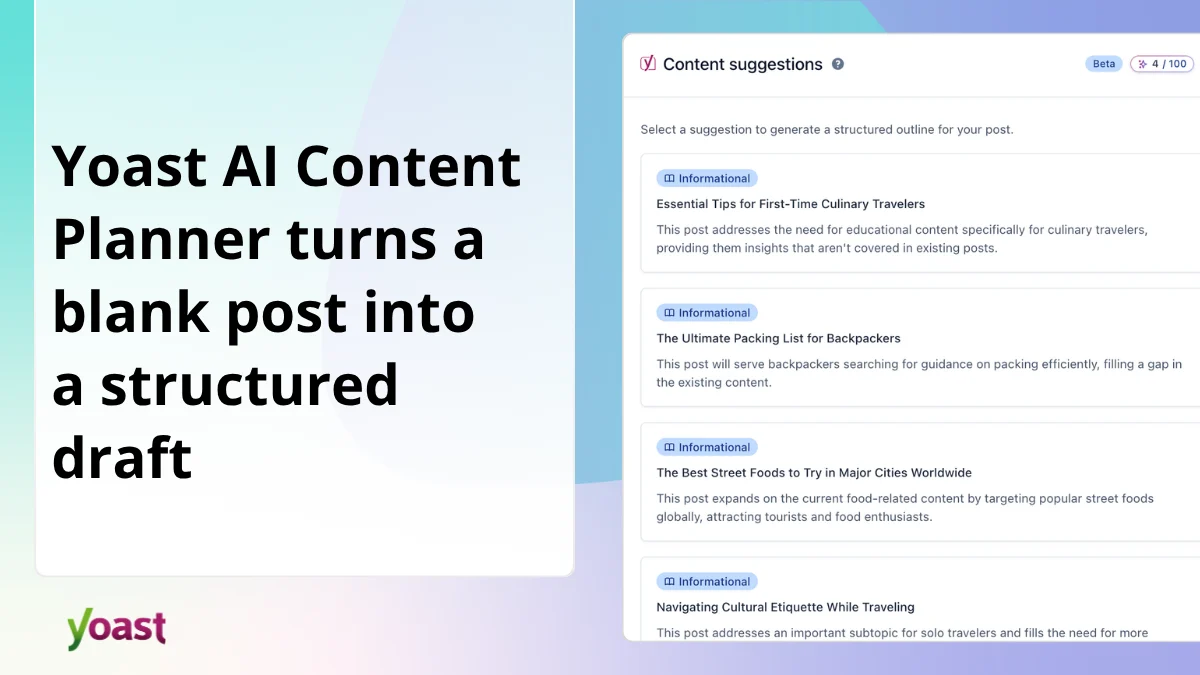
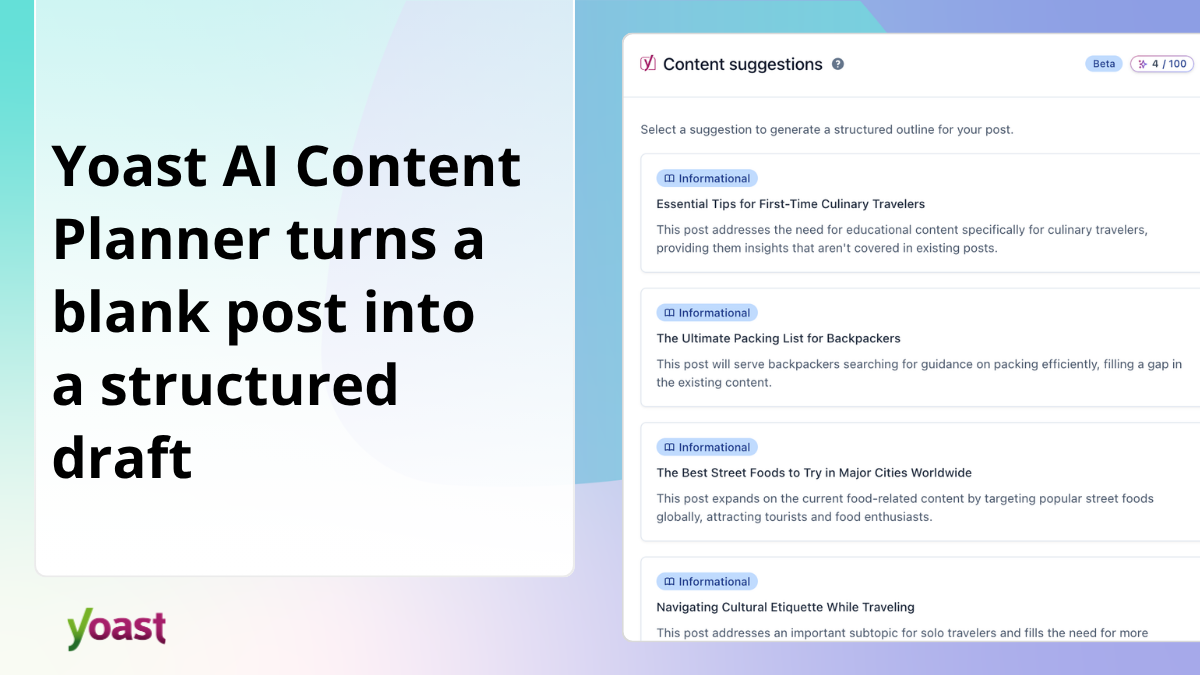
The digital content landscape, ever-evolving and increasingly competitive, presents a perpetual challenge for webmasters and content creators: the dreaded blank page. This universal hurdle, often leading to procrastination and missed opportunities, has historically stifled productivity and creative flow. Addressing this fundamental pain point, Yoast SEO Premium has announced the immediate availability of its new AI Content Planner, a sophisticated tool designed to transform the content creation workflow directly within the WordPress editor. This integration marks a significant step forward in making advanced content strategy accessible and actionable for its premium user base, promising to accelerate the journey from concept to publication by automating the crucial initial stages of ideation and structuring.
A New Era for Content Ideation and Structuring
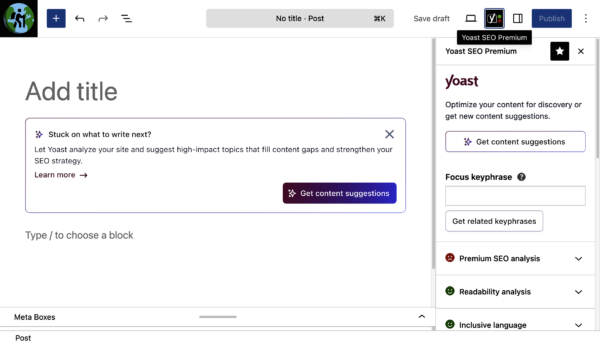
The Yoast AI Content Planner is engineered to tackle the initial, often most daunting, phase of content creation: ideation and structuring. Upon opening a new post within the WordPress editor, Yoast SEO Premium users are greeted not by an empty canvas, but by five highly relevant post ideas. These suggestions are not random; they are intelligently generated based on an in-depth analysis of the user’s existing site content. This contextual understanding allows the AI to identify crucial gaps, areas for expansion, or complementary topics that can enhance the site’s overall topical authority and SEO performance, ensuring that new content strategically reinforces and expands upon existing themes.
Once a user selects an idea, the AI Content Planner springs into action, constructing a comprehensive, structured draft. This draft is more than just a placeholder; it’s a fully fleshed-out skeleton for the new piece of content. Each draft includes a meticulously crafted title, a logical outline breaking the content into manageable sections, a carefully chosen focus keyphrase for SEO optimization, a compelling meta description designed to maximize click-through rates (CTR) in search results, and practical content notes for each section. These notes provide guidance, suggesting angles, sub-topics, or key points to address, effectively guiding the writer through the content creation process. The entire process, from opening a blank page to having a ready-to-write structured draft, is condensed into a matter of minutes, dramatically enhancing efficiency and reducing the mental load on content creators.
Background Context: The Persistent Challenge of Content Creation
For years, content creators, marketers, and webmasters have grappled with the twin demands of consistency and quality in content production. In a world where search engines prioritize fresh, relevant, and comprehensive information, the pressure to constantly generate new material is immense. However, the creative process is often unpredictable. “Writer’s block” or “blank page syndrome” is a widely recognized phenomenon, costing businesses countless hours and delaying content pipelines. A 2020 survey by SEMrush indicated that content creation is the most time-consuming aspect of content marketing for 64% of businesses, often due to the initial ideation and structuring phases. Furthermore, ensuring that new content aligns with existing site themes, addresses user intent, and strategically fills content gaps requires significant manual effort, often involving extensive keyword research and competitive analysis.
Yoast SEO, established as a cornerstone plugin for WordPress users since 2008, has consistently aimed to simplify the complexities of search engine optimization. From its early focus on basic on-page SEO checks to advanced readability analysis and schema markup integration, Yoast has evolved to become an indispensable tool for millions of websites. The introduction of the AI Content Planner represents a natural progression in Yoast’s mission to make SEO accessible to everyone, leveraging artificial intelligence to streamline one of the most resource-intensive aspects of digital marketing. This move aligns with a broader industry trend where AI is increasingly being deployed to augment human capabilities rather than replace them, particularly in creative and strategic fields like content marketing.
The Rise of AI in Content Marketing: A Timeline
The last decade has witnessed an explosion in AI capabilities, particularly in natural language processing (NLP) and machine learning (ML). These advancements have paved the way for sophisticated AI writing assistants, content generators, and optimization tools.
- Early 2010s: Initial AI tools for content focused on basic tasks like grammar checking and rephrasing, often producing generic or robotic text. The integration into mainstream platforms was minimal.
- Mid-2010s: Advances in machine learning began to allow for more coherent text generation, though still largely template-driven. SEO tools started incorporating rudimentary AI for keyword analysis and content scoring. Yoast itself expanded its SEO analysis features, moving beyond keyword density to readability and semantic relevance.
- Late 2010s: The advent of transformer models (e.g., Google’s BERT) revolutionized NLP, enabling AI to understand context and generate more human-like text. This period saw the rise of dedicated AI writing assistants. Yoast continued to refine its core algorithms, incorporating more sophisticated linguistic analysis.
- Early 2020s: Large Language Models (LLMs) like GPT-3 pushed the boundaries of AI-generated content, capable of producing highly creative, contextually relevant, and stylistically nuanced output. This sparked widespread interest in AI for content marketing, leading to a proliferation of AI content tools. It is during this period that Yoast likely began intensive development and testing of its own AI integration for content planning, recognizing the potential to address a major user pain point.
- Current Release (2024): Yoast AI Content Planner integrates cutting-edge AI directly into the WordPress editor, focusing on strategic content ideation and structuring, leveraging a decade of AI advancement to provide practical, actionable tools for its premium users.
Companies across various sectors have begun integrating AI into their content strategies to scale production, improve efficiency, and enhance personalization. From automated news summaries to AI-driven email campaigns and product descriptions, the application of AI is vast. For SEO, AI offers unprecedented opportunities to analyze vast datasets, identify trends, predict user behavior, and automate tedious tasks. Yoast’s AI Content Planner taps into this potential by focusing on the crucial pre-writing phase, ensuring that content creation starts on a strong, data-informed foundation. This isn’t just about generating text; it’s about generating strategic text ideas that align with a site’s existing authority and identified knowledge gaps.
Key Features and User Workflow in Detail
The implementation of the Yoast AI Content Planner is designed for maximum user convenience, requiring no additional installation or complex setup. It seamlessly integrates into the existing WordPress post editor, appearing as an intuitive feature when a new, empty post is initiated.
Here’s a detailed breakdown of what the Yoast AI Content Planner provides and the workflow it facilitates:
- Contextual Analysis of Existing Content: The AI engine performs a deep, semantic scan of the user’s existing published content. This involves analyzing not just keywords, but also the underlying topics, semantic relationships between articles, and the overall thematic structure of the website. It utilizes advanced natural language processing (NLP) to understand the nuances of the site’s content. This analysis helps the AI identify patterns, establish areas of existing authority, and, crucially, pinpoint potential content gaps that, if filled, could significantly boost the site’s SEO, attract new audiences, and enhance user engagement. For instance, if a site extensively covers “beginner’s guide to vegan cooking,” the AI might identify a gap in “advanced vegan meal prep strategies” or “health benefits of a plant-based diet,” suggesting topics that extend the site’s authority.
- Intelligent Idea Generation: Based on its comprehensive analysis, the AI presents five distinct, relevant post ideas. These are not generic prompts but tailored suggestions that resonate with the site’s unique content profile and identified strategic opportunities. The ideas are designed to be actionable and to contribute meaningfully to the site’s content ecosystem.
- Rapid Structured Draft Creation: Once an idea is selected by the user, the AI rapidly constructs a comprehensive starter draft. This draft is a blueprint for the new article, meticulously organized to maximize both readability and search engine visibility. It includes:
- A Proposed Crafted for clarity, keyword relevance, and clickability, aiming to attract search users and accurately reflect the content’s focus.
- A Detailed Outline: A hierarchical structure of headings and subheadings (typically H2s and H3s) that logically organizes the content flow. This ensures comprehensive coverage of the topic, guiding the writer through all necessary points to create a thorough and well-structured article.
- A Focus Keyphrase: A primary keyword or phrase that the content should target, carefully selected based on the site’s existing content, identified gaps, and potential search intent. This keyphrase is central to the SEO strategy for the new post, guiding optimization efforts.
- A Meta Description: A concise, compelling summary designed to appear in search engine results, enticing users to click. It incorporates the focus keyphrase and highlights the unique value proposition of the article, aiming to improve organic click-through rates.
- Section-Specific Content Notes: For each section in the generated outline, the AI provides specific bullet points or brief directives. These notes guide the writer on what information to include, what questions to answer, what sub-topics to explore, or what angles to consider, ensuring the content is comprehensive, addresses user intent effectively, and maintains a consistent tone with existing content.
This structured approach transforms the content creation process from a daunting task into a guided, efficient workflow, allowing writers to focus their energy on crafting high-quality prose, conducting deeper research, and injecting their unique insights, rather than struggling with initial conceptualization and structuring.
Important Considerations for Optimal Performance
For the Yoast AI Content Planner to function optimally and deliver high-confidence, relevant suggestions, a website needs to have a sufficient volume of published content. The AI relies on this existing data to build a “meaningful picture” of the site’s topical authority, content themes, and the relationships between different pieces of information. Websites with sparse content might receive a “low-confidence warning” rather than tailored suggestions, as the AI simply lacks enough data to generate intelligent and relevant ideas. This underscores the importance of a foundational content base for any AI-driven content strategy. It’s a tool that amplifies existing efforts rather than attempting to create something from nothing in a vacuum, making it most effective for sites with an established content library.
Supporting Data: The Impact of Efficient Content Strategy
The benefits of a streamlined content creation process, facilitated by tools like the Yoast AI Content Planner, are substantiated by numerous industry reports and statistics:
- Content Marketing Effectiveness: According to HubSpot’s 2023 State of Content Marketing report, businesses that prioritize blogging are 13 times more likely to see positive ROI. However, 60% of marketers struggle with producing content consistently, often due to time and resource constraints in the ideation and creation phases. The AI Content Planner directly addresses this consistency challenge by simplifying ideation.
- Time Savings: Studies consistently show that content planning and ideation can consume a significant portion of a writer’s time. A 2021 survey by Content Marketing Institute found that 45% of B2B marketers spend 6+ hours per week on content creation alone, with ideation and outlining identified as major time sinks. By automating these initial steps, Yoast’s tool can potentially save hours per piece of content, allowing writers to focus on in-depth research, compelling writing, and meticulous refinement, thereby increasing overall productivity.
- SEO Performance: Content that is well-structured, comprehensive, and targets relevant keywords consistently outperforms poorly planned content. Research by Backlinko indicates that long-form, well-structured content generally ranks higher in search results and receives more backlinks. The AI Content Planner’s ability to generate detailed outlines and focus keyphrases ensures that content is built on a solid SEO foundation from the outset, leading to better search visibility and organic traffic.
- AI Adoption in Marketing: Gartner predicts that by 2025, 60% of B2B marketers will use AI to augment their content creation workflows, up from less than 15% in 2022. Yoast’s early adoption and integration of AI into its flagship product position it at the forefront of this trend, offering users a competitive edge and preparing them for the future of digital marketing.
Statements and Reactions from Industry and Yoast Leadership
While specific quotes were not provided in the original announcement, the launch of such a significant feature would undoubtedly be accompanied by strategic messaging from Yoast’s leadership and garner reactions from industry observers.
A representative from Yoast, such as Beth Parker (Product Marketing Manager and author of the original feature announcement) or one of the company’s founders like Joost de Valk, would likely emphasize the user-centric design and strategic intent behind the AI Content Planner. “Our core mission at Yoast has always been to empower everyone to optimize their websites for search engines,” a spokesperson might state. “The blank page is a significant barrier for many content creators, hindering their ability to consistently produce high-quality, SEO-friendly content. With the AI Content Planner, we’re providing a powerful co-pilot that not only sparks inspiration but also lays a robust, SEO-optimized foundation for every new post. This tool isn’t about replacing human creativity; it’s about augmenting it, allowing our users to focus on what they do best – crafting compelling narratives and valuable information.”
Industry analysts are likely to view this as a strategic move that reinforces Yoast’s position as a leader in the WordPress SEO ecosystem. “The integration of advanced AI capabilities directly into the WordPress editor, particularly for content planning, is a game-changer for many small to medium-sized businesses and individual bloggers,” comments a hypothetical SEO industry expert. “It democratizes access to sophisticated content strategy tools that were once the exclusive domain of large agencies or required significant manual effort. Yoast is not just keeping up with AI trends; it’s setting a new standard for how AI can be seamlessly integrated into everyday content workflows, solidifying its value proposition for premium users.”
Early feedback from beta testers or anticipated user reactions would likely highlight the immediate productivity gains and reduction in creative friction. “Before, I’d spend hours just thinking about what to write next, often feeling overwhelmed by the sheer volume of content needed,” an imagined beta tester might remark. “Now, I open a new post, pick an idea that resonates, and within minutes, I have a complete outline, a focus keyphrase, and even a meta description. It’s like having a dedicated content strategist built right into my WordPress dashboard. My content pipeline has never been smoother, and the quality of my initial drafts has significantly improved.”
Broader Impact and Implications
The introduction of the Yoast AI Content Planner carries significant implications across various facets of the digital content ecosystem:
- For Content Creators and Writers: The most immediate impact will be on efficiency and creative output. By automating the initial, often painstaking, phases of ideation and outlining, writers can dedicate more time and mental energy to in-depth research, drafting, refining, and injecting their unique voice and expertise into the content. This could lead to higher quality, more comprehensive articles published more frequently, mitigating burnout and enhancing job satisfaction. It essentially transforms the writer’s role from struggling with structure to focusing purely on crafting compelling narratives.
- For Businesses and Webmasters: For website owners, particularly small businesses and individual entrepreneurs who often wear multiple hats, the AI Content Planner offers a powerful competitive advantage. It enables them to maintain a consistent publishing schedule, fill critical content gaps, and improve their search engine visibility without needing to hire extensive content strategy teams. This translates to