rifanmuazin
E-commerce businesses operating on Shopify now have a sophisticated new tool to navigate the increasingly complex landscape of artificial intelligence. Yoast SEO for Shopify has officially launched its innovative llms.txt feature, designed to empower merchants by providing explicit instructions to Large Language Models (LLMs) such as OpenAI’s ChatGPT and Google Gemini about their product catalogs and website content. This development comes as a direct response to growing concerns within the online retail sector regarding the potential for AI tools to misinterpret, misrepresent, or inaccurately describe products, ultimately impacting sales, brand reputation, and customer trust.
The proliferation of generative AI has revolutionized how users interact with information online. Conversational AI interfaces are rapidly becoming a primary gateway for product discovery, research, and purchase decisions. However, unlike traditional search engine crawlers that meticulously index entire websites, LLMs often operate by quickly ingesting vast amounts of data, synthesizing information from various sources, and filling in perceived gaps. This approach, while efficient for general knowledge, poses significant challenges for e-commerce stores, particularly those with extensive and frequently updated product catalogs. Without explicit guidance, AI tools can generate incomplete answers, disseminate outdated information, or, in worst-case scenarios, inadvertently direct potential customers to competitors based on flawed data.
The core problem llms.txt aims to solve is the “information vacuum” that AI often encounters when trying to understand a complex e-commerce site. When an AI model attempts to summarize or describe products without a structured directive, it might prioritize easily accessible but less critical information, overlook crucial product specifications, or fail to grasp the nuances of a brand’s unique selling propositions. For a large Shopify store, this could mean millions of dollars in lost revenue due to customer confusion, increased returns, or diminished brand credibility resulting from AI-generated inaccuracies. A recent study by Statista indicated that the global e-commerce market is projected to reach over $6 trillion by 2024, with a significant portion of online shopping journeys now influenced by AI-driven recommendations and summaries. The accuracy of these AI interactions is therefore paramount for merchant success.
A New Standard for AI Communication
The llms.txt feature is conceptualized as an essential digital guide for AI. It creates a dedicated file within a Shopify store’s architecture that explicitly communicates to AI tools which parts of the store are most vital for accurate representation. This includes top-selling products, carefully curated collections, essential company policies (such as returns and shipping), and key informational pages like “About Us” or FAQs. By essentially handing AI a well-organized map of their digital storefront, merchants can ensure that the narrative presented by LLMs is consistent, accurate, and aligned with their brand messaging.
The implementation of llms.txt is designed for unparalleled simplicity, ensuring that even store owners without extensive technical expertise can leverage its benefits. Once activated, the feature operates primarily in two distinct modes, catering to varying levels of merchant control and resource availability.
Two Pathways to AI Content Control
The first, and most straightforward, method is the Automatic Mode. Upon activation, Yoast SEO for Shopify automatically constructs and updates the llms.txt file on a weekly basis. This intelligent system analyzes the store’s Shopify data to identify and prioritize content deemed most critical for AI consumption. This typically includes:
- Top-performing products: Items with high sales volume or significant customer engagement.
- Newly launched products: Ensuring that the latest additions to the catalog are promptly and accurately communicated to AI.
- Bestsellers and featured collections: Highlighting key merchandise that defines the store’s offerings.
- Crucial informational pages: Policies, FAQs, and other content vital for customer understanding and trust.
This automated approach minimizes the administrative burden on merchants, allowing them to focus on core business operations while Yoast ensures their AI content guidance remains current and optimized. The system intelligently handles the complexities of content prioritization, dynamically adjusting the llms.txt file to reflect changes in product popularity, inventory, and strategic focus.
For merchants who prefer a more hands-on approach and require precise control over their AI content narrative, the Manual Selection Mode offers granular customization. In this mode, store owners can meticulously hand-pick the specific products, collections, and pages they wish to feature prominently for AI tools. This level of control is particularly beneficial for businesses launching targeted campaigns, promoting specific seasonal items, or wanting to ensure a particular brand story is consistently conveyed. A dedicated section is also provided for the “About Us” page, allowing merchants to articulate their brand’s mission, values, and history directly to AI, fostering a deeper and more accurate understanding of their identity.
Regardless of the chosen mode, the llms.txt file undergoes weekly updates, ensuring that any changes to the product catalog, such as new additions or the automatic removal of deleted products, are promptly reflected. This dynamic maintenance is crucial in the fast-paced world of e-commerce, where product inventories and promotional strategies can shift rapidly.
Democratizing AI Optimization: No Technical Knowledge Needed
A significant barrier to adopting advanced SEO and AI optimization techniques for many small to medium-sized businesses is the perceived technical complexity. Yoast SEO for Shopify has meticulously engineered the llms.txt feature to circumvent this challenge. Traditionally, establishing such a content guidance system would necessitate direct code editing or intricate server configurations, often requiring specialized developer knowledge. However, Yoast has seamlessly integrated llms.txt directly into the intuitive Yoast SEO for Shopify settings. This design choice means that any member of a merchant’s team, irrespective of their technical background, can activate and manage the feature in mere seconds. Furthermore, the system includes built-in safeguards: if a store already has a redirect established for /llms.txt, the Yoast feature will respect it and notify the user, preventing any conflicts or accidental disruptions to existing configurations.
The Strategic Imperative: Merchant Empowerment in the AI Era
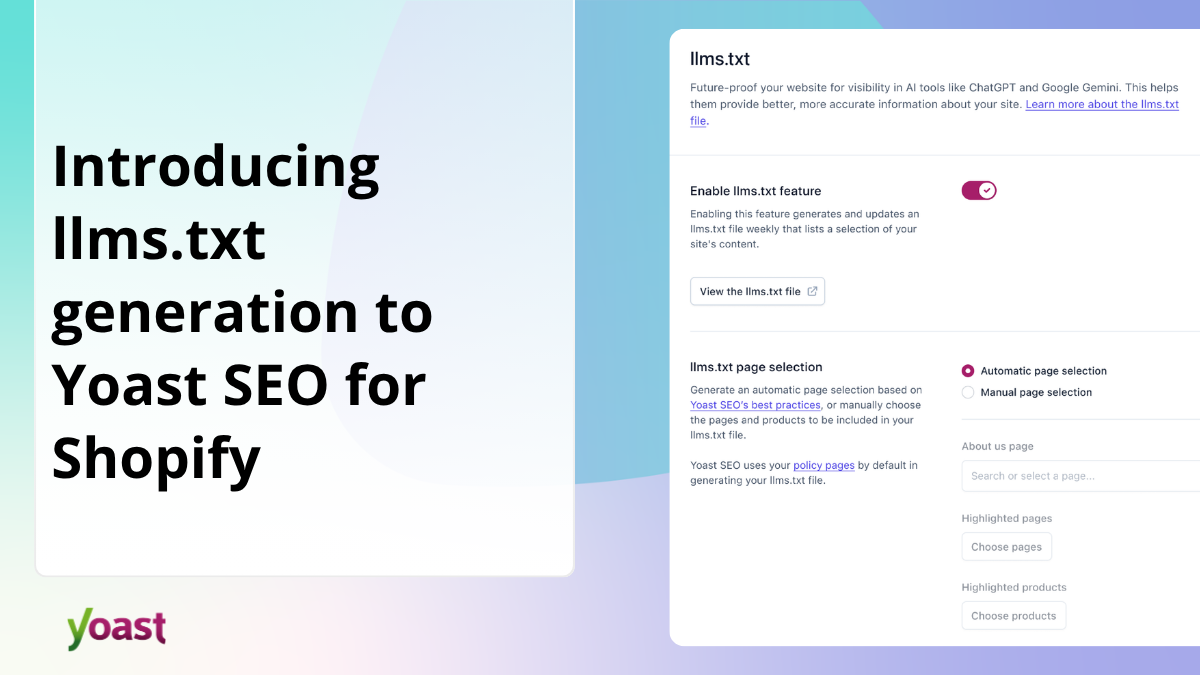
Yoast’s decision to make llms.txt an opt-in feature underscores its commitment to merchant autonomy. In an era where AI is increasingly influencing how consumers discover and engage with products online, Yoast firmly believes that every merchant should retain ultimate control over how their content is perceived and utilized by these powerful models. This opt-in philosophy ensures that businesses can strategically decide when and how they wish to engage with AI content guidance, aligning it with their broader digital marketing and brand protection strategies.
“We believe every merchant deserves control over their digital narrative, especially as AI becomes integral to product discovery,” stated a spokesperson for Yoast. “The llms.txt feature empowers Shopify store owners to ensure their brand story and product details are accurately conveyed, fostering trust and improving the customer journey. It’s about providing the tools for businesses to thrive in an AI-driven world, on their own terms.”
The Broader Context: AI’s Impact on E-commerce and SEO
The introduction of llms.txt is not merely a feature update; it reflects a significant evolution in the field of SEO and content strategy. The rise of LLMs marks a paradigm shift from traditional keyword-based search to more conversational, intent-driven queries. As consumers increasingly turn to AI assistants and chatbots for product recommendations, comparisons, and purchasing advice, the accuracy of the information these AI models provide becomes paramount.
Data from recent industry reports highlights the accelerating integration of AI into e-commerce. According to McKinsey & Company, AI could add $13 trillion to global economic output by 2030, with e-commerce being a prime beneficiary. Furthermore, Gartner predicts that by 2025, 60% of consumers will have used conversational AI to interact with customer service, and a substantial portion of these interactions will involve product inquiries. Inaccurate AI summaries can lead to severe consequences:
- Erosion of Brand Reputation: Misinformation, even if unintentional, can damage a brand’s credibility and trustworthiness.
- Increased Customer Dissatisfaction: Incorrect product details can lead to higher return rates, negative reviews, and a poor customer experience.
- Lost Sales Opportunities: If an AI assistant provides incomplete or misleading information, a potential customer might abandon their purchase journey or be directed elsewhere.
- Competitive Disadvantage: Stores that actively guide AI models will likely present more compelling and accurate product narratives, potentially gaining a significant edge over competitors whose content is left to AI’s unguided interpretation.
Historical Precedent: From Robots.txt to llms.txt
The concept of llms.txt draws a clear parallel to the long-standing robots.txt protocol. For decades, robots.txt has served as a standard for website owners to communicate with search engine crawlers, instructing them on which parts of a site to crawl or not to crawl. This protocol was essential for managing server load, preventing the indexing of sensitive areas, and guiding search engines to the most relevant content.
llms.txt extends this principle into the realm of generative AI. While robots.txt primarily focuses on access and indexing, llms.txt shifts the focus to interpretation and representation. It’s not about preventing AI from accessing content, but rather about guiding AI on how to interpret and synthesize that content accurately for conversational or generative purposes. This distinction is critical as AI models consume data differently than traditional crawlers, often prioritizing synthesis over direct indexing. This new standard proactively addresses the ongoing debate surrounding AI’s usage of web content, offering content owners a clear mechanism to exert control and ensure proper attribution and representation.
Expert Commentary and Industry Reactions
E-commerce experts widely acknowledge the critical need for tools like llms.txt. Dr. Evelyn Reed, a prominent e-commerce analyst, commented, “This feature addresses a critical emerging challenge for online retailers. As AI models become primary information gateways, guiding them effectively is paramount for maintaining brand integrity and optimizing conversion funnels. Yoast’s proactive approach provides a much-needed layer of control for merchants.”
The sentiment across the e-commerce community indicates a strong desire for such control. Merchants are increasingly aware that their digital storefronts are not just for human eyes but also for algorithms and AI models that intermediate customer interactions. The ability to explicitly tell AI what matters most is seen as a strategic advantage in a crowded online marketplace.
Implications for Future SEO and Content Strategy
The launch of llms.txt signals a fundamental shift in SEO and content strategy. Optimizing for search engines will increasingly encompass optimizing for AI models. This means:
- Beyond Keywords: While keywords remain important, content strategies will need to emphasize clarity, factual accuracy, and structured information that is easily digestible by LLMs.
- Explicit AI Guidance:
llms.txtwill become a vital component of a comprehensive SEO strategy, working in conjunction with traditional meta descriptions, structured data, and high-quality content. - Brand Narrative Control: Businesses will need to actively manage their brand narrative not only for human consumption but also for AI interpretation, ensuring consistency across all digital touchpoints.
- Data Governance: The feature highlights the growing importance of data governance and content ownership in the age of generative AI, allowing businesses to dictate how their proprietary information is used.
Conclusion
Yoast SEO for Shopify’s new llms.txt feature represents a significant stride forward in empowering e-commerce merchants to navigate the complexities of the AI era. By providing a simple, yet powerful, mechanism for guiding Large Language Models, Yoast is enabling businesses to safeguard their brand integrity, ensure the accurate representation of their products, and ultimately enhance the online shopping experience for millions of consumers. As AI continues to reshape the digital landscape, tools like llms.txt will become indispensable for merchants seeking to maintain control over their digital narrative and secure their competitive advantage in the ever-evolving world of online retail. Merchants are encouraged to activate the llms.txt toggle in Yoast SEO for Shopify upon their next login to their store, taking a proactive step towards future-proofing their online presence.