rifanmuazin
The digital landscape is undergoing a profound transformation, driven primarily by advancements in artificial intelligence. This was the central theme of Yoast’s May 2026 SEO Update, where prominent experts Carolyn Shelby and Alex Moss convened to dissect Google’s latest AI-driven changes, analyze AI’s pervasive impact on content creation, and articulate why the conventional strategy of merely increasing content volume is not only obsolete but potentially detrimental. The update underscored a critical shift: the era of generic, high-volume content is over, replaced by a demand for authoritative, structured, and genuinely valuable information tailored for both human users and sophisticated AI agents.
The monthly update, a crucial resource for SEO professionals and digital marketers, provided a comprehensive overview of the rapidly evolving search ecosystem. Participants were offered a deep dive into several key announcements and trends, ranging from Google’s new guidelines for publishers to the expansion of AI-driven commerce and the strategic rethinking required for content optimization. The session, available for a full recap on YouTube, addressed audience questions and provided practical examples, reinforcing the urgency for businesses to adapt their digital strategies.
Google’s Strategic Shift: Empowering Publishers and Redefining Source Authority
A significant development highlighted in the update was Google’s release of a comprehensive guide on preferred sources in Google Search for web publishers. This new mechanism allows users to explicitly signal their preference for specific news outlets or content creators, a move with considerable implications, particularly for publishers reliant on advertising revenue. In an increasingly fragmented media environment, where trust and brand loyalty are paramount, this feature offers a pathway for established publishers to bolster their visibility and ensure their content reaches loyal readers directly.
The rationale behind Google’s initiative extends beyond mere user preference; it reflects a broader strategy to combat misinformation and elevate authoritative voices in an information-rich, AI-driven search environment. For publishers, the ability to be designated as a “preferred source” by a significant portion of their audience can translate into more direct impressions, potentially stabilizing or even increasing ad revenue streams that have been under pressure from evolving search behaviors and content summarization by AI. Industry analysts suggest this feature could incentivize publishers to further invest in high-quality, original journalism and content, fostering deeper engagement with their readership rather than solely optimizing for broad search queries. The actionable takeaway for businesses whose models are tethered to search traffic and ad impressions is clear: cultivating reader loyalty and encouraging the use of this preference setting is no longer a peripheral concern but a core strategic imperative.
The Rise of AI-Driven Commerce: Universal Checkout Protocol (UCP)
Another pivotal announcement discussed was Google’s aggressive push for the Universal Checkout Protocol (UCP), an open standard designed to enable AI agents to complete purchases on behalf of users seamlessly. This initiative, already embraced by e-commerce giants like Shopify, signifies a paradigm shift in online retail. Instead of navigating multiple website pages, users can now instruct an AI assistant to identify a product, compare prices, and finalize a purchase directly from search results or other integrated AI interfaces.
This development is a natural progression in Google’s long-term vision for “unified commerce,” where the friction between discovery and transaction is virtually eliminated. The UCP facilitates a more frictionless shopping experience, responding to consumer demands for speed and convenience. For e-commerce businesses, the implications are profound. While UCP promises enhanced conversion rates by simplifying the buying process, it also necessitates a critical re-evaluation of current e-commerce strategies. Ensuring compatibility with UCP is no longer optional; it is essential to prevent losing conversions to competitors or alternative purchasing pathways. Businesses must prioritize API integrations, streamline product data, and ensure their inventory management systems can seamlessly interact with AI agents. This trend points towards a future where the traditional e-commerce website might serve more as a brand touchpoint and less as the sole transaction hub, with AI agents becoming primary facilitators of purchase decisions.
Differentiating Indexing: Search vs. Grounding
Bing’s clarification regarding the distinction between traditional search indexing and “grounding indexing” provided crucial insights into how AI agents process information. Traditional search indexing, familiar to SEO professionals, involves algorithms cataloging web content for human users, considering factors like JavaScript execution and hidden elements. Grounding indexing, however, operates differently. It occurs at “inference time,” meaning AI models scrape and process only visible text, largely ignoring JavaScript-rendered content or information hidden behind interactive elements like accordions or tabs.
This distinction holds significant weight for content strategists. For years, SEO best practices often involved structuring content in collapsible sections to improve user experience on mobile devices or manage information density. However, Bing’s clarification indicates that content concealed in such ways may be effectively invisible to AI agents, even if it is indexed by traditional search engines. This means that while a human user might click to reveal a hidden FAQ, an AI model summarizing information might completely overlook it. The actionable takeaway is to prioritize making critical information directly visible and accessible on the page. Content creators must ensure that core messages, key data, and essential answers are immediately present and scannable, optimizing not just for human readability but also for AI agent processing, which prioritizes raw, visible text.

The Evolving Role of Rich Results: The Decline of FAQ Snippets
Google’s decision to largely discontinue support for FAQ rich results in general search queries marked another notable shift. While these rich snippets, which previously expanded to show answers directly in search results, may still appear for specific, high-authority domains such as medical or government pages, their broad utility has diminished. This follows a pattern of Google continuously refining its display of search results, often removing features that are overused or no longer align with its evolving search experience.
For many websites that had strategically implemented FAQ schema to gain additional visibility in the SERPs, this change necessitates an adjustment in their SEO strategy. The immediate impact is a potential reduction in organic click-through rates for pages that heavily relied on these expanded snippets. However, it’s crucial to understand that the FAQ schema itself is not entirely useless. Industry experts speculate that structured data, including FAQ schema, may still play a role in informing AI responses or future generative AI features, even if it doesn’t manifest as a direct rich result. It contributes to the overall structured understanding of a page’s content, which AI models can leverage. Therefore, while the direct visual benefit has largely vanished, the underlying data may still contribute to a page’s discoverability and utility within an AI-driven search ecosystem.
The Obsolescence of “Ultimate Guides” and Commodity Content
Rand Fishkin’s insightful research, highlighted during the Yoast update, illuminated the declining effectiveness of long-form “ultimate guides” and low-value listicles. For years, these content formats were staples of SEO strategies, designed to capture broad keyword rankings and establish topical authority. However, with the maturation of AI models, which can synthesize answers directly from vast datasets, the need for humans to sift through extensive, generic content has diminished.
Google and other AI systems are increasingly favoring authoritative, structured, and genuinely differentiated content. The sheer volume of information available, combined with AI’s ability to quickly distill it, means that content that merely rehashes existing information or offers superficial insights struggles to gain traction. Publishing generic, high-volume content, often churned out to meet arbitrary word counts or keyword density targets, is no longer a viable SEO strategy. Instead, the emphasis has shifted towards creating unique, expert-driven content that offers novel perspectives, deep analysis, or practical solutions not easily replicated by AI. This represents a call to action for content creators to elevate their craft, focusing on quality, originality, and genuine value proposition over mere quantity.
Gemini Intelligence and the Android Ecosystem: A Shift in User Interaction
Google’s deep integration of Gemini Intelligence into the Android ecosystem signals a profound shift in how users discover information and interact with services. This expansion enables proactive AI features, such as booking appointments, making purchases, or obtaining information directly through conversational interfaces, often bypassing traditional websites entirely. For example, a user might ask their Android device to find and book a restaurant, and Gemini could complete the entire process without the user ever visiting a restaurant’s website or a third-party booking platform.
This development carries significant implications for publishers and businesses accustomed to driving traffic to their websites. As AI agents become more capable of fulfilling user intent directly, the reliance on website visits for discovery and conversion diminishes. This impacts not only organic search traffic but also the potential for ad revenue derived from those visits. Businesses must adapt by optimizing for AI-driven discovery rather than solely focusing on direct website visits. This means ensuring their information is structured and accessible for AI models, their services are integratable with AI platforms, and their brand presence extends beyond traditional web channels into the AI-powered interfaces where users increasingly operate.
Google’s AI Optimization Guide: Navigating New Guidelines
In response to the proliferation of AI-generated content and the need to maintain search quality, Google released a guide on optimizing for generative AI features. This guide explicitly advises against certain practices, notably using AI to generate high volumes of low-quality content, excessively optimizing for AI systems with “AI stuffing,” and creating content primarily for AI rather than human users. These guidelines underscore Google’s ongoing commitment to reducing spam and inefficiency in its AI-driven search results.
However, the Yoast update highlighted a critical nuance: these guidelines are specifically tailored for Google’s ecosystem. Other emerging AI models and search platforms, such as Perplexity and Claude, may still derive significant benefit from structured data and content optimized in ways that Google discourages. This creates a complex optimization landscape where strategies must be tailored to specific AI platforms. While Google aims to prioritize high-quality, human-centric content that also informs its AI, other models might be more reliant on explicit structural cues. The actionable takeaway for SEO professionals is to understand the distinct requirements and preferences of various AI systems, adopting a nuanced approach to content creation and optimization that balances Google’s directives with the broader AI landscape.
Conde Nast’s Proactive Stance: Diversifying Revenue Streams
The proactive stance taken by Conde Nast, a global media giant publishing titles like Vogue and The New Yorker, served as a stark indicator of the broader industry shift. The company’s CEO reportedly advised stakeholders to “plan as if programmatic ad revenue from search traffic will decline to zero.” This bold directive reflects a widespread apprehension among publishers regarding the long-term viability of traditional monetization models in an AI-dominated search environment.
As AI models become increasingly adept at summarizing content and providing direct answers, the incentive for users to click through to original publisher websites diminishes, directly impacting ad impressions and, consequently, revenue. Conde Nast’s strategy signals a crucial imperative for all publishers: diversify revenue streams beyond programmatic advertising. This includes exploring subscription models, premium content offerings, direct reader support, branded content partnerships, and potentially new forms of commerce integrated directly into their platforms. The era of passive ad revenue generation from broad search traffic is drawing to a close, necessitating a more proactive and multifaceted approach to content monetization.
Google I/O 2026: The AI-Driven Ecosystem Unveiled
The insights from Google I/O 2026 provided a glimpse into the company’s overarching vision, further solidifying the themes discussed throughout the Yoast update. Key takeaways included:
- AI Agents as Primary Interfaces: Google underscored its commitment to AI agents becoming the primary way users interact with the digital world, moving beyond traditional search queries.
- Enhanced Personalization: AI-driven personalization will become more sophisticated, tailoring experiences and content discovery to individual user preferences and historical interactions.
- Unified Commerce: The vision of seamless, AI-facilitated transactions across various platforms was reiterated, with UCP being a cornerstone.
- Proactive AI Assistance: AI systems are evolving to anticipate user needs and offer solutions proactively, rather than merely responding to explicit commands.
- Multimodal AI: The ability of AI to understand and generate content across various modalities (text, image, audio, video) will fundamentally change content creation and consumption.
- AI-Powered Search Engine Results Pages (SERPs): The traditional SERP will continue its evolution, integrating more generative AI features and reducing the prominence of standard organic listings.
These announcements collectively indicate Google’s transformation from a mere search engine to an expansive AI-driven ecosystem. This shift fundamentally alters how users discover, consume, and interact with content and services, demanding a radical re-evaluation of digital strategies across all industries.
Yoast’s Response: Empowering Content Creators in the AI Era
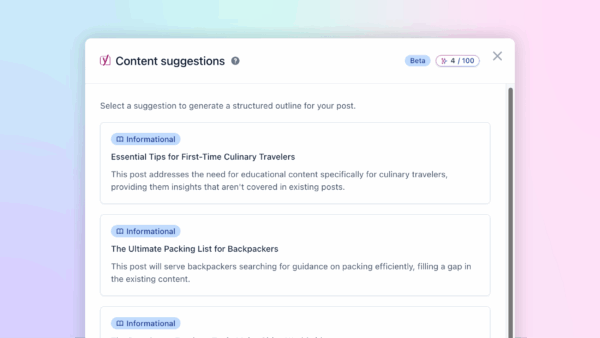
In light of these seismic shifts, Yoast, a leader in SEO software, announced a timely innovation: the launch of the Yoast AI Content Planner. This new tool is designed to address the evolving challenges faced by content creators, particularly the need to produce structured, high-quality, and differentiated content efficiently. The AI Content Planner aims to alleviate writer’s block and streamline the content creation process by transforming a blank page into a structured draft within seconds. It offers intelligent topic suggestions, generates comprehensive outlines, and provides real-time SEO optimization tips, ensuring content is both readable for humans and discoverable by AI.
For Yoast Premium users, this feature is integrated directly into the WordPress editor, offering a practical way to experiment with AI-driven content creation while adhering to best practices. The tool’s focus on structure, readability, and SEO optimization reflects the new imperatives for content success: clarity, authority, and strategic alignment with both human and AI consumption patterns. It empowers users to produce content that stands out in a crowded, AI-influenced digital landscape, saving time and improving the overall quality and effectiveness of their digital presence.
Conclusion: Adapting to an AI-First Digital Future
The May 2026 SEO Update by Yoast served as a powerful reminder that the digital marketing landscape is not merely evolving; it is undergoing a fundamental restructuring. The ascendancy of AI as the primary interface for information discovery and commerce necessitates a comprehensive rethinking of traditional SEO, content creation, and monetization strategies. Businesses and publishers must move beyond simplistic content volume metrics and embrace a future where quality, authority, differentiation, and seamless integration with AI agents are paramount. The changes outlined, from Google’s preferred sources and UCP to the decline of generic content and the rise of proactive AI, paint a clear picture: adaptability and innovation are no longer advantages but essential for survival in the AI-first digital future.
The dialogue on these critical shifts will continue. SEO professionals and digital strategists are encouraged to stay abreast of these ongoing developments. The next SEO Update by Yoast is scheduled for June 30, 2026, at 4:00 PM CET (10:00 AM EST), promising further insights into navigating this dynamic environment.