rifanmuazin
Professional networking giant LinkedIn has announced the broader availability of its artificial intelligence model comparison tool, Crosscheck, to all users across the United States, commencing this week. This significant expansion, following an initial rollout to Premium members last month, marks a pivotal step in democratizing access to AI evaluation tools for professionals navigating the rapidly evolving landscape of generative AI. The platform plans to extend this feature more widely in the coming months, solidifying its commitment to empowering its global professional community with practical, data-driven insights into AI performance.
Understanding Crosscheck: A Deeper Dive into AI Benchmarking
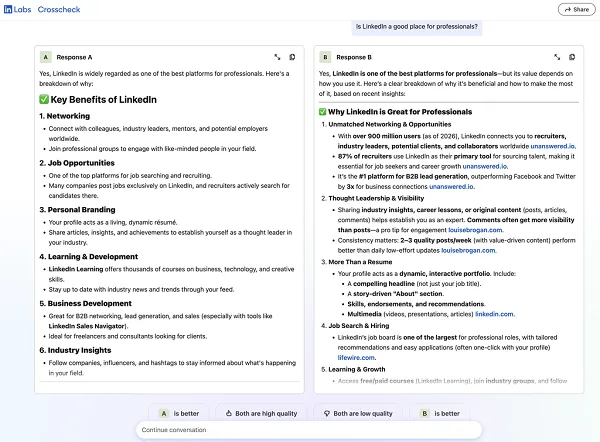
At its core, Crosscheck is designed to enable LinkedIn users to directly compare the outputs of various leading AI models, facilitating an objective assessment to determine which tool is best suited for their specific business needs, professional tasks, or industry sector. Users can submit any prompt, and Crosscheck intelligently matches this input with relevant AI tools from a diverse roster of major developers, including OpenAI, Anthropic, Google, and Microsoft. The system then presents responses from two distinct AI models in a blinded format, meaning the user does not know which model produced each output. This anonymity is crucial for unbiased evaluation, allowing users to rate the quality, relevance, and utility of each response purely on its merit.
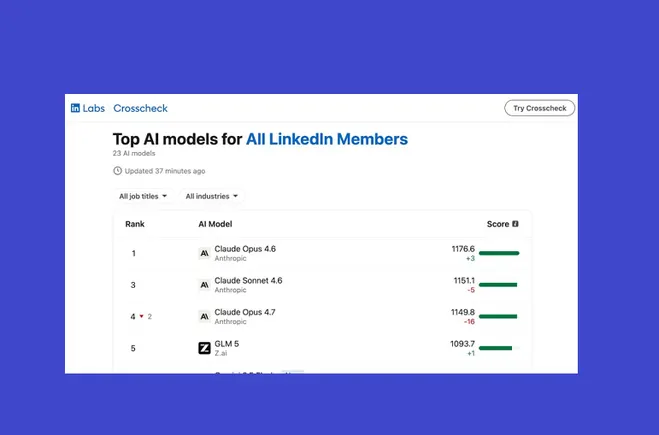
The underlying principle is to generate a comprehensive output comparison across different professional domains. This systematic approach aims to equip LinkedIn members with invaluable insights, helping them identify the most effective AI models for their unique use cases. Beyond individual comparisons, LinkedIn also aggregates user ratings to rank AI models for overall performance and, more critically, against job-type specific metrics. This granular data offers a nuanced understanding of AI capabilities, moving beyond general benchmarks to provide tailored recommendations relevant to specific career paths and industry requirements.
For instance, a marketing professional might compare how different AI models generate campaign taglines, while a software engineer could evaluate their ability to write or debug code snippets. The collective feedback from millions of professionals across diverse roles creates a rich, real-world dataset that is unparalleled in its scope and specificity. This not only aids individual users but also contributes to a broader understanding of AI model strengths and weaknesses in practical applications.
The Genesis and Strategic Rollout
The journey of Crosscheck began with an initial launch to LinkedIn Premium members, a strategic move that allowed for early testing and feedback from a segment of its user base known for early adoption of professional tools. This phased rollout ensured a smoother transition and provided valuable data for refinement before the broader release. The decision to expand availability to all U.S. users in May underscores LinkedIn’s agility in responding to the growing demand for AI literacy and practical application tools within the professional sphere. The subsequent plan for wider global availability in the “coming months” highlights the platform’s vision for Crosscheck as a universally accessible resource.
This initiative is not an isolated development but rather an extension of LinkedIn’s ongoing efforts to integrate AI strategically across its platform. Over the past few years, LinkedIn has increasingly leveraged AI to enhance user experience, from powering personalized job recommendations and content suggestions to facilitating smarter networking connections. Crosscheck represents a more direct engagement with AI models themselves, positioning LinkedIn as a crucial intermediary between AI developers and the professional end-user.
The timing of Crosscheck’s broader launch is particularly pertinent. The past 18-24 months have witnessed an explosion in the development and public availability of generative AI tools, particularly large language models (LLMs). From ChatGPT to Claude, Bard, and Copilot, professionals are inundated with options, often struggling to discern which tool offers the best performance for their specific tasks. This proliferation, while exciting, has also created a significant challenge in objective evaluation and informed decision-making.
Addressing a Critical Market Need: The AI Evaluation Conundrum
The rapid advancement of artificial intelligence, particularly in the realm of generative models, has presented professionals with both unprecedented opportunities and significant challenges. While AI promises to enhance productivity, streamline workflows, and unlock new creative avenues, the sheer volume and variety of available tools can be overwhelming. As of early 2024, the market for AI tools and services continues its exponential growth, with projections estimating it to reach hundreds of billions of dollars globally within the next few years. This burgeoning market is populated by numerous AI models, each with distinct architectures, training data, and performance characteristics.
For an individual professional or a small business, identifying the “best” AI model for a particular task—be it content creation, data analysis, coding assistance, or customer service automation—is a daunting task. Traditional benchmarking often occurs in controlled academic or research environments, which may not accurately reflect real-world professional use cases. Furthermore, subjective biases or marketing claims can further obscure objective comparison. A recent survey indicated that over 60% of professionals using AI tools report difficulty in selecting the most appropriate model for complex tasks, citing a lack of reliable, comparative performance data tailored to their specific roles.
This is precisely the void that LinkedIn’s Crosscheck aims to fill. By providing a neutral, crowdsourced platform for comparing AI outputs, Crosscheck addresses a critical market need for practical, context-specific benchmarking. It transforms a complex, often technical decision into a user-friendly, experience-driven process. The tool leverages the collective intelligence of LinkedIn’s vast network, aggregating diverse professional perspectives to create a dynamic, living benchmark for AI performance across an almost limitless array of professional applications.
The challenge of “AI model drift,” where models can change their performance characteristics over time due to updates or new training data, further complicates selection. Crosscheck’s continuous evaluation mechanism offers a dynamic solution, providing up-to-date insights into model efficacy. This dynamic feedback loop is invaluable in an industry characterized by rapid iterations and continuous improvement.
How Crosscheck Works: A Deeper Dive into the Mechanics
The user experience within Crosscheck is designed to be intuitive and efficient. Upon accessing the tool, a user is prompted to enter a specific task or question, much like interacting with a chatbot. This “prompt” is the core input. Crosscheck’s sophisticated backend then analyzes the prompt for relevance and matches it with a selection of various AI models from its integrated network. This network includes leading models from tech giants like OpenAI (e.g., GPT-4), Anthropic (e.g., Claude), Google (e.g., Gemini), and Microsoft (e.g., various Azure AI services), ensuring a broad and representative comparison.
Once the system has identified two suitable AI models, it generates responses to the user’s prompt from each model. These responses are then presented side-by-side, but crucially, without revealing the identity of the generating AI model. This “blind test” methodology is a cornerstone of objective evaluation, preventing any preconceived notions or brand loyalties from influencing the user’s judgment. Users are then asked to rate each response based on criteria such as accuracy, relevance, coherence, creativity, and overall quality. They can also provide qualitative feedback, detailing why they preferred one response over another, or highlighting specific strengths and weaknesses.

Beyond simple ratings, Crosscheck goes a step further by offering insights into how different AI models perform across various job types and industries. LinkedIn’s rich professional metadata—encompassing job titles, skills, industry affiliations, and career histories—allows for the categorization and analysis of user feedback through these lenses. This means that a marketing manager can see which AI models perform best for marketing-related tasks, as rated by other marketing professionals, rather than just a general, undifferentiated score. This granular segmentation provides highly relevant and actionable intelligence for professionals seeking to optimize their AI toolchain.
The aggregated data then feeds into LinkedIn’s internal ranking system, providing dynamic leaderboards and performance metrics. These rankings are not static; they evolve as more users contribute feedback, ensuring that the insights remain current and reflect the latest performance capabilities of the AI models.
Benefits for Professionals: Enhanced Decision-Making and Productivity
For the individual professional, Crosscheck offers a multitude of benefits, primarily centered around informed decision-making and enhanced productivity. In an era where AI proficiency is fast becoming a core competency, selecting the right tools can significantly impact one’s efficiency and the quality of their work.
- Informed Tool Selection: No longer reliant on anecdotal evidence or marketing hype, professionals can make data-driven decisions about which AI models to integrate into their workflows. This reduces trial-and-error, saving time and resources.
- Optimized Workflow: By identifying the best AI model for specific tasks, professionals can streamline their work, automate routine processes, and focus on higher-value activities. This leads to substantial gains in personal and team productivity.
- Skill Development and Learning: Crosscheck implicitly educates users about the capabilities and limitations of different AI models. By experimenting with various prompts and evaluating diverse outputs, professionals can deepen their understanding of AI applications and refine their prompting skills, a critical aspect of effective AI utilization.
- Staying Competitive: In a competitive job market, professionals who can effectively leverage AI tools possess a distinct advantage. Crosscheck empowers LinkedIn members to stay at the forefront of AI adoption, ensuring they are equipped with the most effective digital assistants.
- Personalized Recommendations: The platform’s ability to categorize feedback by job type means that recommendations are highly personalized, reflecting the unique demands and nuances of different professional roles.
Value Proposition for AI Developers: Real-World Feedback and Iterative Improvement
While Crosscheck is designed with the professional user in mind, it simultaneously provides an invaluable measurement and feedback mechanism for AI developers. The challenge for developers in the rapidly evolving AI space is often obtaining high-quality, real-world performance data from diverse user groups. Traditional testing environments, while rigorous, cannot fully replicate the myriad ways in which professionals interact with AI in their daily tasks.
- Granular Performance Data: Crosscheck offers developers access to an unprecedented volume of user-generated data on model performance across a wide array of professional use cases. This granular feedback goes beyond simple accuracy metrics, providing insights into relevance, contextual understanding, creativity, and user satisfaction.
- Competitive Benchmarking: Developers can anonymously observe how their models stack up against competitors in real-world scenarios, identifying areas of strength and weakness. This competitive intelligence is crucial for strategic product development and market positioning.
- Iterative Improvement: The direct, ongoing feedback loop from millions of professionals allows developers to rapidly identify bugs, biases, or areas for improvement in their models. This accelerates the iterative development cycle, leading to faster and more targeted enhancements.
- Market Insights: Understanding how different professional sectors rate their models provides invaluable market insights. Developers can tailor their AI offerings to better meet the specific demands of industries or job functions where their models show particular promise or require refinement.
- Validation and Trust: Positive performance on Crosscheck, as validated by a broad professional audience, can serve as a powerful testament to a model’s quality and reliability, fostering greater trust among potential enterprise clients and individual users.
LinkedIn’s Strategic Vision: Reinforcing Professional Identity and Trust
LinkedIn’s official statement underscores the strategic importance of Crosscheck: “AI is becoming a daily tool for hundreds of millions of professionals and the models they choose shape the quality of their work. Crosscheck brings together LinkedIn’s unique assets – professional identity at global scale, rich career metadata, and enterprise-grade trust infrastructure – with statistical innovations purpose-built for professional evaluation to help professionals understand the best models for their role.”
This statement highlights several key elements of LinkedIn’s broader strategy. Firstly, it positions LinkedIn at the nexus of professional development and technological adoption, reinforcing its role as a vital resource for career growth. By providing tools that directly impact the “quality of their work,” LinkedIn deepens its value proposition to its members.
Secondly, the emphasis on “professional identity at global scale” and “rich career metadata” points to LinkedIn’s unique advantage. No other platform possesses such a vast and structured dataset of professional information. This allows Crosscheck to move beyond generic AI evaluations, offering contextually rich insights that are directly relevant to specific career paths and industries. This data advantage is a significant differentiator.
Finally, “enterprise-grade trust infrastructure” speaks to the platform’s commitment to reliability, data security, and ethical considerations. In an age of AI concerns regarding bias, misinformation, and data privacy, LinkedIn’s established reputation for trust is a critical asset. Crosscheck is designed to be a trustworthy arbiter of AI performance, built upon a foundation of responsible data handling and objective evaluation.
This move solidifies LinkedIn’s position not just as a professional network, but as an essential professional utility, proactively addressing the evolving needs of the workforce in the age of AI. It reinforces the platform’s role as a trusted guide and enabler in a complex digital landscape.
The Broader Impact on the AI Ecosystem
The widespread adoption of Crosscheck has the potential for significant ripple effects across the entire AI ecosystem.
- Standardization of Evaluation: While not a formal standards body, Crosscheck’s aggregated data could de facto contribute to a more standardized, real-world method for evaluating AI models. This could lead to a common language for discussing AI performance across industries.
- Fostering Innovation: By providing clear feedback on model strengths and weaknesses, Crosscheck can incentivize AI developers to innovate in areas that genuinely matter to professionals, rather than solely focusing on theoretical benchmarks.
- Increased Transparency: The blinded comparison and user ratings bring a new level of transparency to AI model performance, allowing users to see beyond marketing claims and understand practical utility.
- Democratization of AI Expertise: By simplifying AI evaluation, Crosscheck makes sophisticated insights accessible to a broader audience, democratizing what was once the exclusive domain of AI researchers and data scientists.
- Ethical AI Development: Consistent user feedback could highlight instances of AI bias or other ethical concerns in model outputs, prompting developers to address these issues more proactively and fostering a more responsible AI development landscape.
Looking Ahead: The Future of Crosscheck
LinkedIn has indicated that Crosscheck’s availability will continue to expand to more users globally in the coming months. This gradual rollout suggests a commitment to refining the tool based on user feedback and scaling its infrastructure to support a global professional audience. Future enhancements could include deeper integration with LinkedIn’s learning platform, offering courses or resources based on identified AI skill gaps, or even personalized AI recommendations based on a user’s career trajectory and stated goals.
As AI becomes increasingly intertwined with every facet of professional life, tools like Crosscheck will become indispensable. LinkedIn’s initiative positions it as a key facilitator in this transition, helping professionals navigate the complexities of AI, make informed decisions, and ultimately enhance their careers in an AI-powered world. The ongoing feedback loop between professionals and AI developers, facilitated by Crosscheck, promises to accelerate both individual and collective growth in the era of artificial intelligence.