
 rifanmuazin
The digital marketing landscape has undergone a fundamental shift as businesses move away from static “digital brochure” websites toward dynamic, high-performance sales engines designed for measurable lead generation. Industry data suggests that the traditional homepage, once the centerpiece of a brand’s online presence, is increasingly being bypassed in favor of specialized landing experiences that cater to specific user intents. As organizations seek to maximize the return on investment (ROI) from paid advertising and organic search, the focus has pivoted toward conversion rate optimization (CRO) through a combination of psychological triggers, technical performance, and artificial intelligence.
The Shift Toward Marketer-Centric Control
For much of the past two decades, website updates and campaign deployments were heavily gated by technical departments. Marketing teams often faced significant “IT bottlenecks,” where the implementation of a single landing page or the adjustment of a call-to-action (CTA) could take weeks of development time. This delay often resulted in lost momentum for seasonal campaigns and an inability to respond to real-time market shifts.
The emergence of “no-code” and “low-code” platforms has effectively returned control to the marketing department. This transition is not merely a matter of convenience; it is a strategic necessity. According to industry analysts, the ability to rapidly deploy and test page variants is directly correlated with lower customer acquisition costs (CAC). By utilizing drag-and-drop interfaces and AI-driven tools, marketers can now execute complex lead-generation strategies without the need for traditional coding, allowing for a more agile approach to demand generation.
The Chronology of Conversion Strategy Evolution
The evolution of lead generation can be categorized into three distinct eras:
- The Brochure Era (1995–2010): Websites served as static repositories of information. Success was measured by “hits” or pageviews, with little emphasis on capturing user data beyond a basic “Contact Us” page.
- The Analytical Era (2010–2020): The rise of Google Analytics and early A/B testing tools introduced the concept of the conversion funnel. Marketers began to realize that generic homepages were inefficient for paid traffic, leading to the birth of the dedicated landing page.
- The Optimization and AI Era (2020–Present): Lead generation is now a science of precision. Strategies involve dynamic text replacement, AI-powered traffic routing, and hyper-personalization based on user behavior and demographic data.
High-Impact Strategies for Modern Lead Capture
To navigate this current era, successful organizations are implementing a suite of 16 proven strategies designed to transform casual browsers into qualified prospects.

1. Deployment of Dedicated Landing Pages
The use of dedicated landing pages remains the most effective method for converting paid traffic. Unlike a homepage, which serves multiple audiences and offers numerous navigation paths, a landing page is designed with a single conversion goal. Research indicates that companies with 40 or more landing pages get 12 times more leads than those with five or fewer. The removal of the navigation menu—a tactic known as “ratio-based optimization”—focuses the user’s attention entirely on the offer at hand.
2. The Power of Micro-Adjustments in A/B Testing
Small changes frequently yield disproportionate results. A landmark case study involves the travel deals company Going.com, which achieved a 104% increase in conversions simply by altering three words in its CTA. By changing “Sign up for free” to “Trial for free,” the company doubled its results without increasing its advertising spend. This underscores the importance of testing headlines, button colors, and form lengths to identify the specific triggers that resonate with a target audience.
3. Value-First Lead Magnets
The “value exchange” is the cornerstone of lead generation. In an era of heightened privacy concerns, users are increasingly reluctant to share their contact information without a significant incentive. Modern lead magnets have shifted away from generic “tips” to high-utility tools, such as interactive calculators, proprietary industry reports, and templates that solve immediate pain points.
4. Form Simplification and Conditional Logic
The friction of a lead capture form is a primary driver of bounce rates. Data shows that reducing the number of form fields from four to three can increase conversions by up to 50%. However, when complex data is required, marketers are increasingly turning to conditional logic. These “smart forms” only display subsequent questions based on previous answers, reducing the perceived effort for the user while still capturing high-quality data for the sales team.
5. AI-Powered Traffic Routing
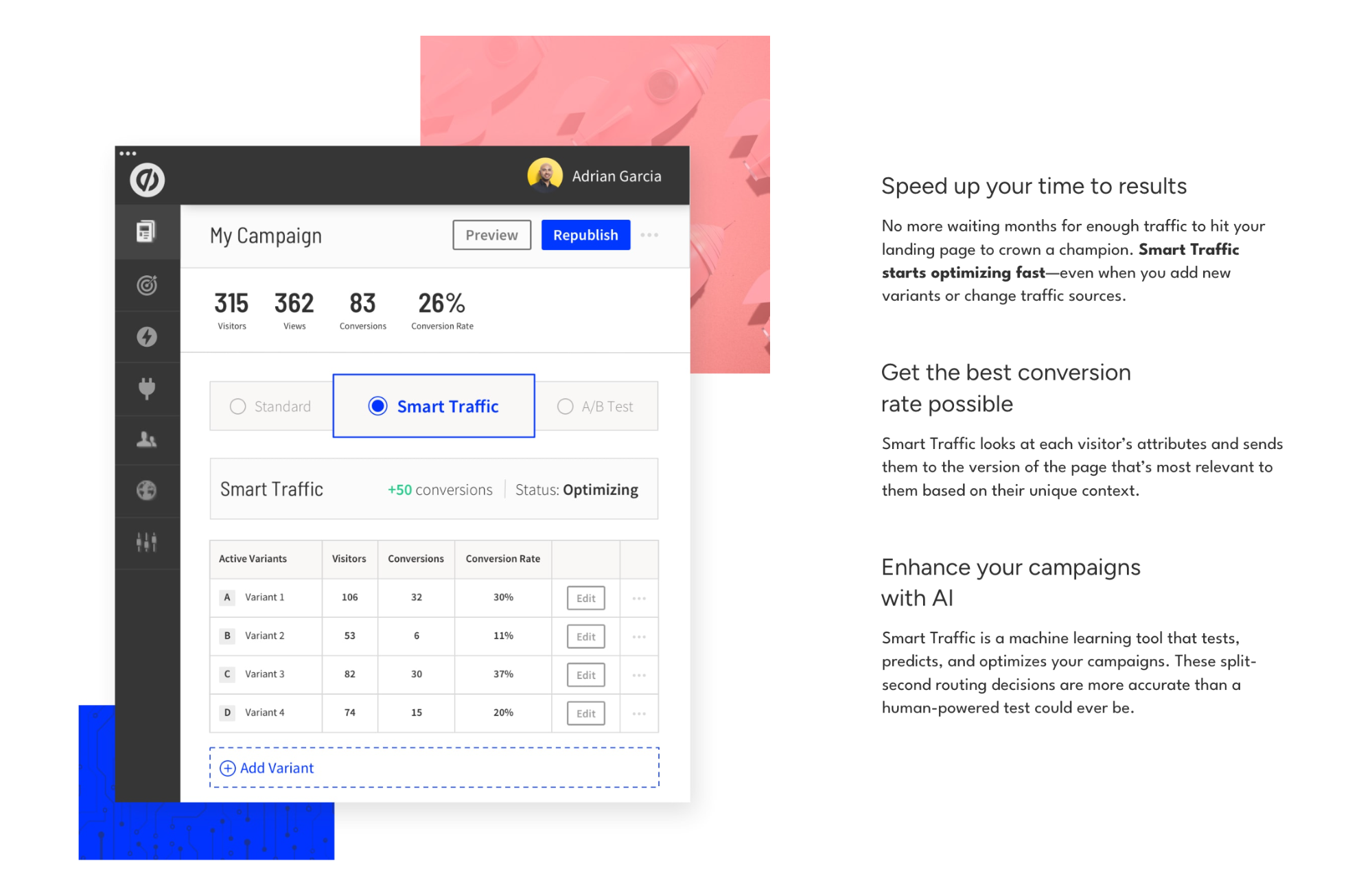
Artificial Intelligence has introduced the concept of “Smart Traffic,” which moves beyond the binary nature of traditional A/B testing. Rather than declaring a single “winner” for all visitors, AI analyzes visitor characteristics—such as geographic location, device type, and time of day—to route them to the page variant most likely to convert that specific individual. This allows for real-time optimization even with lower traffic volumes.
6. Strategic CTA Placement and F-Pattern Design
Eye-tracking studies consistently show that users scan web pages in an “F” or “Z” pattern. Placing CTAs in the path of natural eye movement—specifically in the “above-the-fold” area, at the end of high-value content blocks, and in persistent sticky bars—ensures that the next step is always visible.

7. The Psychology of Social Proof
Trust is a prerequisite for conversion. The integration of social proof—including client logos, verified review counts, and “mini” case study snippets—serves as a psychological “consensus” trigger. Industry reports suggest that 92% of consumers hesitate to make a purchase when there are no customer reviews available.
The Technical Imperative: Speed and Performance
Technical performance is no longer just an IT concern; it is a critical marketing metric. Data from Google and other major analytics providers confirms that 53% of mobile visitors will abandon a page if it takes more than three seconds to load. Furthermore, conversion rates drop by an average of 4.42% for every additional second of load time.
To mitigate these losses, organizations are adopting aggressive optimization techniques:
- Image Compression: Utilizing Next-Gen formats like WebP to reduce file sizes without sacrificing quality.
- Lazy Loading: Prioritizing the loading of content that is currently in the user’s viewport.
- Content Delivery Networks (CDNs): Reducing latency by serving content from servers geographically closer to the user.
Content as a Lead Generation Engine
Content marketing has transitioned from a brand-awareness play to a direct lead-generation tactic. By targeting specific customer “pain points” through educational content, businesses can attract high-intent traffic. This approach relies on the “problem-solution” framework: identifying a specific challenge the user is facing and offering a solution that naturally leads to the company’s product or service.
Pop-ups and sticky bars, often maligned in the early days of the internet, have been reimagined as “engagement overlays.” When triggered by “exit-intent” (when a user moves their cursor toward the browser’s close button) or after a user has scrolled through 70% of a page, these tools can recover up to 15% of abandoning visitors.
Real-Time Engagement and Personalization
The rise of live chat and AI-driven chatbots reflects a consumer demand for immediacy. A visitor with an unanswered question is a visitor who is likely to bounce. Chat solutions provide an immediate feedback loop, qualifying leads in real-time and routing them to sales representatives when interest is at its peak.
Personalization has also moved beyond simple name-tagging in emails. Dynamic Text Replacement (DTR) allows landing pages to automatically update their copy to match the specific keywords a user searched for. For instance, if a user searches for “accounting software for small business,” the landing page can dynamically update its headline to reflect that exact phrase, creating an immediate sense of relevance.
Bridging the Gap: Marketing and Sales Alignment
A persistent challenge in lead generation is the “quality vs. quantity” debate between marketing and sales departments. To resolve this, organizations are implementing robust lead qualification frameworks.
- Marketing Qualified Leads (MQLs): Leads that have shown interest but may not be ready for a direct sales pitch.
- Sales Qualified Leads (SQLs): Leads that meet specific criteria (such as budget, authority, and timeline) and are ready for direct outreach.
By using lead scoring systems—where points are awarded for specific actions like downloading a pricing sheet or visiting a “Request a Demo” page—marketing teams can ensure that only the most high-value prospects are passed to the sales department. This alignment reduces resource waste and improves overall organizational morale.
Broader Implications and Future Outlook
The continuous refinement of website lead generation has broader implications for the global digital economy. As conversion strategies become more sophisticated, the barrier to entry for new businesses shifts from “having a website” to “having an optimized ecosystem.”
Analysts predict that the next frontier of lead generation will be defined by “predictive analytics,” where AI not only responds to user behavior but anticipates it based on historical data patterns. Organizations that fail to adopt these agile, data-driven methodologies risk becoming obsolete in an increasingly competitive digital marketplace.
Ultimately, the transformation of a website from a “digital brochure” into a “lead-generating powerhouse” is not a one-time project but a continuous process of testing, learning, and optimizing. The marketers who succeed will be those who embrace technical speed, psychological triggers, and the autonomy to experiment without institutional friction.








