


The practice of manual A/B testing remains a cornerstone of digital optimization strategy, serving as a silent but prevalent alternative to high-cost enterprise platforms. While the broader industry conversation often focuses on sophisticated, third-party experimentation suites, a significant segment of growth teams continues to rely on custom-built stacks, feature flags, and internal analytics to validate product changes. This approach is particularly common among organizations managing high-compliance environments, limited budgets, or highly specialized technical architectures. However, as digital maturity increases, the transition from these manual workflows to automated platforms represents a critical inflection point for businesses seeking to scale their decision-making processes.
The Operational Reality of Manual Experimentation
Manual A/B testing refers to the execution of controlled experiments without the assistance of a dedicated testing platform. In this environment, engineering and data teams assume full responsibility for the "experimentation lifecycle," which includes traffic allocation, user randomization, data collection, and statistical analysis. Unlike turnkey solutions that offer visual editors and automated statistical engines, manual setups require developers to hard-code variations and analysts to manually calculate significance using SQL, Python, or spreadsheet-based models.
The motivation for maintaining a manual setup is rarely rooted in a desire for complexity; rather, it is a response to specific organizational constraints. For many startups, the primary driver is fiscal. With enterprise experimentation platforms often commanding five-figure annual contracts, small teams find it more economical to leverage existing tools like Google Analytics 4 (GA4) or internal feature flag systems.
Beyond cost, engineering control plays a pivotal role. In modern software environments—particularly those utilizing headless frontends, server-side rendering (SSR), or native mobile applications—third-party scripts can introduce latency or "flicker" (the flash of original content before the variation loads). By building experimentation logic directly into the application code, technical teams can ensure a seamless user experience and maintain strict ownership over the data schema.
A Chronology of the Build-Versus-Buy Dilemma
The evolution of a testing program typically follows a predictable timeline. In the "Proof of Concept" phase, a team might run two or three tests per quarter using simple redirects or basic JavaScript injections. At this stage, manual testing is highly efficient; the overhead is low, and the results are easy to interpret.
As the program moves into the "Scaling" phase, the frequency of testing increases. This is where the manual model begins to show signs of strain. The timeline for a single experiment expands because every new test requires a developer to write code, a QA engineer to verify the logic, and a data scientist to analyze the output. By the time a company reaches the "Institutionalized Experimentation" phase—running dozens of tests simultaneously across different departments—the cost of engineering hours often surpasses the cost of a dedicated platform.
Industry analysts note that the "hidden cost" of manual testing is the opportunity cost of engineering time. When senior developers spend 20% of their week setting up traffic splits and cleaning data for A/B tests, they are not building core product features. This realization often serves as the catalyst for organizations to migrate toward automated solutions.
Methodologies of Non-Platform Testing
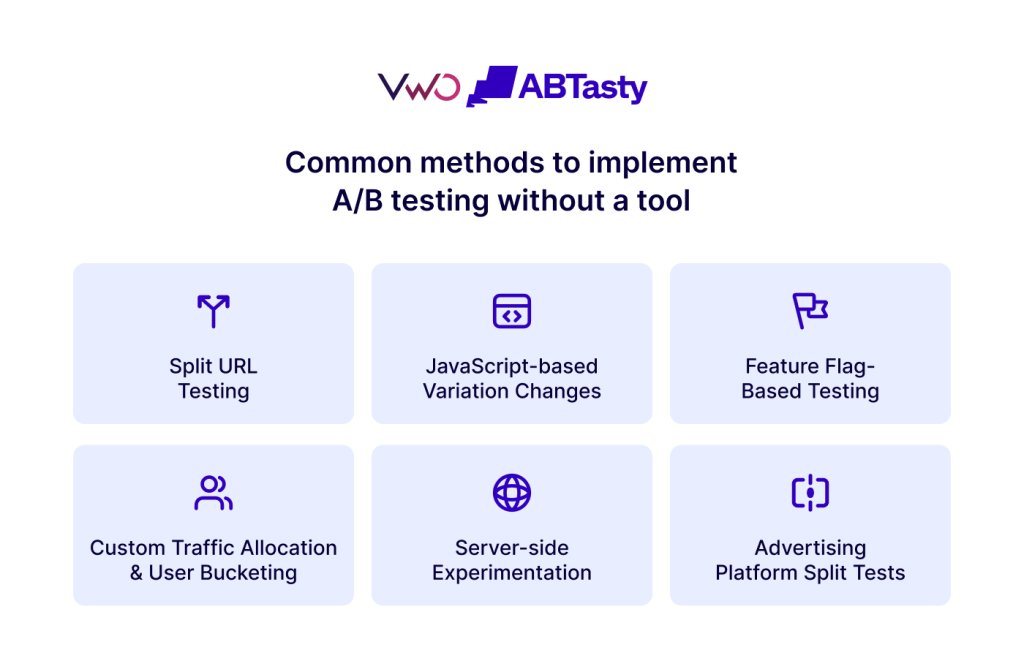
Teams operating without a dedicated platform generally employ one of five primary methodologies to segment their audiences and deliver variations:
- Split URL Testing: This is the most straightforward approach, where two distinct versions of a page exist on different URLs. Traffic is routed between them at the server or CMS level. While effective for major redesigns, it is notoriously difficult to manage from an SEO perspective due to the risk of duplicate content.
- JavaScript-Based Variation: Developers use client-side scripts to modify DOM elements dynamically. While this offers flexibility for marketing teams to test headlines and CTAs, it is the most prone to performance issues and layout shifts.
- Feature Flag-Based Testing: Increasingly popular in DevOps-centric organizations, feature flags allow teams to toggle new features on or off for specific user groups. This method integrates experimentation directly into the deployment pipeline, making it safer for backend changes.
- Server-Side Assignment: In this sophisticated model, the server determines which version of a feature a user should see before the page is even rendered. This eliminates client-side latency and is the gold standard for testing complex logic like pricing algorithms or recommendation engines.
- Ad Platform Experiments: For many marketing teams, testing begins and ends within the walled gardens of Google Ads or Meta Ads. These platforms provide built-in split testing for creatives and landing pages, though the data remains siloed within the advertising ecosystem.
Statistical Integrity and the Risk of False Positives
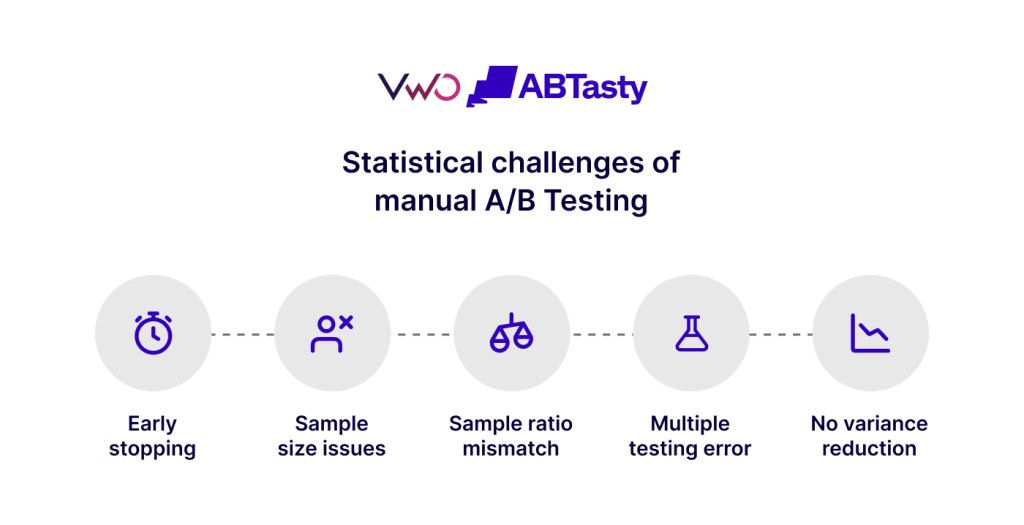
The most significant risk associated with manual A/B testing is not technical, but statistical. Dedicated platforms include "guardrails" designed to prevent common analytical errors. Manual setups, by contrast, are vulnerable to several critical failures:
The Peeking Problem: In a manual setup, it is tempting for stakeholders to check the results daily. If they see a "95% confidence" result on day three and stop the test, they are likely falling victim to a false positive. Statistical significance is only valid if the sample size was predetermined and the test ran for its full duration.
Sample Ratio Mismatch (SRM): If a test is designed for a 50/50 split but the actual data shows a 52/48 split, the experiment is likely compromised. This can happen due to bot traffic, caching issues, or flawed randomization logic. Automated platforms flag SRM instantly; manual teams often miss it entirely, leading them to make business decisions based on corrupted data.
Variance Reduction: Advanced platforms use techniques like CUPED (Controlled-experiment Using Pre-Experiment Data) to reduce "noise" in the data, allowing for faster results with smaller sample sizes. Implementing these algorithms manually requires a high level of data science expertise that many growth teams do not possess.
The SEO and Performance Implications
From a journalistic perspective, the impact of manual testing on a brand’s organic search visibility cannot be overstated. Google’s official documentation is clear: experimentation should not be used for "cloaking" (showing search engines different content than users).
In manual environments, poorly implemented split URL tests often fail to use rel=canonical tags, leading Google to index both versions of a page. This dilutes ranking signals and can lead to a drop in organic traffic. Furthermore, client-side manual tests that cause high Cumulative Layout Shift (CLS) can negatively impact a site’s Core Web Vitals, which are direct ranking factors in the Google search algorithm.
Market Analysis: The Shift Toward Unified Insights
The current market trend suggests a move away from "siloed testing" toward "unified experimentation." This involves connecting behavioral data (heatmaps and session recordings) with quantitative A/B test results.
Inferred statements from industry CTOs suggest that the primary goal for 2024 and 2025 is the reduction of "technical debt." Manual testing frameworks, while agile in the short term, often result in a "spaghetti code" of legacy feature flags and abandoned experiment logic. A dedicated platform acts as a system of record, documenting every hypothesis, variation, and result in a centralized location.
Data from recent industry reports indicates that organizations using dedicated experimentation platforms run, on average, 3.5 times more tests per year than those using manual methods. This increase in velocity is directly correlated with higher conversion rates and faster product-market fit.
Conclusion: Balancing Autonomy and Scale
Manual A/B testing remains a vital tool for teams in the early stages of growth or those with extreme technical constraints. It fosters a culture of "building" and gives engineers a deep understanding of how data flows through their applications.
However, the transition to a dedicated platform like VWO or similar enterprise tools is an inevitability for any organization that views experimentation as a core business function. The shift is not merely about buying software; it is about reclaiming engineering time, ensuring statistical rigor, and protecting the brand’s digital infrastructure from the risks of SEO penalties and performance degradation. As the digital landscape becomes increasingly competitive, the ability to run reliable, high-velocity experiments will likely be the primary differentiator between market leaders and those struggling to keep pace.







