The contemporary digital landscape presents a significant challenge for individuals seeking to maintain online privacy, particularly concerning search engine usage. While a multitude of alternatives to dominant players like Google and Bing have emerged, purporting to offer enhanced privacy, the nuances of their data collection, monetization strategies, and AI integration often remain opaque. This analysis delves into seven active private search services, examining their stated data practices, the origins of their search results, their revenue models, and the extent to which their artificial intelligence features can genuinely be disabled, providing a comprehensive guide for users with varying threat models and privacy requirements.
The Evolving Demand for Privacy in Digital Search
The concept of a "private search engine" has evolved significantly over the past decade, driven by increasing public awareness of data surveillance, targeted advertising, and the extensive profiles built by major technology companies. Users are no longer simply seeking alternatives to Google; they are demanding transparency regarding data handling, control over their digital footprint, and a clear understanding of how their search queries are processed. However, the term "does not track you" has become a marketing platitude, encompassing a broad spectrum of practices from stringent no-logging policies to more permissive approaches that anonymize data after collection, or share it with third parties under specific conditions. This ambiguity necessitates a deeper examination beyond surface-level claims.
The integration of Artificial Intelligence (AI) into search results further complicates the privacy landscape. While AI-powered summaries and generative answers can enhance convenience, they also introduce new vectors for data processing, potentially involving third-party AI models with their own data retention policies. Users must now consider not only who collects their search queries but also who processes them through AI, and what data persists from those interactions.
Moreover, the quest for a universally "best" private search engine is often futile. Optimal choice depends heavily on an individual’s "threat model"—the specific risks they aim to mitigate. Factors such as desired search relevance, willingness to pay for a service, the importance of index independence (not relying on Google or Bing’s core infrastructure), and the absolute control over AI features all play a critical role. A configuration that offers maximum privacy might be too slow or technically demanding for daily use, while a highly relevant engine might require an account or transmit queries to an upstream index. Even a provider minimizing its own data collection cannot prevent an internet service provider (ISP) or the destination websites from seeing user activity.
Methodology: A Multifaceted Examination
This analysis evaluates private search engines across several key dimensions:
- Data Collection & Retention: What personal and non-personal data is collected, for how long, and for what purpose?
- Result Sourcing: Do they use their own independent indexes, or do they rely on upstream providers like Google or Bing?
- Monetization Model: How does the service generate revenue (e.g., ads, subscriptions, donations), and what are the privacy implications?
- AI Control: Can generative AI features be completely disabled, and what are the associated data handling practices?
- Usability & Performance: How practical and effective is the engine for daily use across various devices?
Based on this comprehensive assessment, DuckDuckGo emerges as the top recommendation for most users due to its robust balance of privacy, convenience, and clear AI control. For those prioritizing independence from major tech giants, Brave Search offers a compelling free alternative. Meanwhile, users willing to invest in a premium experience will find Kagi to be the leading paid option, delivering exceptional control and ad-free results.
Leading Private Search Engines: A Detailed Breakdown
1. DuckDuckGo: The Accessible Privacy Standard
![Best Search Engine for Privacy in 2026 [7 Ranked]](https://searchenginewatch.com/wp-content/uploads/2026/08/best-search-engine-for-privacy.jpg)
DuckDuckGo consistently ranks as the most straightforward entry point into private search, offering an accessible balance of privacy and usability that appeals to a broad user base. The service explicitly states in its privacy policy that it does not log IP addresses or unique identifiers in conjunction with search queries. While it does retain anonymized search terms to improve its service (e.g., correcting misspellings, enhancing result quality), these terms are deliberately disconnected from any personally identifiable information. This level of precision and transparency in its data handling claims is often perceived as more credible than blanket assertions of "no data processing whatsoever."
Operationally, DuckDuckGo leverages a combination of its own web crawlers and various "instant answer" sources. However, a significant portion of its traditional web links and image results are supplied by Microsoft Bing. This approach allows DuckDuckGo to offer broad search coverage without directly exposing user identities to Microsoft, as requests are proxied. Critics sometimes point to this reliance on Bing as a limitation, arguing that it does not foster true index independence in the way Brave or Mojeek do.
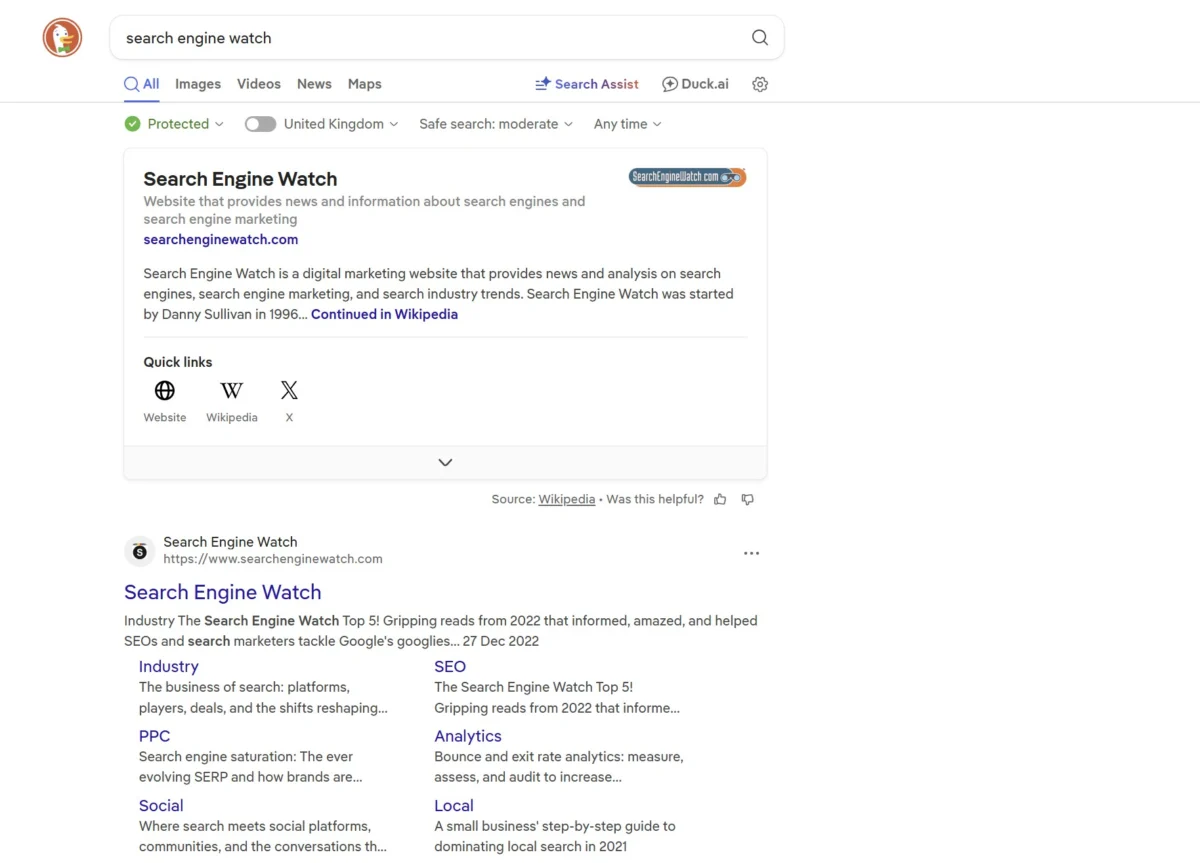
A standout feature for 2026 is noai.duckduckgo.com, a dedicated version of the search engine designed specifically to address growing concerns about AI. This endpoint completely disables DuckDuckGo’s "Search Assist" and "Duck.ai" features and actively filters out AI-generated images from results. This proactive measure provides users with a clear and unambiguous "no-AI" option, distinguishing it from services that merely offer a toggle within settings while retaining AI elements in the interface.
Despite its strengths, DuckDuckGo is not without its compromises, primarily concerning search relevance for highly specific or niche queries. User feedback, particularly in privacy-focused online communities, frequently highlights instances where detailed searches (e.g., for obscure forum discussions, complex troubleshooting, or nuanced academic topics) require fallback to other engines. While DuckDuckGo’s !bang shortcuts facilitate quick redirection to other search services (e.g., !g for Google, !r for Reddit), using these shortcuts bypasses DuckDuckGo’s privacy protections and subjects the subsequent search to the destination service’s policies.
- Choose DuckDuckGo if: You seek the optimal free blend of privacy, ease of use, and explicit no-AI control across desktop and mobile platforms.
- Skip DuckDuckGo if: Your search habits frequently involve obscure research, highly technical queries, or extensive user-generated content, and you prefer to avoid fallback mechanisms.
2. Kagi: The Premium, Ad-Free Experience
Kagi represents a paradigm shift in the search engine model, demonstrating what is possible when the user, rather than the advertiser, is the primary customer. Its subscription-based model entirely eliminates advertisements, allowing for a user experience focused solely on relevance and control. Kagi provides an exceptional degree of customization, enabling users to elevate, demote, or outright block specific domains, apply "lenses" to filter results, and draw from a diverse range of sources including Kagi’s proprietary indexes and anonymized requests to other traditional search indexes.
Kagi’s pricing structure offers flexibility, starting with a 100-search trial, followed by tiers like $5 per month for 300 searches, and $10 per month for unlimited usage, with an "Ultimate" tier providing premium AI features at $25 per month. The subscription model inherently enhances privacy by removing the economic incentive for user tracking and profiling that underpins ad-supported services.
However, the requirement for an account for billing purposes introduces a privacy consideration. While Kagi asserts that search activities are anonymized and not linked to user accounts, its privacy documentation acknowledges the existence of temporary search-query debugging logs. These logs, which are said to be removed after seven days, represent a level of data retention that some privacy purists might find undesirable, even if the queries are not tied to an individual’s account. To mitigate this, Kagi offers "Privacy Pass" for supported paid plans, issuing anonymous tokens to confirm subscription entitlement without revealing the user’s account identity to the search service. This thoughtful design is a significant step, though its availability varies by plan and browser, with Safari being a notable limitation.
Kagi also excels in its AI control features. Its Search AI settings clearly state that AI is invoked only on demand. Users can disable AI functionalities, which not only hides AI-related interface elements but also prevents explicit AI triggers. For those who choose to utilize Kagi’s AI features, the service transparently advises users to review the separate provider disclosures, as underlying AI model vendors may have their own limited data retention policies.
- Choose Kagi if: Search quality and comprehensive control without advertising justify a $10 monthly investment, and you value a highly customizable, ad-free experience.
- Skip Kagi if: You require a service that is entirely account-free, offers zero temporary query retention, or provides a fully functional free tier.
3. Brave Search: Championing Index Independence
Brave Search positions itself as a critical answer for users who prioritize true independence from the search infrastructures dominated by Google and Microsoft. Its core service operates on Brave’s own independent web index, a distinction that carries significant weight beyond mere branding. Unlike services that act as a private frontend to Bing or Google, Brave controls the entire search pipeline—from crawling and indexing to ranking and result delivery. This vertical integration means that Brave is not merely protecting a user’s identity from an upstream provider, but is actively contributing to a more diverse and competitive search ecosystem at the foundational level. An optional Google fallback feature is available for instances where Brave’s own index might yield weaker results, but enabling it naturally lessens the degree of independence.
![Best Search Engine for Privacy in 2026 [7 Ranked]](https://searchenginewatch.com/wp-content/uploads/2026/08/best-search-engine-for-privacy-duckduckgo-1024x737.jpg)
Brave’s privacy policy states that IP addresses are not retained, and any displayed search advertisements are strictly contextual, not based on personal profiles or tracking. The service does employ anonymous usage metrics, which are enabled by default. While Brave affirms these metrics exclude actual query text, IP addresses, and unique identifiers, privacy-conscious users are advised to review their Search settings and consider disabling them.
The question of AI control presents a nuanced picture for Brave Search. While users can disable automatic "Answer with AI" summaries, the "Ask" entry point for AI queries remains visible within the search interface. This design choice may be acceptable for individuals who primarily wish to avoid automatically generated text appearing above traditional links. However, it does not constitute a complete, "AI-free" mode in the same vein as DuckDuckGo’s dedicated endpoint or Kagi’s comprehensive AI disabling options. For users seeking absolute absence of AI features or prompts, this distinction is important.
- Choose Brave Search if: You desire a free, capable private search engine built on its own independent index and are comfortable with an optional AI interface that can be partially controlled.
- Skip Brave Search if: Your definition of "no AI" encompasses the complete absence of any AI button, prompt, or generative feature within the search experience.
4. Startpage: Familiarity with a Privacy Layer
Startpage offers a compelling solution for users who appreciate the quality and familiarity of mainstream search results (primarily Google and Bing) but are unwilling to compromise on their personal search profile being built. Its core mechanism involves submitting user searches to Google and Bing on the user’s behalf, then returning the results while acting as an intermediary to shield the user’s identity.
Startpage’s privacy policy asserts that it does not record IP addresses or user agents, maintaining only aggregate search counts by language. It employs transient anti-abuse techniques rather than conventional IP logging and avoids tracking cookies, though an optional preference cookie can be set to remember user settings. A key feature, "Anonymous View," extends this proxy model beyond the search results page. When activated, Startpage retrieves the destination webpage using its own IP address and displays it to the user, effectively masking the user’s IP from the visited site. While useful for quick, private reads, this feature may break certain scripts or interactive functions and should not be equated with the stronger anonymity and traffic separation provided by tools like Tor.
Crucially, Startpage’s core search results currently do not incorporate generative AI summaries, and its "Instant Answers" are conventional result modules that can be disabled. This makes it a viable choice for users seeking an AI-free experience in their primary search results.
However, the primary trust caveat surrounding Startpage relates to its corporate ownership and audit history. While operating from the Netherlands, Startpage received investment through Privacy One from System1, an advertising-technology company. Startpage maintains that its management retains full control over privacy decisions and practices. While there is no public evidence to suggest System1 has compromised these practices, the involvement of an ad-tech firm raises questions for some privacy advocates. Furthermore, its most significant public audit—EuroPriSe recertification—was postponed in 2017, meaning its strongest third-party validation is somewhat dated.
- Choose Startpage if: Familiar result quality from mainstream engines is paramount, but you demand a privacy layer that prevents personal profiling, and you prefer no generative AI in core search.
- Skip Startpage if: Ownership by an ad-tech group or reliance on Google and Bing for results falls outside your personal threat model or trust parameters.
5. MetaGer: The Nonprofit Metasearch Standard
MetaGer distinguishes itself by combining several attributes rarely found together in the search engine landscape: it is operated by a German nonprofit organization, publishes its source code, operates without advertisements, and does not require a personal account. These characteristics underscore a strong commitment to user privacy and transparency.
According to its July 2026 privacy policy, MetaGer explicitly states that IP addresses and user agents are neither saved nor shared. As a metasearch engine, it aggregates results from multiple partners (including Brave, Mojeek, and Google results via Serper), requiring it to send queries to these partners. However, MetaGer ensures that returned results and the original query are retained only for a few hours for display purposes.
Instead of a conventional account system, MetaGer provides users with a random key for anonymous access. This key can be topped up with tokens via a one-time payment (e.g., €5 for approximately 500 tokens, estimated to last a typical user around two months). The availability of cash payment options further enhances anonymity by allowing users to avoid leaving a digital payment trail. The key also grants access to a proxy service, enabling users to load destination pages through MetaGer’s servers, thereby masking their IP address from the visited sites.
![Best Search Engine for Privacy in 2026 [7 Ranked]](https://searchenginewatch.com/wp-content/uploads/2026/08/best-search-engine-for-privacy-kagi-1024x551.jpg)
While MetaGer’s design offers a credible and robust privacy framework, its payment model and ecosystem can be less convenient than free, ad-supported alternatives. It provides browser integrations and an Android app, but notably lacks a native iOS application. During the review, no standard generative-answer layer was found in its search product, making it an excellent no-AI choice for users who are comfortable with its unique payment and access model.
- Choose MetaGer if: You prioritize nonprofit governance, open-source code, a complete absence of advertising, and a strong anonymous payment and access model.
- Skip MetaGer if: You seek a frictionless free default search experience or require a polished, native iPhone application.
6. Mojeek: The UK’s Independent Index
Mojeek offers a clear answer for users in the United Kingdom and beyond who seek a locally based search company with a genuinely independent web index. Headquartered in Brighton, UK, Mojeek undertakes its own web crawling and ranking processes, a significant achievement in a field dominated by a few giants.
Its privacy policy states that operational logs are retained indefinitely but are stripped of IP addresses, which are replaced with a two-letter country code. Mojeek characterizes the remaining data as non-personal and confirms that it does not set cookies unless a user actively chooses to save their preferences. This approach demonstrates a commitment to minimizing personally identifiable data retention.
Mojeek does incorporate a generative "Search Summary" feature, but critically, it is user-triggered rather than automatically displayed with every result set. This summary appears alongside traditional links and includes citations, giving users the option to engage with AI on their terms. This makes Mojeek a reasonable choice for individuals who prefer AI to be off by default, even if the engine possesses AI capabilities.
The primary trade-off for Mojeek’s independence is the depth of its index. While it can deliver excellent results for straightforward queries and provides a distinct ranking perspective, its smaller corpus can be less reliable for highly obscure, niche, hyper-local, shopping-related, or rapidly evolving queries. Users of Mojeek may find it beneficial to keep a fallback search engine readily available for such instances.
- Choose Mojeek if: UK jurisdiction, and complete independence from Google, Bing, and even Brave’s index, are your foremost priorities.
- Skip Mojeek if: You require a single search engine capable of consistently handling every deep or time-sensitive query without needing a fallback.
7. SearXNG: The Self-Hosters’ Choice for Ultimate Control
SearXNG is fundamentally different from the other services on this list; it is not a commercial search company but rather open-source metasearch software. This software allows users to query a customizable mix of external search services (e.g., Google, Bing, DuckDuckGo) while removing identifying headers and cookies before transmitting the requests.
This inherent flexibility is precisely why SearXNG is highly recommended within privacy communities, but also why simplistic rankings often misrepresent it. Its privacy posture is entirely dependent on its deployment model. If a user opts for a public SearXNG instance (hosted by someone else), they must implicitly trust the administrator of that instance. SearXNG’s own documentation explicitly warns that an instance operator could potentially log or sell data. Conversely, if a user chooses to self-host SearXNG, they gain maximum control over logs and configuration. However, even with self-hosting, upstream search engines will still see requests originating from the user’s instance. A server used by only one person might generate a query stream that is easier to isolate and potentially de-anonymize than one shared by a multitude of users through a popular public instance.
The default SearXNG software does not impose a generative answer layer, though instance operators have the flexibility to modify the interface or integrate AI-capable engines. Consequently, aspects such as speed, uptime, the mix of search results, and privacy guarantees are highly variable and depend entirely on the specific instance being used.
- Choose SearXNG if: You possess the technical understanding for deployment and desire maximum control over search sources and configuration, willing to manage the inherent trust model.
- Skip SearXNG if: You require a service with consistent privacy properties, reliable support, and guaranteed uptime without the need for technical setup and ongoing administration.
The AI Dilemma in Private Search
![Best Search Engine for Privacy in 2026 [7 Ranked]](https://searchenginewatch.com/wp-content/uploads/2026/08/best-search-engine-for-privacy-brave-1024x501.jpg)
The rapid advancement and integration of generative AI into search engines present a new frontier for privacy considerations. While AI-powered summaries and direct answers can enhance efficiency, they also introduce several challenges:
- Third-Party Data Processing: Many AI models, especially large language models (LLMs), are provided by third-party vendors. Even if a search engine anonymizes queries before sending them to an LLM, the vendor’s own data retention policies and processing practices become a factor.
- Data Retention by AI Models: Some AI models may retain prompts and generated outputs for training, improvement, or abuse prevention, potentially introducing new points of data storage outside the direct control of the private search engine.
- "Hallucinations" and Misinformation: AI models can sometimes generate incorrect or misleading information, which, when presented as authoritative search results, can have significant implications for information accuracy.
- User Expectations: Users seeking privacy often implicitly seek control. The presence of AI, even if optional, can create unease if its underlying data flow is not fully transparent.
The analysis shows that providers like DuckDuckGo and Kagi offer the most comprehensive AI control, with dedicated no-AI modes or explicit opt-out functionalities. Brave Search offers partial control, while Startpage and MetaGer currently lack generative AI layers in their core products, making them de facto no-AI options. This spectrum of AI integration and control allows users to align their search experience with their comfort level regarding AI’s role in their data processing.
Addressing Common Misconceptions and Unrecommended Services
The private search market is dynamic, with many services vying for user attention. It is crucial to distinguish between genuine privacy-focused offerings and those whose claims are less robust upon closer inspection. Several popular services, while not inherently "bad," do not meet the stringent criteria for top-tier privacy recommendations under their current terms and availability:
- Qwant: Its policy details Microsoft receiving queries and technical data, including full IP addresses in some scenarios, and describes longer data retention periods than the recommended finalists.
- Ecosia: Despite its environmental mission, its privacy policy states that IP addresses and queries are automatically shared with Bing or Google. While it offers an "AI-free mode," this does not alter the fundamental reliance on upstream giants for core results.
- Swisscows Free: The free tier explicitly shares queries and masked technical data with advertising partners, and embedded ad iframes can transmit personal data directly to Bing or Google. Its "Pro" version offers a different, paid proposition.
- Ghostery Private Search: As of June 1, 2026, it has been in closed beta and is not publicly available for general recommendation.
- Mullvad Leta: This service was shut down by Mullvad on November 27, 2025.
These examples underscore the necessity of scrutinizing privacy policies beyond marketing slogans. Community discussions, particularly on platforms like Reddit, often highlight real-world usability trade-offs (e.g., DuckDuckGo’s struggle with deep queries, Kagi’s cost). However, such discussions, while valuable for assessing user experience, cannot substitute for official disclosures, technical audits, or documented incidents when evaluating a provider’s backend data handling practices. Claims of an engine being "compromised" or offering "perfect anonymity" must be substantiated by verifiable evidence.
Private Search is Not Anonymous Search
A fundamental distinction must be made between "private search" and "anonymous search." A private search engine primarily limits what the search provider records about the user and how it profiles them. It does not render the entire browsing session invisible or anonymous to other entities. Your Internet Service Provider (ISP) can still see your connection to the search engine, and the websites you click on from search results will see your IP address (unless you use a proxy or VPN).
For users whose threat model requires hiding their IP address from the search provider itself, or achieving broader anonymity online, additional tools are necessary. Privacy Guides, a respected resource, consistently recommends considering Tor Browser or a trusted Virtual Private Network (VPN). Tor Browser offers stronger anonymity by routing internet traffic through a global network of relays, making it extremely difficult to trace back to the user. However, its privacy benefits are contingent on correct usage and can come with speed limitations. A private search engine functions as one crucial layer within a broader privacy strategy, not as an all-encompassing invisibility cloak. Browser security, up-to-date software, robust tracker blocking, careful account management, and the judicious use of tools like Tor or a VPN collectively contribute to a more secure and private online experience.
Choosing Your Private Search Engine: A Strategic Decision
The selection of a private search engine in 2026 is a strategic decision that should align with an individual’s specific privacy priorities and technical comfort level. For the vast majority of users, DuckDuckGo provides an excellent entry point, offering a strong balance of privacy, ease of use, and explicit control over AI features. Those willing to pay for an enhanced, ad-free experience with granular control will find Kagi to be an unparalleled choice. For users deeply committed to challenging the dominance of major tech infrastructures, Brave Search offers a compelling, independent, and free solution.
Regardless of the choice, understanding the underlying data practices, monetization models, and AI integration of any search service is paramount. The digital landscape continues to evolve, and vigilance remains the user’s strongest tool in safeguarding their privacy.