rifanmuazin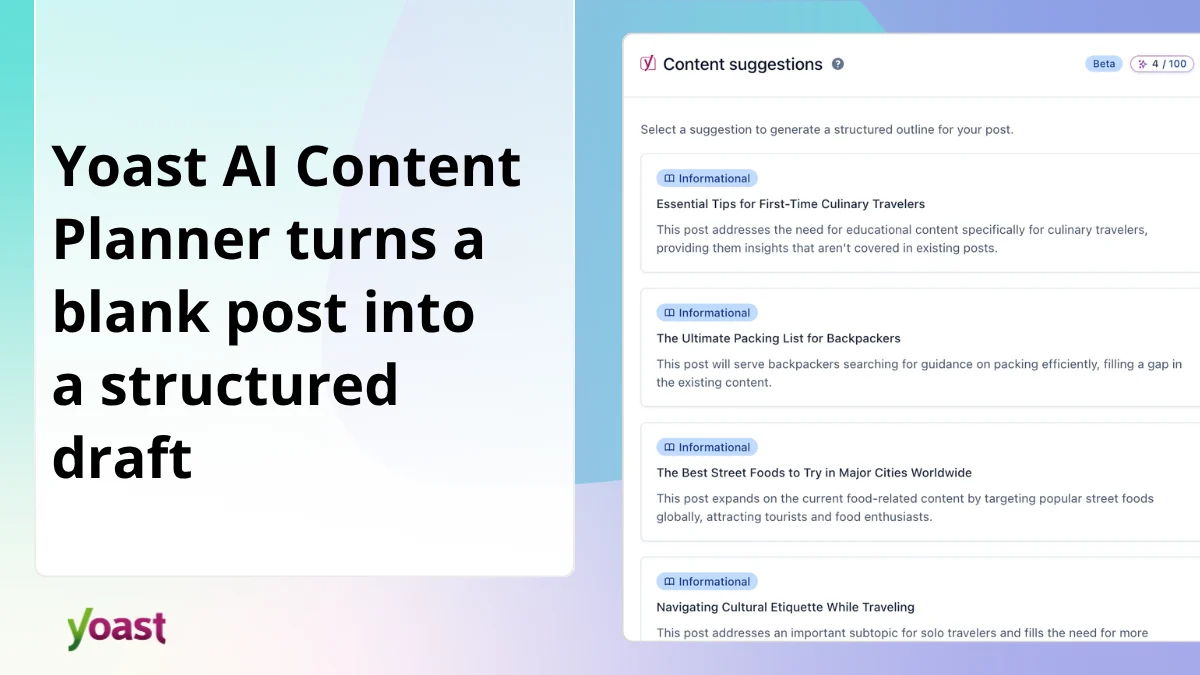
The long-standing challenge of the blank page, a pervasive obstacle for content creators worldwide, is now being directly addressed by Yoast SEO with the introduction of its AI Content Planner. This innovative feature, now available to Yoast SEO Premium users, integrates directly into the WordPress editor, offering immediate, data-driven post ideas and structured drafts to streamline the content generation process. The launch signifies a significant step in Yoast’s commitment to enhancing SEO capabilities and user efficiency within the WordPress ecosystem, leveraging artificial intelligence to bridge content gaps and expedite publishing.
Bridging the Content Gap: The Core Functionality
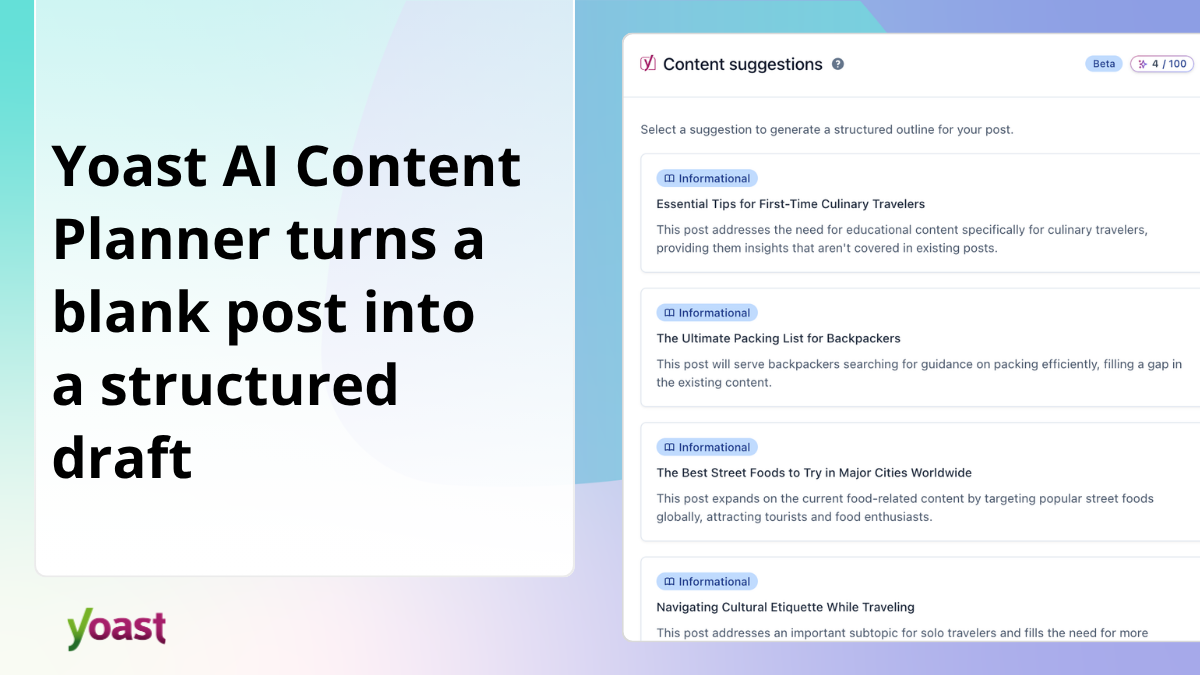
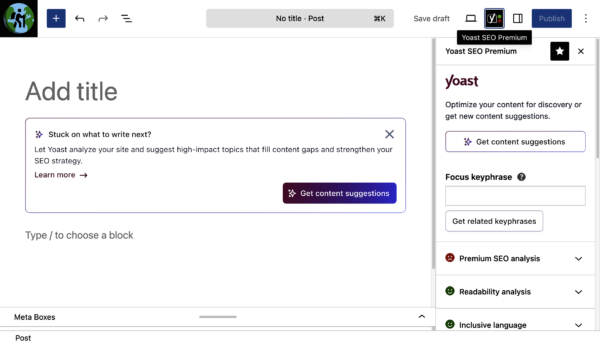
At its essence, the Yoast AI Content Planner is designed to mitigate "writer’s block" and facilitate a more strategic approach to content development. Upon opening a new post in the WordPress editor, Premium users are greeted with five relevant post ideas. These suggestions are not arbitrary; they are intelligently generated by scanning the user’s existing site content, identifying thematic clusters, popular topics, and crucially, potential content gaps that, if addressed, could enhance the site’s overall topical authority and SEO performance. This analytical approach moves beyond simple keyword suggestions, aiming to foster a more comprehensive and interconnected content strategy.
Once a user selects an idea, the AI Content Planner constructs a structured starter draft within moments. This draft is comprehensive, including a proposed title, a logical outline for the article, a primary focus keyphrase, a meta description for search engine snippets, and detailed content notes for each section. These notes act as prompts, guiding the writer on key points to cover, relevant subtopics, and potential angles, ensuring that the resulting content is not only well-structured but also strategically aligned with the identified content gap and SEO objectives. The transition from an empty editor to a fully structured, ready-to-write draft can be accomplished in minutes, drastically reducing the initial setup time for content creation.
The Evolution of Content Creation and Yoast’s Role
The introduction of AI into content planning by Yoast is not an isolated event but rather a reflection of broader trends in digital marketing and technological advancement. For years, content creators have grappled with the dual pressures of producing high-quality, engaging material consistently while also optimizing it for search engines. Tools like Yoast SEO have been instrumental in the latter, guiding users on keyword density, readability, internal linking, and technical SEO aspects. However, the initial ideation and structuring phase often remained a highly manual and time-consuming endeavor.
According to various industry reports, content marketers spend an average of 4-6 hours per blog post, with a significant portion dedicated to research and outlining. A survey by Semrush in 2023 indicated that 65% of companies actively invest in content marketing, highlighting its critical role in digital strategy. Yet, 40% of marketers struggle with producing engaging content, and 30% find it difficult to generate enough content consistently. The Yoast AI Content Planner directly addresses these pain points by automating the initial, often most daunting, stages of content creation, promising to enhance efficiency and output.
Yoast SEO, founded by Joost de Valk in 2007, has grown to become one of the most widely used WordPress plugins, boasting over 5 million active installations. Its enduring success is attributed to its continuous innovation and its role in democratizing SEO, making complex optimization accessible to a broad user base. The integration of AI capabilities into its core offering marks a natural progression, aligning with the industry’s rapid adoption of AI for various tasks, from data analysis to content generation. This move solidifies Yoast’s position not just as an SEO optimization tool but as a comprehensive content strategy assistant.
A Timeline of AI Integration in Digital Marketing
The journey of AI in digital marketing has accelerated significantly in recent years.
- Early 2010s: Basic machine learning algorithms began assisting with ad targeting and predictive analytics.
- Mid-2010s: Natural Language Processing (NLP) started to improve, leading to better keyword research tools and sentiment analysis.
- Late 2010s: Generative AI, particularly with the advent of large language models (LLMs) like GPT-2, showed nascent capabilities in generating human-like text, though often requiring significant human editing.
- Early 2020s: The release of more sophisticated LLMs (e.g., GPT-3, GPT-4) democratized AI content generation, leading to a proliferation of AI writing assistants. Tools began emerging that could not only generate text but also analyze content gaps, suggest topics, and even create basic outlines.
- 2023-2024: Deep integration of AI into existing platforms became a key trend. Rather than standalone AI tools, established software solutions like Yoast SEO are now incorporating AI functionalities directly into their user interfaces, aiming for seamless workflow integration. The Yoast AI Content Planner fits squarely into this latter category, representing a mature application of AI within a familiar environment.
Technical Underpinnings and Accessibility
The technical implementation of the Yoast AI Content Planner is designed for maximum user convenience. It operates entirely within the WordPress post editor, requiring no separate installations, external logins, or additional setup procedures. This seamless integration ensures that the user experience remains cohesive and efficient. The AI’s ability to generate relevant ideas stems from its sophisticated analysis of the site’s existing published content. It maps the topics covered, identifies patterns, and uses this understanding to pinpoint areas where new content could logically extend the site’s authority or address related queries.
A critical prerequisite for the feature’s optimal performance is a sufficient volume of published content on the user’s site. The AI requires a robust dataset to build a "meaningful picture" of what the site already covers and where the gaps lie. If a site has limited content, the system will issue a low-confidence warning, indicating that it cannot generate reliable suggestions. This highlights the AI’s reliance on data quality and quantity for accurate and valuable output, underscoring that it augments existing content efforts rather than creating them from a vacuum.
Inferred Statements and Strategic Vision
While direct quotes were not provided in the source material, the launch of such a feature would typically be accompanied by strategic statements from Yoast leadership. One could infer Thijs de Valk, CEO of Yoast, emphasizing the company’s continuous innovation: "Our mission at Yoast has always been to empower creators to build amazing websites. The AI Content Planner is a testament to this commitment, directly addressing one of the biggest bottlenecks in content creation – the initial ideation and structuring. We believe this tool will significantly boost productivity for our Premium users, allowing them to focus more on crafting high-quality narratives and less on the mechanics of getting started."
Similarly, a product manager like Beth Parker, who authored the original announcement, might elaborate on the user benefits: "We’ve listened to our users’ frustrations with writer’s block and the time-consuming nature of content planning. The AI Content Planner is engineered to transform that experience. By providing intelligently suggested topics and ready-made outlines, we’re helping users go from a blank canvas to a structured draft in minutes, ensuring their content strategy is always moving forward and always optimized." These inferred statements underscore the user-centric design philosophy and the strategic importance of AI in Yoast’s product roadmap.
Broader Implications for Content Marketing and SEO
The integration of AI-powered content planning tools has profound implications for the content marketing and SEO landscape:
- Enhanced Content Velocity and Efficiency: Businesses can significantly accelerate their content production cycles. The reduction in time spent on ideation and outlining means content teams can publish more frequently, maintaining a consistent flow of fresh, relevant content, which is crucial for SEO.
- Improved Content Strategy and Topical Authority: By identifying content gaps, the AI helps businesses build more comprehensive topical clusters around their core subjects. This systematic approach can improve a site’s overall authority in the eyes of search engines, leading to better rankings across a wider range of related keywords.
- Augmented Human Creativity: Crucially, this tool is designed to augment human creativity, not replace it. The AI provides a starting point, freeing up writers to focus on research, unique insights, compelling storytelling, and refining the tone and voice, aspects where human ingenuity remains irreplaceable. It shifts the emphasis from structural planning to creative execution.
- Democratization of Advanced Content Strategy: Similar to how Yoast SEO democratized technical SEO, the AI Content Planner makes advanced content strategy more accessible to small businesses and individual bloggers who may not have dedicated content strategists or large marketing teams.
- Competitive Landscape Shift: This move by Yoast sets a new standard for SEO plugins. Competitors will likely feel pressure to integrate similar AI-driven features, leading to an arms race in AI-powered SEO tools and ultimately benefiting users with more sophisticated options.
- Ethical Considerations and Quality Control: While AI can generate ideas and structures, the ultimate responsibility for factual accuracy, originality, and ethical content creation remains with the human writer. The tool streamlines the process but does not diminish the need for human oversight and editorial rigor to prevent the spread of misinformation or generic content. Quality control, fact-checking, and infusing human perspective will become even more critical to differentiate AI-assisted content.
Industry Reactions and Expert Perspectives
Initial reactions from the SEO and content marketing community are anticipated to be largely positive, especially among those grappling with the demands of consistent content creation. SEO professionals may view this as a valuable tool for identifying strategic content opportunities that align with their overall SEO goals. Content managers are likely to appreciate the efficiency gains, allowing their teams to be more productive.
For small businesses and individual bloggers, this feature could be a game-changer. "The biggest hurdle for many small businesses is simply knowing what to write next that will actually benefit their SEO," says Sarah Chen, a freelance content strategist. "Having an AI suggest relevant topics and an outline based on your existing site content is like having a junior content strategist working for you 24/7. It significantly lowers the barrier to entry for effective content marketing."
However, some experts might caution against over-reliance on AI, emphasizing the need for critical thinking and human input. "While AI can identify gaps and structure content, it lacks the nuanced understanding of audience emotion, brand voice, and unique selling propositions that a human writer brings," notes Dr. Alex Kim, a professor of digital marketing. "The real power comes from using the AI as a highly intelligent assistant, not a replacement for strategic human thought."
Availability and Future Outlook
The Yoast AI Content Planner is exclusively available to Yoast SEO Premium users, reinforcing the value proposition of the premium subscription. Access is immediate upon opening a new post within the WordPress editor, highlighting the plug-and-play nature of the feature. This strategic move is likely to encourage upgrades to Premium, further solidifying Yoast’s revenue model and enabling continued investment in advanced features.
Looking ahead, the integration of AI into Yoast SEO is likely to deepen. Future iterations might include more personalized content suggestions, real-time feedback on content quality and uniqueness, advanced competitive analysis capabilities, or even integration with other marketing platforms. As AI technology continues to evolve, tools like the Yoast AI Content Planner will become increasingly sophisticated, continuously redefining the boundaries of what is possible in content creation and SEO. The company’s commitment to staying at the forefront of these technological advancements ensures that Yoast SEO remains an indispensable tool for anyone serious about their online presence.