
 rifanmuazin
Customer Effort Score (CES) has emerged as a pivotal metric in the landscape of customer experience (CX) management, shifting the focus from the pursuit of customer “delight” to the pragmatic necessity of friction reduction. In an era where digital consumers prioritize speed and convenience, the ability of a business to minimize the labor required to complete a task has become a primary driver of long-term loyalty and operational efficiency. Unlike traditional metrics that measure emotional satisfaction or the likelihood of recommendation, CES provides a clinical assessment of the ease of interaction, offering businesses a direct roadmap for technical and procedural improvements.
The Evolution of Customer Experience Metrics: A Chronology
The concept of the Customer Effort Score was formally introduced in 2010 through a seminal Harvard Business Review article titled “Stop Trying to Delight Your Customers,” authored by researchers from the Corporate Executive Board (CEB), which was later acquired by Gartner. The study challenged the prevailing wisdom that brands needed to exceed customer expectations through “wow” moments to build loyalty. Instead, the researchers found that the most effective way to retain customers was by simply solving their problems quickly and easily.
Following its introduction, CES underwent several iterations. The original version utilized a 1-to-5 scale, asking customers to rate the effort they put into a specific interaction. By 2013, the metric was refined into “CES 2.0,” which utilized a 1-to-7 scale and shifted the phrasing to a statement of agreement: “The company made it easy for me to handle my issue.” This evolution reflected a deeper understanding of user psychology, focusing on the company’s role in facilitating a seamless experience rather than the customer’s internal perception of their own “effort.”
Today, CES sits alongside Net Promoter Score (NPS) and Customer Satisfaction (CSAT) as the “holy trinity” of CX metrics. While NPS measures long-term brand advocacy and CSAT captures immediate sentiment, CES serves as a leading indicator of churn, identifying specific points of friction before they lead to a total breakdown in the customer relationship.

The Mechanics of Measuring Customer Effort
The implementation of a CES program requires a structured approach to data collection and analysis. At its core, the metric is derived from a single-question survey deployed immediately after a critical touchpoint. The most common phrasing used by modern enterprises is: “How easy was it to resolve your issue today?”
Respondents typically select from a Likert scale, which can range from 1 to 5, 1 to 7, or even 1 to 10. A 7-point scale is widely regarded as the industry standard, where 1 represents “Extremely Difficult” and 7 represents “Extremely Easy.” The calculation of the final score is straightforward: the sum of all individual ratings is divided by the total number of responses to provide an average score.
However, quantitative data alone is often insufficient for driving organizational change. Leading CX professionals advocate for the inclusion of qualitative follow-up questions, such as “What made this experience difficult?” or “How could we have made this easier?” This dual-layered approach allows teams to identify not just that friction exists, but the specific technical or procedural origin of that friction.
Strategic Deployment: Identifying Moments of Truth
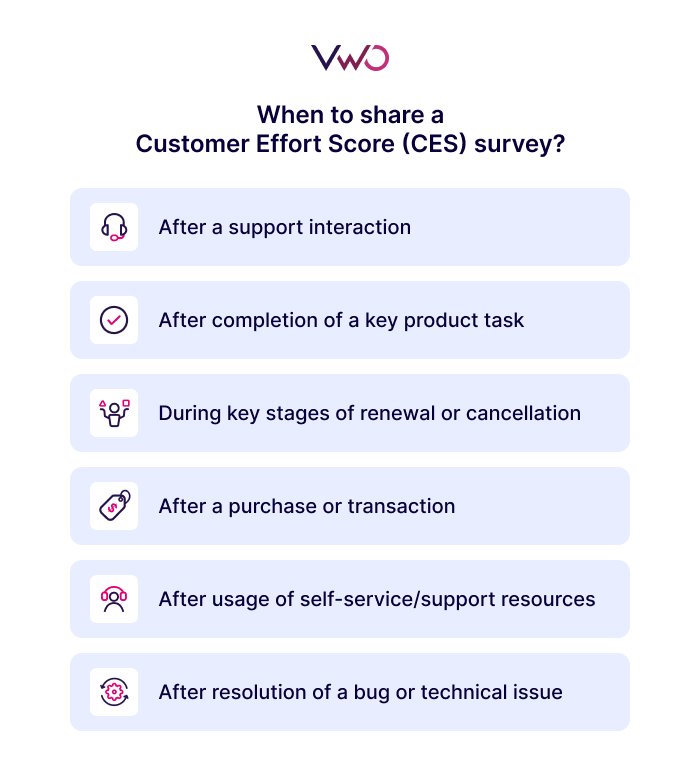
The efficacy of CES is highly dependent on timing. Unlike NPS surveys, which are often sent at regular intervals regardless of recent activity, CES surveys must be “transactional.” They are most effective when triggered by specific “moments of truth” in the user journey:
- Post-Support Resolution: This is the most traditional use case. Measuring effort immediately after a customer interacts with a support agent via chat, email, or phone helps assess the efficiency of the support team and the clarity of the solution provided.
- Post-Transaction/Checkout: For e-commerce entities, the checkout process is a critical friction point. Deploying a CES survey after a purchase helps identify technical bugs, confusing form fields, or unexpected payment hurdles that could lead to cart abandonment.
- Product Onboarding and Task Completion: In the Software-as-a-Service (SaaS) sector, CES is used to gauge the intuitiveness of new features. If a user struggles to set up a dashboard or integrate a third-party tool, the high effort score signals a need for better UI/UX design or more robust documentation.
- Self-Service Resource Utilization: As companies move toward AI-driven help centers and chatbots, CES helps determine if these self-service tools are actually helpful. If a user rates a help article as “high effort,” it indicates that the content is likely outdated, poorly written, or difficult to find.
Supporting Data and Industry Benchmarks
The shift toward prioritizing low effort is backed by substantial empirical evidence. According to research conducted by Gartner, 94% of customers who report a “low-effort” experience express an intention to repurchase, compared to only 4% of those who experience high effort. Furthermore, the same study revealed that the cost to serve a low-effort customer is 37% lower than the cost to serve a high-effort one, primarily because easy experiences lead to fewer follow-up calls and repeat tickets.

Industry benchmarks suggest that a “good” Customer Effort Score is typically above 5 on a 7-point scale. Organizations reaching a score of 6 or higher are considered leaders in customer centricity. Conversely, a score below 4 is a critical warning sign, often correlating with high churn rates and negative word-of-mouth.
The financial implications of high effort are significant. Customers are rarely vocal about minor frictions; instead, they exhibit “silent churn.” Every extra click, confusing navigation menu, or redundant form field acts as a micro-aggression against the user experience. Over time, these moments erode the “trust bank” of the brand, making the customer more susceptible to competitors who offer a more streamlined path to the same outcome.
Expert Perspectives on Digital Friction
Industry experts emphasize that reducing effort is not just about technical speed, but about psychological clarity. Jon MacDonald, a noted specialist in conversion rate optimization, observes that every element on a website sends a signal. “Sometimes those signals are clear, but at other times they simply create confusion that pushes visitors to look elsewhere,” MacDonald states. He argues that the real challenge for modern businesses is identifying these moments across the digital journey and understanding the deeper reasons behind them.
Similarly, April Hung, a specialist in user feedback, highlights the necessity of real-time data. “When users encounter a problem while browsing, they can share their thoughts immediately instead of trying to recall the experience later,” Hung explains. This immediacy is what makes CES a more reliable diagnostic tool than retrospective surveys, as it captures the raw frustration or ease of the moment.
Actionable Strategies for Reducing Customer Effort
To improve a CES rating, organizations must move beyond measurement and into active optimization. This involves a multi-pronged strategy:
- Friction Mapping: Using behavior analytics tools, such as heatmaps and session recordings, teams can visually identify where users stall or “rage-click.” By overlaying these visual insights with high-effort CES scores, businesses can prioritize fixes for the most damaging bottlenecks.
- Streamlining Navigation: Many high-effort experiences stem from information overload. Simplifying website architecture and using clear, action-oriented language can significantly reduce the cognitive load on the user.
- Empowering Self-Service: Investment in searchable, high-quality knowledge bases and intuitive AI chatbots allows customers to resolve issues without the effort of contacting a human agent. However, these tools must be continuously audited to ensure they do not become “dead ends.”
- Proactive Communication: Reducing effort often means anticipating needs. For example, if a shipping delay occurs, proactively notifying the customer reduces the effort they would otherwise spend tracking the package or contacting support.
The Role of Artificial Intelligence in CX Optimization
The integration of Artificial Intelligence (AI) is revolutionizing how CES is managed. Modern platforms, such as VWO, are utilizing AI-driven “copilots” to help teams generate more effective survey questions and analyze qualitative feedback at scale. AI can categorize thousands of open-ended survey responses into themes—such as “technical bug,” “pricing confusion,” or “slow loading”—allowing product teams to address systemic issues with precision.
Furthermore, AI-driven personalization can reduce effort by presenting users with the most relevant information or features based on their past behavior, effectively shortening the path to task completion.
Broader Impact and Implications
The adoption of Customer Effort Score represents a fundamental shift in the philosophy of business-to-consumer relationships. It acknowledges that in a hyper-competitive digital economy, time and mental energy are the most valuable currencies a customer possesses.
By prioritizing ease, companies do more than just improve a metric; they build a foundation of reliability. Low-effort experiences reduce the operational burden on support teams, increase the lifetime value of the customer, and create a brand reputation for efficiency. As digital ecosystems become increasingly complex, the organizations that thrive will be those that master the art of simplicity, ensuring that every interaction is as invisible and effortless as possible. The Customer Effort Score is not merely a number—it is a mandate for clarity in an age of distraction.








