rifanmuazin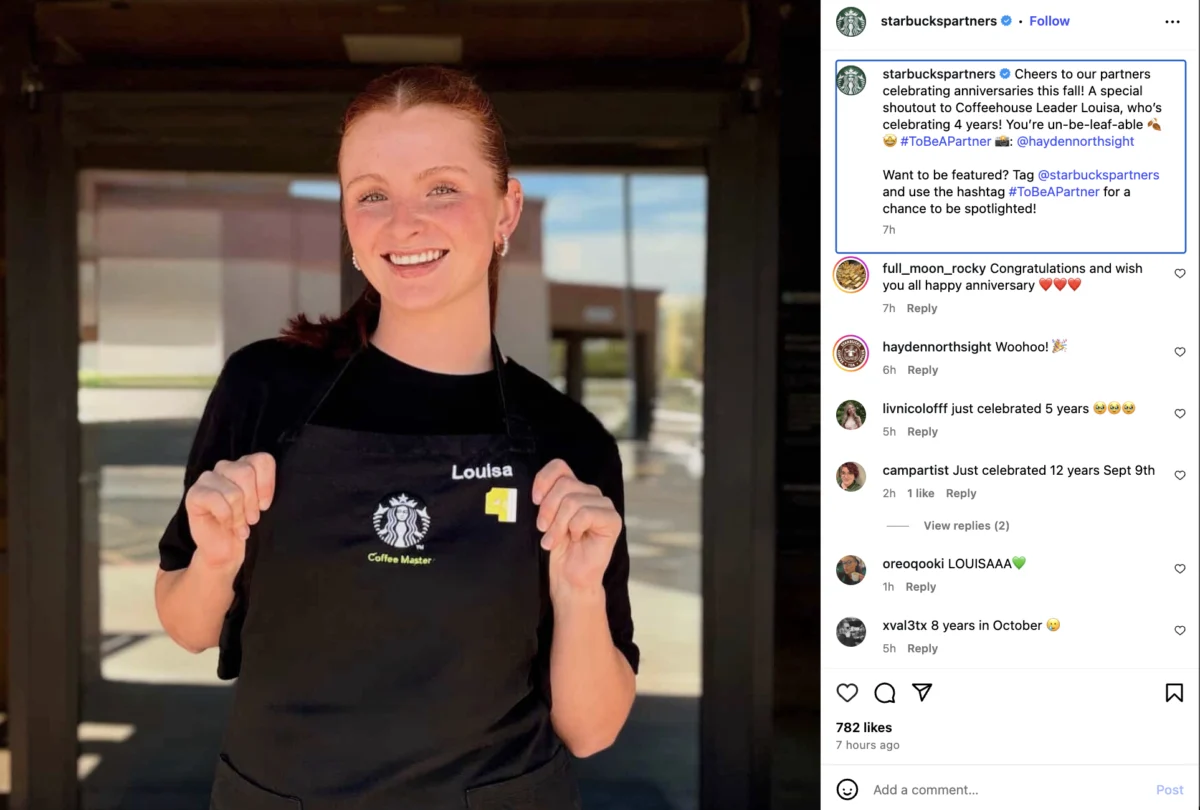
The modern digital landscape has fundamentally reshaped how brands connect with their audiences, making authentic voices more valuable than ever. In an era where consumers are increasingly wary of traditional advertising, the recommendations of trusted individuals — particularly those within a company — hold significant sway. This paradigm shift has propelled employee advocacy programs from a niche marketing tactic to an indispensable component of comprehensive corporate strategy, allowing organizations to transform their workforce into powerful, credible brand ambassadors.
The Evolution and Mechanism of Employee Advocacy
An employee advocacy program is a meticulously structured initiative designed to empower and encourage employees to share company-related content, insights, and experiences across their personal social media networks. This extends beyond merely forwarding corporate announcements; it encompasses sharing thought leadership, celebrating company milestones, providing glimpses into workplace culture, and promoting product launches or campaigns. The underlying premise is simple yet profound: human connections foster trust. Unlike a corporate billboard or a brand’s official social media post, content shared by an employee is often perceived as more genuine, relatable, and trustworthy.

Historically, word-of-mouth marketing has always been a potent force. In the pre-digital age, this might have manifested as an employee discussing their positive work experiences with friends and family. The advent of social media platforms like LinkedIn, X (formerly Twitter), and even Instagram and Facebook has amplified this inherent human tendency, giving employees a global megaphone. Formal employee advocacy programs capitalize on this, providing employees with the tools, content, and guidance to consistently and effectively communicate brand messages.
The distinction between informal advocacy and a structured program lies in its intentionality and measurement. Informal advocacy is spontaneous—an employee might organically praise a company achievement. While valuable, it is unpredictable, difficult to scale, and impossible to systematically track. A structured program, conversely, provides a framework:
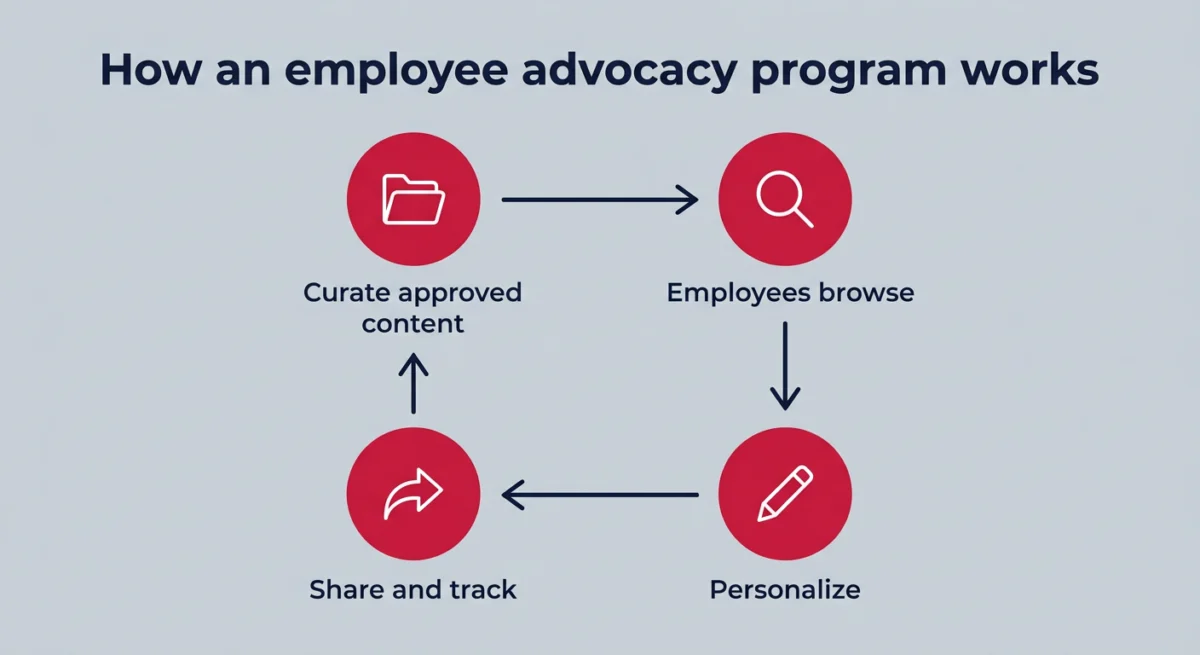
- Content Curation: A centralized repository of pre-approved, brand-safe content (articles, videos, job postings, company news) ready for sharing.
- Training and Guidelines: Employees receive instruction on best practices, social media etiquette, company policies, and how to personalize content while maintaining brand voice.
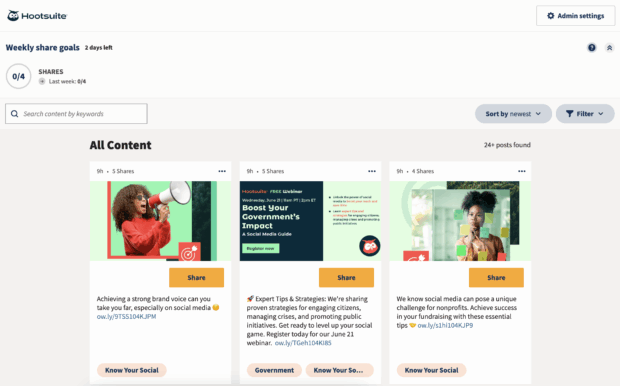
- Technology Platforms: Dedicated tools like Hootsuite Amplify, Haiilo, or EveryoneSocial streamline content distribution, enable easy sharing, and provide analytics.
- Recognition and Incentives: Programs often include gamification, leaderboards, or non-monetary rewards to encourage consistent participation.
This systematic approach allows companies to extend their organic reach dramatically, humanize their brand, and tap into new audiences that traditional marketing channels might miss.
The Indisputable Benefits: Why Companies Invest
The decision for companies to implement employee advocacy programs is driven by tangible business outcomes, ranging from enhanced brand visibility to direct revenue generation, often at a fraction of the cost of traditional marketing. Victoria Samways, Marketing & Brand Manager at Major Tom and a seasoned user of Hootsuite Amplify, succinctly articulates this value: “Our employees are very powerful brand ambassadors. Each employee can easily have hundreds of connections on LinkedIn alone. Multiply that by the number of employees a brand has, and that’s a large audience.” This collective reach translates into several critical advantages:
-
Expanded Brand Reach and Awareness: Employees collectively possess a social network far vaster and more diverse than a company’s official channels. When employees share content, it bypasses algorithmic filters that often suppress corporate pages, reaching new, warm audiences without necessitating paid media spend. This authentic dissemination creates a ripple effect, significantly broadening brand exposure. Studies consistently show that employee shares generate significantly more engagement than brand shares.
-
Attraction and Recruitment of Top Talent: In today’s competitive talent market, employer branding is paramount. A company’s careers page can articulate its culture, but an authentic post from a current employee showcasing daily life, team achievements, or professional development opportunities is far more convincing. This "insider view" provides a genuine reflection of the employee experience, fostering trust and making a company a more attractive prospect for potential candidates. According to LinkedIn data, candidates are often three times more likely to trust company information coming from employees than from the employer itself.
-
Enhanced Brand Reputation and Credibility: People inherently trust other people more than corporate entities. The Edelman Trust Barometer, a leading global study on trust, reported that 88% of consumers consider trust as important as price and quality. When employees actively and positively represent their workplace, it humanizes the brand, building credibility and fostering a perception of a positive, transparent, and employee-centric organization. Even non-promotional posts that reflect a positive work environment contribute to this robust reputation.
-
Boosted Organic Engagement and SEO Value: Social media algorithms are increasingly prioritizing personal content over corporate posts. Employee-generated content often garners higher rates of likes, comments, and shares, which signals relevance and value to these algorithms. This increased engagement not only expands reach but can also contribute indirectly to SEO by driving traffic back to company websites and improving overall brand visibility in search results. Samways’ experience at Major Tom validates this: "Amplify quickly became our second-best channel to generate net-new signups to our webinar. It was only surpassed by paid social, which required budget." This resulted in a remarkable 30% increase in webinar attendees at minimal additional cost.
-
Support for Sales and Lead Generation (Social Selling): The concept of social selling thrives on trusted connections. When sales teams or other employees share content related to products, services, or industry insights, it often reaches prospects within their existing networks, warming up leads and shortening sales cycles. A study by Hinge Marketing found that nearly 64% of advocates in formal programs attributed new business attraction and development to employee advocacy, with 45% crediting it for new revenue streams. Major Tom’s advocacy program, for example, directly generated $100,000 in their sales pipeline from a single campaign, demonstrating the direct financial impact.
-
Positioning Employees as Thought Leaders: Employee advocacy programs equip staff with curated content and platforms to share their expertise, insights, and professional achievements. This empowers individuals to build their personal brand and establish themselves as industry thought leaders, which, in turn, reflects positively on the company’s intellectual capital and expertise. Hinge Marketing also reported that almost 86% of advocates in a formal program experienced a positive impact on their career from their social media involvement. This reciprocal benefit fosters employee engagement and loyalty.
Leading Examples of Employee Advocacy Programs in 2026
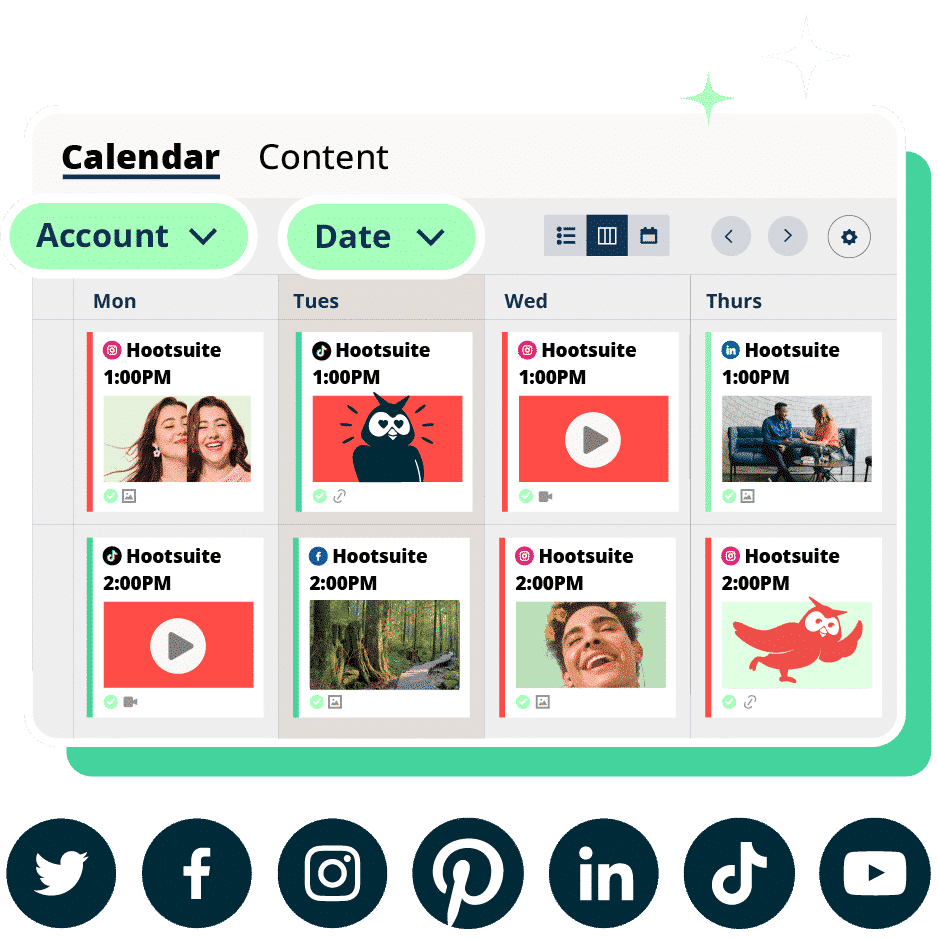
The success of employee advocacy is not theoretical; it’s demonstrated by a diverse array of companies globally. These examples highlight various approaches, priorities, and measurable outcomes.
1. Hootsuite
- Industry: Software as a Service (SaaS)
- Focus: Brand awareness, talent recruitment, revenue growth.
- Implementation: As a pioneer in social media management, Hootsuite leverages its own Amplify platform. The program prioritizes relevance through a cross-departmental Amplify Content Council, ensures engagement with a Recognition Program (prizes, incentives), and provides continuous support via training, onboarding, and push notifications. Content is diverse, catering to various teams and interests.
- Key Results: 3x higher click-through rates on employee-shared content, 2.5x increase in organic reach for job postings, 25% of social media traffic from employees.
- Takeaway: A well-rounded content strategy that caters to diverse employee interests, coupled with consistent recognition, is crucial for sustained engagement and program success.
2. Armanino
- Industry: Accounting, Business Consulting, Technology
- Focus: Brand awareness, talent recruitment, thought leadership.
- Implementation: Armanino structured content hubs by industry and service themes within Hootsuite Amplify. They invested heavily in "brand bootcamps" and social media workshops, training 595 active Amplify users to personalize pre-approved content with their authentic voice.
- Key Results: 350% increase in social media engagement, 12% increase in new hires through social channels, 100% ROI within the first year.
- Takeaway: Comprehensive training that empowers employees to adapt content authentically significantly boosts engagement and measurable results beyond simple sharing.
3. Dell Technologies
- Industry: Information Technology
- Focus: Building trust, extending reach in B2B tech, empowering employee engagement, compliance.
- Implementation: Dell operates one of the world’s largest employee advocacy programs, anchored by its "Social Media and Communities University." This mandatory training ensures employees understand responsible social media use. Dell adheres to an 80/20 content rule: 80% informative/personally interesting content, 20% direct company promotion, preventing posts from feeling overly sales-driven.
- Key Results: Over 20,000 active advocates, hundreds of thousands of social interactions annually, significant amplification of corporate social responsibility (CSR) initiatives.
- Takeaway: Robust training and a balanced content strategy that prioritizes informative and engaging content over purely promotional material are vital for large-scale, sustainable advocacy.
4. Athletico
- Industry: Healthcare
- Focus: Brand awareness, community engagement, employee empowerment.
- Implementation: Athletico utilizes Hootsuite Enterprise and Amplify to identify and support social media-savvy employees. Regular content planning sessions ensure a fresh pipeline of brand-owned posts, thought leadership, and community-focused campaigns.
- Key Results: 3.4 million organic impressions, 200% increase in social media reach, over 100 job applications directly attributed to employee shares.
- Takeaway: Even with a lean marketing team, focused support and ready-to-share content can enable engaged employees to drive substantial reach and recruitment outcomes.
5. Antalis
- Industry: Papers, Packaging, Visual Communication
- Focus: Employer branding, recruiting, sales enablement.
- Implementation: Antalis launched its ambassador program with Hootsuite Amplify, emphasizing training and support to build employee confidence in sharing pre-approved content. A central content library with regional governance allowed diverse teams to find relevant posts easily. Peer learning and ongoing training were key to adoption.
- Key Results: 300% increase in social media engagement, 2x increase in website traffic from social shares, 15% reduction in recruitment costs.
- Takeaway: Providing accessible, relevant, and high-quality content that employees are proud to share, coupled with robust training and ongoing support, drives adoption and tangible business benefits.
6. Starbucks
- Industry: Food and Beverage
- Focus: Reputation management, employer branding, community engagement.
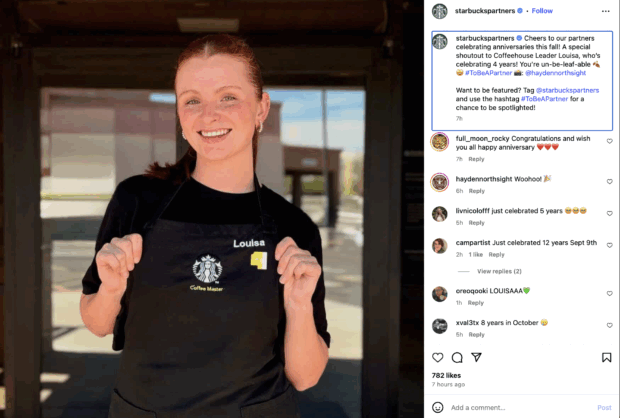
- Implementation: Starbucks fosters advocacy through its "Starbucks Partner" program, where employees (or "partners") share stories about workplace culture, company initiatives, and community involvement. This blends structured programs with organic sharing, supported by content resources, training, and regular recognition. The #ToBeAPartner hashtag is a key identifier for their authentic employee stories.
- Key Results: Strong, authentic employer brand perception, increased candidate interest, enhanced community ties.
- Takeaway: Advocacy doesn’t have to be product-centric. When employees share stories rooted in company values, purpose, and community, it builds genuine trust and reinforces brand identity.
7. Salesforce
- Industry: Software as a Service (SaaS)
- Focus: Global brand awareness, thought leadership, culture, recruiting.
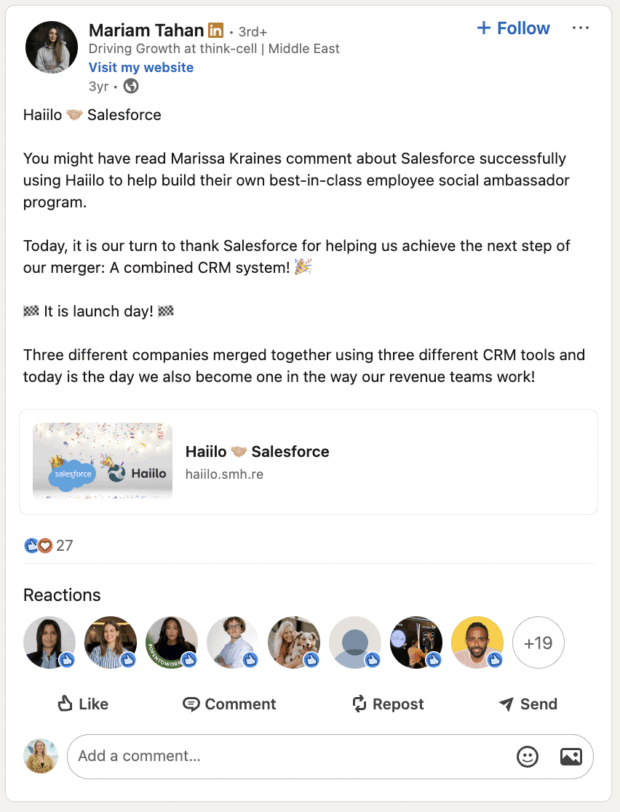
- Implementation: Salesforce revamped its Social Ambassador Program using the Haiilo platform. This sophisticated system offers curated content, training, and gamification. Employees are auto-subscribed to relevant channels based on role and location, with options to personalize copy in multiple languages, ensuring global relevance and ease of use.
- Key Results: Over 5,000 active advocates globally, millions of social media impressions, significant contribution to thought leadership positioning, enhanced recruitment outreach.
- Takeaway: Balancing structured frameworks with personalization options is key for large, global programs. Empowering employees to tailor content in their own voice, across languages, drives higher adoption and impact.
8. Morgan Philips Group
- Industry: Recruitment and Talent Management
- Focus: Brand awareness, consultant expertise, global visibility.
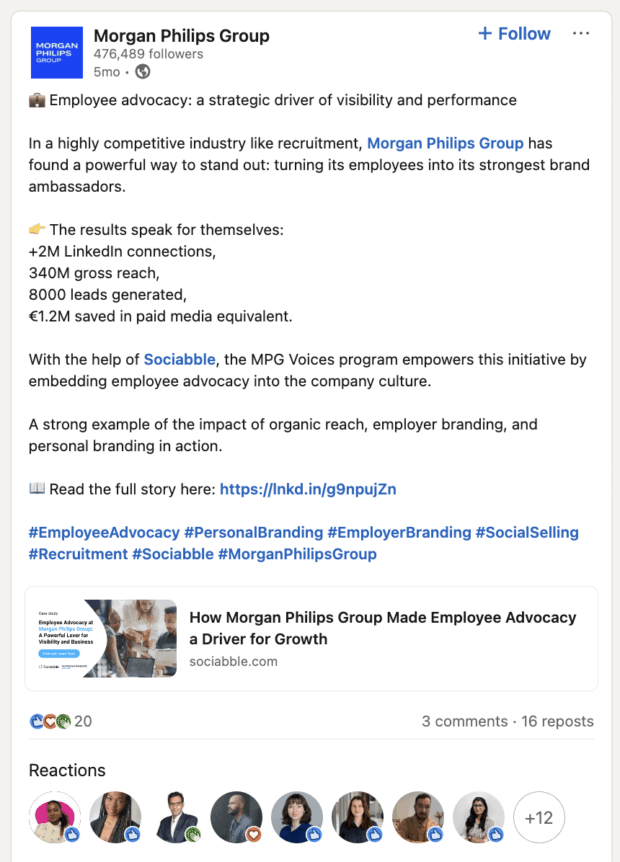
- Implementation: Morgan Philips Group utilizes Sociabble to empower its recruiters and consultants. The platform enables them to share content about their specialized work, industry sectors, and company news, positioning them as experts in their respective fields.
- Key Results: Over 2 million LinkedIn connections reached, 340 million gross social media reach, estimated €1.2 million saved in paid media equivalent.
- Takeaway: In competitive, knowledge-based industries, making it effortless for employees to share content reflecting their domain expertise is a powerful way to build visibility and credibility.
9. DaVita
- Industry: Healthcare
- Focus: Recruiting top nursing and patient care talent, empowering authentic employee stories.
- Implementation: DaVita runs a 200+ employee ambassador program powered by Hootsuite Amplify. Ambassadors access pre-approved, brand-safe content that emphasizes real teammate experiences, which recruiters and staff then share to boost reach and credibility in talent acquisition.
- Key Results: 400% increase in career page traffic, 20% higher conversion rate for applicants from social channels, 3x increase in job applications from employee shares.
- Takeaway: By focusing on authentic "people-centric" content that highlights employee achievements and experiences, companies can effectively bridge the gap between recruitment and marketing, significantly improving talent acquisition metrics.
10. Croda
- Industry: Healthcare (Specialty Chemicals)
- Focus: Increase visibility, strengthen customer relationships, amplify sustainability messaging.
- Implementation: Croda centralized 36 brand social channels using Hootsuite Enterprise and integrated Amplify for content sharing. This provided consistency and efficiency to a previously fragmented digital strategy. With advanced analytics and built-in security, Croda aligned its efforts around key priorities: sustainability and customer relationships.
- Key Results: 150% increase in social media engagement, 3x increase in web traffic from employee shares, enhanced perception as an industry leader in sustainability.
- Takeaway: Even in highly technical B2B sectors, employee advocacy can humanize a brand and drive results. Success hinges on a clear digital strategy, high-quality content, and centralized management tools.
11. Adobe
- Industry: Software as a Service (SaaS)
- Focus: Brand awareness, employee engagement, internal communications, social recruiting.
- Implementation: Adobe leverages EveryoneSocial, providing employees with a curated content library tailored to different interests and roles. This allows employees to share posts, engage with peers, and follow content groups that resonate with them, fostering a sense of community and personalized relevance.
- Key Results: Millions of additional social media impressions, increased employee engagement and satisfaction, significant contribution to employer branding efforts.
- Takeaway: Tailoring content to reflect diverse employee roles and interests is crucial for driving program adoption and sustained participation, transforming employees into passionate brand storytellers.
Strategic Implications and Future Outlook
The consistent success stories from diverse industries underscore that employee advocacy is no longer an optional add-on but a strategic imperative. It represents a fundamental shift from traditional, top-down corporate communication to a more distributed, authentic, and peer-to-peer model. For organizations, the implications are far-reaching:
- Integrated Strategy: Employee advocacy must be woven into the fabric of marketing, HR, and sales strategies, operating as a cohesive unit to maximize impact.
- Cultural Enhancement: Successful programs foster a culture of transparency, trust, and empowerment, where employees feel valued and connected to the company’s mission.
- Data-Driven Optimization: The use of analytics tools is critical for measuring ROI, identifying top-performing content, and optimizing program effectiveness over time.
- Resilience and Agility: In times of crisis or rapid change, an engaged network of employee advocates can serve as a rapid, credible communication channel, reinforcing brand messages and countering misinformation.
As social media continues to evolve, incorporating elements like AI-powered content recommendations, deeper integration with internal communication platforms, and more sophisticated personalization will further enhance the power and efficiency of employee advocacy programs. By harnessing the collective voice of their workforce, companies are not just amplifying their message; they are building stronger, more humanized brands that resonate deeply with audiences in an increasingly noisy world.