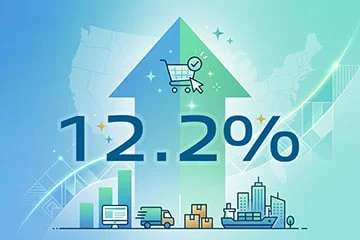
U.S. retail ecommerce sales experienced a significant rebound in 2026, marking its second consecutive quarter of double-digit year-over-year growth. This resurgence, detailed in recent U.S. Census Bureau data, signals a return to pre-pandemic growth patterns and suggests a maturing, yet robust, online retail landscape. Seasonally adjusted Q2 2026 retail ecommerce sales reached $340.2 billion, representing a robust 12.2% increase compared to the same period in the previous year. This follows an already strong Q1 2026, which saw a 10.1% year-over-year (YoY) increase.
The momentum carried through the first half of 2026, with total ecommerce sales accumulating to $668.1 billion, an 11.1% rise from the first six months of 2025. This sustained period of double-digit growth is particularly noteworthy, especially when contrasted with the more moderate expansion seen in the years immediately following the initial pandemic surge.
The Pandemic’s Transformative Impact on Online Retail
The COVID-19 pandemic undeniably acted as a catalyst for ecommerce adoption, fundamentally altering consumer purchasing habits. While ecommerce was steadily growing before 2020, the global health crisis forced a dramatic and rapid shift towards online channels. Reports of the first COVID-19 cases emerged in late Q4 2019, a period that saw U.S. retail ecommerce sales grow by a notable 16.2% year-over-year, according to Census Bureau figures.
As the virus spread globally and lockdowns became widespread across the United States, brick-and-mortar retail operations faced unprecedented restrictions or complete shutdowns. For many consumers, online shopping transitioned from a convenience to a necessity, becoming the primary, and often only, avenue for acquiring goods.
This shift was vividly reflected in the sales figures. In Q2 2020, U.S. ecommerce sales exploded, registering a staggering 53.5% YoY increase. The momentum continued unabated for the subsequent three quarters, with growth rates exceeding 40% YoY. However, as the immediate crisis subsided and physical stores reopened, the hyper-growth phase began to decelerate. By Q2 2022, annual U.S. ecommerce growth had moderated to 5.1%, indicating a stabilization after the pandemic-induced boom.
A Gradual Acceleration Towards Renewed Double-Digit Growth
The period following the peak of the pandemic saw a more measured, yet consistent, expansion of the ecommerce sector. In 2025, online sales growth began to show signs of renewed acceleration. Q2 2025 recorded a 5.0% YoY increase, followed by 5.3% in Q3 and 5.9% in Q4. While these figures represent healthy growth, they stood in contrast to the extraordinary spikes witnessed in 2020 and 2021.
However, the data from the first half of 2026 indicates a significant inflection point. The return to double-digit growth signifies that ecommerce is not merely recovering lost ground but is actively expanding its market share and consumer base, mirroring the strong performance observed in the pre-pandemic era.
Table 1: U.S. Retail Ecommerce Sales Growth (Selected Periods)
| Quarter | Ecommerce Sales | QoQ Growth | YoY Growth |
|---|---|---|---|
| 2025 Q2 | $303.3B | 1.9% | 5.0% |
| 2025 Q3 | $310.8B | 2.5% | 5.3% |
| 2025 Q4 | $318.0B | 2.3% | 5.9% |
| 2026 Q1 | $327.9B | 3.1% | 10.1% |
| 2026 Q2 | $340.2B | 3.8% | 12.2% |
This renewed surge positions ecommerce as a dominant force in the retail sector. In Q2 2026, ecommerce sales grew at a rate of 12.2% YoY, significantly outpacing the overall U.S. retail sales growth, which stood at 6.7% YoY for the same quarter. This disparity led to an increase in ecommerce’s share of total retail sales, rising to 17.1% from 16.3% in Q2 2025. This trend suggests that the growth in ecommerce is not simply a byproduct of broader retail spending but a reflection of consumers increasingly opting for online channels.
Factors Influencing the Growth Trajectory
While the overall growth figures are encouraging, a closer examination of the data reveals nuances and potential influencing factors. One significant consideration is inflation. The Census Bureau’s figures are not adjusted for inflation, meaning that a portion of the reported sales increase can be attributed to higher prices rather than an absolute increase in the volume of goods sold. Economists widely acknowledge that inflationary pressures have impacted consumer spending across all sectors.
Furthermore, the timing of major promotional events can influence quarterly figures. Amazon’s decision to move its annual Prime Day event to June in 2026, from its traditional July slot, may have shifted billions of dollars in ecommerce spending from Q3 into Q2. This strategic move by a dominant online retailer could have artificially boosted Q2’s growth rate while potentially impacting Q3’s performance. This highlights the importance of considering specific market dynamics and promotional calendars when interpreting short-term sales data.
Divergent Performance Across Product Categories
The robust overall ecommerce growth in Q2 2026 masks significant variations in performance across different product categories. While some sectors experienced substantial expansion, others saw more modest gains, illustrating the diverse nature of online consumer demand.
Table 2: Q2 2026 U.S. Ecommerce Performance by Category
| Category | Q2 2025 Ecommerce | Q2 2026 Ecommerce | Growth | Added Sales |
|---|---|---|---|---|
| General merchandise | $38.5B | $46.9B | 21.60% | +$8.3B |
| Sporting goods, hobby, books | $3.3B | $4.0B | 20.40% | +$673M |
| Building materials & garden | $12.3B | $13.7B | 11.50% | +$1.4B |
| Health & personal care | $2.4B | $2.6B | 9.30% | +$220M |
| Food & beverage | $9.6B | $10.3B | 8.10% | +$775M |
| Clothing & accessories | $15.5B | $16.1B | 3.80% | +$592M |
The "General merchandise" category emerged as a standout performer, with a significant 21.6% YoY growth in Q2 2026, contributing approximately $8.3 billion in new sales. This broad category likely encompasses a wide array of goods, from electronics and home goods to general consumer products, reflecting strong demand across multiple segments. Similarly, "Sporting goods, hobby, and books" saw a remarkable 20.4% increase, adding $673 million in sales, indicating a renewed consumer interest in leisure and personal pursuits.
In contrast, "Clothing and accessories," a historically large segment of retail, experienced a more subdued growth of 3.8% YoY, adding $592 million to its sales. While this still represents an increase, its percentage growth rate significantly lagged behind other categories. This divergence highlights the varied impact of economic conditions and evolving consumer preferences on different retail sectors.
Understanding Contribution vs. Growth Rate
It is crucial to distinguish between a category’s percentage growth rate and its actual contribution to overall ecommerce sales. A category with a high growth rate may not necessarily add the most revenue, and conversely, a slower-growing category can still be a significant contributor due to its larger market size.
For instance, "Health and personal care" demonstrated a healthy 9.3% growth, more than double the rate of "Clothing and accessories." However, in absolute dollar terms, "Clothing and accessories" contributed a larger absolute increase in sales ($592 million) compared to "Health and personal care" ($220 million). This is because the base sales volume for clothing and accessories is substantially higher.
This distinction is vital for businesses in their strategic planning. A fast-growing category might offer opportunities for rapid expansion, but a larger, more established category, even with slower growth, can represent a more significant and stable source of revenue. Factors such as product mix, pricing strategies, marketplace presence, geographical reach, and specific customer segments all play a role in a business’s ability to capitalize on these varied market dynamics.
Looking Ahead: Sustained Momentum or Temporary Blip?
The consistent double-digit growth in U.S. ecommerce sales in the first half of 2026 presents a compelling picture of a sector regaining its stride. However, the key question for businesses, investors, and market analysts remains: does this trend signal a lasting acceleration, or is it an outlier influenced by temporary factors such as inflation and event timing?
The coming quarters will be critical in determining the long-term trajectory of U.S. ecommerce. A sustained period of strong growth could embolden businesses to make significant investments in crucial areas such as inventory management, customer acquisition strategies, technological advancements, and fulfillment infrastructure. Such investments are often predicated on the expectation of continued demand and market expansion.
Conversely, the uneven economic performance observed across different product categories and the potential impact of inflationary pressures suggest that the ecommerce landscape is not monolithic. Businesses must navigate these complexities, understanding that success hinges not just on riding a broad market wave but on adapting to specific category dynamics and consumer behaviors.
The robust performance of ecommerce, as evidenced by the recent Census Bureau data, indicates a dynamic and evolving retail environment. The return to pre-pandemic growth patterns, coupled with the increasing share of online sales within the total retail market, underscores the enduring significance of digital commerce. As the sector continues to mature, strategic insights into category performance, inflationary impacts, and consumer preferences will be paramount for sustained success in the years ahead. The ongoing analysis of these trends will shape future investment decisions and the overall strategic direction of the U.S. retail landscape.