

Navigating the complexities of email marketing platform pricing can be a significant challenge for businesses of all sizes, with unexpected overage fees and escalating costs often catching users by surprise. A thorough understanding of Constant Contact’s pricing structure, including its specific plans, potential hidden add-on fees, and how these compare to key market alternatives, is crucial for accurate budget forecasting and strategic decision-making. This guide aims to demystify Constant Contact’s cost implications, providing a detailed breakdown of what businesses can expect to pay at various levels, assessing the inherent value of its plans, and ultimately assisting organizations in determining if the platform aligns with their operational needs and financial constraints.
The Evolving Landscape of Email Marketing Platforms
Email marketing has long been a cornerstone of digital strategy, offering a direct and highly effective channel for customer engagement, lead nurturing, and sales generation. Platforms like Constant Contact have played a pivotal role in democratizing access to sophisticated marketing tools for small and medium-sized businesses (SMBs) since its founding in 1995. Initially conceived to help small businesses leverage email, Constant Contact has evolved alongside the digital marketing industry, continuously updating its features to include social media integration, automation, and more. This evolution, however, also brings complexity to its pricing models, which are designed to scale with a business’s growth and feature requirements.
The challenge for many businesses lies not just in the initial subscription fee but in the dynamic nature of these costs. As subscriber lists expand, email sending volumes increase, or advanced features become necessary, the monthly expenditure can diverge significantly from the advertised entry price. This necessitates a deep dive into the true total cost of ownership, accounting for every variable that can influence the final bill.
Constant Contact’s Tiered Pricing: A Core Overview
Constant Contact employs a tiered pricing model primarily driven by the number of contacts a business maintains in its database. Beyond this fundamental factor, the cost is also influenced by the chosen plan (Lite, Standard, Premium), the desired sending frequency, and whether a business opts for upfront annual payments to secure discounts. This structure means that while base plans may appear affordable, the actual monthly outlay can escalate rapidly as a business grows.
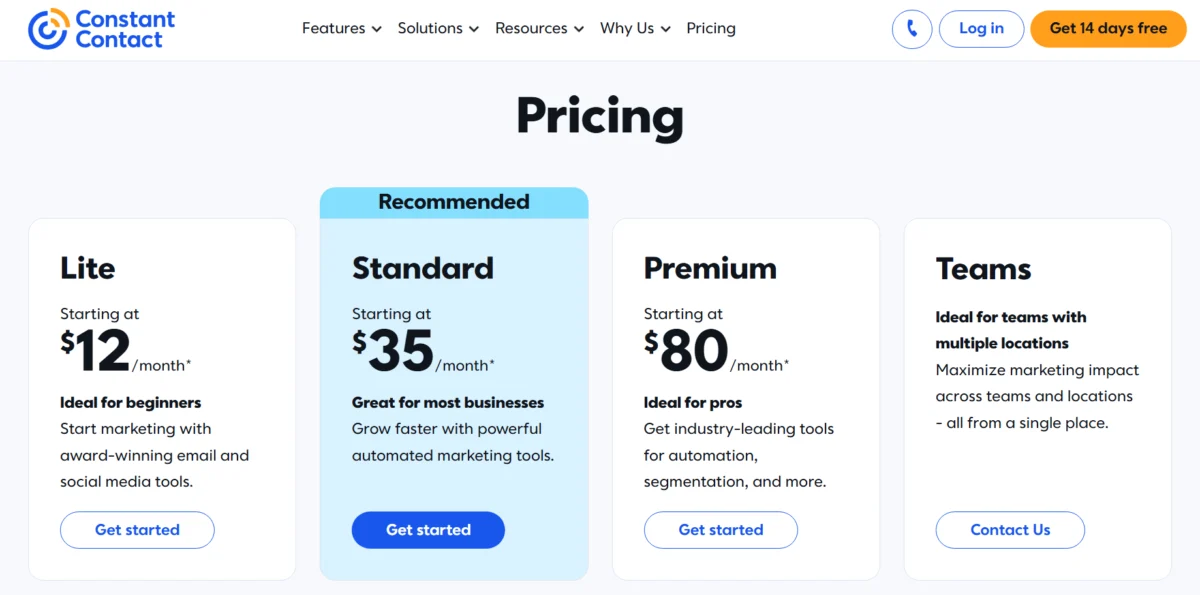
The platform’s three main pricing tiers—Lite, Standard, and Premium—are designed to cater to a spectrum of business needs, from solo entrepreneurs to large enterprises. Each tier unlocks progressively more advanced features, but also comes with a corresponding increase in price. For instance, a business with up to 500 contacts might pay $12/month for the Lite plan, $35/month for Standard, and $80/month for Premium. However, as the contact list grows to, say, 1,001-2,500 contacts, these prices jump to $50/month, $75/month, and $150/month respectively. This exponential scaling continues, with businesses holding 20,001-25,000 contacts facing monthly bills of $280 (Lite), $310 (Standard), and $425 (Premium). For organizations exceeding 50,000 contacts, pricing transitions to a custom quote, reflecting the personalized requirements of larger operations.
(Pricing verified as of June 2024, reflecting the most current publicly available information, assuming the “June 2026” in the original article was a typo for the current year or a placeholder for future verification.)
![Constant Contact Pricing: Plans, Costs & Fees [2026 ]](https://www.omnisend.com/blog/wp-content/uploads/2026/06/1.-Constant-contact-pricing-page.png)
This pricing strategy, common across many SaaS platforms, offers initial accessibility but can pose budgeting challenges for rapidly growing businesses. The 30-day money-back guarantee provides a window for new users to assess the platform’s value proposition against its cost without significant financial risk.
Understanding the “Send Allowance” and Overage Fees
A critical component of Constant Contact’s pricing model is its “send allowance” system. Each plan includes a limit on the maximum number of emails a user can send per month. Exceeding this allowance triggers additional charges, typically at a rate of $0.002 per email. It’s important to note that certain automated emails, such as welcome series, abandoned cart reminders, and transactional messages, are generally excluded from this allowance and do not incur overage fees. This distinction is vital for businesses relying heavily on automated campaigns, as it can significantly impact their effective cost. However, for those running frequent, large-scale promotional campaigns, carefully monitoring send volumes is paramount to avoid unexpected charges. For example, a business on the Lite plan with 300 contacts, already paying $12/month, could see its bill increase to $14 if it incurs an additional 1,000 email overages. While $2 may seem negligible for 1,000 emails, these small increments can accumulate, particularly for larger lists or frequent senders.
Beyond the Base: Unpacking Additional Costs and Add-ons
The advertised monthly rates for Constant Contact plans represent only a portion of the potential total expenditure. Various add-on services can quickly inflate the overall bill, making it essential for businesses to identify and account for these supplementary costs. While the original content did not detail specific add-ons, common offerings in the email marketing space that often come with additional fees include:
- SMS Marketing: Many platforms offer SMS capabilities as an integrated or separate service, often priced per message segment sent or as an additional monthly fee.
- Dedicated IP Address: For businesses sending high volumes of email and requiring greater control over their sender reputation, a dedicated IP can be a crucial but costly add-on.
- Premium Templates and Design Services: Access to an expanded library of professional templates or bespoke design services may incur extra charges.
- Advanced Reporting and Analytics: While basic reporting is usually included, more in-depth insights, custom dashboards, or integration with advanced analytics tools can be premium features.
- Managed Services/Premium Support: Beyond standard live chat and phone support, some platforms offer dedicated account managers, priority support lines, or strategic consulting services at an extra cost.
- Website Builder/E-commerce Integrations: While basic integrations might be free, more advanced e-commerce functionalities, booking tools, or a fully integrated website builder can come with additional subscription tiers.
- AI-Powered Tools: Features like AI-driven content generation, predictive analytics, or advanced personalization might be offered as premium add-ons or exclusive to higher-tier plans.
Constant Contact does offer annual prepay discounts, which can mitigate some of these costs. A six-month commitment typically yields a 10% discount, while a 12-month prepayment can result in a 15% reduction in the overall subscription fee. These discounts provide an incentive for long-term commitment and can be a strategic way for businesses to manage their marketing budgets more effectively.
Nonprofit Pricing: Acknowledging Budgetary Constraints
Recognizing the often-tight budgetary constraints faced by nonprofit organizations, Constant Contact provides specific discounts. Qualified nonprofits, upon verifying their tax-exempt status, can access reduced rates. A 20% discount is available for organizations prepaying for six months, which increases to a substantial 30% for those committing to a full year in advance. This program is a critical consideration for nonprofits, allowing them to leverage powerful email marketing tools at a more accessible price point, contingent on their ability to make upfront financial commitments. US-based organizations typically need to submit their Federal government Letter of Determination, while international nonprofits provide an equivalent document.
![Constant Contact Pricing: Plans, Costs & Fees [2026 ]](https://www.omnisend.com/blog/wp-content/uploads/2026/06/2.-constant-contact-lite-paln.png)
Deep Dive into Constant Contact’s Plan Offerings
A detailed examination of each Constant Contact plan reveals the specific features and limitations that define its value proposition and target audience.
Lite Plan: The Entry Point
Best for: Freelancers, solopreneurs, and small businesses with foundational email marketing needs.
Priced at $12/month for up to 500 contacts, the Lite plan offers essential email marketing tools. It is designed for those beginning their digital marketing journey, providing a user-friendly email builder, basic social media tools, and AI-powered content suggestions. While attractive for its affordability, the Lite plan comes with strict limitations, including only one user seat, restricted automation capabilities, basic segmentation, and a single pre-built automation template. This tier serves as a solid foundation for creating professional-looking emails and tracking basic performance metrics but can quickly become limiting as a business scales or requires more sophisticated marketing strategies. It lacks A/B testing, advanced contact management, and custom automation paths.
Standard Plan: Growing Businesses
Best for: Small to medium-sized businesses seeking more robust automation, advanced segmentation, and multichannel marketing capabilities.
Stepping up to the Standard plan, starting at $35/month for up to 500 contacts, unlocks a more comprehensive suite of tools. This tier is ideal for businesses looking to enhance their marketing beyond basic email campaigns. Key upgrades include multichannel marketing tools, more advanced automation capabilities with three pre-built templates, and sophisticated segmentation options for targeted campaigns. Users also gain access to A/B testing, allowing for campaign optimization, and improved analytics and reporting. The Standard plan includes a social media ads manager and supports up to three user seats, facilitating limited team collaboration. While offering significant enhancements, it still restricts custom automation paths and advanced contact activity segmentation. The analytics, while improved, are described as somewhat basic compared to enterprise-grade solutions.
Premium Plan: Enterprise-Grade Marketing
Best for: Large businesses and enterprises demanding extensive marketing tools, unlimited users, and advanced integrations.
The Premium plan, Constant Contact’s most comprehensive offering, begins at $80/month for up to 500 contacts. It is tailored for organizations with complex marketing requirements, large teams, and a need for advanced integrations. This tier provides custom automation, advanced segmentation, and extensive reporting capabilities, making it suitable for large-scale campaigns. A significant advantage is the provision of unlimited user seats, which is invaluable for agencies or large marketing departments requiring collaborative tools and shared resources. Additional features include Facebook Lookalike Ad targeting, Google Ads Manager integration, revenue reporting, and SEO recommendations. Priority onboarding and dedicated priority support further enhance the experience for high-volume users. Despite its comprehensive nature, the Premium plan represents a significant price jump and may offer features that are overkill for smaller operations, presenting a steep learning curve for some functionalities.
![Constant Contact Pricing: Plans, Costs & Fees [2026 ]](https://www.omnisend.com/blog/wp-content/uploads/2026/06/3.-constant-contact-standard-plan.png)
The Total Cost of Ownership: A Critical Analysis
The journey from a free trial to a fully operational, scaling email marketing strategy with Constant Contact highlights the importance of understanding the total cost of ownership (TCO). This extends beyond monthly subscription fees to encompass overage charges, add-on services, and even the “exit cost” associated with platform transitions. The requirement to call customer support to cancel an account, rather than a simple dashboard option, underscores a potential friction point for users considering alternatives. This practice, while not unique to Constant Contact, can be a deterrent for businesses seeking seamless operational control and flexibility.
Constant Contact in the Competitive Landscape
The email marketing sector is highly competitive, with numerous platforms vying for market share, each offering distinct feature sets and pricing models. Comparing Constant Contact to key competitors like Omnisend, Klaviyo, and Mailchimp reveals differing approaches to value and cost.
| Feature / Platform | Constant Contact | Omnisend | Klaviyo | Mailchimp |
|---|---|---|---|---|
| Free plan | No (14-day trial) | Yes (up to 250 contacts) | Yes (up to 250 contacts) | Yes (up to 250 contacts) |
| Lite plan (Entry) | $12/month | — | — | $13/month |
| Standard plan | $35/month | $16/month | $20/month | $20/month |
| Premium plan | $80/month | $59/month | $35/month | $350/month |
| Discount for Nonprofits | Yes (20-30%) | No | No | 15% |
| Prepay Subscription Disc. | Yes (10-15%) | Yes (30% for 3 months) | No | No |
| G2 Score (June 2024) | 4.2 | 4.6 | 4.6 | 4.3 |
| Capterra Score (June 2024) | 4.3 | 4.7 | 4.6 | 4.5 |
Note: Pricing shown for comparative platforms are starting rates and also scale with contact count. G2 and Capterra scores are subject to change.
This comparison highlights several key differentiators. While Constant Contact does not offer a free plan (only a 14-day trial), many competitors provide generous free tiers for smaller contact lists, enabling businesses to test features without financial commitment. Platforms like Omnisend and Klaviyo are often lauded for their e-commerce-specific features, including native SMS marketing, advanced automation workflows tailored for online stores, and deep integrations with platforms like Shopify and WooCommerce. These features, which Constant Contact might offer as premium upgrades or through higher tiers, are often central to the value proposition of e-commerce-focused alternatives. For instance, Omnisend reportedly offers a high ROI for e-commerce businesses, with integrated SMS and robust automation capabilities from its free plan upwards. Mailchimp, a long-standing competitor, also offers a free plan and competitive entry-level pricing, though its higher tiers can become quite expensive.
The choice of platform often hinges on a business’s primary focus. A generalist platform like Constant Contact may suit a broad range of businesses requiring solid email marketing fundamentals. However, for e-commerce brands, a specialized platform offering seamless integration, advanced segmentation based on purchasing behavior, and omnichannel capabilities (email, SMS, push notifications) might offer greater value, even if the base price seems comparable.
Implications for Business Decision-Making
![Constant Contact Pricing: Plans, Costs & Fees [2026 ]](https://www.omnisend.com/blog/wp-content/uploads/2026/06/4.-constant-contact-premium-plan.png)
The implications of Constant Contact’s pricing structure are far-reaching for businesses. For startups and small businesses, the initial affordability of the Lite plan is appealing, but the rapid escalation of costs with subscriber growth demands careful financial planning. The tiered system incentivizes growth but can also penalize it if not managed proactively. Businesses must project their subscriber growth and email sending volumes accurately to avoid unexpected budget overruns.
For mid-sized businesses, the Standard plan offers a robust set of tools, balancing cost with enhanced features. However, the limitation on user seats and the absence of custom automation paths might necessitate an upgrade to the Premium plan sooner than anticipated, incurring significant additional costs. Large enterprises, while benefiting from the comprehensive features and unlimited user access of the Premium plan, must still weigh the high cost against the specific functionalities provided by competitors, particularly those excelling in niche areas like advanced e-commerce or highly specialized integrations.
The difficulty in canceling a Constant Contact account—requiring a phone call rather than a self-service option—also speaks to a broader implication for user experience and flexibility. In an era where digital platforms strive for seamless user journeys, such hurdles can influence a business’s long-term commitment and perception of vendor lock-in.
Conclusion: Aligning Value with Cost
In conclusion, Constant Contact offers a robust suite of email marketing tools with a pricing model that scales with a business’s contact list and feature requirements. From the entry-level Lite plan to the comprehensive Premium tier, the platform aims to cater to a diverse user base. However, understanding the true Constant Contact cost involves looking beyond initial advertised rates to account for contact-based escalations, potential overage fees for exceeding email send allowances, and additional costs for specific add-on services. While prepay discounts and dedicated nonprofit pricing offer avenues for cost reduction, businesses must carefully evaluate these against their specific needs and growth projections.
For businesses with a strong e-commerce focus, or those prioritizing omnichannel marketing capabilities, a comparative analysis with platforms like Omnisend, Klaviyo, and Mailchimp becomes essential. These alternatives often present different value propositions, sometimes offering more advanced e-commerce features, native SMS integration, or more flexible free plans. Ultimately, the decision of whether Constant Contact’s pricing is “worth it” hinges on a comprehensive assessment of how well its features, scalability, and overall cost align with a business’s unique marketing goals, operational requirements, and long-term budgetary considerations. A careful, data-driven approach to platform selection is paramount to maximizing email marketing ROI and ensuring sustainable digital growth.








