AI search interfaces are fundamentally altering how digital content is discovered, consumed, and attributed, marking a pivotal shift from traditional search engine optimization (SEO) to Answer Engine Optimization (AEO). This transformation necessitates a strategic re-evaluation of content creation, with Frequently Asked Questions (FAQs) emerging as a critical structural asset for enhancing visibility in these evolving environments. Recent data underscores this paradigm shift: a 2025 Pew Research study revealed that approximately one in five Google searches produced an AI-generated summary, with a remarkable 88% of these summaries citing three or more distinct sources. Complementing this, Bain’s 2025 research highlighted that nearly 80% of consumers now rely on zero-click results for at least 40% of their searches, signifying a profound change in user interaction with search outcomes.
The Evolution of Search: From Keywords to Conversational AI
The digital landscape has witnessed a rapid evolution in how users interact with information. For decades, traditional search engines primarily functioned as directories, matching keywords to relevant web pages and presenting them as a list of links. The goal of SEO was to achieve top rankings in these lists, driving organic traffic through clicks. However, the advent of sophisticated large language models (LLMs) and generative AI has ushered in a new era. Tools like Google AI Overviews and conversational AI platforms (e.g., ChatGPT, Bard, Bing Chat) now synthesize information from multiple sources to provide direct, comprehensive answers, often bypassing the need for users to click through to individual websites.
This shift means that visibility no longer solely hinges on a page’s ranking position. Instead, it depends on whether a piece of content can be cleanly extracted, summarized, and cited within an AI-generated response. Content creators and marketers are now challenged to optimize their digital assets not just for traditional search algorithms, but for the interpretive capabilities of AI systems. This new discipline, Answer Engine Optimization (AEO), focuses on making content inherently quotable and understandable to machines, ensuring it contributes to the synthesized answers users receive.
Understanding Answer Engine Optimization (AEO)
AEO is a specialized form of optimization designed to increase the likelihood of content being selected, summarized, and cited by AI-powered search engines and conversational interfaces. Unlike traditional SEO, which often prioritizes keyword density, backlinks, and page authority to improve ranking, AEO emphasizes structural clarity, semantic precision, and extractability. The core premise is that if an AI system can easily understand, process, and attribute a piece of information, it is far more likely to include it in its generated responses.
Answer engines operate by identifying the user’s intent, retrieving relevant passages from a vast index of information, and then synthesizing these passages into a coherent, direct answer. This process heavily favors content that is well-structured, unambiguous, and provides answer-first responses. If a passage is convoluted, requires extensive reinterpretation, or lacks clear attribution signals, its chances of being cited diminish significantly.
The Indispensable Role of FAQs in AEO
FAQs, when designed with AEO in mind, are uniquely positioned to meet the demands of answer engines. They mirror the conversational patterns of AI tools by posing explicit questions and providing direct resolutions. This structured question-and-answer format inherently supports the retrieval process, making it easier for AI systems to identify, extract, and attribute specific pieces of information.
FAQs built for AEO differ fundamentally from traditional FAQ pages. While traditional FAQs primarily served as navigational aids or repositories for common queries, AEO-optimized FAQs are engineered for machine readability and content extraction. They are characterized by being:

- Answer-First: Each response begins with a direct resolution to the question.
- Structured for Extraction: Content is segmented into discrete, self-contained units.
- Entity-Consistent: Key terms and concepts are used consistently to reinforce semantic understanding.
- Schema-Supported: Enhanced with structured data markup to explicitly define questions and answers.
- Aligned with Natural Language: Questions are phrased to match how users genuinely ask them in conversational search.
This structured approach is particularly crucial given findings from HubSpot’s 2025 AI Trends for Marketers report, which indicated that 31% of Gen Z respondents initiate their queries in AI or chat-based tools rather than traditional search engines. By mirroring these conversational patterns, AEO FAQs enhance relevance and visibility where a growing segment of users begins their information journey.
Why FAQs Enhance AEO Performance in LLMs
FAQ sections significantly boost AEO performance when implemented with structural rigor. They improve extractability, minimize ambiguity, and reinforce entity clarity—all pivotal factors in determining whether a passage is selected and cited by AI models. LLMs retrieve passages linked to defined entities and construct responses based on contextual alignment. When a section cleanly isolates a question and resolves it, it substantially reduces the interpretive effort required during the synthesis phase.
In practical terms, answer engines prioritize content that exhibits:
- High Extractability: Content that can be quoted directly with minimal modification.
- Semantic Precision: Clear, unambiguous language that avoids jargon or vague phrasing.
- Entity Consistency: Uniform use of names, terms, and concepts.
- Authoritative Sourcing: Clear indications of expertise, experience, authoritativeness, and trustworthiness (E-E-A-T).
These structural signals align with observable patterns in AI-generated search features, where long-tail, instructional, and meticulously organized content tends to surface more frequently. FAQs achieve this through three primary mechanisms:
- Reduced Interpretive Effort: By isolating questions and providing direct answers, FAQs minimize the need for AI to infer context or extract meaning from dense prose. This efficiency makes them prime candidates for citation.
- Enhanced Entity Clarity: Explicit question-and-answer pairs allow for consistent repetition of key entities and their relationships. For example, a definition like “AEO is the process of optimizing content so AI systems can extract, summarize, and cite it in answer-driven search environments” clearly establishes the entity “AEO” and its core function. Repeating explicit entity relationships across multiple passages within an FAQ reduces ambiguity and strengthens the AI’s confidence in attributing information.
- Improved Micro-Intent Alignment: FAQs can precisely address specific, narrowly defined user queries (micro-intents). By systematically covering various facets of a topic through individual questions, a single FAQ page can cater to a broader range of nuanced inquiries, increasing its “retrieval surface area” without diluting its thematic authority.
Structuring FAQs for Optimal AI Readability
Answer engines prioritize structure over raw prose. They actively scan for defined question patterns, extractable answers, and consistent hierarchies to determine what a page covers and which passages are suitable for reuse. A disciplined FAQ system is crucial to prevent structural inconsistencies as content scales, thereby safeguarding citation eligibility. The following five steps are essential for establishing repeatable standards:
-
Choose One Topic Per FAQ Page and Define It Clearly:
An FAQ page achieves optimal performance when its scope is tightly defined. Attempting to cover disparate subjects like product features, pricing, onboarding, and compliance on a single page weakens thematic boundaries and reduces topical clarity, ultimately lowering the AI’s confidence in selecting information. A focused FAQ page should:- Possess a clear, singular subject.
- Address various facets of that specific topic.
- Maintain consistent terminology throughout.
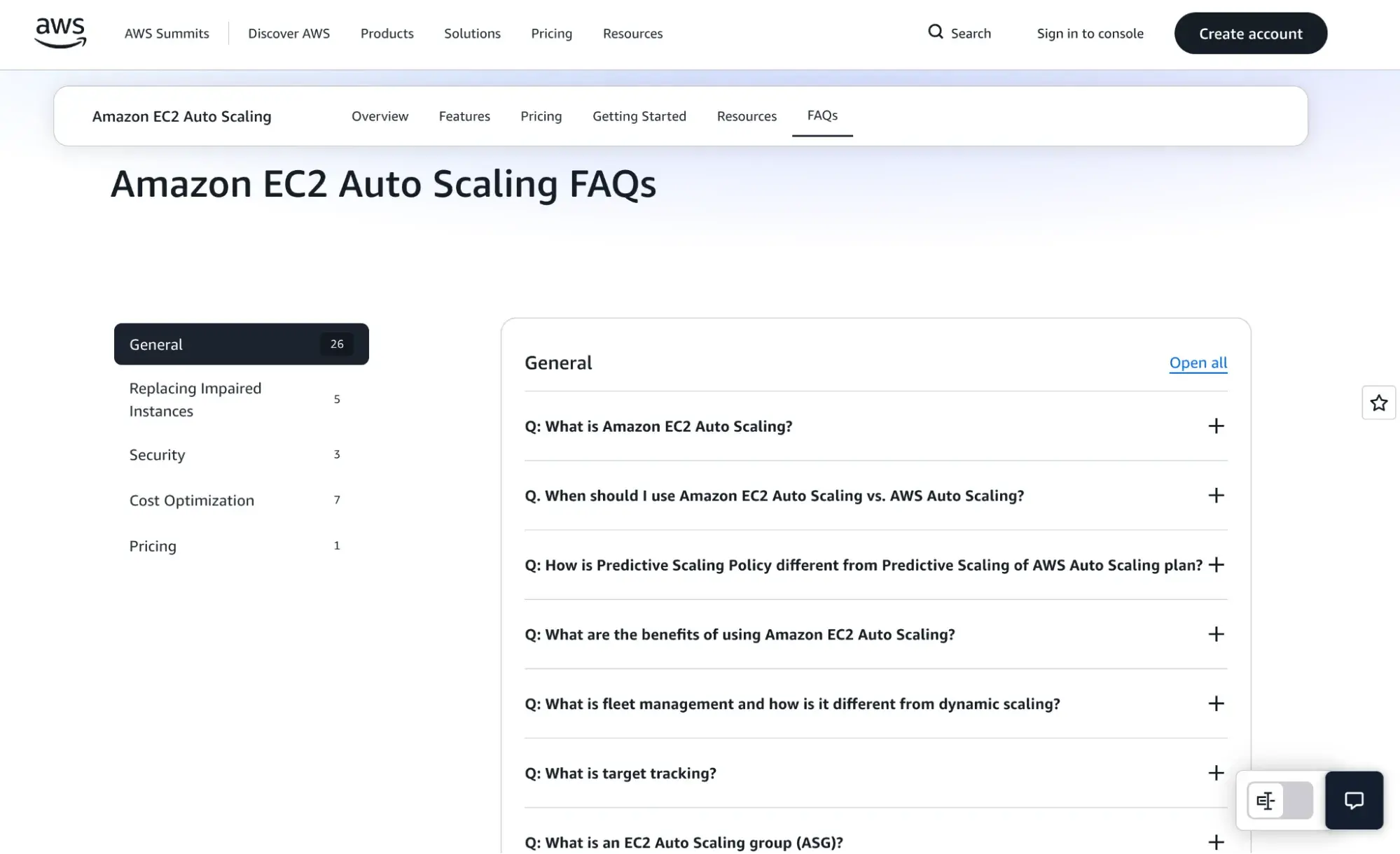
Avoid generic or “catch-all” FAQ collections. Clear thematic ownership, such as Amazon Web Services’ dedicated FAQ for EC2 Auto Scaling, significantly enhances retrieval precision and strengthens authority signals for that specific domain.
-
Use a Consistent Question-and-Answer Pattern for Every Entry:
Answer engines favor predictable hierarchies. Each FAQ entry must adhere to a repeatable structural pattern to ensure unambiguous identification of question and answer boundaries. Implementation standards include:- Using distinct HTML headings (e.g.,
<h2>or<h3>) for questions. - Placing the answer immediately after its corresponding question.
- Employing consistent formatting (e.g., bolding questions, standard paragraph text for answers).
- Ensuring answer text is rendered directly in the HTML on page load, even if presented in accordions, to avoid hindering retrieval.
Structural consistency minimizes interpretation overhead and improves passage-level reliability, making content easier for AI systems to process at scale.
- Using distinct HTML headings (e.g.,
-
Write Answer-First Responses That Can Stand Alone When Quoted:
AI systems frequently extract isolated snippets, often devoid of their original surrounding context. Consequently, each FAQ response must be entirely self-sufficient. Direct, answer-first responses significantly increase the probability of citation because they reduce the interpretive burden on AI systems during extraction.
Start each answer by directly resolving the question in approximately 40-60 words. The initial one or two sentences should define, recommend, or resolve the query without requiring prior explanation. Follow with one to three supporting sentences that add operational clarity. If steps or criteria are involved, present them as a concise list of three to five items to maintain scannability and structural integrity.
Avoid:- Beginning answers with conversational phrases like “To answer your question…” or “It depends…”
- Requiring users or AI to infer context from previous paragraphs.
- Overly long, meandering explanations that dilute the core answer.
Passage completeness enhances citation stability and mitigates the risk of AI systems needing to rewrite or omit the content.
-
Match Question Phrasing to Real-World Query Language:
FAQ headers should accurately reflect how users phrase questions in AI tools and search interfaces. Aligning with natural language improves retrieval matching and minimizes semantic drift. Effective question design includes:
- Using complete sentences.
- Mirroring common user questions and long-tail queries.
- Focusing on clear intent (e.g., “What is X?”, “How do I do Y?”, “Why is Z important?”).
Avoid vague labels or fragmentary headers that lack explicit query phrasing. Clear, user-centric question phrasing strengthens the alignment between buyer intent and page structure, making the content more discoverable by AI.
-
Add FAQ Schema Only After the Content is Structurally Stable:
Schema markup serves to reinforce existing structure; it is not a substitute for weak formatting. Once the FAQ content is meticulously organized and answer-first, implementingFAQPageschema explicitly clarifies which text represents the question and which constitutes the answer. This structured data identifies a list of question-and-answer pairs for answer engines, enabling systems to clearly differentiate prompts from their corresponding responses.
Implementation standards include:- Ensuring the schema exactly matches the visible on-page content.
- Using valid JSON-LD format.
- Only marking up actual question-and-answer pairs.
- Validating the schema using Google’s Rich Results Test or similar tools.
Schema acts as a vital structural verification layer. When correctly implemented, it formalizes the relationship between questions and answers, significantly reducing ambiguity during machine interpretation and boosting eligibility for rich results.
Advanced FAQ Optimization Tips for AEO
Once foundational formatting is in place, AEO FAQ optimization shifts to refining structure, aligning intent, and maximizing extractability. While structural clarity establishes eligibility, optimization determines competitive visibility.
-
Align FAQ Questions with Commercial Intent:
Many FAQ sections overly concentrate on definitional queries, which primarily support awareness. However, to drive tangible business outcomes, optimization requires expanding coverage to include decision-oriented micro-intents that influence evaluation or purchase stages. High-value FAQ questions frequently address:- Pricing and cost structures.
- Implementation details and integration requirements.
- Comparisons with competitors or alternative solutions.
- Common challenges, troubleshooting, and support.
- Specific use cases and benefits for different personas.
Examples include: “What is the cost of HubSpot’s AEO tool?”, “How does [Product A] integrate with [System B]?”, or “What are the key differences between [Service X] and [Service Y]?” Questions tied to cost and implementation directly reflect evaluation-stage behavior. Including them increases the likelihood that FAQ content surfaces during commercially relevant prompts, thereby improving alignment between AI visibility and pipeline impact.
-
Optimize for Extractability Across Platforms:
Answer engines prioritize passage completeness and synthesis efficiency. Extractability hinges on how easily a response can be quoted without requiring structural reconstruction by the AI. Optimization standards include:- Conciseness: Keeping answers succinct and to the point.
- Self-Containment: Ensuring each answer provides a complete thought without external dependencies.
- Clarity: Using simple, direct language.
- Internal Linking (Judiciously): While answers should be self-contained, strategic internal links can guide users and AI to deeper, related content without disrupting the primary answer structure.
Content that can be reused with minimal rewriting is significantly more likely to be cited. This principle forms the bedrock of generative engine optimization frameworks, which underscore clarity and structural coherence as primary drivers for citation.
-
Reinforce Entity Clarity Within Each Answer:
Consistent entity usage strengthens an AI model’s confidence. Unnecessary shifts in terminology weaken semantic reinforcement. LLMs associate entities across dimensions such as:- Canonical Name: The official or primary name of a product, service, or concept.
- Aliases/Synonyms: Recognizable alternative terms.
- Attributes: Defining characteristics or properties.
- Relationships: How the entity connects to other entities.
If an FAQ references a product, its official name should be used consistently. If an FAQ defines a category, the core term should be restated rather than replaced with stylistic synonyms. Clear entity framing supports association stability, particularly when explaining related concepts like different AI agent types or classifications. This level of optimization is not merely stylistic; it provides structural reinforcement of knowledge relationships, bolstering entity recognition and E-E-A-T signals over time.
-
Include Freshness and Source Signals:
Answer engines evaluate credibility alongside clarity. Content that appears outdated or lacks discernible sourcing introduces risk during synthesis, potentially leading to exclusion. Strengthen authority signals by:- Dating Content: Clearly indicating the last update or publication date.
- Citing Reputable Sources: Referencing studies, reports, or expert opinions with clear links.
- Attributing Authorship: Providing clear author bios with relevant expertise.
- Maintaining Accuracy: Regularly reviewing and updating factual information.
Temporal specificity reduces ambiguity, and proper attribution minimizes rewrite risk. Both factors significantly improve the likelihood of content appearing in AI responses.
-
Connect FAQ Optimization to Visibility Measurement:
Optimization without measurement yields limited strategic value. FAQ sections must contribute to broader AI visibility objectives, including brand mentions, citation frequency, sentiment framing, and overall share of voice across prompts. Operational measurement can include:- Citation Frequency: How often the brand or specific FAQ content is cited in AI summaries.
- Sentiment Analysis: The overall tone and context in which the brand is mentioned.
- Share of Voice: The percentage of AI-generated responses for relevant queries that reference the brand.
- Traffic & Engagement (Indirect): While AEO focuses on zero-click results, increased brand mentions can still drive direct traffic or brand awareness.
Benchmarking citation performance across various AI platforms requires dedicated visibility tracking tools. It is crucial for marketing teams to evaluate AI performance in conjunction with traditional search performance. This integrated approach allows for a holistic understanding of content effectiveness and ensures that FAQ optimization contributes meaningfully to broader marketing objectives. The BrightEdge AI Overview research, which found that over 80% of AI-generated citations originate from pages outside conventional top-ranking results, powerfully reinforces the importance of structural clarity over mere positional dominance.
Sustainable AI Visibility: A Strategic Imperative
FAQs designed for AEO are more than just content elements; they are structural assets engineered to improve citation eligibility. By isolating user intent, resolving it with precision, and consistently reinforcing terminology across related questions, these sections expand retrieval surface area without fragmenting authority. When AEO FAQs align with buyer-stage prompts and adhere to answer-first formatting, they become powerful tools for capturing attention in the generative search era.
However, thoughtful AI adoption remains paramount. Simply expanding FAQ libraries or generating vast volumes of AI-assisted pages will not, on its own, guarantee increased selection likelihood. Answer engines prioritize clarity, specificity, and coherence. Sustainable AEO performance stems from intentional publishing and meticulous structuring of content. When content is genuinely useful, accurate, and structurally precise, citation naturally becomes a byproduct of its inherent quality. This strategic shift demands a renewed focus on content integrity, technical excellence, and a deep understanding of how AI systems interpret and reuse information, ensuring long-term digital visibility in an increasingly intelligent search landscape.