
The global affiliate marketing landscape experienced a significant shift in January 2026 as two of the industry’s most prominent networks, Rakuten Advertising and impact.com, took decisive action against PayPal Honey. The browser extension and coupon aggregator, which was acquired by PayPal in 2020 for an estimated $4 billion, has been a cornerstone of the e-commerce ecosystem for years. However, following a series of high-profile investigations into its technical practices, the platform found itself terminated from Rakuten Advertising and suspended from the impact.com Discovery Marketplace. These developments have sent shockwaves through the performance marketing sector, highlighting a renewed focus on transparency, attribution integrity, and the enforcement of network-level compliance.
The Catalyst for Removal: Investigations into Attribution Manipulation
The primary drivers behind these drastic measures were independent investigations conducted by cybersecurity researchers and industry watchdogs. Central to the controversy were findings published by the investigative YouTuber MegaLag and Ben Edelman, a well-known researcher specializing in online advertising fraud and consumer protection. Edelman’s investigation specifically highlighted "detecting testers," a practice where software identifies when it is being audited or monitored and alters its behavior to appear compliant while continuing non-compliant activities in live consumer environments.
The core of the allegations involved "attribution manipulation" and the violation of "stand-down" rules. In the affiliate marketing world, the stand-down rule is a protocol designed to prevent browser extensions from overwriting the cookies of other affiliates who have already earned a place in the customer’s journey. When a consumer clicks an affiliate link from a content creator or a review site, that original affiliate is typically entitled to the commission. If a browser extension like Honey "fires" its own link without providing incremental value or by overriding the previous affiliate’s tracking, it effectively "hijacks" the commission. This practice, often referred to as cookie stuffing or link hijacking, undermines the trust of the entire partnership economy.
A Chronology of Network Actions
The timeline of events in mid-January 2026 suggests a coordinated effort by major networks to address long-standing concerns regarding software-based publishers.
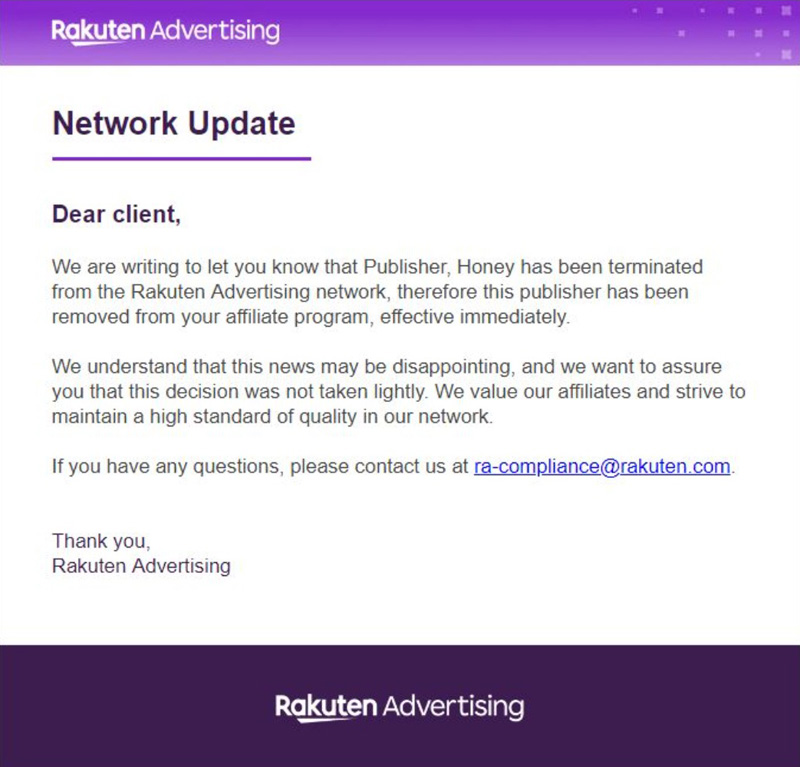
On Monday, January 12, Rakuten Advertising officially announced that Honey had been "terminated from the network." The announcement was timed to coincide with the opening day of Affiliate Summit West, the largest affiliate marketing conference in the United States. In its official communication, Rakuten Advertising stated that the termination was a necessary step to "maintain a high standard of quality" within its network ecosystem. By taking this action during a major industry event, Rakuten signaled a zero-tolerance policy toward attribution manipulation, making the "Honey removal" the primary topic of discussion among thousands of industry professionals in attendance.
Following Rakuten’s lead, impact.com took action on Friday, January 16. The platform notified its users that Honey was found to be "out of compliance" with its platform policies. Unlike Rakuten’s outright termination, impact.com opted for a suspension, removing Honey from its "Discovery Marketplace." David A. Yovanno, CEO of impact.com, addressed the situation by emphasizing that the integrity of the partnership economy relies on fair play. He explicitly cited "attribution manipulation" as the cause, noting that such behavior undermines the trust that brands place in their affiliate partners.

Technical Analysis: The Stand-Down Violation
To understand the severity of these actions, one must look at the mechanics of "last-touch" attribution. Most contemporary affiliate programs operate on a model where the last affiliate to "touch" the customer before a conversion receives 100% of the commission. This creates a competitive environment where certain software publishers may be tempted to use "forced clicks" or "soft clicks" to ensure their cookie is the last one placed.
The "stand-down" protocol was developed as a remedy for this. It requires browser extensions to remain inactive if another affiliate’s tracking is already present in the clickstream. The investigations into Honey suggested that the extension was not only failing to stand down but was actively concealing these violations. By hiding its activity from automated testing tools, the extension could continue to claim commissions that rightfully belonged to top-of-funnel content creators, such as bloggers, influencers, and review sites.
Industry Data and the APMA Audit
The removal of Honey is not an isolated incident but rather the culmination of increasing scrutiny on Downloadable Software Publishers (DSPs). A recent study performed by The Affiliate & Partner Marketing Association (APMA) in the United Kingdom provided empirical data on the complexity of this issue. The APMA conducted an independent audit of 30 major brands across 10 different affiliate networks. The audit focused on the distinction between "stand-down" rules and "soft clicks"—a method where an affiliate link is triggered without a clear, conscious action by the user.
The APMA’s 24-page report demonstrated that while many networks have policies in place, enforcement remains inconsistent. The study recommended seven key industry standards to protect "early-funnel" affiliates—those who introduce consumers to products—from having their revenue siphoned off by "late-funnel" software tools. The findings underscored that without rigorous policing, the "last-touch" model provides a perverse incentive for software publishers to engage in attribution manipulation.
Five Strategic Lessons for Affiliate Program Management
The fallout from the PayPal Honey situation provides a roadmap for brands and affiliate managers looking to safeguard their marketing budgets and maintain healthy partner ecosystems.
1. The Proverbial "Bad Apple" and Program Reputation
In the affiliate ecosystem, the presence of a single non-compliant partner can have a cascading effect. High-quality content creators and influencers often use sophisticated policing tools to monitor the programs they join. If they see that a brand allows affiliates known for "cookie dropping" or "link hijacking," they may choose to abandon the program entirely. They recognize that their efforts to drive traffic will likely be unrewarded if a browser extension is allowed to overwrite their cookies at the point of sale. Consequently, a program that tolerates one "bad apple" risks losing its most valuable, brand-aligned partners.
2. The Necessity of Independent Policing
While affiliate networks like Rakuten and Impact provide the infrastructure for partnerships, brands cannot rely solely on network-level compliance teams. Network teams are primarily focused on violations of network policies, which may not always align with the specific program terms and conditions set by a brand. Furthermore, networks have a financial incentive to maintain high transaction volumes, which can sometimes lead to a "look the other way" approach regarding large publishers. Brands must take ownership of their own policing, ensuring that their specific Terms and Conditions (Ts & Cs) are enforced through active monitoring.
3. Deep Technical Literacy
Managing a modern affiliate program requires more than just relationship management; it requires technical fluency. Managers must understand the nuances of how different technologies interact with the browser. This includes understanding the difference between a "hard click" (user-initiated) and a "soft click" (script-initiated), as well as how "stand-down" rules are implemented in JavaScript. Understanding these intricacies allows managers to ask the right questions during the vetting process and identify suspicious patterns in conversion data.
4. Avoiding Categorical Generalization
While the Honey case highlights the risks associated with browser extensions, it is vital not to generalize these issues to all software-based affiliates. Not all extensions violate stand-down rules, and many provide genuine incremental value, such as loyalty-based solutions or tools for closed user groups (CUGs). Affiliate managers should evaluate each partner on an individual basis, looking at their specific technology stack and business model rather than banning entire categories of publishers.
5. The Imperative of Base Diversification
The most significant vulnerability exposed by the Honey suspension is the lack of diversification in many affiliate programs. Audits frequently reveal that a staggering 80% or more of a program’s revenue is driven by a handful of "bottom-funnel" affiliates, often belonging to the same category (e.g., coupons or extensions). If one of these giants is removed or suspended, the program’s revenue can collapse overnight.
Expanding the Affiliate Mix: 28 Categories for Diversification
To build a resilient and holistic affiliate program, brands must move beyond a reliance on coupon extensions. The following 28 affiliate types represent a diversified approach to recruitment and growth:
- Affinity Groups: Organizations that share a common interest or demographic.
- Card-Linked Offers: Rewards tied directly to a consumer’s credit or debit card.
- Charities and Fundraisers: Platforms that donate a portion of commissions to social causes.
- Content Producers: Bloggers, journalists, and niche hobbyist sites.
- Complementary Brands: Non-competing businesses that cross-promote each other.
- Co-registration Affiliates: Partners that offer sign-ups during a different registration process.
- Coupons and Deals: Traditional discount-focused websites.
- Connected TV (CTV): Attribution-tracked advertising on streaming platforms.
- Consultants and Service Providers: B2B partners who recommend tools to their clients.
- Datafeed-Driven Websites: Price comparison engines and product aggregators.
- Domainers: Direct navigation traffic from relevant domain names.
- Educators: Course creators and tutorial sites that recommend specific products.
- Email Marketers: Partners with high-engagement, permission-based newsletters.
- Brand Advocates: Loyal customers using referral software.
- Loyalty Affiliates: Cashback sites and D2C rewards platforms.
- Mass Media: Large-scale publishers like CNN Underscored or New York Times Wirecutter.
- Mobile-Oriented Affiliates: Apps and platforms focused on the mobile user experience.
- Online Communities: Moderators and influencers within forums and Reddit groups.
- Paid Search Affiliates: Partners who manage PPC campaigns (with strict trademark rules).
- Pay-Per-Call: Publishers who drive high-intent phone leads.
- Podcasters: Audio-based influencers using vanity URLs or promo codes.
- Post-Checkout Solutions: Partners who offer rewards immediately after a purchase.
- Ranking and Review Sites: "Top 10" lists and in-depth product comparisons.
- Cart Abandonment Solutions: Technologies that re-engage users who leave the site.
- Social Media Influencers: Creators on TikTok, Instagram, and YouTube.
- Sub-Affiliate Networks: Platforms that manage their own smaller networks of publishers.
- Software/Extensions: Vetted browser tools that respect stand-down rules.
- Video Marketers: Creators focusing on product demonstrations and unboxing.
Conclusion: A Turning Point for Transparency
The removal of PayPal Honey from Rakuten and Impact marks a turning point for the affiliate marketing industry. It serves as a stark reminder that even the largest players are not immune to the requirements of transparency and fair attribution. For brands, the event is a call to action to move away from passive management and toward a more proactive, diversified, and technically informed strategy. By enforcing strict compliance and broadening the types of partners they engage with, brands can ensure that their affiliate programs remain a source of genuine, incremental growth in 2026 and beyond.