rifanmuazin
WordStream, a long-standing authority in advertising benchmark data, has released a comprehensive analysis of TikTok ad costs, drawing on a decade of experience and direct data from managed TikTok ad accounts. This report aims to provide advertisers with the most current and actionable insights into the financial landscape of advertising on the rapidly evolving platform.
TikTok has transformed from a hub for viral challenges into a significant marketplace for product discovery. Data indicates that a substantial 82% of TikTok users have discovered a small or medium-sized business on the app before encountering it elsewhere. This shift has empowered diverse businesses, from dental practices in Detroit to local handymen in Houston, to find new clientele. For businesses contemplating an investment in this dynamic marketing channel, understanding the cost of TikTok ads is paramount.
The analysis, compiled by WordStream, synthesizes data from extensive industry studies and real-world performance metrics from their managed TikTok ad accounts. This dual approach ensures both broad market perspective and granular, up-to-date cost information. The report delves into the intricacies of TikTok’s bidding process and offers strategic recommendations for campaign optimization to maximize return on investment.

Average TikTok Ad Costs: A Detailed Breakdown
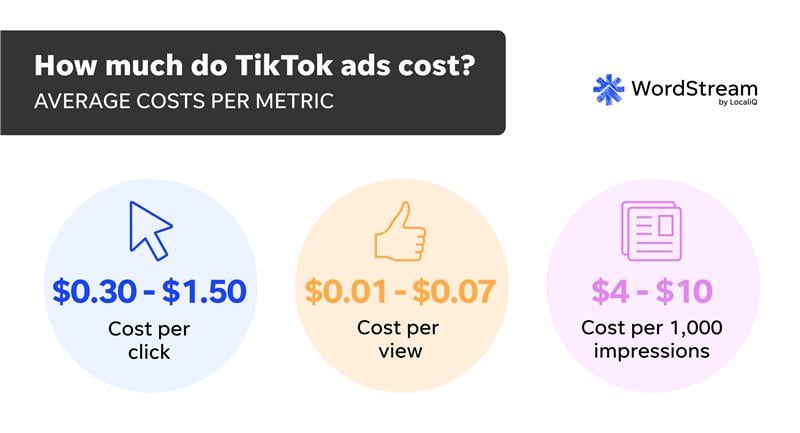
WordStream’s findings indicate a general range for TikTok ad expenses:
- Cost Per Click (CPC): $0.30 to $1.50
- Cost Per Thousand Impressions (CPM): $4 to $10
- Cost Per View (CPV): $0.01 to $0.07
These figures represent averages, and actual costs can fluctuate based on numerous influencing factors, which will be explored further in this analysis.
Understanding Key Cost Metrics on TikTok
TikTok Ads Cost Per Click (CPC)
The Cost Per Click (CPC) for TikTok ads typically falls between $0.30 and $1.50. This metric signifies the amount paid each time a user clicks on an ad. It’s important to note TikTok’s specific definition of a click for CPC campaigns: a click is registered only when a user taps the ad’s call-to-action (CTA) button, profile picture, nickname, or a "Learn More" link that directs them to a destination. Actions like liking or commenting on an ad do not incur CPC charges.
Ad clicks are a valuable metric as they represent a user actively moving off the TikTok platform and engaging with a business’s sales or landing pages, indicating a higher level of intent.
TikTok Ads Cost Per Thousand Impressions (CPM)

For medium to high-performing campaigns, the Cost Per Thousand Impressions (CPM) on TikTok ranges from $4 to $10. An impression is counted each time an ad is displayed on a user’s screen. CPM is a critical metric for brand visibility and is often employed by businesses aiming to reach a broad audience and increase brand awareness.
TikTok Ads Cost Per View (CPV)
The average Cost Per View (CPV) for TikTok ads is between $0.01 and $0.07. TikTok defines a view as the moment a video ad begins playing on a user’s screen. This definition is notable, as some other social media platforms may require an ad to play for a minimum duration before counting it as a view. This lower threshold for counting views can be advantageous for advertisers focused on video content reach and engagement.
TikTok Ad Costs by Ad Type

The diverse range of ad formats available on TikTok directly impacts pricing, with each type catering to different advertising objectives and budgets. The choice of ad type should align with a business’s specific goals, whether it’s precise audience targeting or mass reach.
| Ad Type | Description | Cost Estimate |
|---|---|---|
| In-Feed Ads | Skippable video ads that appear natively within the "For You" feed. | $4 to $8 CPM |
| TopView Ads | Full-screen ads displayed immediately upon app opening. | Around $50,000/day |
| Branded Hashtag Challenge | Brand-sponsored challenges encouraging user-generated video content. | $150,000+ per campaign |
| Branded Effects | Custom AR filters and effects for users to incorporate into their videos. | Starting around $45,000 |
| Spark Ads | Promoted organic content from a business’s or creator’s account. | $4 to $8 CPM |
| Shopping Ads | Shoppable video, catalog, and live ads integrated with TikTok Shop. | Similar to In-Feed CPM |
| Search Ads | Ads appearing in TikTok search results for specific keywords. | $0.10 to $0.30 CPC |
Minimum Budget Requirements for TikTok Ads
TikTok mandates a minimum daily budget of $20 at the ad group level and $50 at the campaign level. For advertisers opting for a lifetime budget, the minimum is calculated by multiplying the daily minimum by the campaign duration. For instance, a 10-day campaign would require a minimum lifetime budget of $200.
However, these minimums may not be sufficient for achieving optimal campaign performance. As a general guideline, WordStream recommends allocating between $50 to $150 per day during the testing phase to allow the algorithm sufficient time to optimize creatives. For scaling successful campaigns, a daily budget of $200 to $500 is advisable.

The Mechanics of TikTok Ads Bidding
TikTok employs an auction-based bidding system, where advertisers compete in real-time for ad placements. When a user opens the app, an instant auction is conducted. The winning ad is determined by a combination of three key factors:
- Bid: The maximum amount an advertiser is willing to pay for a specific action.
- Relevance and Quality Score: TikTok’s assessment of how relevant and engaging an ad is to the target audience. This score is influenced by factors like click-through rates, conversion rates, and user engagement.
- Estimated Action Rates: TikTok’s prediction of how likely an ad is to result in a desired action from the user.
A higher overall score, achieved through a combination of a competitive bid and a high-quality, relevant ad, is crucial for winning ad placements. This means a lower bid with a highly effective ad can outperform a higher bid with a less compelling creative.
Bidding Strategies and Methods

Advertisers can select from three core bidding strategies tailored to their campaign objectives:
- Lowest Cost: Aims to achieve the lowest possible cost per conversion without a defined bid cap.
- Cost Cap: Sets a maximum average cost per conversion, allowing for flexibility while maintaining budget control.
- Bid Cap: Establishes a fixed maximum bid for each auction.
The choice of strategy depends on the advertiser’s desired level of control versus reliance on TikTok’s automated optimization.
TikTok also offers four distinct bidding methods that dictate how advertisers are charged:
- CPC (Cost Per Click): Advertisers pay each time a user clicks on their ad.
- CPM (Cost Per Mille/Thousand Impressions): Advertisers pay for every 1,000 times their ad is displayed.
- CPV (Cost Per View): Advertisers pay each time a user views their video ad.
- OCPM (Optimized Cost Per Mille): This method optimizes for conversions, aiming to deliver impressions to users most likely to convert at the lowest possible CPM.
Factors Influencing TikTok Ad Costs

Several variables directly impact the actual cost of running TikTok ads:
- Audience Targeting: The specificity and competitiveness of the target audience significantly influence costs. Niches with high demand and limited supply will generally command higher prices. For example, targeting a broad demographic like "all TikTok users" will be less expensive than targeting a highly specific segment like "millennial women in New York City interested in sustainable fashion."
- Ad Placements: Where ads appear on the platform—such as within the "For You" feed, on profile pages, or in search results—affects pricing. Premium placements typically incur higher costs.
- Ad Format: As previously detailed, different ad types, from In-Feed ads to TopView and Branded Hashtag Challenges, have vastly different cost structures, ranging from CPM-based to significant flat rates for high-impact formats.
- Time of Year and Day: Advertising costs can fluctuate seasonally and even hourly. Demand surges during peak shopping periods like holidays (e.g., Black Friday, Cyber Monday) or specific cultural events can drive up CPMs and CPCs. Conversely, running campaigns during off-peak times might yield lower costs, particularly for brand awareness objectives.
- Competition: The number of advertisers vying for the same audience and ad space directly impacts auction prices. Higher competition generally leads to increased costs.
- Ad Quality and Relevance: TikTok’s algorithm prioritizes ads that are engaging and relevant to users. High-quality creatives that align with TikTok’s native content style can achieve better performance and potentially lower costs, even with lower bids.
- Campaign Objective: The chosen campaign objective—whether it’s for brand awareness, traffic, app installs, or conversions—influences the bidding strategy and, consequently, the cost. Campaigns focused on direct conversions often have higher CPCs or CPMs than those focused on broad reach.
- Seasonality and Trends: Advertisers may need to adjust their bids and budgets to align with prevailing trends or seasonal demand for their products or services. For instance, a swimwear brand might see increased costs during summer months due to higher demand.
Optimizing Your TikTok Ads Budget: Six Key Strategies
To maximize the effectiveness of TikTok ad spend, advertisers can implement the following strategies:
-
Create Content That Resonates Natively: TikTok users are drawn to authentic, engaging content that blends seamlessly with organic posts. Ads that appear overly polished or sales-driven are often ignored. Successful TikTok ads leverage trends, use popular sounds, feature relatable creators, and adopt a storytelling approach. This native feel enhances user engagement and message retention.

-
Refine Audience Targeting: Achieving a balance between broad reach and precise targeting is crucial. Overly broad targeting can waste budget on uninterested users, while excessively narrow targeting might limit reach. A systematic approach to audience segmentation, starting with broad demographics and progressively narrowing down based on interests, behaviors, and custom audiences, can identify the most receptive segments.
-
Test Multiple Creatives Before Scaling: Success on TikTok hinges on iterative testing. Launching several ad variations with modest budgets allows for the identification of top-performing creatives. By making only one significant change per ad version (e.g., offer, hook, music, format), advertisers can pinpoint what drives performance. Budgets should then be concentrated on the most successful ads, with continuous refinement of creative assets. A gradual budget increase of around 20% every few days after the testing phase is recommended to maintain stability and allow for adjustments.
-
Strategic Campaign Timing: The optimal time for running TikTok ad campaigns depends on budget constraints and objectives. For campaigns with tight budgets focused on long-term brand awareness, running ads during off-peak hours or seasons can reduce costs. Conversely, time-sensitive conversion campaigns, such as those for seasonal products or events, require strategic placement to maximize impact, even if costs are higher during peak demand periods.
-
Leverage Spark Ads for Organic Content: Spark Ads offer a cost-effective method to amplify the reach of high-performing organic posts. By placing ad budget behind content that has already demonstrated strong organic engagement, advertisers benefit from a "free A/B test" and inherently native ad creative. This approach is particularly effective for small businesses that may not have extensive creative production budgets.

-
Automate Budget Optimization: Utilizing automated tools within the TikTok Ads Manager or third-party platforms can significantly enhance budget allocation. These tools can automatically direct spending towards the campaigns, ad sets, and ads that are delivering the highest return on investment. Features like automated rules and budget optimization tools within TikTok can help streamline this process.
Implications and Broader Impact
The insights provided by WordStream underscore the dynamic nature of advertising on TikTok. The platform’s evolution into a robust e-commerce and discovery engine presents significant opportunities for businesses of all sizes. However, navigating its advertising ecosystem requires a strategic approach that balances cost considerations with creative execution and precise audience engagement.
The ability of businesses, from small local services to larger e-commerce brands, to find new customers on TikTok highlights its democratizing effect on digital advertising. The platform’s emphasis on authentic, user-generated content necessitates a shift in advertising strategies, favoring creativity and relatability over traditional, overtly promotional messaging.
As TikTok continues to grow and introduce new ad formats and features, staying informed about cost benchmarks and optimization strategies will be critical for advertisers seeking to capture the attention of its vast and engaged user base. The data suggests that while TikTok can be an affordable platform for reaching large audiences, achieving significant ROI requires careful planning, continuous testing, and a deep understanding of the platform’s unique advertising dynamics.
For businesses looking to delve deeper into optimizing their advertising spend across various digital platforms, WordStream offers additional resources. Understanding and adapting to the ever-changing digital advertising landscape is key to sustained success in reaching and converting target audiences.