


In the meticulously crafted world of digital marketing, where subject lines are agonized over, call-to-action buttons A/B tested, and preview text optimized to the pixel, one critical element often remains an afterthought: the email footer. Dismissed by many as a mere formality or a legal necessity, this seemingly innocuous section at the bottom of every commercial email represents a significant missed opportunity, and, in many cases, a substantial compliance risk. Far from being a digital graveyard for boilerplate text, a thoughtfully constructed email footer serves as a consistent piece of digital real estate, legally mandated, and instrumental in safeguarding a business’s reputation, fostering subscriber trust, and reinforcing brand identity with every single message dispatched.
The Overlooked Powerhouse: Why Email Footers Matter More Than Ever
Email marketing continues to be a cornerstone of digital communication, with billions of emails sent daily. Despite its prevalence, the strategic importance of the email footer is frequently underestimated. While marketers invest heavily in the "above the fold" content to capture immediate attention, the footer often receives a perfunctory copy-paste from previous campaigns. This oversight is a critical error. The footer is, in essence, the digital handshake that concludes every interaction, providing essential information that can dictate whether a message is perceived as legitimate, professional, or even welcomed. It is the silent workhorse that ensures legal adherence, acts as a crucial safety net for subscriber management, and provides a final touchpoint for brand reinforcement. Neglecting it is akin to delivering a perfectly packaged product without clear instructions or contact information, leaving recipients feeling disoriented or, worse, distrustful.
Navigating the Regulatory Landscape: A Global Imperative
The primary, non-negotiable function of an email footer is to ensure legal compliance. A complex web of international regulations governs commercial email, making a compliant footer an absolute necessity rather than an optional add-on. Failing to adhere to these statutes can result in hefty fines, damage to sender reputation, and even legal action.
-
CAN-SPAM Act (Controlling the Assault of Non-Solicited Pornography and Marketing Act) – United States (Enacted 2003): This foundational U.S. law sets the rules for commercial email. Key requirements include:

- Accurate Header Information: No misleading "From," "To," "Reply-To," or routing information.
- Clear Identification as an Advertisement: Emails must clearly indicate if they are an advertisement or promotional material.
- Physical Postal Address: Senders must include their valid physical postal address.
- Clear Unsubscribe Mechanism: A clear and conspicuous way for recipients to opt out of future emails. This mechanism must be operational for at least 30 days after the email is sent, and opt-out requests must be honored within 10 business days. Penalties for non-compliance can reach up to $50,120 per email.
-
CASL (Canada’s Anti-Spam Legislation) – Canada (Enacted 2014): Widely considered one of the strictest anti-spam laws globally, CASL requires:
- Express or Implied Consent: Senders must have explicit consent (opt-in) or a specific implied consent relationship with the recipient before sending commercial electronic messages.
- Identification Information: The sender’s name and contact information (physical address, email, or phone number) must be clearly displayed.
- Unsubscribe Mechanism: A clearly visible and functional unsubscribe mechanism.
- Prohibited Practices: Strict prohibitions against address harvesting, misleading representations, and altering transmission data. Fines can be up to CAD $1 million for individuals and CAD $10 million for organizations per violation.
-
GDPR (General Data Protection Regulation) – European Union (Enacted 2018): This comprehensive data privacy law, while not exclusively an email regulation, profoundly impacts email marketing by regulating the processing of personal data, including email addresses. Key implications for footers include:
- Lawful Basis for Processing: Senders must have a lawful basis (e.g., consent) to process personal data.
- Transparency: Information about data processing, including the identity of the data controller and the purpose of processing, must be provided.
- Right to Withdraw Consent: Recipients must have an easy way to withdraw consent for marketing communications, which typically translates to an accessible unsubscribe link.
- Data Protection Officer (DPO) Contact (if applicable): Contact details for the DPO may need to be provided. Violations can result in fines of up to €20 million or 4% of annual global turnover, whichever is higher.
-
Other Regional Regulations: Beyond these major players, numerous other regional and national laws exist, such as Australia’s Spam Act 2003, the UK’s PECR (Privacy and Electronic Communications Regulations), and various state-level privacy laws in the U.S. (e.g., CCPA/CPRA in California). While specific requirements may vary, the common thread across all these regulations is the demand for transparency, a clear sender identity, and an accessible unsubscribe option.
A quick self-assessment for marketers: if you stripped your email footer down to only the physical address and the unsubscribe link, would it still meet the legal minimums for your target regions? If not, crucial elements are missing, exposing your business to significant legal and reputational risks.
Beyond Compliance: Building Trust and Brand Identity
While legal compliance is foundational, a well-constructed footer extends its utility far beyond merely avoiding penalties. It serves as a powerful tool for building and maintaining subscriber trust and reinforcing brand identity. A footer that includes a legitimate business address, a functional unsubscribe link, and transparent sender information signals professionalism and respect for the recipient’s inbox. Conversely, a footer lacking these details, or one that attempts to obscure them, can instantly trigger suspicion, making even the most compelling email campaign appear like spam.
Consider the psychological impact: a clear, concise, and professional footer reassures recipients that they are interacting with a legitimate entity, fostering a sense of security and transparency. This psychological comfort directly contributes to a stronger brand perception and a higher likelihood of continued engagement.
The Mechanics of an Effective Footer: Required Elements
For any commercial email, certain elements are consistently non-negotiable across most regulatory frameworks:
-
Sender Identification:
- Company Name: Clearly state the legal name of your organization.
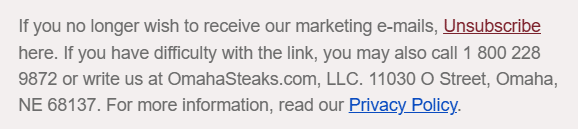
- Physical Postal Address: A valid, current physical mailing address where your business can be reached. This cannot be a P.O. Box in many jurisdictions.
- Contact Information: An email address or phone number for customer service, separate from the marketing sender, can enhance trust.
-
Unsubscribe Mechanism:
- Clear and Conspicuous Link: This is paramount. The link must be easy to find, clearly labeled (e.g., "Unsubscribe," "Manage Preferences"), and functional.
- Single-Click Unsubscribe (where possible): Best practice dictates making the unsubscribe process as frictionless as possible. Ideally, a single click should remove the subscriber from the list or take them directly to a preference center.
- Prompt Processing: Unsubscribe requests must be honored within the legally mandated timeframe (e.g., 10 business days for CAN-SPAM).
-
Copyright Information:
- Copyright Year and Owner: A simple "© [Year] [Company Name]. All rights reserved." is standard practice and protects your intellectual property.
Elevating the Footer: Strategic Additions for Engagement
Once the legal necessities are addressed, the footer transforms into a valuable piece of marketing real estate. Strategic additions can enhance subscriber experience, drive engagement, and further brand objectives:
-
Preference Center Link: Instead of a blunt unsubscribe, offer a "Manage Preferences" link. This empowers subscribers to tailor the content, frequency, or topics of emails they receive, potentially preventing an unsubscribe and turning a potential loss into a segmented, engaged subscriber. Data shows that offering a preference center can reduce unsubscribe rates by enabling users to fine-tune their experience.
-
Social Media Links: Provide direct links to your company’s active social media profiles (e.g., Facebook, Twitter/X, Instagram, LinkedIn). This encourages cross-platform engagement, expands your digital footprint, and allows subscribers to connect with your brand on their preferred channels.
-
Website Link/Logo: A prominent link back to your main website or a small, recognizable company logo reinforces brand presence and provides an easy navigation path for interested recipients. Integrating the logo also adds a professional and visually consistent touch, as seen in many exemplary footers.
-
Referral Programs or Special Offers: A small, non-intrusive call-to-action for a referral program ("Refer a friend and get X% off!") or an exclusive footer-only discount can incentivize further interaction and loyalty.
-
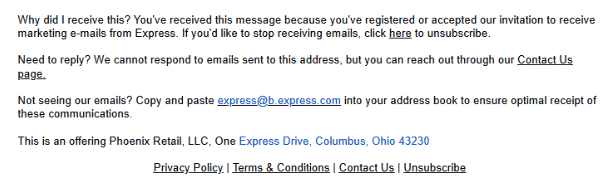
"Why You’re Receiving This Email" Statement: As highlighted by effective examples, a brief reminder such as, "You are receiving this email because you subscribed to our newsletter on [date/website]" can significantly reduce spam complaints. Many users mark emails as spam simply because they’re forgotten they signed up. This simple statement acts as a helpful memory jog.
-
Trust Badges or Certifications: If applicable, display trust badges (e.g., security certifications, industry awards, privacy policy links) to further instill confidence and credibility.
-
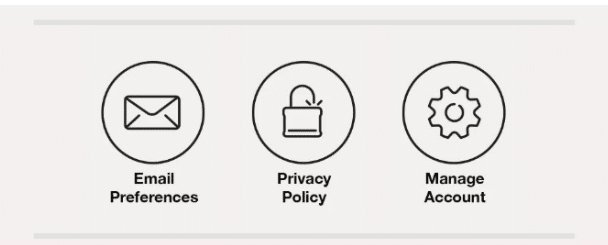
Accessibility Considerations: Ensure that all links, especially unsubscribe and preference links, are designed with accessibility in mind. This means using sufficiently large font sizes, clear contrast, and tap-friendly button-like areas, particularly for mobile users. Examples like Omaha Steaks, with their prominent, easy-to-tap buttons, demonstrate a commitment to user experience and accessibility, often placed just above the fine print.
Designing for Success: Key Best Practices
To maximize the impact of your email footer, adhere to these best practices:
-
Keep it Clean and Concise: A cluttered footer overwhelms recipients and is difficult to navigate, especially on smaller mobile screens. Prioritize required elements, then judiciously add only a few high-value extras. The goal is clarity, not a link farm.
-
Don’t Bury the Unsubscribe Link: Hiding or obfuscating the unsubscribe link is a self-defeating strategy. While it might seem to prevent immediate unsubscribes, it invariably leads to frustration, increased spam complaints, and severe damage to your sender reputation and deliverability rates. Email service providers (ESPs) and internet service providers (ISPs) actively monitor spam complaints, which are far more detrimental than a clean opt-out. Data consistently shows that brands that make unsubscribing easy maintain healthier email lists and better sender scores.
-
Design for Mobile-First: With over half of all email opens occurring on mobile devices (some reports indicate over 60-70%), responsive design for the footer is non-negotiable. Ensure text remains legible without zooming, and links are adequately spaced to prevent accidental taps. Mobile-friendly footers contribute significantly to a positive user experience.
-
Maintain Consistency: Employ a uniform footer format, fonts, colors, and branding across all email campaigns. This consistency builds brand recognition, reinforces professionalism, and establishes a trustworthy presence in the recipient’s inbox over time.
-
Rigorously Test All Links: Broken unsubscribe links, dead social media icons, or incorrect website URLs are common yet entirely avoidable mistakes. Before every send, or at least after any template updates, meticulously test every link within the footer. Automated testing tools can be invaluable here.

-
Revisit Periodically: The digital landscape, including regulations and your business’s offerings, is dynamic. An address that was correct two years ago, or a social media channel your company no longer actively uses, can quietly become a liability or a dead end. Conduct a comprehensive review of your email footer at least once a year, or whenever there are significant company changes, to ensure all information is current and compliant.
The Cost of Neglect: Risks and Consequences
Ignoring the strategic importance of the email footer carries a multitude of risks:
- Legal Fines: As detailed, non-compliance with CAN-SPAM, CASL, GDPR, and other regulations can lead to substantial financial penalties that can cripple a business.
- Damaged Sender Reputation: High spam complaint rates, often a direct result of inaccessible unsubscribe options, signal to ISPs that your emails are unwanted. This can lead to emails being routed directly to spam folders or even outright blocked, severely impacting your deliverability and the effectiveness of your entire email marketing program.
- Reduced Engagement: A footer that lacks professionalism or critical information erodes subscriber trust, leading to decreased open rates, click-through rates, and overall engagement.
- Brand Erosion: A sloppy or non-compliant footer undermines your brand’s credibility and professionalism, suggesting a lack of attention to detail or respect for the customer.
- Lost Opportunities: Neglecting to use the footer for strategic additions like preference centers or social links means missing out on opportunities to nurture relationships and drive further value from your email list.
The Future of Email Footers: Evolving Expectations
As digital privacy concerns grow and regulations become more stringent, the role of the email footer is likely to evolve further. Expect increasing emphasis on:
- Enhanced Transparency: More detailed information about data usage and privacy policies.
- Granular Preference Management: Subscribers will demand even more control over the types and frequency of communications they receive.
- Accessibility Standards: Continued focus on ensuring email content, including footers, is accessible to all users, regardless of ability.
- Dynamic Content: Footers might become more dynamic, displaying personalized content or offers based on subscriber segments or recent interactions.
Conclusion: A Small Space, A Significant Impact
The email footer, though often relegated to the bottom of the design priority list, carries an outsized responsibility. It is the silent guardian of compliance, a fundamental builder of subscriber trust, and an understated extension of your brand identity. Treating it with the same intentionality, strategic thought, and rigorous testing applied to the rest of your email campaign is not merely a best practice; it is a business imperative. A well-crafted footer protects your legal standing, enhances your sender reputation, and nurtures lasting customer relationships. Don’t let a footer misstep undermine the hard work put into the rest of your email marketing efforts. Instead, leverage this small but mighty section to build a foundation of trust and professionalism that resonates with every recipient.








