A shift in operational strategy, moving away from traditional growth models centered on expanding headcount and increasing marketing budgets, is proving to be a more effective route to enhanced profitability for e-commerce businesses. Contrary to the prevailing narrative that business expansion necessitates a larger workforce and aggressive advertising, emerging data and anecdotal evidence suggest that operational leanness and strategic tax planning are significantly more impactful drivers of financial success. This approach prioritizes efficiency, outsourcing, and intelligent financial management over sheer scale.
The conventional wisdom in business growth often equates revenue increases with proportional increases in staff. This model, where scaling up sales figures directly translates to hiring more full-time employees, has been the bedrock of many expansion strategies for decades. However, a closer examination of high-performing e-commerce businesses reveals a divergence from this path. Instead of solely focusing on increasing top-line revenue through marketing prowess, top-tier companies are demonstrating that optimizing operational costs and minimizing tax liabilities can yield substantially higher net profits and reduce overall business stress.
This paradigm shift is exemplified by the experience of a small e-commerce store owner who, despite solid revenue and a team of 35 employees, consistently faced tighter-than-expected profit margins and significant personal stress. Managing a team of that size, in addition to the core responsibilities of running a business, proved to be an overwhelming task. The owner’s strategic decision to pivot included embracing a remote work model, outsourcing fulfillment to a third-party logistics (3PL) provider, and transitioning from full-time employees to a lean team of one employee and eight contractors. The outcome of these "hard calls" was a dramatic increase in profitability and a significant reduction in stress levels, challenging the long-held belief that larger revenue must equate to larger payrolls.

What the Research Actually Shows
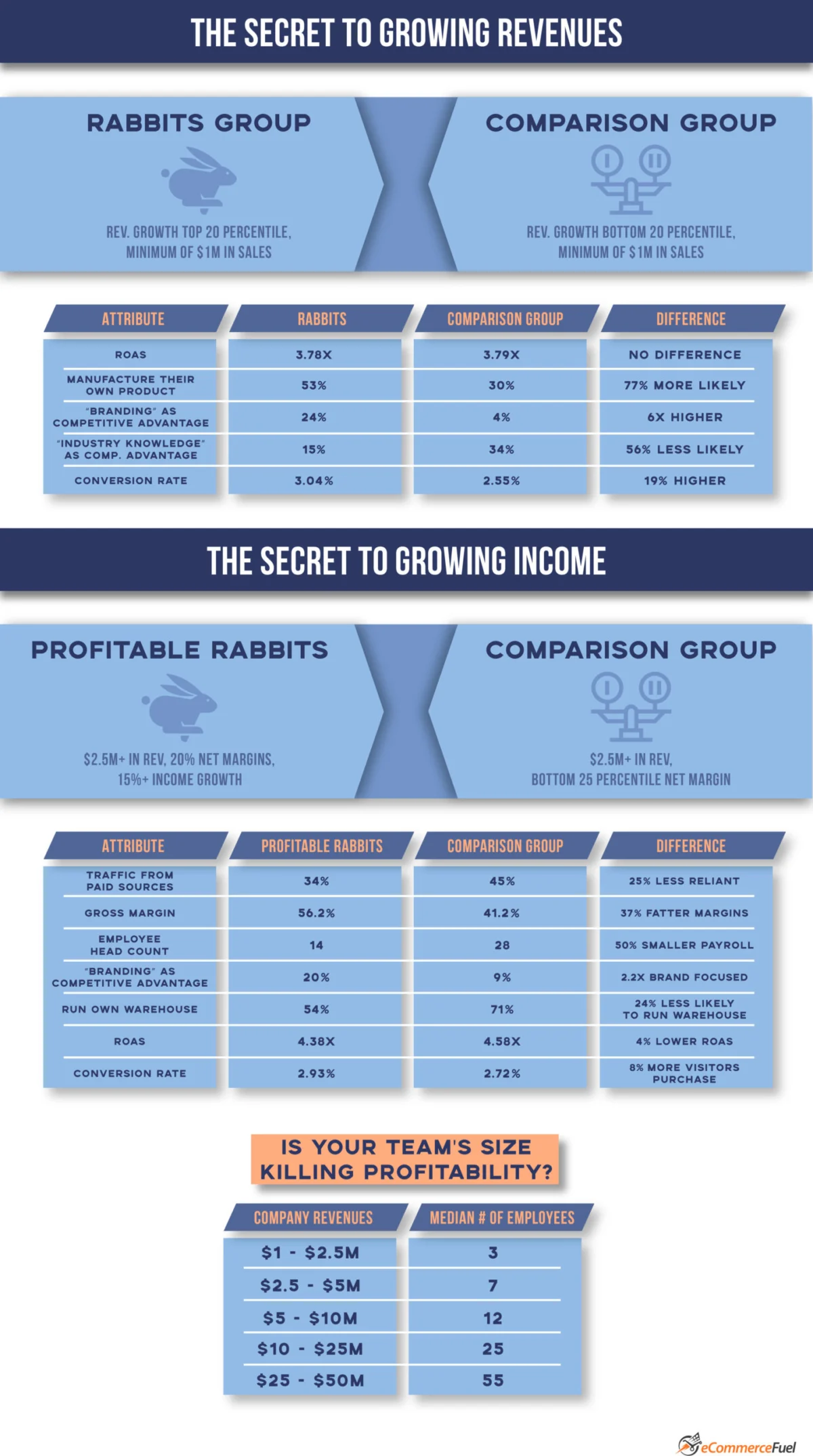
A comprehensive study analyzing hundreds of e-commerce businesses to identify the key differentiators between profitable and struggling operations yielded surprising results. While marketing effectiveness, measured by metrics like Return on Ad Spend (ROAS) and Customer Acquisition Cost (CAC), was expected to be the primary determinant of success, the research indicated otherwise. Top-performing stores did not necessarily exhibit superior marketing acumen. The difference in ROAS between the highest and lowest performers was negligible, suggesting that advanced Facebook ad campaigns or sophisticated SEO strategies were not the exclusive drivers of profitability.
Instead, the critical distinction lay in operational efficiency. The study found that highly profitable e-commerce businesses had, on average, half the payroll of their less profitable counterparts. Furthermore, these top performers were 25% more likely to outsource their warehouse operations and 25% less reliant on paid traffic for customer acquisition. This data strongly suggests that operational leanness, characterized by efficient resource allocation and strategic outsourcing, consistently outperformed marketing sophistication in driving profitability.
The data is set to be updated in the upcoming eComFuel Trends Report, inviting store owners to contribute their operational data to further validate these patterns.

Lean Means More Than Headcount
The concept of "staying lean" is often misinterpreted as merely reducing headcount through layoffs. However, true operational leanness extends far beyond staffing numbers. It encompasses a critical evaluation of all overhead costs, including physical office spaces that may have become underutilized in a post-pandemic remote work landscape, warehouse facilities that could be more cost-effectively managed by a 3PL, and recurring SaaS subscriptions that often auto-renew without active consideration.
A useful framework for assessing these costs involves identifying what is truly core to a brand’s unique selling proposition. For instance, if product design is a key differentiator, retaining in-house design talent might be justifiable. However, if the primary activity is packing and shipping, outsourcing these functions to a specialized 3PL often proves more efficient and cost-effective. Profitable e-commerce businesses are not cutting costs indiscriminately; rather, they are making deliberate decisions about which activities and resources are essential to their competitive advantage and which can be streamlined or eliminated.
The Uncomfortable Truth About Hard Conversations

A widely cited principle for personal and professional success emphasizes the importance of embracing difficult conversations. Many individuals and businesses tend to postpone these crucial discussions until external pressures, such as economic downturns, cash flow shortages, or declining profitability, force their hand. In contrast, businesses that consistently achieve high profitability are characterized by their proactive approach to these challenging dialogues.
These forward-thinking leaders engage in rigorous self-examination, asking critical questions: "Do we truly need this role, or was it a consequence of perceived busyness?" "Are we paying for this software out of necessity or simply out of habit?" and "What would be the first 25% of our expenses we would cut if faced with an immediate financial crisis?" The willingness to confront these questions and, crucially, to act upon the answers by making strategic cuts is not a sign of impending trouble, but rather a hallmark of intentional and disciplined business management.
The Second Unsexy Lever: Strategic Tax Planning
Beyond operational efficiency, another significant yet often overlooked lever for enhancing profitability is strategic tax planning. Many business owners, including those with substantial incomes, tend to view taxes as a fixed cost, a percentage of revenue that is non-negotiable. However, a segment of highly successful entrepreneurs demonstrates a markedly different approach, paying a fraction of the taxes on similar income levels. This is achieved not through illicit means, but through a deliberate and informed engagement with tax strategies.

A compelling illustration of this potential difference can be observed by comparing two hypothetical store owners, each with identical businesses generating $2.5 million in revenue and $250,000 in profit, drawing the same salary and having similar family situations. Owner A might pay approximately $75,000 in annual taxes, while Owner B, through intentional strategies, could reduce their tax liability to around $21,000. This significant difference of $54,000 annually can be attributed to a proactive approach to tax optimization.
Owner B’s strategies might include:
- Profit Sharing: Contributing a substantial amount, such as $45,000, into retirement accounts through profit-sharing plans, exceeding standard 401(k) limits. This can lead to savings of approximately $13,500, assuming a 30% marginal tax rate.
- Appreciated Stock Donations: Donating stocks that have appreciated in value to charities instead of cash. This strategy allows for the avoidance of capital gains tax while still claiming the full deduction, potentially saving around $3,500.
- Maxed Health Savings Account (HSA): Contributing the maximum family limit ($8,500) to an HSA, which offers triple tax advantages, yielding savings of approximately $2,550.
- Paying Children for Real Work: Employing children to perform legitimate tasks within the business and paying them a reasonable salary, such as $7,000 each for three children. These payments are deductible for the business owner, and the children can invest their earnings in Roth IRAs, allowing for tax-free growth for decades. This strategy could save approximately $6,300 in taxes.
- Inventory Donations: Donating slow-moving inventory to charities at its fair market value. For instance, donating $60,000 worth of old inventory could result in a deduction of approximately $18,000, a significantly underutilized strategy in e-commerce.
These strategies, when combined, illustrate the substantial financial benefits of a proactive and informed approach to tax planning.
Why This Stays Invisible

The reason these tax optimization opportunities often remain elusive for many business owners is the fragmented nature of financial reporting. Tax obligations are typically spread across personal returns, business filings, brokerage statements, and payroll tax reports, preventing a holistic view of the overall tax burden. Consequently, business owners may not fully comprehend their total tax liability or recognize the potential for reduction.
The hypothetical Owner A is not necessarily lacking in intelligence or financial acumen. However, without a comprehensive overview of their tax situation and a proactive advisor, they may overlook these strategic savings. Standard accounting services often focus on compliance and accurate filing rather than proactively identifying and proposing tax-saving strategies.
A Simple Test for Your CPA
A key indicator of a CPA’s value beyond basic compliance lies in their proactivity. A simple test is to consider the last time your Certified Public Accountant (CPA) initiated contact with a proactive suggestion, rather than merely responding to your questions or processing routine filings. If such proactive engagement is a rarity, it suggests that while your accountant may be competent in handling the basics, they might be costing you significant financial opportunities. The substantial differences in tax liabilities, like the $54,000 illustrated, are not typically the result of complex financial engineering but rather of intentional and informed planning. If your CPA is not actively bringing forward innovative strategies, it may be time to seek one who will.

Two Levers Most People Ignore
While marketing metrics such as ROAS, CAC, and Lifetime Value (LTV) dominate industry discussions and attention, they represent only one facet of business performance. The truly profitable e-commerce entrepreneurs often focus on two less glamorous, yet profoundly impactful, levers: operational efficiency and tax optimization. By maintaining lean teams, strategically outsourcing non-core functions, and meticulously planning their tax liabilities, these businesses retain a significantly larger portion of their earnings. While enhancing marketing efforts is beneficial, the ability to keep more of what is already earned often represents a more immediate and sustainable path to increased profitability.
Want to Go Deeper?
For business owners seeking ongoing insights into building leaner, more profitable e-commerce operations, drawing from the collective experience of a community of successful entrepreneurs, staying connected through regular newsletters and industry reports can provide invaluable guidance.