
 rifanmuazin
In the modern competitive landscape, the primary driver of customer churn is not always a lack of product features or high pricing, but rather the cumulative weight of friction. While businesses often focus on "delighting" customers with unexpected perks, research indicates that the ease of an experience is a far more reliable predictor of long-term loyalty. Customers rarely voice their frustrations when a process requires excessive effort; instead, they quietly migrate to competitors who offer a more seamless journey. Every unnecessary click, redundant form field, or ambiguous navigation step erodes the user experience, leading to a steady decline in retention and repeat behavior.
To combat this, organizations are increasingly turning to the Customer Effort Score (CES). This metric allows businesses to quantify the perceived difficulty of an interaction from the customer’s perspective. By identifying and mitigating high-effort touchpoints, companies can streamline the user journey, improve operational efficiency, and secure a more stable customer base.
The Evolution and Definition of Customer Effort Score
The concept of Customer Effort Score was first introduced to the mainstream business world in a landmark 2010 study published in the Harvard Business Review titled "Stop Trying to Delight Your Customers." Conducted by the Corporate Executive Board (CEB), which was later acquired by Gartner, the study challenged the conventional wisdom that businesses should aim to exceed expectations through "wow" moments. The researchers found that while delighting customers might generate short-term buzz, it had a negligible impact on loyalty compared to the simple act of reducing the effort required to solve a problem.
At its core, CES is a customer experience (CX) metric that asks a single, fundamental question: "How easy was it to resolve your issue or complete your task today?" Unlike other metrics that focus on emotional satisfaction or the likelihood of referral, CES provides a clinical assessment of the functional efficiency of a specific interaction.
Why Customer Effort is the New Currency of Loyalty
When interactions feel burdensome, customers are statistically less likely to return, regardless of the quality of the underlying product. CES shifts the focus from nebulous "satisfaction" to concrete "effort," allowing teams to pinpoint exactly where the user journey is failing. There are four primary reasons why tracking CES has become a priority for modern enterprises:
1. Identifying Drivers of Retention
Loyalty is built on reliability and ease. When customers encounter obstacles while performing basic tasks—such as tracking a shipment, updating billing information, or finding a pricing table—their trust in the brand diminishes. By quantifying the effort involved in these tasks, organizations can prioritize fixes that have the highest impact on long-term retention.
2. Early Detection of Churn Signals
A high CES is a leading indicator of potential churn. It highlights systemic issues before they manifest as a total loss of interest. Whether it is a confusing user interface (UI), a slow-loading checkout page, or an unresponsive support bot, these friction points provide early warning signals that the customer experience is beginning to fracture.

3. Contextualizing Beyond Satisfaction Scores
Traditional metrics like Customer Satisfaction (CSAT) can sometimes be misleading. A customer might report being "satisfied" with a support agent’s politeness while still being frustrated by the three hours it took to reach that agent. CES provides the necessary context that CSAT often misses, measuring whether the brand is meeting the rising expectation for instantaneous, low-friction digital experiences.
4. Enhancing Operational Efficiency
High-effort interactions are expensive. When a customer cannot find an answer in a self-service help center, they inevitably turn to live support channels, increasing the volume of tickets and the cost of operations. By reducing effort through optimized self-service resources, businesses can lower support costs and reduce the frequency of repeat interactions.
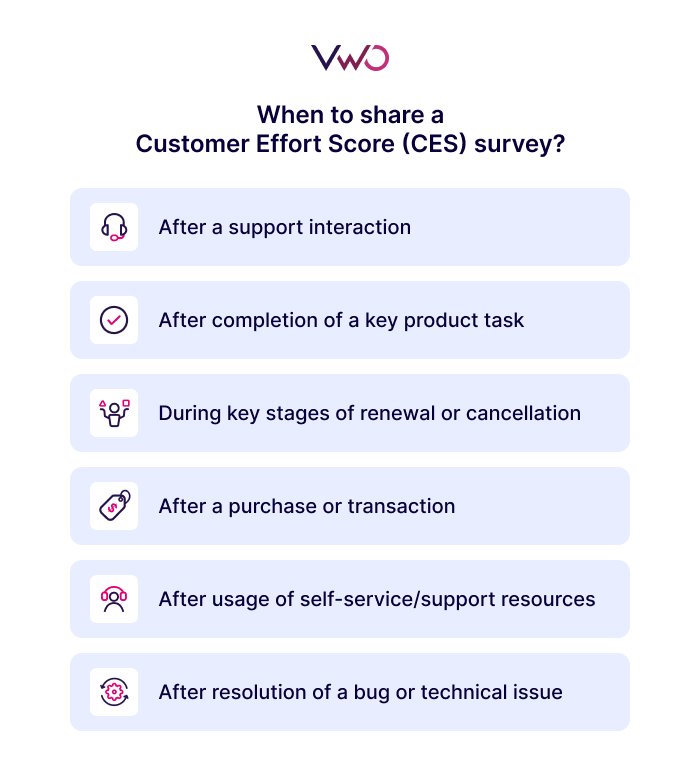
The Chronology of Measurement: When to Deploy CES Surveys
Timing is the most critical factor in obtaining an accurate Customer Effort Score. Because the metric measures the perception of effort, the survey must be triggered immediately after a task is completed to ensure the experience is fresh in the user’s mind.
After Support Interactions
This remains the most common application of CES. Organizations typically deploy a survey via email, chat, or SMS immediately after a support ticket is marked as resolved. This helps measure the efficiency of the support staff and the effectiveness of the resolution process.
Following Key Product Milestones
In the Software-as-a-Service (SaaS) sector, CES is often used during the onboarding phase. Measuring the effort required to set up an account, integrate a new tool, or invite a team member allows product managers to identify "stuck points" that might prevent a user from realizing the product’s value.
Post-Transaction and Checkout
For eCommerce entities, the checkout process is the most vulnerable point in the funnel. Triggering a CES survey on the "Thank You" or order confirmation page can reveal hidden friction in the payment gateway or shipping selection process that may be causing cart abandonment in other segments.
Self-Service and Help Center Audits
When a user navigates a knowledge base, they are attempting to avoid a live interaction. Deploying a quick effort survey at the bottom of help articles ("Was this article easy to follow?") allows content teams to refine documentation and ensure that self-service options are actually serving their purpose.
Methodology: How to Calculate and Interpret CES
Measuring CES requires a structured approach to both the question and the response scale. While the phrasing can vary, the most widely accepted format is: "To what extent do you agree with the following statement: The company made it easy for me to handle my issue."

Organizations typically use one of three scales:
- The 1–7 Likert Scale: Ranging from "Strongly Disagree" to "Strongly Agree."
- The 1–5 Scale: A simplified version often used for mobile or in-app surveys.
- The Emoticon Scale: Utilizing visual cues from "Very Easy" to "Very Difficult," which is useful for quick, high-response-rate feedback.
The formula for calculating the score is the sum of all individual ratings divided by the total number of responses. For example, if a company receives 200 responses with a total point value of 840, the CES is 4.2.
A "good" score depends on the scale used, but generally, any score above 5 on a 7-point scale is considered strong. Industry benchmarks suggest that moving a customer from a "high effort" (1–3) to a "low effort" (5–7) experience can increase their likelihood of repurchasing by up to 40%.
Expert Perspectives on Digital Friction
Industry leaders emphasize that CES is not just about numbers, but about understanding the psychology of the user. Jon MacDonald, a prominent voice in conversion rate optimization, notes that every element on a website sends a signal regarding brand trustworthiness. "Sometimes those signals are clear, but at other times they simply create confusion that pushes visitors to look elsewhere," MacDonald explains. The challenge for brands is to identify these moments of confusion across the digital journey.
Similarly, April Hung, a specialist in user research, advocates for real-time, on-site surveys. "When users encounter a problem while browsing, they can share their thoughts immediately instead of trying to recall the experience later," Hung states. This real-time capture makes it significantly easier to identify friction at the exact moment it occurs, providing a more cost-effective research method than retrospective interviews.
Strategies for Improving Customer Effort Scores
Improving a CES requires a cross-functional effort involving product, design, and support teams. The following strategies are proven to reduce friction and boost scores:
Journey Mapping and Friction Audits
By utilizing session recordings and heatmaps, teams can visually observe where users hesitate or "rage-click." Combining this behavioral data with CES survey responses allows for a precise diagnosis of which steps in a journey are perceived as high-effort.
Streamlining Navigation and UI
Cognitive load is a major contributor to effort. Simplifying navigation menus, reducing the number of steps required to reach a destination, and providing clear "next step" calls to action (CTAs) can drastically lower the perceived difficulty of a website or app.
Proactive Communication and AI Integration
Modern optimization platforms, such as VWO Pulse, allow teams to capture real-time feedback and use AI-driven tools like VWO Copilot to generate structured, relevant survey questions. This enables companies to launch thoughtful surveys quickly, closing the loop between identifying a problem and implementing a fix.
Empowering Self-Service
The most effortless interaction is the one the customer can handle themselves in seconds. Investing in a searchable, clear, and multimedia-rich help center reduces the need for customers to wait in support queues, which is the single largest driver of high-effort scores.
Broader Impact and Future Implications
The shift toward measuring effort represents a fundamental change in how businesses view the customer relationship. In an era of instant gratification, "ease" has become a competitive moat. Companies that master the art of low-effort interactions—such as Amazon’s "One-Click" buying or Netflix’s seamless "Skip Intro"—set the standard for all other industries.
As artificial intelligence becomes more integrated into customer service, the measurement of CES will evolve. AI can now analyze the sentiment of a support call or chat in real-time, assigning an "effort score" based on the customer’s tone and the complexity of the language used, even without a formal survey.
Ultimately, the Customer Effort Score is more than just a metric; it is a philosophy of respect for the customer’s time. By prioritizing ease over "delight," businesses can build a foundation of loyalty that is resistant to market fluctuations and competitor pressure. In the final analysis, the brands that win are not necessarily the ones that offer the most, but the ones that require the least.








