rifanmuazin
January 20, 2026. The daily operational cadence within the fastest-growing technology companies has long been punctuated by an underlying strategic tension. In the virtual corridors of Slack channels and bustling meeting rooms, a familiar debate often unfolds: marketing teams championing feature-rich platforms for crafting engaging newsletters and sophisticated automation, celebrating successful campaigns that drive customer engagement. Simultaneously, in a parallel digital universe, development teams diligently maintain the application’s core transactional email infrastructure, ensuring the reliable dispatch of critical notifications like password resets and welcome messages, often powered by a robust but entirely separate email API. This operational duality, while seemingly pragmatic, has evolved into a significant strategic liability, introducing substantial and costly challenges across the modern enterprise.
For too long, businesses have been confronted with a false dilemma, compelled to choose between investing in a platform that empowers marketers to cultivate rich customer experiences or one that provides developers with the raw power and reliability essential for system-critical communications. In the contemporary landscape of product-led growth (PLG), where the product itself is the primary driver of customer acquisition, retention, and expansion, this fragmented approach is no longer sustainable. The answer, increasingly evident, lies in neither a singular focus nor a continued division, but in the adoption of an all-in-one email platform designed to seamlessly serve both marketing and transactional needs. This strategic convergence is not merely an operational efficiency gain; it represents a fundamental shift towards a more coherent, agile, and compliant digital communication strategy.
The Persistent Divide: A Legacy Challenge in Modern Tech
The historical separation of marketing and transactional email systems emerged from distinct functional requirements and technological evolutions. Marketing email platforms were built for broadcast, segmentation, analytics, and creative flexibility, catering to the needs of campaigns and promotions. Transactional email, conversely, prioritized reliability, speed, and API integration, serving as the digital plumbing for critical user interactions with an application. Developers often favored direct API access for these essential system messages, while marketers gravitated towards user-friendly interfaces for campaign management. This divergence, once logical, has created a chasm that impedes holistic customer engagement and operational synergy in today’s interconnected digital ecosystem.
In a PLG environment, every touchpoint with a user, from the initial signup to a password reset, is an opportunity to reinforce brand value and guide them towards activation and deeper engagement. When these touchpoints emanate from disparate systems, with inconsistent branding, messaging, and underlying data, the customer journey becomes disjointed, eroding trust and hindering growth. The challenge is not merely about aesthetic inconsistency; it delves into fundamental issues of data integrity, operational agility, and regulatory compliance.
Unpacking the Strategic Liabilities: The Hidden Costs of Fragmentation
Running two disparate email systems might appear manageable at first glance, but the insidious nature of their hidden costs quietly accumulates, systematically sabotaging growth, brand integrity, and internal efficiency. These pains are most acutely felt by the very teams tasked with propelling the business forward, generating friction where seamless flow is paramount.

Inconsistent Customer Experience: The Erosion of Brand Trust
Customers do not perceive internal departmental silos; they perceive one unified brand. They are indifferent to whether an email is categorized as “marketing” or “transactional.” To them, every message constitutes a single, continuous conversation with your company. When the email strategy is fractured, this crucial conversation becomes disconnected, and the overall customer experience deteriorates rapidly.
Consider a prospective user, initially captivated by a sophisticated marketing email showcasing an application’s elegant user interface. Intrigued, they proceed to sign up for a trial. However, a subsequent mistyped password leads them to click the “Forgot Password” link, only to be met with a plain-text, unbranded email that evokes the aesthetics of a bygone era. The trust and excitement meticulously cultivated by the marketing team instantly evaporate, replaced by confusion and a subtle, yet significant, sense of disappointment.
This scenario exemplifies where brand trust suffers a death by a thousand cuts. Every inconsistent touchpoint – be it a stark payment receipt, a generic shipping notification, or an unhelpful error message – widens the cracks in the meticulously mapped customer journey. Achieving a truly consistent brand experience across all email communications becomes an impossible feat. In the user’s perception, if a company struggles to maintain visual and tonal consistency across its own emails, questions arise about the reliability and seamlessness of the product itself. The simple act of unifying transactional and marketing email under a single brand identity is a foundational step that siloed systems render unachievable. Data from Mailjet’s email engagement report, published in 2024, underscored this, revealing that brands with a distinct and consistent look and voice across all customer interactions saw significantly higher recognition and trust, directly translating to improved open and engagement rates.
Developer Bottlenecks and Stifled Innovation
In the fiercely competitive, PLG-driven world, speed, agility, and the capacity for rapid iteration are paramount. A product’s communication strategy is a critical lever for growth, guiding users towards activation, feature adoption, and sustained engagement. For Product or Growth Leads, however, a divided email strategy represents a constant source of frustration, often manifesting as the dreaded developer bottleneck.
Imagine a Growth Manager who, after meticulous analysis of user behavior data, designs an ingenious five-part automated sequence for user onboarding. The objective is to proactively guide new users through critical activation steps within their inaugural week. The copy is compelling, the email designs are engaging, yet the project encounters an immediate roadblock. The foundational welcome emails are hard-coded deep within the application and dispatched via a rudimentary transactional service that the marketing team lacks any access or control over.
The request inevitably lands in the development backlog, where it languishes for weeks, awaiting prioritization against a myriad of critical bug fixes and new feature builds. When it finally receives attention, the implementation often represents a diluted version of the original vision. The crucial opportunity to rapidly A/B test email subject lines, experiment with different calls-to-action, or dynamically alter content based on real-time user actions is irrevocably lost. The SaaS email platform, which should function as a potent growth accelerator, instead becomes a significant brake, actively inhibiting the very experiments that could dramatically enhance activation rates and curb churn. Industry reports from late 2025 indicated that companies relying on siloed systems typically experienced email-related feature deployment cycles that were 30-50% longer than those with unified platforms.
Governance Nightmares and Escalating Compliance Risks
For any leader overseeing operations, security, or finance, email governance and regulatory compliance are non-negotiable, top-tier priorities. A divided email strategy, characterized by duplicate data stores, fragmented user permissions, and a conspicuous absence of a central command center, is a ticking time bomb of operational and legal risk.
With stringent data privacy regulations such as GDPR and CCPA carrying severe financial penalties, a lack of centralized email management is a risk no modern business can afford to bear. When a user in Europe exercises their “right to be forgotten,” can an organization confidently guarantee that their data has been comprehensively scrubbed from both the marketing platform and the transactional service’s logs? When a customer unsubscribes from a promotional newsletter, is there absolute certainty they will not inadvertently receive another promotional email triggered from the “transactional” system, potentially leading to a compliance violation and severely damaging sender reputation?
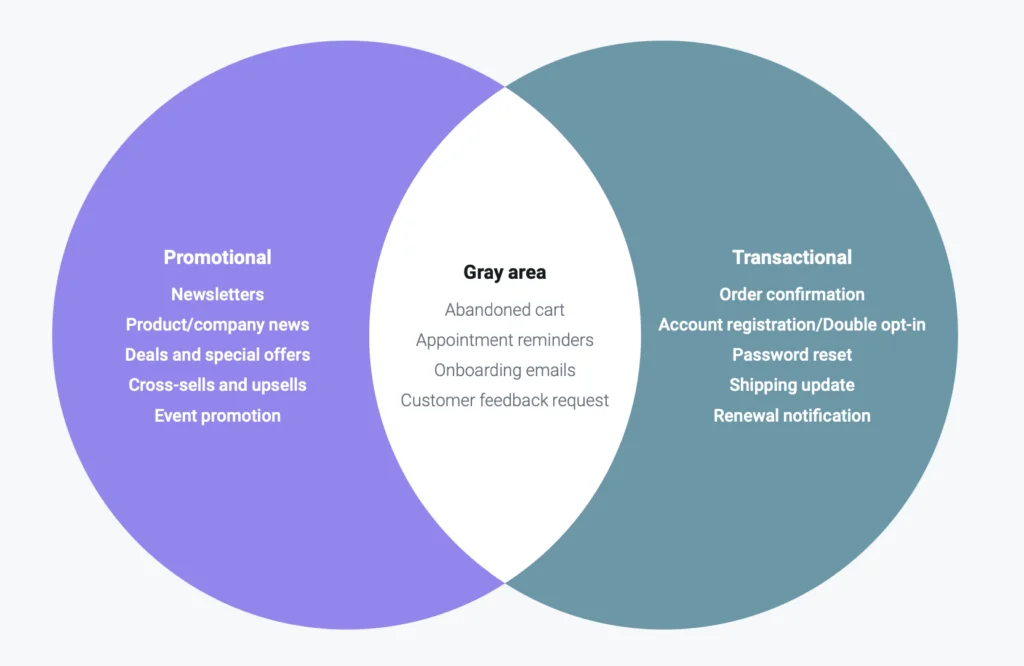
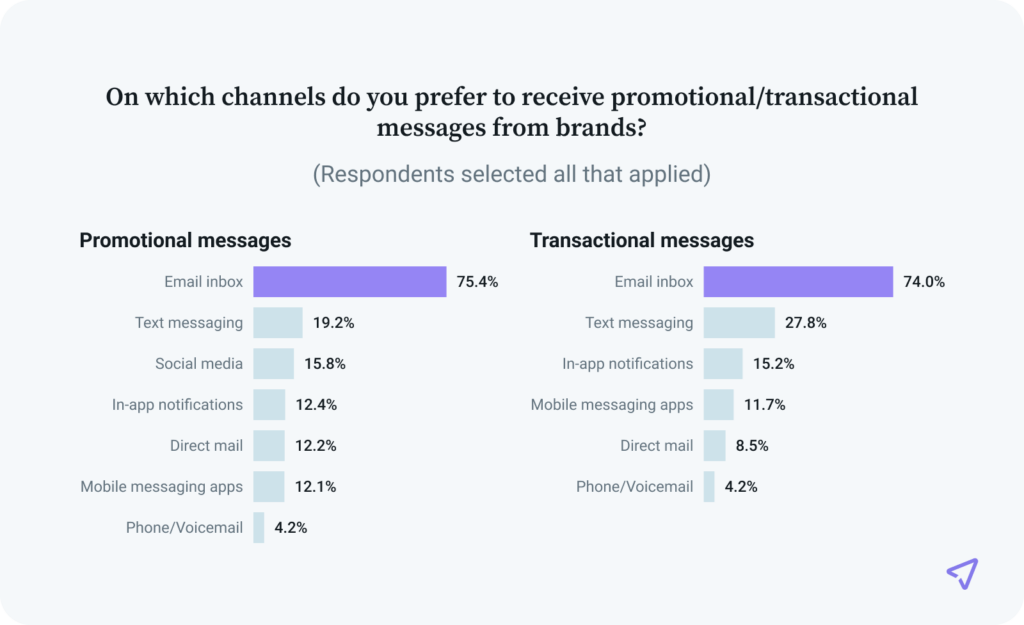
Furthermore, this operational division profoundly impacts core email deliverability. If, for instance, a transactional system maintains poor list hygiene, persistently sending emails to invalid or inactive addresses, it can severely degrade the sending domain’s overall reputation. Crucially, because both marketing and transactional systems often send from the same domain, the marketing team’s meticulously crafted campaigns may, through no fault of their own, begin to land in spam folders, bypassing the intended recipients entirely. A 2024 email engagement report highlighted that while 71% of respondents confirmed they would check their spam/junk folder for a transactional email, this is far from an ideal user experience. It underscores the critical need for unified, robust deliverability practices across all email types to prevent reputational damage and ensure critical messages reach their destination.
The Paradigm Shift: Embracing a Unified Email Framework
The solution to this strategic chaos is not a perpetual search for a better compromise; it is a fundamental re-imagination of the underlying model. A unified email platform is built upon the simple yet profoundly powerful principle that all email communications are integral parts of a single, continuous customer conversation. By bringing these disparate functions together, businesses unlock profound, business-altering benefits that drive growth, enhance trust, and ensure robust operational control.
Fostering a Cohesive Customer Journey
When all of a company’s email communications originate from a single, centralized platform, organizations can finally deliver the cohesive and professional brand experience that is instrumental in building enduring trust and delight. Every single touchpoint, from the very first marketing welcome email to the final invoice, speaks with a singular, consistent voice, maintains a uniform aesthetic, and powerfully reinforces the brand’s identity.
This level of consistency is made possible through effective email template management designed specifically for modern, collaborative teams. Platforms featuring robust collaborative tools, for instance, enable teams to construct and maintain a shared gallery of email templates. Marketers can design aesthetically pleasing, on-brand, and mobile-responsive templates for every conceivable scenario – encompassing password resets, new feature announcements, usage alerts, and payment receipts. Developers can then seamlessly integrate these pre-approved, polished templates via a simple API call, confident that every email triggered from the application is perfectly on-brand and professionally executed. The long-standing debate over transactional versus marketing email branding is thus definitively resolved, eliminating a pervasive source of internal friction.
Empowering Teams and Accelerating Product Innovation
A unified email platform fundamentally breaks down the artificial wall separating product and marketing functions, permanently eradicating the debilitating developer bottleneck. This new operational model reoptimizes workflows, significantly enhancing efficiency and agility.
In this transformed environment, Growth Managers gain unprecedented autonomy. They can independently design, iterate, and launch comprehensive email automation sequences for SaaS onboarding using intuitive visual workflow builders. They are empowered to A/B test email subject lines for welcome series, optimize open rates with different messaging strategies, or test various calls-to-action on trial expiration nudges to maximize conversions, all without direct developer intervention. This agility allows for rapid experimentation and data-driven optimization, directly impacting key PLG metrics.
The developer’s role, consequently, becomes far more strategic. Instead of being mired in the laborious task of coding HTML emails or responding to ad-hoc template requests, they can dedicate their expertise to building and refining the core product. Their responsibility shifts to enabling this new, streamlined workflow by making simple, clean API calls from the application to trigger the appropriate, pre-designed template at precisely the right moment. This API-first approach drastically shrinks innovation cycles from months and weeks to mere hours and days, providing a critical competitive advantage. Recent industry benchmarks suggest that companies adopting unified platforms see a 25% faster time-to-market for new email-driven features and a 10-15% improvement in key user activation metrics.
Strengthening Control and Ensuring Robust Governance
For Platform Owners and Operations leaders, a unified platform delivers the ultimate desideratum: a single pane of glass for the entire email infrastructure. From one central dashboard, stakeholders can monitor crucial deliverability metrics across all email types, manage user permissions with granular role-based access control, and maintain a single, global suppression list that guarantees compliance with opt-out requests.
This model strikes an optimal balance between team autonomy and centralized control. Leading platforms are specifically architected to meet this exacting need. For example, Mailjet’s Sub-accounts feature allows a central administrator to establish distinct, sandboxed accounts for different teams, brands, or even operational environments (e.g., development, staging, production). Each team can operate independently, managing its own templates and sender lists, while the master account owner retains ultimate visibility and comprehensive control over billing, security protocols, and global compliance rules. This architectural approach epitomizes centralized email management without stifling the essential agility of individual teams. Moreover, consolidated reporting provides a holistic view of email performance, enabling proactive identification and mitigation of deliverability risks before they escalate.
Industry Outlook and the Path Forward
The long-standing debate over the necessity of separate transactional versus marketing email platforms is, hopefully, now recognized as a relic of a bygone era. Unified email platforms fundamentally flip the script, transforming a historical operational challenge into a potent strategic advantage. The benefits they provide in fostering deeper customer relationships, accelerating product innovation, and delivering the robust, centralized governance required to scale with unwavering confidence cannot be overstated.
Industry analysts are increasingly emphasizing that the integration of marketing and transactional email is no longer a luxury but a strategic imperative for any enterprise aiming for sustainable growth in a product-led world. Companies that continue to operate with fragmented email strategies risk falling behind competitors who leverage a unified approach to deliver seamless experiences, iterate faster, and maintain superior compliance. The competitive implications are clear: a cohesive email strategy directly translates to stronger brand loyalty, more efficient product development cycles, and a significantly reduced risk profile.
The time for deliberation is over. Businesses must now move beyond the outdated paradigm of choosing between distinct email functionalities and instead embrace the powerful synergy of unification. Are you ready to dismantle your email silos and effectively combine transactional and marketing email? The journey towards a seamless email experience, from the very first marketing touchpoint to the last critical notification, begins with a unified platform designed for the complexities and opportunities of the modern digital landscape.


 Ammar Sabilarrohman
 Asro
Asro