
 rifanmuazin
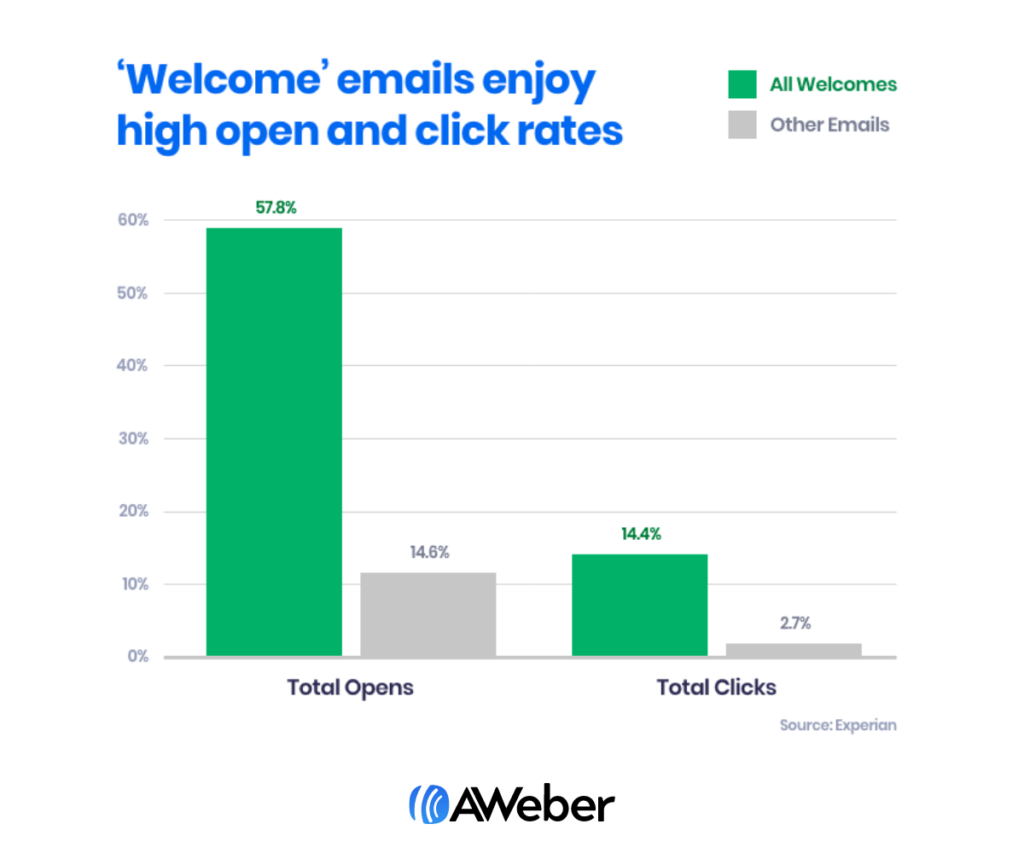
For small businesses navigating the competitive digital landscape, the welcome email stands as the single most potent automated message, delivering an unparalleled return on investment (ROI). Data consistently reveals that these initial touchpoints generate nearly four times more opens and over five times more clicks than conventional promotional emails, underscoring their critical importance in forging immediate connections and setting the stage for long-term customer relationships. The act of a new subscriber voluntarily joining an email list represents a significant investment of trust, a culmination of prior efforts to attract and engage them. However, the journey does not conclude with a signup; it merely begins, demanding a strategic, engaging follow-up to convert nascent interest into enthusiastic, enduring loyalty. This foundational engagement is universally initiated and nurtured through a meticulously crafted welcome email or, more effectively, a series of them.
Defining the Welcome Email: More Than Just a Greeting
A welcome email is an automated message dispatched to new subscribers immediately upon their enrollment in an email list. While a single welcome email serves a foundational purpose, many astute email marketers opt for a "welcome series" – a sequence of typically three to five emails delivered over a period, often one per day. This multi-message approach allows for a more comprehensive introduction, deeper value delivery, and a gradual build-up of trust and familiarity, significantly enhancing the subscriber onboarding experience.

The rationale behind sending a welcome email is rooted in a fundamental psychological principle: peak interest. A new subscriber’s curiosity and receptiveness to communication are never higher than in the immediate moments following their signup. This precious window of attention, however, is fleeting. A well-timed welcome email capitalizes on this heightened engagement, ensuring the initial impression is positive, informative, and compelling. Neglecting this crucial step or delaying the message can result in missed opportunities, subscriber apathy, and ultimately, a diminished list value.
The Unparalleled Impact: Supporting Data and Strategic Significance
The stark performance difference between welcome emails and standard promotional messages is not merely anecdotal; it is a well-documented phenomenon. Industry benchmarks frequently highlight that welcome emails boast average open rates ranging from 50% to 90%, far surpassing the typical 15-25% for regular newsletters. Click-through rates (CTRs) also exhibit a similar disparity, with welcome emails often achieving 10-20% or higher, compared to the 2-4% seen in general campaigns. This extraordinary engagement can be attributed to several factors:
- Anticipation and Permission: Subscribers have actively opted in, indicating a clear expectation and desire for communication.
- Timeliness: The message arrives precisely when the subscriber is thinking about the brand or the offer they signed up for.
- Transactional Nature (Often): Many welcome emails deliver a promised incentive, download, or access, making them highly relevant and anticipated.
- Novelty Effect: Being the first communication from a new source, it garners more attention.
Beyond these immediate metrics, the long-term implications are profound. A robust welcome sequence can significantly influence subscriber lifetime value (LTV). Studies by various email marketing platforms suggest that subscribers who receive a welcome email show 33% more long-term engagement with the brand. They are also more likely to make a purchase, refer others, and remain subscribed for extended periods. This makes the welcome email not just a courtesy, but a strategic imperative for sustainable business growth.
Crafting the Perfect First Impression: Key Elements of an Effective Welcome Email
For small businesses, a successful welcome email, or the initial message in a series, should meticulously cover five essential components: a heartfelt thank you, the immediate delivery of any promised incentive, a clear articulation of future communications, accessible contact information, and a concise introduction to the sender.
1. A Genuine Thank You and Immediate Deliverance: The opening lines must unequivocally acknowledge the subscriber’s decision to join and, critically, deliver on any promise made during the signup process. Whether it’s a free checklist, an exclusive discount code, a resource guide, or access to premium content, the "goods" should be prominently featured and easily accessible within the first two sentences. Burying the promised content deep within the email or requiring additional steps can lead to frustration and a breach of initial trust. For instance, if a subscriber signed up for a free e-book, the direct download link should be the immediate focal point.
2. Setting Clear Expectations: Managing subscriber expectations is paramount for sustained engagement. The welcome email should succinctly outline what kind of content they will receive, the frequency of these communications, and the value proposition of remaining subscribed. A brief statement, perhaps one or two sentences, explaining "what’s coming next" can be the decisive factor between a subscriber who eagerly anticipates the next email and one who quickly forgets their initial interest. This proactive approach minimizes unsubscribe rates by ensuring content aligns with expectations.
3. A Brief, Human Introduction: In an era of automated communications, connecting on a human level is invaluable. The welcome email should offer a brief introduction to the individual or team behind the emails. This is not the place for an exhaustive biography, but rather a concise overview of who you are, what your business does, and, most importantly, who you help. This personal touch fosters relatability and reinforces the idea that a real person, not just a faceless entity, is communicating with them. Deeper narratives and origin stories can be reserved for subsequent emails in a welcome series.
4. Making Accessibility a Priority: Providing clear contact information (e.g., email address, website, social media links) and encouraging subscribers to add the sender’s email to their contacts list serves multiple purposes. It enhances deliverability by signaling to email service providers that the sender is a legitimate contact and helps prevent future emails from landing in spam folders. Furthermore, it demonstrates transparency and accessibility, reinforcing the brand’s commitment to open communication. A call to action like "Reply to this email with any questions!" can further humanize the interaction.
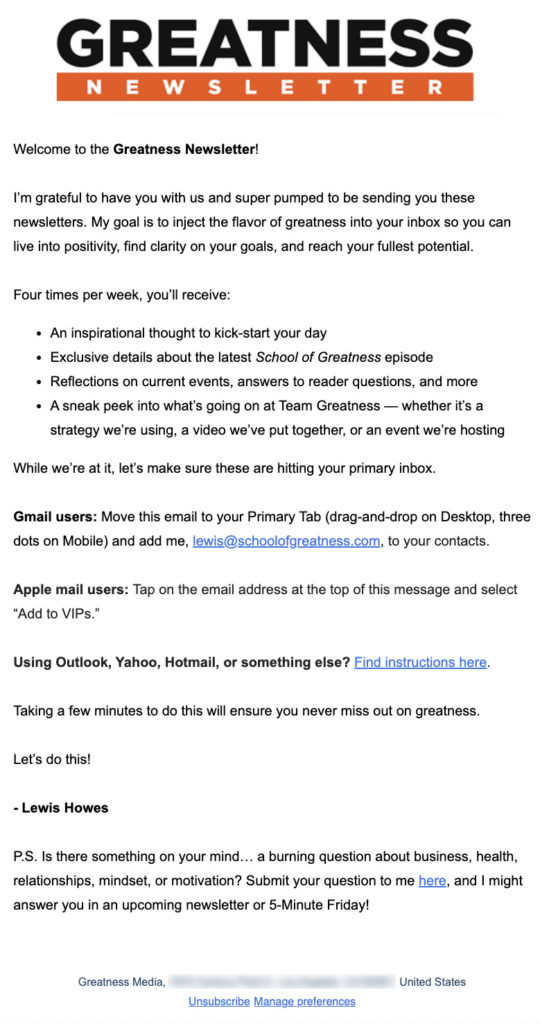
5. The Power of a Postscript (Pro Tip): As exemplified by AWeber customer Lewis Howes of The School of Greatness, incorporating an interactive element in a postscript can be incredibly effective. Asking new subscribers a simple, open-ended question like, "What’s the biggest challenge you’re currently facing with [topic related to your business]?" achieves several objectives: it encourages direct replies, providing invaluable insights into audience needs and pain points; it strengthens the perception of accessibility and friendliness; and crucially, email replies signal to inbox providers that your emails are valued, further boosting deliverability.
Crafting Compelling Welcome Email Subject Lines
The subject line is the gatekeeper of the inbox, and its importance is amplified for welcome emails. It must be direct, informative, and reassuring. Here are five effective welcome email subject line strategies:
- Direct & Informative: "Welcome to [Your Brand]! Here’s Your [Incentive/Resource]"
- Personalized & Friendly: "So Glad You Joined, [Subscriber Name]!"
- Benefit-Oriented: "Your Journey to [Desired Outcome] Starts Now!"
- Action-Oriented: "Here’s How to Get Started with [Your Service/Product]"
- Curiosity & Value: "A Special Welcome Gift from [Your Brand]"
Tools like AWeber’s Subject Line Assistant, which analyzes email content and generates variations based on extensive email marketing best practices, can be invaluable for optimizing these critical first impressions.
The Best First Emails Feel Personal: An Example of Reply-Driving Engagement
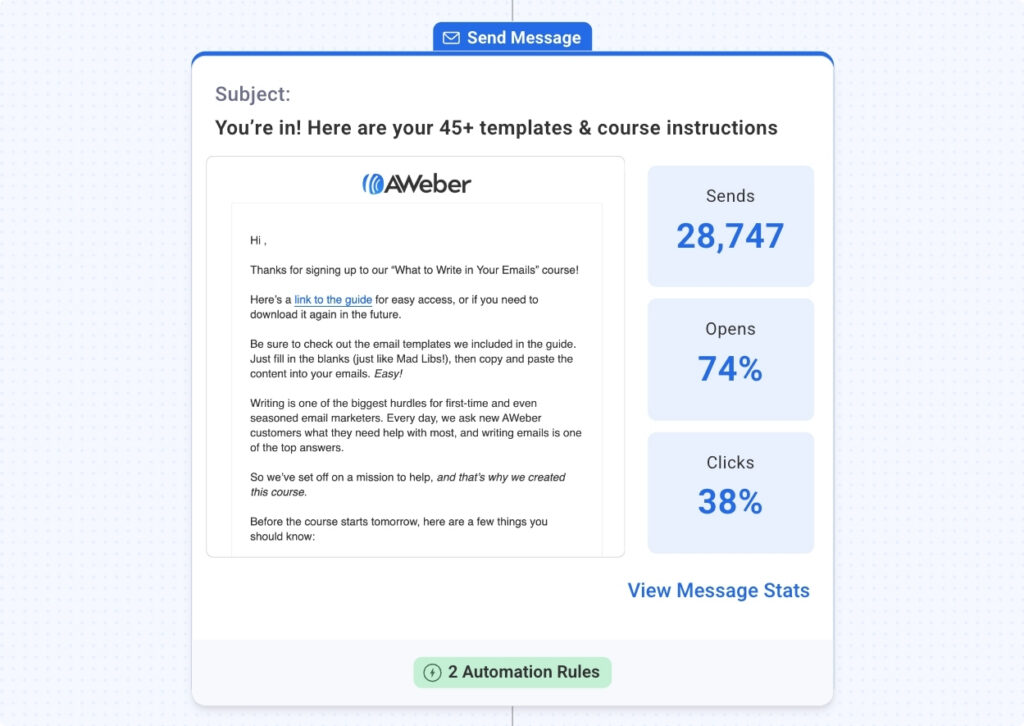
The most successful welcome emails transcend mere marketing; they feel like a genuine message from someone genuinely pleased to connect. AWeber’s own welcome email for its "What to Write in Your Emails" course perfectly illustrates this principle. The subject line, "You’re in! Here are your 45+ templates & course instructions," is devoid of mystery, immediately delivering on the subscriber’s expectation.
Within the email, the guide link is prominently displayed, followed by a clear explanation of what to expect next and a single, actionable step. The masterstroke, however, is the embedded question: "What’s the biggest challenge you’re facing with your emails right now?" This simple query initiates a real conversation, provides invaluable feedback for content creation, and crucially, signals to email providers that recipients are actively engaging with the sender, thereby improving future deliverability. Experiencing such a sequence firsthand, as offered by signing up at aweber.com/whattowrite, provides practical insight into effective onboarding.
Diversifying Welcome Approaches: Types of Welcome Emails with Examples
The optimal welcome email strategy often varies depending on the business model and the specific incentive offered at signup. Tailoring the welcome message to the context of the subscription enhances relevance and effectiveness.
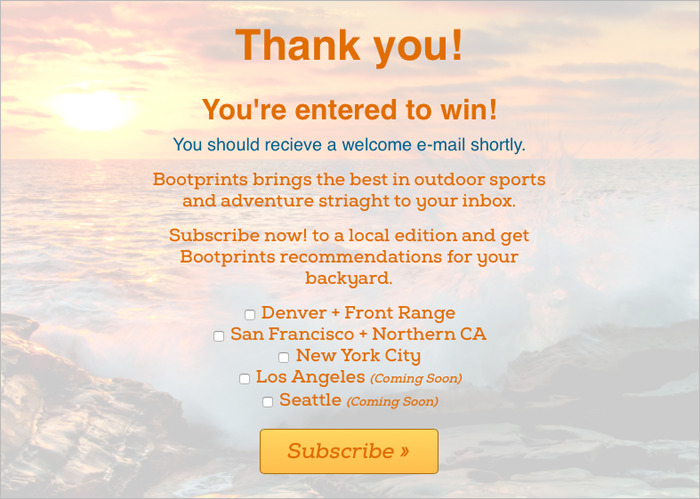
1. Contest Entry Welcome: When collecting subscribers through a promotional contest, the welcome email must clearly articulate the terms of the contest, confirm entry, and set expectations for future communications. As demonstrated by Bootprints, reminding subscribers of their contest entry provides context for their presence on the list and clarifies the value proposition.
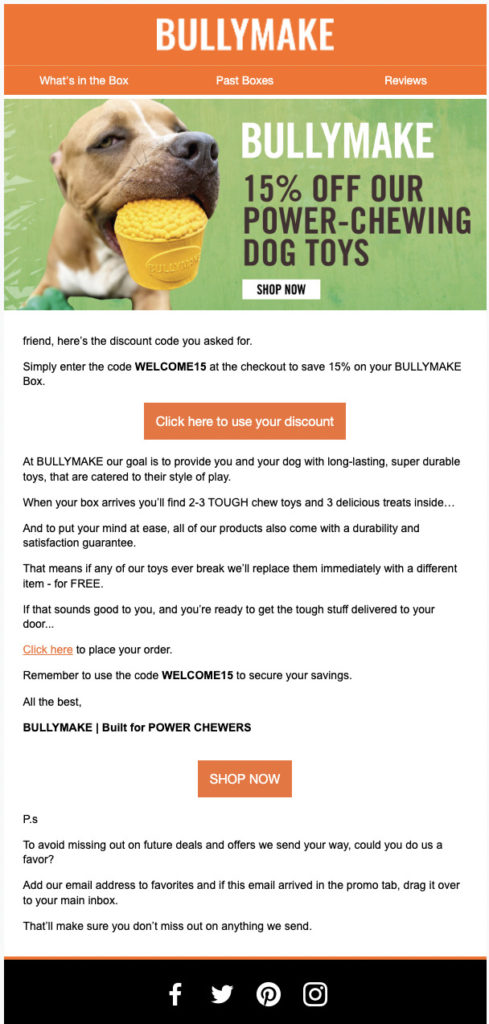
2. Incentive-Based Welcome: For businesses offering a lead magnet or discount in exchange for an email address, the immediate delivery of this incentive is non-negotiable. Bullymake, for example, promptly delivers its promised coupon in the initial welcome message, fulfilling the opt-in promise without delay. This instant gratification reinforces trust and encourages immediate action.
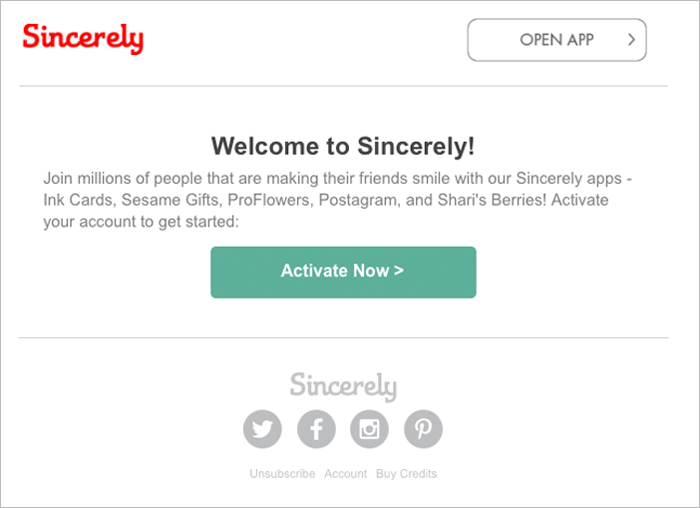
3. "Log In to Get Started" Welcome: Businesses with an app, software-as-a-service (SaaS) platform, trial offer, or membership site should prioritize guiding new users directly to their login portal. The welcome email should provide clear instructions and direct links to facilitate immediate engagement with the product or service, making the onboarding process seamless.
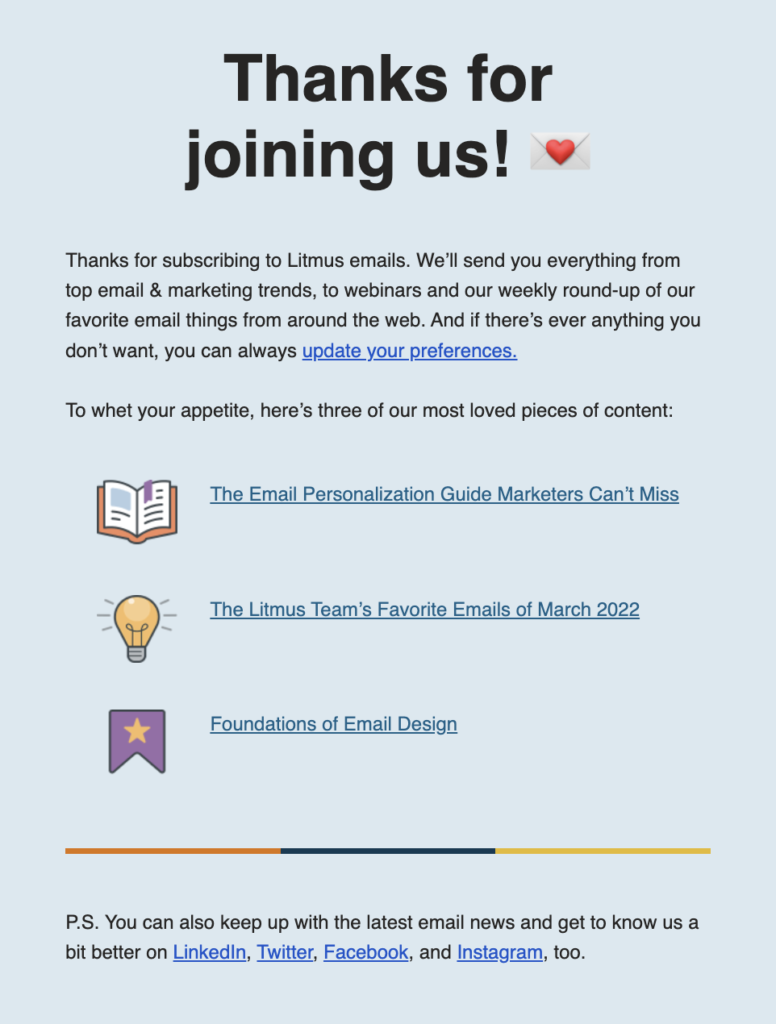
4. "Steps to Getting Started" Welcome: Ideal for businesses with a wealth of existing content, upcoming events, or diverse offers. This type of welcome email curates a starting point for new subscribers. The key is to avoid information overload. Litmus excels in this by providing two or three key resources or next steps, reserving more comprehensive content for later stages of the welcome campaign.
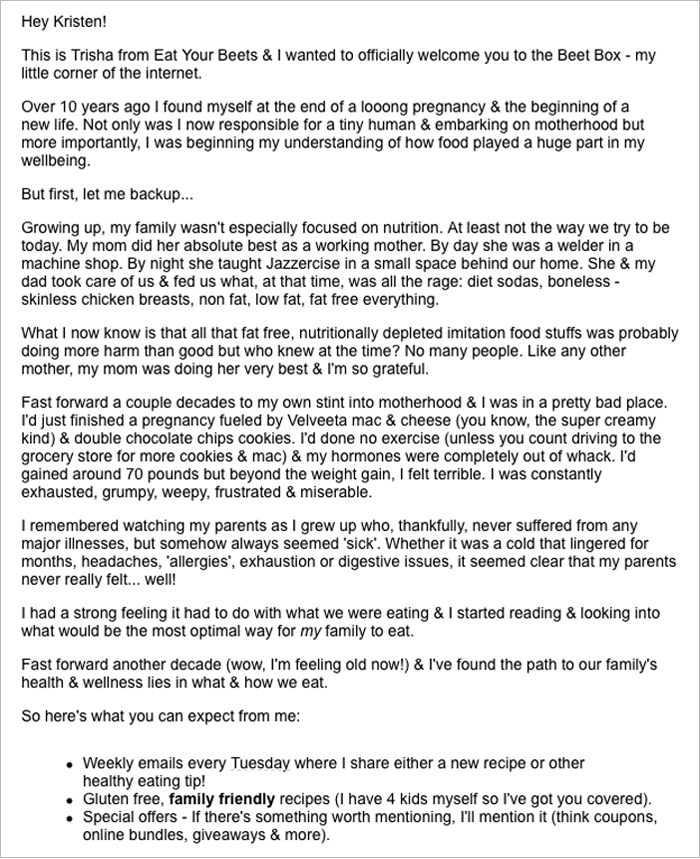
5. "Get to Know You Better" Welcome (Personal Story): Particularly effective for personal brands, coaches, or businesses built on a strong narrative, this approach aims to forge a deeper, more personal connection. Sharing a brief, compelling personal story, as seen with Trisha from Go Eat Your Beets, humanizes the brand. Even without a "hard-hitting" story, including a few personal tidbits demonstrates authenticity and helps subscribers connect with the real person behind the emails.
The Strategic Power of a Welcome Email Series
While a single welcome email is essential, most small businesses benefit immensely from a series of three to five emails delivered over the first week. A solitary message, no matter how well-crafted, often leaves much of the crucial relationship-building undone. A series provides the necessary time and space to deliver layered value, share the brand’s narrative, and introduce offerings without overwhelming the recipient or cramming excessive information into one communication.
A common and highly effective structure for a welcome series follows a "value-value-story-offer" pattern, a framework that consistently drives results for small businesses.
- Email 1 (Immediately After Signup):
- Goal: Deliver the freebie or lead magnet and any special offers. Explain what to expect from future emails, including frequency.
- Content: Express gratitude, provide the promised asset, clearly set expectations for content and cadence, and include contact information.
- Email 2 (24 Hours After Signup):
- Goal: Articulate the "why" behind the company, its mission statement, and invite subscribers to connect on other social media platforms.
- Content: Share the brand’s core values, its unique selling proposition, and a brief narrative about its inception or purpose. Provide links to social channels.
- Email 3 (48 Hours After Signup):
- Goal: Build social proof and deliver curated, high-value content.
- Content: Feature a few compelling customer testimonials. Link to the brand’s all-time best-performing content or articles that are most crucial for new subscribers to see. For example, Wine Awesomeness strategically shares an engaging article about "screw caps versus corks," a topic relevant to both novices and aficionados, within its welcome sequence.
- Email 4 (72 Hours After Signup – Story):
- Goal: Deepen the emotional connection through storytelling.
- Content: This email shifts focus from direct value to narrative. Share a more personal story about the business’s journey, a significant customer success story, or the founder’s inspiration. This emotional resonance builds stronger brand loyalty.
- Email 5 (96 Hours After Signup – Soft Offer):
- Goal: Gently introduce the core offerings.
- Content: This is not a hard sell but a clear, natural introduction to what the business provides and for whom. The trust and value delivered in the preceding emails do the heavy lifting, making this soft offer feel like a natural progression rather than an abrupt sales pitch.
Timing is Everything: The Imperative of Immediacy
The optimal timing for the first welcome email is unequivocally immediate. The moment a new subscriber clicks "submit" on a signup form, their interest reaches its zenith. This peak engagement is fleeting, not lasting an hour or until the next morning. Dispatching the first welcome email instantaneously capitalizes on this heightened curiosity, significantly increasing the likelihood of an open, a click, and positive initial interaction. Delaying this crucial first touch risks a rapid decline in interest and a lost opportunity to make a memorable first impression.
The Broader Onboarding Ecosystem: Confirmation Emails and Thank You Pages
Understanding where welcome emails fit within the larger subscriber onboarding process is crucial for a holistic strategy. This ecosystem extends beyond welcome messages to include confirmation emails (for double opt-in) and thank you pages.
Welcome Emails vs. Confirmation Emails: It is vital to distinguish between welcome emails and confirmation emails, though both are sent shortly after signup. A confirmation email is specifically designed to verify that an individual genuinely wishes to be on the email list, forming part of a "double opt-in" process. In double opt-in, subscribers sign up and then must click a link in a confirmation email to finalize their subscription. While this adds an extra step, it is highly recommended as it typically leads to significantly higher engagement rates, a cleaner list, and improved deliverability by filtering out invalid or disinterested email addresses. The welcome email, by contrast, is sent after confirmation (if double opt-in is used) or immediately (if single opt-in is used) to initiate the relationship and deliver value.
The Strategic Thank You Page: Often overlooked, the thank you page—the page displayed immediately after a subscriber clicks "submit" on a signup form—is another critical component of the onboarding sequence. Smart email marketers transform this page from a bland acknowledgment into a dynamic, multi-media experience. Instead of using a default message from an email service provider, they customize it to reinforce the brand, provide immediate value, and guide the subscriber to their next step.
A prime example is AWeber customer Tim Ferriss, who utilizes his thank you page to host a brief (53-second) welcome video. This video serves as an excellent introduction, explaining the newsletter’s purpose, its content, and what subscribers can expect. Such a comprehensive thank you page not only enhances the subscriber experience but also reinforces the brand message and reduces initial friction, effectively mirroring and augmenting the content of the first welcome email.
Sustaining Engagement: What Happens After the Welcome Campaign?
The end of the welcome campaign does not signify the end of the subscriber relationship; rather, it marks a transition. Having successfully delivered value, built trust, and introduced the brand, subscribers are now primed for deeper engagement. At this juncture, they might be ready to explore product offerings, engage with ongoing content, or be integrated into the regular newsletter cadence. The strategic insights gleaned from their initial interactions (e.g., questions asked in a postscript) can inform future content and offers, ensuring the relationship continues to evolve in a meaningful and mutually beneficial way. The well-crafted welcome sequence is the bedrock upon which all future successful email marketing efforts are built, transforming initial interest into lasting customer loyalty and sustained business growth.









