
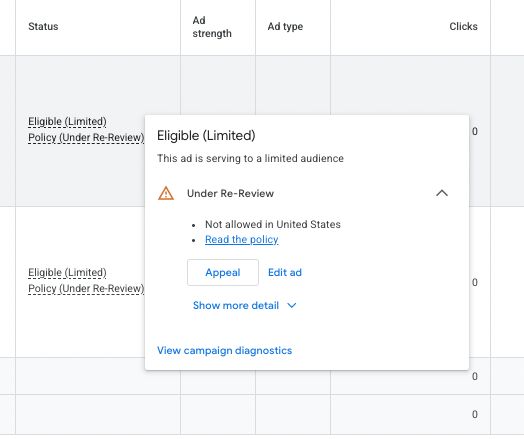
The digital advertising landscape, constantly evolving under the stringent watch of platform giants, has recently seen a notable shift in Google Ads’ operational transparency. Advertisers are now encountering a distinct "Under Re-Review" label within their ad status dashboards, a development that signifies an intensified and more explicit phase of scrutiny for advertising content. This new, prominent status indicates that an ad, while technically "eligible but limited," is currently serving to a restricted audience, with Google specifying the parameters within which the ad’s reach is curtailed. This explicit communication, first brought to widespread attention by Anthony Higman on LinkedIn, has sparked discussions among the advertising community regarding its implications for campaign management and policy compliance.
The observation, accompanied by a screenshot shared by Higman, clearly displays the "Under Re-Review" status, followed by the crucial caveat: "this ad is serving to a limited audience." This immediate visual feedback provides advertisers with a clear, albeit potentially concerning, indicator of their ad’s current operational state. While the concept of an ad being subject to re-evaluation is not new within Google’s extensive policy framework, the direct, top-level display of "Under Re-Review" marks a significant evolution in how Google communicates these internal processes to its users. Indeed, historical references show that the term "re-review" has been mentioned in Google’s policy documentation and even within ad status descriptions several years ago, as noted by industry observers. However, the direct, explicit label now appearing as a primary status marker is a distinct change, aiming to provide advertisers with clearer, more immediate actionable insights into their campaign performance and compliance standing. Despite its recent heightened visibility, Google has indicated that the underlying "re-review" status mechanism itself is "several years old," suggesting a refinement in its user interface to better communicate an existing operational protocol.
Understanding Google Ads’ Comprehensive Review Process
To fully grasp the significance of the "Under Re-Review" status, it is essential to contextualize it within Google Ads’ broader and highly sophisticated ad review ecosystem. Google, as the world’s largest digital advertising platform, processes an astronomical volume of ad submissions daily, requiring a multi-layered approach to ensure quality, safety, and compliance. This process typically involves a combination of advanced artificial intelligence (AI) and machine learning algorithms, augmented by human review teams.
Upon initial submission, every ad undergoes an automated scan that checks for adherence to Google’s extensive advertising policies. These policies cover a vast array of categories, including prohibited content (e.g., illegal products, hate speech, dangerous products), prohibited practices (e.g., data collection misuse, misrepresentation, circumventing systems), restricted content (e.g., alcohol, gambling, pharmaceuticals), and editorial & technical requirements (e.g., clear and accurate language, functional landing pages). The primary objective of this initial review is twofold: to protect users from misleading, harmful, or irrelevant content, and to maintain a fair and trustworthy environment for advertisers. Ads that fail this initial check are typically disapproved, requiring advertisers to make necessary edits before resubmission.
However, the review process does not conclude once an ad is approved and begins serving. Google employs continuous monitoring systems that actively track ad performance, user feedback, and potential policy violations even after an ad goes live. This ongoing surveillance is critical in a dynamic digital environment where new threats emerge, policies evolve, and advertisers might inadvertently (or intentionally) introduce non-compliant elements over time. The "Under Re-Review" status emerges precisely from this continuous monitoring, indicating that an ad that was previously approved is now under renewed scrutiny.
The Mechanism of "Re-Review": Delving Deeper into "Eligible But Limited"
The "Under Re-Review" status is not a random occurrence but a triggered response to various internal and external factors. Its appearance signals that Google’s systems have identified a potential issue warranting a closer look at an active ad or campaign. Understanding these triggers is paramount for advertisers seeking to maintain campaign stability and compliance.

Several key factors can prompt an ad to enter a re-review phase:
- Policy Updates: Google regularly updates its advertising policies to address emerging legal requirements, technological advancements, and evolving societal standards. An ad that was compliant at the time of its initial approval might inadvertently fall afoul of a newly introduced or amended policy. Google’s systems are designed to identify such discrepancies and flag affected ads for re-evaluation.
- Changes to Ad Elements: Any modification, no matter how minor, to an ad’s core components—be it the ad copy, headline, description, call-to-action, landing page URL, or even associated keywords—can trigger an automated re-review. This ensures that any new content or destination remains compliant.
- User Feedback and Complaints: Google places significant emphasis on user experience. If users report an ad for being misleading, inappropriate, or linking to a poor-quality landing page, these complaints are meticulously reviewed and can initiate a re-review process for the offending ad.
- Automated System Flags: Google’s AI and machine learning algorithms continuously analyze vast datasets related to ad performance, user engagement, and potential anomalies. Unusual click-through rates, high bounce rates on landing pages, or suspicious traffic patterns can all serve as red flags, prompting an automated system to push an ad into re-review. This proactive measure aims to catch potential issues before they escalate.
- Post-Approval Audits: Even without specific triggers, Google conducts routine, random quality checks on a subset of approved ads. These post-approval audits ensure ongoing adherence to policies and help identify systematic compliance gaps.
- Competitive Landscape and Reports: In some instances, competitors might report ads they believe violate Google’s policies, leading to an investigation and potential re-review of the reported ad.
- Regulatory or Legal Changes: New laws or industry regulations specific to certain geographies or product categories can necessitate a re-evaluation of existing ads to ensure continued legal compliance.
The accompanying phrase, "eligible but limited," is crucial for advertisers. It signifies that the ad is not entirely disapproved but its reach and targeting capabilities are significantly curtailed. This limitation might manifest in various ways: the ad might be prevented from serving in specific geographic regions, to particular demographic segments, or for certain sensitive search queries where the potential policy violation is deemed more impactful. This status acts as a probationary period, giving advertisers a chance to identify and rectify the underlying issues before a full disapproval or, in more severe cases, an account suspension. For advertisers, this translates into reduced impressions, potentially lower click-through rates, and ultimately, a negative impact on campaign performance, conversions, and overall return on investment (ROI). It underscores the immediate financial and strategic consequences of failing to maintain continuous compliance.
A Chronology of Transparency: From Implicit Mentions to Explicit Labeling
While the "Under Re-Review" mechanism itself may not be entirely novel, its explicit presentation within the Google Ads interface represents a significant step forward in transparency. Industry veterans recall instances from as far back as five years ago where Google Ads status messages would reference "re-review" within a descriptive text, such as under a "Past Violations" status. However, these mentions were often embedded within more general explanations, requiring advertisers to infer the ongoing nature of the scrutiny.
The current, direct "Under Re-Review" label, positioned prominently as a primary status indicator, eliminates ambiguity. This evolution suggests a deliberate move by Google to provide clearer, more actionable feedback to its advertisers. By making the re-review process explicit and visible, Google aims to empower advertisers to react more swiftly to potential policy issues, thereby minimizing disruption to their campaigns. Google’s official stance that this status has been "several years old" points to a continuous refinement of its communication strategy rather than the introduction of an entirely new policy enforcement mechanism. This refinement reflects an ongoing effort to balance the vast complexity of ad moderation with the need for advertiser clarity and operational efficiency. The goal is to demystify parts of the ad review process, fostering greater trust and enabling advertisers to navigate the platform more effectively.
Industry Reactions and Google’s Operational Imperatives
Google’s decision to make the "Under Re-Review" status more explicit aligns with its operational imperative to maintain the integrity and stability of its advertising ecosystem. Processing billions of ad impressions daily, Google faces immense pressure to safeguard user experience, prevent malicious advertising, and ensure fair competition among advertisers. The "re-review" mechanism, whether explicitly labeled or not, is a critical component of this ongoing vigilance, acting as a secondary line of defense against evolving threats and policy circumventions.
From Google’s perspective, this explicit labeling simplifies communication. Instead of a general "limited" status that might require further investigation, "Under Re-Review" directly informs the advertiser about the specific nature of the limitation. This allows Google to efficiently manage the vast scale of ad moderation, leveraging automated systems to flag potential issues that then queue for more detailed human review.
The advertiser community, while appreciating enhanced transparency, is likely to view this development with a mix of apprehension and pragmatic adaptation. The immediate concern for many advertisers will be the potential for campaign disruption and the financial implications of "eligible but limited" ad serving. Digital marketing forums and social media discussions often highlight the delicate balance between Google’s need for strict policy enforcement and advertisers’ need for predictable, stable campaign performance. The explicit "Under Re-Review" status will undoubtedly prompt a renewed focus on understanding Google’s policies in greater detail and implementing proactive compliance strategies. Experts in the digital marketing field would likely underscore the importance of continuous monitoring of ad status dashboards and the need for prompt action upon encountering such a label. They would emphasize that robust internal processes for ad creation, review, and landing page management are now more critical than ever.
Implications and Best Practices for Advertisers
The introduction of the explicit "Under Re-Review" status carries significant implications for advertisers, necessitating a recalibration of their approach to campaign management and policy compliance. This change demands heightened vigilance and a proactive stance to mitigate potential disruptions and maintain optimal ad performance.
- Heightened Vigilance and Proactive Monitoring: Advertisers must integrate regular checks of their Google Ads dashboards into their daily or weekly routines. Relying solely on email notifications for ad disapprovals is no longer sufficient. The "Under Re-Review" status demands immediate attention, as it signifies a live ad that is underperforming due to restricted reach.
- Deep Dive into Policy Compliance:
- Thorough Policy Review: Advertisers should commit to regularly reviewing Google’s extensive advertising policies, paying particular attention to updates. This is especially crucial for industries that operate in sensitive categories (e.g., healthcare, finance, gambling) where regulations are frequently updated.
- Landing Page Optimization: The quality and compliance of landing pages are paramount. Advertisers must ensure their landing pages are high-quality, relevant to the ad copy, transparent about product/service offerings, and provide a seamless user experience. Issues like slow load times, broken links, misleading information, or intrusive pop-ups can all trigger re-reviews.
- Ad Copy Scrutiny: Ad copy should be meticulously reviewed for any potentially ambiguous language, exaggerated claims, or references to prohibited content. Clarity, accuracy, and honesty are non-negotiable.
- Keyword Relevance: Ensuring that keywords are highly relevant to the ad content and landing page is vital to avoid misrepresentation and ensure user intent is met.
- Swift Action and Rectification: Upon encountering an "Under Re-Review" status, advertisers should immediately investigate the potential cause. This involves reviewing recent changes to ads or landing pages, checking for new policy updates, and scrutinizing any user feedback. Once the potential policy violation is identified, prompt corrective action must be taken, and the ad resubmitted for review.
- Understanding the Appeal Process: Advertisers must familiarize themselves with Google’s appeal process. If they believe an ad has been flagged in error, they should be prepared to provide clear justifications and evidence of compliance to Google’s review teams. A well-documented appeal can expedite the resolution process.
- Strategic Campaign Planning: For time-sensitive campaigns, advertisers might need to build in additional buffer time for ad approvals and potential re-reviews. This foresight can prevent significant disruptions and ensure campaign objectives are met even if ads face temporary limitations.
- Diversification of Ad Strategies: While Google Ads remains a dominant platform, the increasing scrutiny and potential for ad limitations underscore the importance of a diversified digital marketing strategy, not solely reliant on one channel.
Broader Ecosystem Considerations: The Evolving Landscape of Digital Advertising
The explicit "Under Re-Review" status is more than just a minor UI update; it reflects broader trends and challenges within the digital advertising ecosystem. It underscores the immense responsibility platforms like Google bear as gatekeepers of online content and commerce. In an era marked by increasing concerns over misinformation, data privacy, consumer protection, and brand safety, major advertising platforms are under relentless pressure from regulators, consumers, and advertisers themselves to enforce stricter standards.
This ongoing commitment to ad quality highlights the continuous evolution of Google’s policy enforcement mechanisms, which increasingly rely on a sophisticated synergy between artificial intelligence and human oversight. AI systems are adept at identifying patterns and anomalies at scale, flagging potential issues, while human reviewers provide the nuanced judgment required for complex cases that AI alone cannot fully resolve. The "re-review" status likely represents a critical juncture where an automated flag triggers a more detailed human assessment.
Furthermore, by rigorously enforcing policies and providing clearer feedback, Google aims to foster a fairer and more trustworthy advertising environment. This helps prevent malicious or deceptive ads from gaining traction, which in turn protects legitimate businesses from unfair competition and preserves user trust in the platform. Increased transparency in status reporting, while sometimes inconvenient, ultimately builds greater confidence among advertisers, ensuring they understand the reasons behind their ad performance and the actions required to rectify issues. This explicit labeling is a significant step towards demystifying parts of the ad review process, fostering a more informed and compliant advertising community.
In conclusion, the prominent display of "Under Re-Review" in Google Ads serves as a powerful signal of Google’s unwavering commitment to ad quality and policy compliance. While the underlying re-review mechanism has existed, its newfound explicit visibility demands a heightened level of attention and proactive engagement from advertisers. To navigate this evolving landscape successfully, advertisers must prioritize continuous policy education, rigorous ad and landing page scrutiny, and diligent monitoring of their campaign statuses. This proactive approach will not only help them avoid disruptions but also contribute to a healthier, more trustworthy digital advertising ecosystem for all stakeholders.