
 rifanmuazin
In the dynamic landscape of digital marketing, the moment of hitting ‘send’ on an email campaign can be fraught with anticipation, often quickly turning to frustration when bounce notifications replace expected engagement. This scenario is a familiar challenge for marketing professionals globally, underscoring a critical issue: as contact databases expand, the complexity of maintaining their integrity escalates proportionally. Email list validation automation emerges as a proactive and essential solution to this scaling problem, fundamentally shifting the paradigm from reactive clean-ups to an always-on defense mechanism that safeguards deliverability, enhances campaign performance, and ultimately protects the bottom line. This comprehensive approach delves into the mechanics of automated verification, unveils the true economic and reputational costs associated with compromised data, and outlines a practical framework for implementing a strategy that ensures email lists remain consistently pristine.
The sustained prominence of email marketing as a foundational tool in the digital arsenal is undeniable. Industry projections indicate a robust 15.92 percent compound annual growth rate (CAGR) for the email marketing market between 2024 and 2030, a testament to its enduring effectiveness and adaptability. A primary catalyst for this anticipated growth is the pervasive adoption of automation across various marketing functions, with email list validation being a particularly critical application. Email list validation automation leverages advanced technological solutions to systematically verify the authenticity and viability of email addresses within a database. Unlike episodic, manual list scrubbing operations, automation integrates seamlessly into ongoing data workflows, functioning as a perpetual guardian. It automatically identifies and flags invalid, risky, or dormant email addresses before messages are dispatched, effectively serving as an automated security checkpoint for customer relationship management (CRM) systems and other marketing platforms. Much like airport security rigorously screens every passenger and piece of luggage, automated validation meticulously inspects every email address—whether newly acquired or long-standing—prior to its entry or continued presence on a mailing list. This continuous vigilance ensures that only legitimate, engaged contacts populate the system, thereby fortifying sender reputation around the clock.
The Evolving Landscape of Email Marketing and Data Challenges
Email has remained a cornerstone of digital communication for decades, evolving from simple direct mail to a sophisticated channel for personalized engagement, lead nurturing, and customer retention. Its enduring appeal lies in its directness, cost-effectiveness, and measurable return on investment. However, this ubiquity also brings inherent challenges. The sheer volume of emails sent daily – estimated to be well over 300 billion globally – creates a highly competitive inbox environment. Furthermore, the rapid expansion of digital footprints means businesses are constantly acquiring new contacts through various channels: website sign-ups, lead magnet downloads, sales interactions, and third-party data sources. This accelerated data acquisition, while vital for growth, concurrently introduces a heightened risk of data quality degradation.
The problem of "dirty" email lists is not new, but its scale and impact have intensified. Historically, businesses might conduct quarterly or annual list purges, a reactive measure often taken only after experiencing significant deliverability issues. However, the dynamic nature of email addresses – people change jobs, abandon old accounts, or make typos during sign-up – means data decays rapidly. Studies suggest that email lists can degrade by as much as 20-30% annually, a rate that manual, periodic clean-ups simply cannot keep pace with. This constant flux necessitates a continuous, automated approach to data hygiene, moving beyond mere damage control to proactive prevention.
The Insidious Costs of Neglected Email Data
A neglected email list, far from being a benign oversight, carries a multitude of hidden costs that can severely undermine marketing performance, erode brand trust, and negatively impact overall business results. These costs manifest in several critical areas:
- Diminished Sender Reputation and Deliverability: Email Service Providers (ESPs) and Internet Service Providers (ISPs) like Gmail, Outlook, and Yahoo meticulously monitor sender behavior. High bounce rates, frequent spam complaints, and hits on spam traps are strong negative signals. These signals degrade a sender’s reputation, leading to lower inbox placement rates and an increased likelihood of emails being diverted to spam folders or blocked entirely. Even legitimate messages from reputable senders can suffer if their list is compromised.
- Wasted Marketing Spend: Every email sent to an invalid or unengaged address represents wasted resources. This includes the direct cost per email charged by many ESPs, but also the opportunity cost of marketing automation tools, staff time spent crafting and scheduling campaigns, and the resources allocated to content creation. If 20% of a list is invalid, 20% of the budget allocated to that campaign is effectively thrown away.
- Skewed Analytics and Impaired Decision-Making: Inaccurate data leads to misleading performance metrics. A low open rate might not reflect poor content but rather a large percentage of undeliverable emails. Similarly, conversion rates could appear lower than they truly are. This distorted view hinders accurate campaign analysis, making it difficult for marketers to identify effective strategies, optimize future campaigns, and justify ROI.
- Damaged Brand Image and Customer Trust: Sending emails to non-existent addresses or, worse, to spam traps, can flag a brand as potentially illegitimate or careless. Repeatedly attempting to reach inactive or invalid addresses can annoy potential customers, leading to unsubscribes or, in extreme cases, marking emails as spam, further damaging reputation. The perception of a brand that doesn’t maintain its data can erode trust and professionalism.
- Increased Compliance Risks: With evolving data privacy regulations like GDPR in Europe and CCPA in California, maintaining accurate and current contact information is not just good practice but a legal requirement. Sending unsolicited emails to unverified addresses or retaining data without a clear legitimate basis can lead to significant fines and legal repercussions. A clean list ensures compliance and minimizes legal exposure.
- Operational Inefficiencies: Manual data cleaning is a laborious and time-consuming process. Marketing and sales teams spend valuable hours exporting, cleaning, and re-importing CSV files, diverting their attention from strategic, revenue-generating activities. This inefficiency impacts productivity across departments, from lead routing in sales to reporting in marketing.
A Strategic Shift: Five Business-Critical Benefits of Automation
Implementing an automated email list validation strategy represents a fundamental shift from a defensive posture to an offensive one, generating compounding value that extends far beyond merely a clean list. Here are five powerful ways automated email list validation delivers a profound impact on business operations and outcomes:

-
Protect and Build Your Sender Reputation: Your sender reputation is arguably the most valuable asset in email marketing, serving as the primary determinant of whether your messages successfully land in the inbox or are relegated to the spam folder. Providers like Gmail and Outlook continuously monitor key metrics such as bounce rates, spam complaint rates, and spam trap hits. Automated validation proactively removes invalid addresses and identifies potentially risky ones, significantly reducing these negative signals. This consistent demonstration of good sending hygiene fosters trust with ISPs, leading to improved inbox placement and ensuring that your crucial messages reliably reach their intended audience. Maintaining a high sender score, often on a scale of 0-100, is critical, as even a small drop can significantly impact deliverability.
-
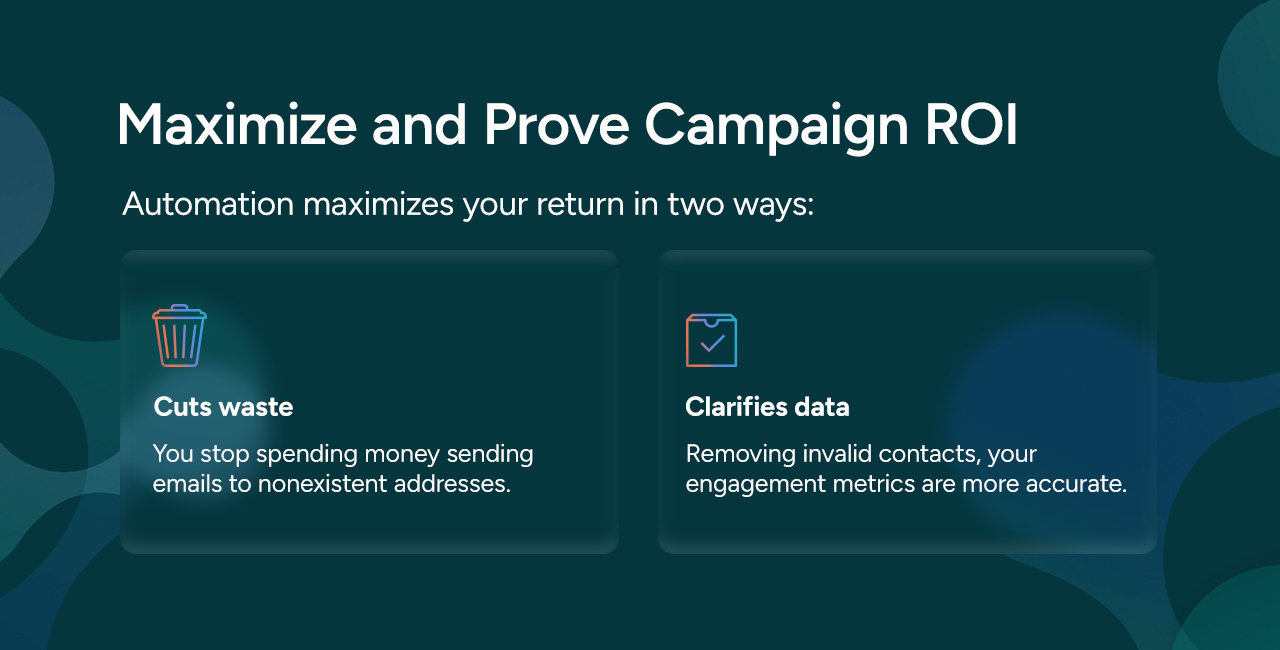
Maximize and Prove Campaign ROI: While email marketing is renowned for its exceptional return on investment, often cited around $36 for every dollar spent, this ROI is only achievable if emails actually reach the inbox and engage real people. Automation maximizes this return in two pivotal ways:
- Reduced Waste: By eliminating invalid contacts, every dollar spent on email campaigns is directed towards a viable recipient, ensuring that resources are allocated efficiently. This directly translates to lower operational costs per deliverable email.
- Enhanced Engagement and Conversions: When emails consistently reach active inboxes, open rates, click-through rates, and ultimately, conversion rates naturally improve. Accurate data allows for more precise targeting, leading to more relevant messaging and higher engagement. This measurable improvement in campaign performance provides concrete data to prove and continually optimize marketing ROI.
-
Enhance Personalization and Segmentation: Effective marketing thrives on reliable, accurate data. Consider a re-engagement campaign targeting customers who haven’t made a purchase in six months. If 20 percent of that meticulously crafted segment consists of invalid or outdated addresses, the campaign’s results will be skewed and unreliable. This inaccuracy could lead marketers to mistakenly abandon a potentially effective strategy or misallocate resources based on flawed insights. An automated email verification service ensures that the foundational data underpinning segments is robust and accurate, thereby enabling genuinely precise analysis, deeper personalization, and more informed strategic decision-making across all marketing initiatives. This precision is vital for advanced strategies like lifecycle marketing and account-based marketing.
-
Drive Radical Efficiency for Marketing and Sales Operations: The time of marketing and sales teams is an invaluable asset. The manual process of exporting, cleaning, and re-uploading comma-separated values (CSV) files is not only incredibly time-consuming but also prone to human error, which can further jeopardize data integrity. An automated verification process liberates operations specialists from these tedious data hygiene tasks, allowing them to redirect their focus to high-impact strategic work, such as campaign optimization, lead nurturing, and advanced analytics. For organizations utilizing powerful platforms like Salesforce, this capability is a transformative game-changer. Teams can operate with confidence, trusting that the data residing within their CRM is consistently reliable, which in turn makes lead routing, comprehensive reporting, and accurate forecasting significantly more efficient and dependable. This operational streamlining leads to faster sales cycles and improved collaboration between marketing and sales.
-
Secure Your Email List at the Point of Entry: Real-time automation acts as an indispensable security guard for your entire database. By seamlessly integrating a verification API (Application Programming Interface) at every potential point of data capture – from newsletter signup forms and lead magnet downloads to demo request forms and e-commerce checkouts – businesses can drastically reduce the influx of bad data into their systems. This proactive measure constitutes the first and most critical line of defense against common data pollution issues: simple typos by legitimate users, deliberately fake addresses, and the pervasive problem of bot-driven sign-ups that often rely on invalid or disposable email addresses to overwhelm and contaminate mailing lists. By filtering out these undesirable entries in real-time, the integrity of the list is preserved from its very inception.
Implementing a Robust Validation Strategy: A Four-Step Framework
Building a comprehensive and robust email verification strategy requires a structured approach. The following four-step framework provides a clear pathway for effective implementation:
Step 1: Audit Your Current Email List and Identify Goals
Before deploying any new solution, a thorough assessment of existing list management practices is paramount. Begin by conducting a comprehensive health check of your current email lists. This involves analyzing segments for abnormally high bounce rates, persistently low engagement metrics, and identifying any legacy lists that have not been recently cleaned. Define clear, measurable objectives for your organization. Is the primary goal to reduce bounce rates by a specific percentage, improve overall deliverability, or specifically clean up a large, aging legacy list acquired years ago? Establishing these precise baselines and goals is crucial for accurately measuring the return on investment (ROI) and demonstrating the value of the automation solution post-implementation. This audit should also involve understanding where bad data is currently entering the system.
Step 2: Choose the Right Email Verification Service
The selection of an appropriate email verification vendor is a critical decision. When evaluating potential solutions, accuracy and security must be the paramount considerations. A seemingly inexpensive tool that frequently produces false positives (incorrectly flagging valid emails as invalid) can lead to significant lost revenue by preventing legitimate contacts from receiving communications. Conversely, a tool that misses invalid emails defeats the purpose. Look for a secure, scalable solution that offers:
- Industry-leading Accuracy: The ability to precisely identify valid, invalid, disposable, catch-all, and risky email addresses.
- Real-time API: For instant verification at the point of capture on web forms.
- Bulk Verification Capabilities: For periodic cleaning of existing databases.
- Comprehensive Reporting: Detailed insights into list health, common issues, and trends.
- Robust Security and Privacy Compliance: Adherence to data protection regulations (GDPR, CCPA) and secure data handling practices.
- Scalability: The capacity to handle growing list sizes and increasing verification volumes.
Step 3: Integrate with Your Marketing and Sales Stack
True automation necessitates seamless integration between your chosen email verification tool and your existing marketing and sales technology ecosystem. For existing historical data, connect the verification tool directly to your CRM (e.g., Salesforce, HubSpot) or Marketing Automation Platform (e.g., Marketo, Pardot). Schedule regular bulk verifications to proactively address ongoing data decay. For new data acquisition, implement the verification API directly into your web forms (e.g., newsletter sign-ups, contact forms, lead generation pages). This real-time verification allows users to immediately correct typos before submitting their information, ensuring that only clean, valid data enters your system from the outset. Many advanced solutions offer native integrations with popular platforms, simplifying this crucial step.
Step 4: Monitor and Refine
Implementation is not the final step; continuous monitoring and refinement are essential for sustained success. Regularly review the verification reports provided by your service. Are you observing a disproportionate increase in invalid emails originating from a specific lead source or a particular campaign? Is a certain web form attracting an unusual volume of bot traffic or disposable email addresses? Leverage these granular insights to refine your overall lead acquisition strategy, adjust form fields, or further tighten your list capture rules. This iterative process of analysis and optimization ensures that your email list validation strategy remains dynamic, effective, and perfectly aligned with your evolving business needs, continuously improving the quality and effectiveness of your email communications.
Industry Perspectives and Broader Implications
Industry analysts consistently emphasize that data quality is no longer merely an IT concern but a fundamental business imperative. Marketing leaders recognize that the efficacy of personalization, segmentation, and even the most creative campaigns hinges entirely on the accuracy of the underlying data. Data privacy experts, meanwhile, underscore the ethical and legal responsibilities associated with maintaining clean lists, noting that automated validation helps ensure compliance with stringent regulations like GDPR and CCPA by confirming the validity of consent and reducing the risk of processing data for non-existent individuals.
The broader implications extend beyond immediate marketing metrics. High-quality data fuels more accurate sales forecasting, enables better customer service through reliable contact information, and enhances overall customer experience by ensuring relevant communications. A commitment to data hygiene signals a professional and trustworthy brand, fostering stronger relationships with customers and industry partners alike.
The Role of Trusted Providers in Data Quality
In this complex environment, partnering with a trusted global leader in data quality and ethical marketing is crucial. Organizations like Validity, which supports tens of thousands of businesses worldwide, play a vital role in providing the technology necessary for robust data hygiene. Their flagship verification solutions, such as Validity BriteVerify, validate millions of email addresses daily with industry-leading accuracy and speed. Unlike isolated tools, comprehensive solutions integrate into a wider ecosystem designed to optimize every stage of an email program, offering seamless integrations with major platforms like Salesforce. This integrated approach simplifies the implementation of the advanced automation strategies discussed here, making it effortless for businesses to achieve and maintain pristine email lists.
Conclusion: Safeguarding the Future of Digital Communication
The journey of an email, from a marketer’s outbox to a recipient’s inbox, is increasingly complex and fraught with potential pitfalls. Email list validation automation is no longer a luxury but a fundamental necessity for protecting a company’s revenue streams, preserving its hard-earned reputation, and ensuring the long-term viability of its digital communication strategies. By embedding automation into the core of email hygiene practices, businesses can effectively prevent the infiltration of bad data, guarantee that their marketing efforts are precisely targeted at real, engaged individuals, and ultimately foster more meaningful and productive customer relationships. The choice to embrace automated list validation is a strategic investment in the future of effective and compliant digital communication, promising improved deliverability, increased engagement, and significantly lower operational costs for superior segmentation and unparalleled marketing performance.









