

The modern corporate landscape is increasingly defined by a paradox of data: while companies collect more customer feedback than ever before, they often remain oblivious to the primary drivers of customer attrition. Recent industry benchmarks and research from Gartner’s Effortless Experience studies reveal a startling reality for the software-as-a-service (SaaS) sector. Approximately 96% of customers who experience high-effort interactions become disloyal, yet most of this dissatisfaction never reaches a support desk. Instead, it manifests as "silent churn," where roughly 43% of customers who leave a platform never voice a single concern prior to their departure. This data suggests that the traditional methods of measuring customer health—such as support ticket volume and quarterly surveys—capture only a small fraction of the actual friction present in the user journey.
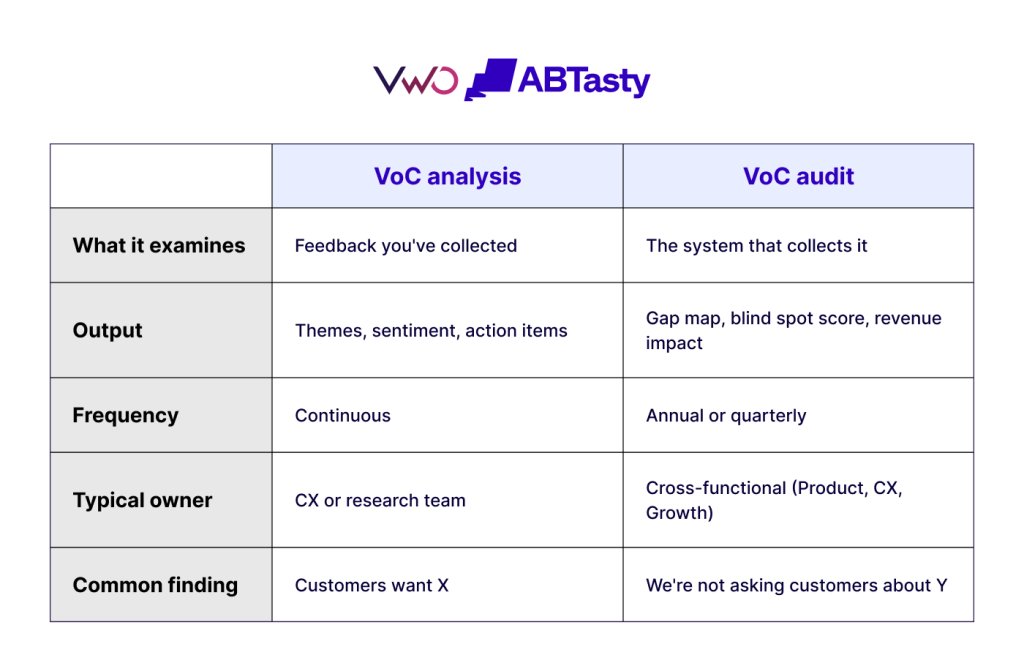
To address this visibility gap, organizations are increasingly turning to a Voice of Customer (VoC) audit. Unlike a standard VoC analysis, which interprets existing data, an audit evaluates the measurement system itself. It identifies structural blind spots in how feedback is captured and quantifies the revenue currently being "leaked" to unaddressed friction. As the SaaS market matures and the cost of customer acquisition continues to rise, the ability to identify and mitigate silent churn has transitioned from a niche customer experience (CX) function to a critical financial imperative.
The Structural Gap Between Feedback and Reality
The fundamental challenge facing modern CX programs is the "Ticket Iceberg" phenomenon. Research pioneered by organizations such as TARP and Lee Resources, and frequently cited across CX literature, suggests that for every customer who takes the time to lodge a formal complaint, approximately 24 others remain silent while disengaging from the product. This means a support queue that appears manageable or even "healthy" can coexist with a catastrophic retention problem.
Most VoC programs are built incrementally rather than strategically. Over several years, a company might launch a Net Promoter Score (NPS) survey at the request of a board member, add a feedback widget during a website redesign, and collect sales notes in a CRM. This results in a patchwork of disconnected channels. The gaps between these channels are where the most expensive friction lives.
Three primary structural patterns contribute to these blind spots. First is the over-reliance on support tickets as a primary signal. Tickets only capture "loud" friction—issues severe enough that a user is willing to stop their work to seek help. They miss the "quiet" friction, such as a slightly confusing interface or a slow-loading page, which may not trigger a complaint but will eventually trigger a cancellation. Second is the use of cadence-based surveys rather than event-based ones. A quarterly NPS survey captures sentiment at a random moment in time; it rarely captures the specific instant of frustration that leads to a user giving up on a feature. Finally, the prevalence of closed-form questions (multiple choice) limits the depth of insight. While categories like "too expensive" are easy to graph, they offer no actionable data on why the user perceives the value to be lower than the price.
A Chronological Framework for the Voice of Customer Audit
Executing a comprehensive VoC audit typically requires a two-to-six-week commitment, depending on the scale of the organization and the complexity of its tech stack. The process follows a rigorous six-step framework designed to move from qualitative mapping to quantitative revenue recovery.
Step 1: Comprehensive Channel Mapping
The audit begins with an exhaustive inventory of every touchpoint where a customer can provide feedback. This includes obvious channels like support tickets and NPS, but also overlooked sources such as G2 and Capterra reviews, App Store ratings, sales call recordings, and Customer Success (CS) quarterly business reviews. Most growth-stage companies discover they have between seven and fifteen distinct channels, many of which are owned by different departments with no central data repository.
Step 2: Strength and Blind Spot Identification
Once the channels are mapped, the audit evaluates what each is "structurally" capable of capturing. For example, session recordings are excellent for seeing what a user did, but they cannot explain why the user did it. NPS provides a high-level sentiment trend but lacks the granularity to identify which specific product feature is failing. By mapping these channels against key questions—such as "Why did users drop off during onboarding?"—organizations can identify where their measurement is thinnest.
Step 3: Quantitative Measurement of the Blind Spot
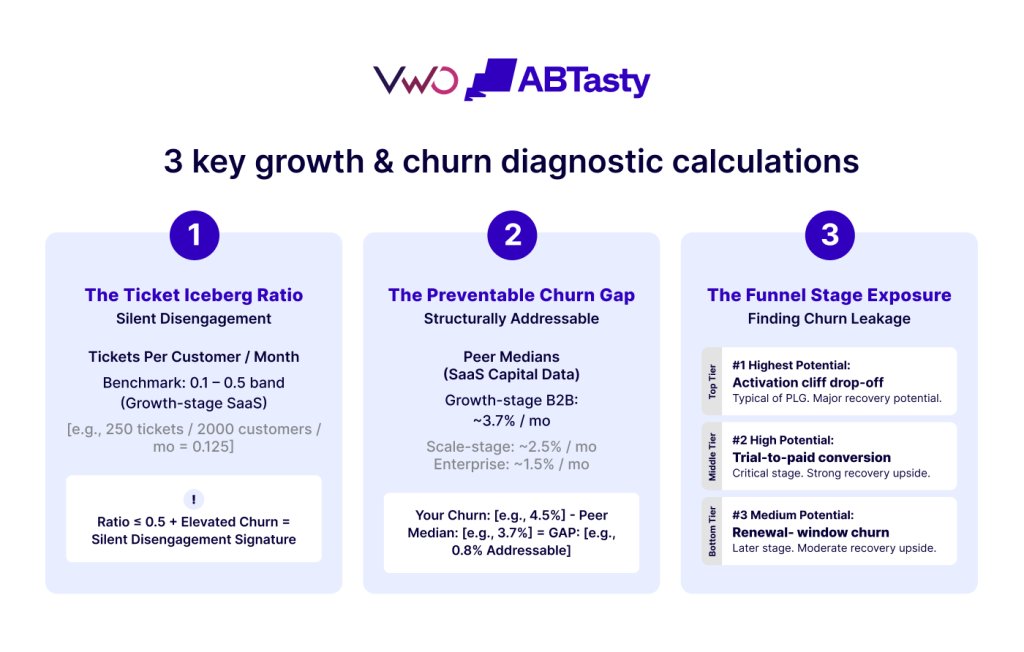
This is the most critical phase of the audit, where the "gap" is translated into financial terms. Analysts calculate the "Ticket Iceberg Ratio"—the number of tickets per customer per month compared against industry benchmarks (typically 0.1 to 0.5 for growth-stage SaaS). A low ratio combined with high churn is a definitive signature of silent disengagement.
Furthermore, the audit calculates the "Preventable Churn Gap." By comparing the company’s current churn rate against peer medians—SaaS Capital data suggests roughly 3.7% for growth-stage B2B SaaS and 1.5% for enterprise—the audit identifies the portion of churn that is structurally addressable through better friction management.
Step 4: Friction Pattern Diagnosis
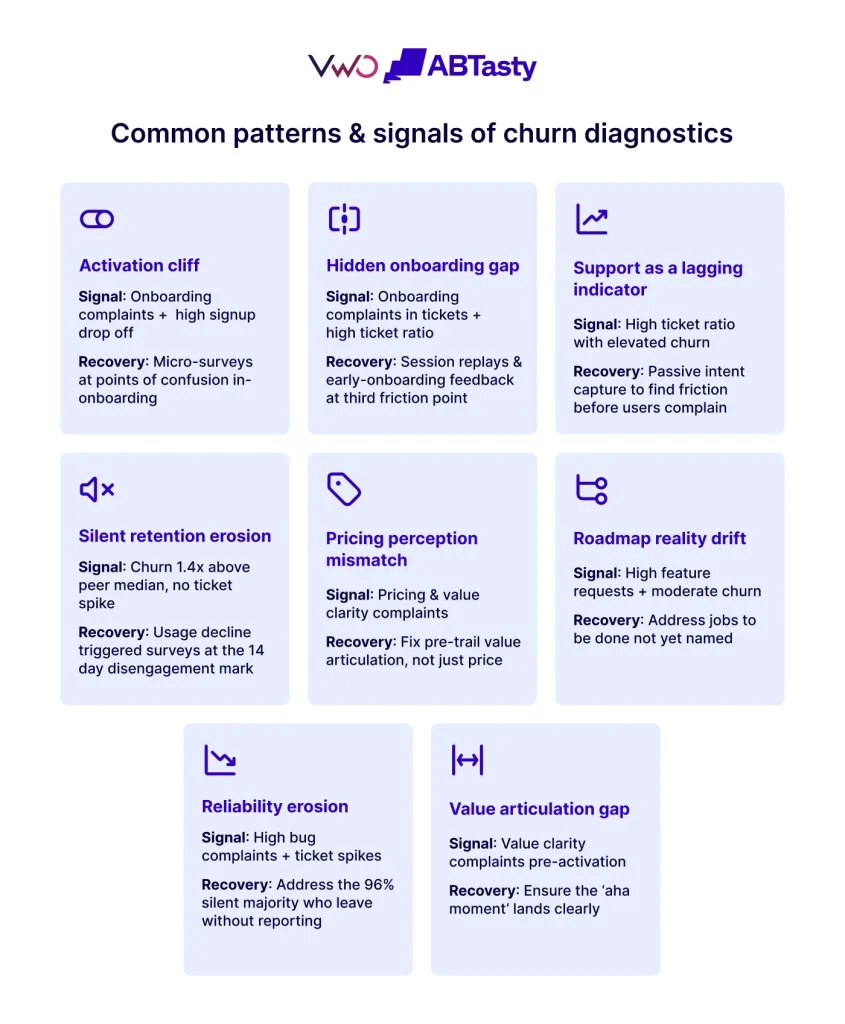
The audit then moves to categorize the types of friction occurring. Common patterns include the "Activation Cliff," where users drop off immediately after sign-up; "Usage Decline," where a once-active user slowly stops logging in; and "Feature Failure," where a specific tool within the platform consistently underperforms. Each of these patterns requires a different intervention strategy, ranging from product redesigns to proactive CS outreach.
Step 5: Leverage-Based Prioritization
Rather than fixing the "loudest" problem, the audit prioritizes based on leverage. In a Product-Led Growth (PLG) model, a 5% improvement in the activation rate often yields higher long-term revenue than a 10% reduction in late-stage churn. This is because activation gains compound across every future cohort of users.
Step 6: The Experimentation Loop
The final step involves turning findings into hypotheses. Every identified friction point becomes an experiment—such as a changed onboarding flow or a behavior-triggered micro-survey—with a specific recovery target. This transforms the audit from a one-time report into a continuous operational rhythm.
Revenue Leakage and the CFO’s Perspective
The most compelling output of a VoC audit for executive leadership is the Revenue Leakage Estimate. This figure provides a dollar value for the monthly revenue lost to addressable friction. The methodology for this calculation is increasingly standardized: it combines conversion loss (unconverted traffic multiplied by the stage-leak coefficient and Average Revenue Per User) with preventable retention loss (the portion of the customer base churning above the peer benchmark multiplied by Life Time Value).
By presenting these findings in terms of "dollars leaked" rather than "customer satisfaction scores," CX and Product teams can align their initiatives with the company’s broader financial goals. In an era of "efficiency-first" growth, identifying $100,000 in monthly leaked revenue is often more cost-effective than attempting to generate $100,000 in new top-of-funnel leads.
Voice of Customer vs. Customer Experience Audits
It is important to distinguish between a VoC audit and a Customer Experience (CX) audit. While they are complementary, they serve different purposes. A CX audit is typically qualitative; it uses journey mapping and observational research to ask, "Is the experience broken?" A VoC audit, conversely, is a diagnostic of the measurement system itself, asking, "Are we even capable of seeing if the experience is broken?"
Industry experts suggest that companies should run a VoC audit first. There is little value in commissioning expensive journey mapping if the underlying data collection system is fundamentally flawed or missing the "silent" majority of users. Once the VoC audit identifies where the measurement is thin, targeted CX research can be deployed to those specific journey stages.
The Role of Modern Technology in Closing the Gap
The maturity of Voice of Customer platforms, such as VWO Pulse and similar tools, has changed the feasibility of these audits. Historically, analyzing open-text feedback from thousands of users required weeks of manual labor. Modern platforms now utilize AI-driven sentiment analysis and automatic categorization to surface themes in real-time.
Furthermore, the shift toward contextual, behaviorally-triggered feedback is solving the "cadence problem." Instead of sending an email survey three months after a purchase, companies can now trigger micro-surveys the moment a user abandons a specific task within the product. This captures the user’s "intent" while it is still fresh, providing a much higher signal-to-noise ratio than retrospective surveys.
Broader Implications for the SaaS Industry
The move toward rigorous VoC auditing reflects a broader shift in the software industry toward "Customer-Led Growth." As market saturation increases across most SaaS verticals, the competitive advantage is shifting from those who can build features fastest to those who can remove friction fastest.
The implications of silent churn extend beyond immediate revenue loss. It affects brand reputation, increases the cost of future sales due to a lack of advocates, and can lead to a "death spiral" where a company spends its entire R&D budget fixing problems it didn’t see coming, rather than innovating.
Ultimately, the Voice of Customer audit serves as a vital "health check" for the modern enterprise. By quantifying the invisible, organizations can move from a reactive posture—responding only to those who complain—to a proactive strategy that preserves revenue and builds genuine loyalty among the silent majority. For companies aiming to achieve world-class retention rates, the question is no longer whether they can afford to run an audit, but whether they can afford the cost of remaining blind to the friction their customers are facing every day.







