rifanmuazin
Selling music online has transcended the simple act of uploading tracks to streaming platforms and hoping for algorithmic favor. As of 2026, e-commerce has firmly established itself as an indispensable pillar for musicians seeking to forge deeper connections with their audiences and cultivate sustainable income streams. This evolution is not merely about transactional sales; it represents a fundamental shift in how artists operate their careers, transforming them into multifaceted digital entrepreneurs.
For independent artists, touring musicians, and established bands alike, the digital marketplace is no longer an afterthought but a central hub for fan engagement and financial viability. In 2026, the scope of musician e-commerce extends far beyond traditional merchandise like t-shirts and vinyl. Artists are actively managing comprehensive digital businesses, offering a diverse array of products and services. This includes subscription-based memberships, exclusive fan content, event tickets, sample packs for producers, and a wide range of digital downloads. The efficacy and user-friendliness of the platform chosen to manage these operations can profoundly impact both the artist’s experience and their fans’ satisfaction.
Recognizing the critical nature of this digital infrastructure, a comprehensive investigation was undertaken over several weeks, involving meticulous research, comparative analysis, and hands-on testing of leading e-commerce platforms tailored for musicians. Each platform evaluated exhibits distinct strengths, catering to different aspects of a musician’s business, from seamless digital delivery and sophisticated merchandising capabilities to robust community-building features and essential touring support.
This guide meticulously dissects the top-tier tools available, prioritizing those that align with the actual sales activities and revenue models currently employed by musicians. The objective is to provide a clear framework for artists to match their unique career goals with the most suitable e-commerce solution, whether they are planning a modest merchandise release or aiming to construct a comprehensive, long-term brand presence.
Key E-commerce Trends for Musicians in 2026
- Diversification of Revenue Streams: Musicians are no longer solely reliant on music sales or streaming royalties. The current landscape emphasizes a multi-pronged approach, incorporating merchandise, digital content, fan memberships, and live event revenue.
- Direct-to-Fan (D2F) Models: Platforms that facilitate direct interaction and sales between artists and fans are gaining prominence, allowing for greater control over branding, pricing, and customer relationships.
- Community Building and Fan Engagement: E-commerce platforms are increasingly incorporating features that foster community, such as forums, exclusive content access, and direct communication channels, transforming passive listeners into active supporters.
- Subscription and Membership Economy: Recurring revenue through fan memberships and subscriptions is becoming a cornerstone of sustainable artist income, providing a predictable financial base.
- Leveraging AI in Operations: Emerging AI tools are beginning to assist artists with store setup, product descriptions, marketing content, and customer service, streamlining operational tasks.
Quick Comparison: Top E-commerce Platforms for Musicians
| Platform | Best For | Starting Price (Monthly) | Free Plan? | Key Benefit |
|---|---|---|---|---|
| Shopify | Serious Merch Businesses | $29 | No | Full control and scalable e-commerce |
| Bandcamp | Selling Digital Music Directly to Fans | Free | Yes | Direct-to-fan music sales & discovery |
| Bandzoogle | All-in-One Musician Website | $11 | No | EPK, ticketing, music player, store |
| Big Cartel | Indie Artists with Small Product Lines | Free | Yes | Simple setup, no platform fees |
| Patreon | Monthly Memberships + Community | 10% of Revenue | No | Recurring fan support & exclusive content |
| Gumroad | Sample Packs and Digital Content | 10% + $0.50 per sale | Yes | Simple checkout for digital goods |
| Ko-fi | Tips, Small Digital Sales, Light Memberships | Free | Yes | Tip jar, minimal effort, quick sales |
| Squarespace | Beautiful, Polished Websites with E-commerce | $16 | No | Visual branding with robust e-commerce |
| Wix | Customizable Artist Sites with E-commerce | $17 | Yes | All-in-one builder with marketing tools |
| WooCommerce | Custom Workflows and Advanced SEO | Free (plus hosting) | No | Full control for advanced users |
1. Shopify: The E-commerce Powerhouse for Serious Music Ventures
Starting price: $29 per month (billed annually)
AI tools included: Yes (Shopify Sidekick)
Shopify stands out as the premier e-commerce platform for musicians aiming to establish robust, scalable online businesses. Its comprehensive suite of sales tools, extensive integration capabilities, and inherent scalability make it an ideal choice for artists ranging from those launching their first merchandise drop to those managing complex global shipping operations.
While Shopify presents a slightly steeper learning curve for absolute beginners compared to more specialized platforms like Big Cartel, its depth of functionality offers a significant long-term advantage. It empowers artists to build professional, scalable online stores with a high degree of control. From managing intricate product bundles and print-on-demand fulfillment to processing digital downloads and overseeing inventory with precision, Shopify’s tools are engineered to support creator growth. The initial adjustment to its backend interface may require some effort, but the reward is unparalleled command over every facet of the online store.
Recent advancements, notably the integration of AI-powered tools like Shopify Sidekick, are further enhancing its accessibility. During testing, Sidekick proved invaluable in expediting store setup. By providing basic details about planned sales (e.g., vinyl records and tour merchandise), the AI generated a complete store framework, including suggested product categories and tags, significantly reducing the time from initial setup to being ready for sales.
Pros:
- Unmatched scalability for businesses of all sizes.
- Extensive app store for third-party integrations.
- Robust inventory and order management features.
- Powerful marketing and SEO tools.
- Seamless integration with print-on-demand services.
- AI-powered assistance for store management.
Cons:
- Higher monthly cost compared to simpler platforms.
- Can be overwhelming for artists with very basic needs.
- Transaction fees apply unless using Shopify Payments.
Why Use Shopify in 2026?

Shopify’s core purpose is e-commerce, and this singular focus translates into a highly effective infrastructure for musicians. It provides the complete toolkit for selling everything from digital albums to bundled merchandise and ticket packages. Its scalability ensures that artists can begin small and expand their operations without ever needing to migrate to a different system. Furthermore, Shopify’s seamless integration with fulfillment applications, marketing platforms, and point-of-sale (POS) systems makes it exceptionally well-suited for touring musicians. The addition of AI assistance further streamlines store management, enabling artists to maintain a professional online presence without the need for a dedicated operational team.
Shopify is suitable for:
- Artists and bands with a significant merchandise catalog.
- Musicians planning to scale their online sales operations.
- Those seeking complete control over their brand and customer experience.
- Artists who require robust inventory and order management.
Shopify isn’t suitable for:
- Artists with very limited technical expertise and a desire for extreme simplicity.
- Those primarily focused on selling only digital music downloads.
- Musicians with extremely small budgets who cannot afford a monthly subscription.
2. Bandcamp: The Unrivaled Champion for Direct Music Sales
Starting price: Free to use
AI tools: No
Bandcamp remains the undisputed leader for musicians focused on selling their music directly to fans, particularly for digital downloads. Its artist-centric philosophy is evident in every aspect, from its intuitive interface to its transparent fee structure, which prioritizes the musician. There is no monthly subscription fee; Bandcamp derives its revenue solely from a percentage of sales.
The platform allows for the sale of albums, singles, physical merchandise, and the implementation of discount codes and special bundles. Its integrated fan-follow system is a crucial tool for nurturing audience relationships, automatically notifying subscribers of new releases, messages, and updates. This functionality elevates Bandcamp beyond a mere sales platform, positioning it as a hybrid sales tool and community hub.
During testing, the process of uploading a short EP and making it available for sale was remarkably swift. Bandcamp efficiently handled digital delivery, pricing configurations, and even offered a "pay what you want" option for select tracks. This flexibility, combined with the absence of recurring monthly costs, makes it an exceptionally strong choice for emerging artists prioritizing simplicity and direct fan engagement.
Pros:
- No monthly fees, making it highly accessible.
- Excellent for selling digital music and physical merchandise.
- Artist-friendly revenue share model.
- Integrated fan-following and discovery features.
- Supports "pay what you want" pricing.
- Artists retain ownership of their sales data.
Cons:
- Limited customization options for store design.
- Less robust merchandising features compared to dedicated e-commerce platforms.
- No built-in AI tools for operational assistance.
- Transaction fees can add up for high-volume sellers.
Why Use Bandcamp in 2026?
For artists whose primary focus is selling albums, singles, or digital content without the need for a complex, generalized e-commerce platform, Bandcamp continues to be the optimal solution. It is purpose-built for the music industry, facilitating both music discovery and direct sales. Crucially, it eliminates the burden of website maintenance and hosting for artists.
Bandcamp is suitable for:

- Independent artists and bands primarily selling music.
- Musicians who want a simple, direct way to reach fans.
- Those seeking to build a dedicated fan base around their music.
- Artists looking for a platform with a strong community ethos.
Bandcamp isn’t suitable for:
- Artists whose main revenue comes from extensive merchandise sales.
- Those requiring advanced website customization and branding control.
- Musicians needing integrated ticketing or advanced fan club features.
3. Bandzoogle: The Integrated Artist Website Solution
Starting price: $11 per month (billed annually)
AI tools: No
Bandzoogle distinguishes itself as the singular platform on this list meticulously engineered for musicians constructing their official websites. It consolidates all essential artist needs into a single package: an Electronic Press Kit (EPK), integrated music players, ticketing functionalities, mailing list management, and a comprehensive e-commerce store. A significant advantage is the absence of platform fees on sales, a rarity among all-in-one solutions.
The streamlined experience for artists was a standout feature during testing. The need to install third-party plugins or external applications was entirely eliminated. Every aspect, from updating tour dates and uploading music tracks to managing sales orders, was accessible within a unified dashboard.
The setup process for the store was remarkably straightforward. Upon selecting a template and uploading music and merchandise listings, everything functioned seamlessly out of the box. This integration allowed for a focus on content creation rather than technical setup, making it an efficient choice for artists prioritizing ease of use and comprehensive functionality.
Pros:
- All-in-one solution specifically for musicians.
- Includes EPK, music player, ticketing, and mailing list tools.
- No platform fees on sales.
- User-friendly interface designed for artists.
- Mobile-responsive templates.
Cons:
- Less advanced e-commerce features compared to Shopify.
- Limited design customization compared to broader website builders.
- No built-in AI tools for content generation or store optimization.
Why Use Bandzoogle in 2026?
Bandzoogle is the ideal platform for artists who prefer to manage their entire digital presence from a single, cohesive location. It extends beyond mere sales of merchandise or music; it functions as a central artist hub, encompassing tour schedules, email marketing capabilities, and a professional EPK, all without the necessity of hiring a web developer.
Bandzoogle is suitable for:
- Independent musicians and bands seeking an integrated online presence.
- Artists who need an EPK, music player, and store in one place.
- Those who value simplicity and ease of use in website management.
- Musicians who want to avoid additional platform fees on sales.
Bandzoogle isn’t suitable for:
- Artists requiring highly advanced e-commerce functionalities or extensive customization.
- Musicians who need complex integrations with third-party marketing tools beyond its built-in features.
- Those prioritizing cutting-edge AI features for website management.
4. Big Cartel: The Go-To for Indie Merch Drops
Starting price: Free for up to 5 products
AI tools: No
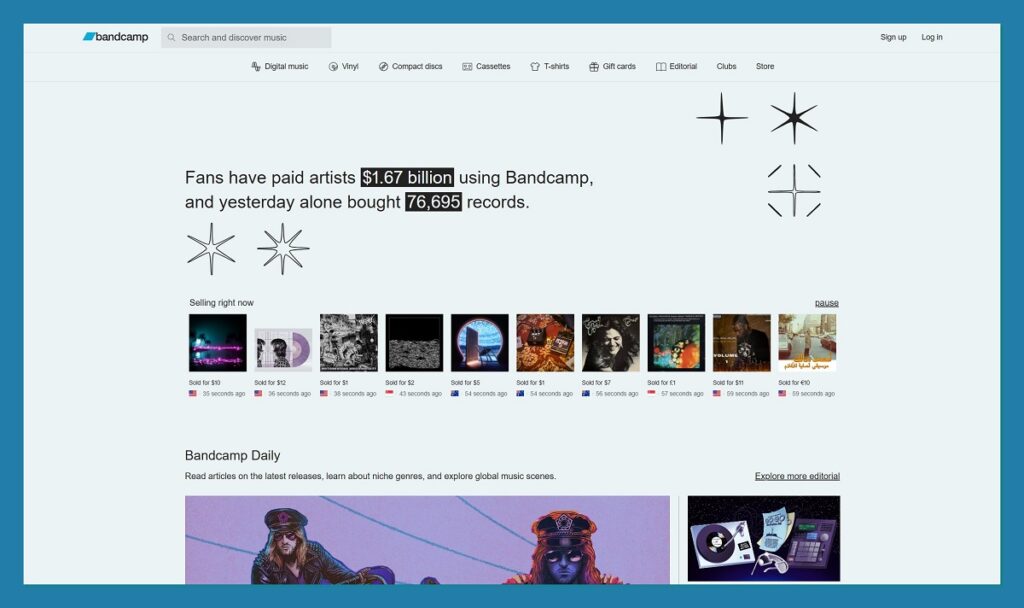
Big Cartel is specifically designed for artists and creators who desire a quick and uncomplicated method for selling a limited selection of products. It eschews the complexity of a full-fledged e-commerce engine, instead focusing on empowering musicians to launch and manage small-scale shops with minimal technical hurdles.
This platform is particularly effective for single-item product releases or short-term promotional campaigns. Its interface is clean and intuitive, and the product editor is straightforward. Integration with Stripe and PayPal ensures easy payment processing.
During testing, setting up a limited-edition vinyl release on Big Cartel was accomplished within an hour. This efficiency makes it an excellent match for artists who intend to sell only a few items at a time, avoiding the costs and features they are unlikely to utilize.
Pros:
- Generous free plan for small inventories.
- No platform fees on sales.
- Extremely user-friendly and simple to set up.
- Ideal for limited edition releases and small shops.
- Supports physical and digital products.
Cons:
- Limited product count on free and lower-tier plans.
- Fewer advanced features and integrations compared to larger platforms.
- Basic design customization options.
- No AI-powered assistance.
Why Use Big Cartel in 2026?
For artists engaged in quick merchandise drops or those who sell products infrequently, Big Cartel provides all the necessary tools without the imposition of platform fees or long-term contracts. Its approach is simple, focused, and champions creative control for the artist.
Big Cartel is suitable for:
- Independent artists and bands with a small number of products.
- Musicians focused on limited edition releases or occasional sales.
- Those seeking a free or low-cost entry into e-commerce.
- Creatives who prioritize simplicity and ease of use.
Big Cartel isn’t suitable for:
- Artists with large or rapidly expanding product catalogs.
- Musicians requiring advanced inventory management or international shipping features.
- Those needing sophisticated marketing or analytics tools.
5. Patreon: Cultivating Recurring Fan Support and Community
Starting price: Free to start, 10% of earnings
AI tools: No
Patreon has emerged as the definitive platform for creators offering exclusive content, fan clubs, and subscription-based communities. For musicians, it represents an invaluable opportunity to provide behind-the-scenes access, unreleased music, early event tickets, and a host of other benefits through recurring monthly memberships.
The platform facilitates the creation of tiered membership levels, the gating of exclusive content, and direct communication with supporters via messages and chats. Its utility in building a consistent, predictable income stream to underpin long-term creative projects is significant.
The setup process involved creating three distinct membership tiers, each with associated exclusive audio content for higher-tier fans. The process was intuitive, and Patreon offered helpful guidance on refining messaging and fan outreach strategies.
Pros:
- Established platform for recurring fan support.
- Enables tiered membership structures and exclusive content.
- Facilitates direct communication with supporters.
- Builds a dedicated fan community.
- Offers a predictable monthly income stream.
Cons:
- High revenue share (10%) for lower tiers.
- Not designed for selling physical merchandise or traditional e-commerce.
- Limited design customization of the creator page.
- Potential for churn if value proposition is not consistently met.
Why Use Patreon in 2026?
For artists committed to fostering a genuine fan community and securing consistent monthly support, Patreon remains the most established and effective platform. While not designed for merchandise or complex e-commerce transactions, it excels in providing exclusive access and delivering ongoing value, fulfilling its core purpose exceptionally well.
Patreon is suitable for:
- Artists seeking to build a strong, engaged fan community.
- Musicians who can offer exclusive content or experiences.
- Those aiming for a predictable, recurring revenue stream.
- Creators who value direct interaction with their most dedicated supporters.
Patreon isn’t suitable for:
- Artists whose primary revenue comes from selling physical products.
- Musicians who need a comprehensive e-commerce solution.
- Those looking for a platform with extensive design customization.
6. Gumroad: Streamlined Digital Product Sales
Starting price: Free to start
AI tools: No
Gumroad offers a straightforward e-commerce solution perfectly suited for musicians selling digital goods. Whether the offering includes sample packs, beat licenses, sheet music, or video lessons, Gumroad provides a clean and efficient method for listing and delivering products with minimal effort.
The platform operates without a monthly subscription fee, featuring a simple pricing structure that makes it accessible for new artists or creators testing product viability. While it lacks a built-in music player or advanced fan engagement tools, Gumroad excels at rapidly delivering digital content to purchasers.
The process of uploading a drum kit and a series of video lessons was fast and seamless. Gumroad automatically generated a checkout link that could be easily embedded on a website or shared directly with the audience.
Pros:
- Ideal for selling digital products like sample packs, presets, lessons.
- Simple pricing structure with no monthly fees.
- Easy to set up and use.
- Handles digital delivery efficiently.
- Supports discount codes and affiliate programs.
Cons:
- Limited features for physical product sales.
- Basic store customization options.
- No built-in community or fan engagement tools.
- Transaction fees can be higher for lower-priced items.
Why Use Gumroad in 2026?
Gumroad is the optimal choice for artists who wish to sell simple digital products without the complexities of building a full-scale online store. Its lightweight setup and creator-centric tools make it an excellent fit for beatmakers, music educators, or any musician offering downloadable content.
Gumroad is suitable for:
- Producers selling sample packs, loops, or MIDI files.
- Music educators offering online courses or tutorials.
- Songwriters selling sheet music or lyrical content.
- Artists looking for a simple way to monetize digital creations.
Gumroad isn’t suitable for:
- Artists primarily selling physical merchandise.
- Musicians needing a comprehensive website with advanced features.
- Those requiring sophisticated fan community-building tools.
7. Ko-fi: For Tips, Light Memberships, and Quick Sales
Starting price: Free
AI tools: No
Ko-fi provides a low-pressure avenue for fans to support creators through tips, small purchases, or basic memberships. For musicians, it functions effectively as a complementary tool to their primary store or website, allowing fans to contribute financially without the expectation of a specific product in return.
Unlike Patreon, Ko-fi does not mandate monthly commitments, and its zero-fee option (with optional payment processor fees) makes it attractive for artists just beginning their e-commerce journey. The platform also allows for the offering of digital downloads, custom commissions (e.g., personalized jingles), and basic membership tiers.
Testing Ko-fi involved uploading exclusive tracks and enabling donation options. While not designed as a primary sales platform, it serves as an excellent conduit for capturing small, consistent income from appreciative fans.
Pros:
- Free to start with minimal fees.
- Ideal for accepting tips and donations.
- Supports small digital sales and basic memberships.
- Easy to integrate with existing websites and social media.
- No monthly commitments required for basic use.
Cons:
- Limited features for complex e-commerce operations.
- Basic design and customization options.
- Not suitable for large-scale merchandise sales.
- Payment processor fees apply to transactions.
Why Use Ko-fi in 2026?
Ko-fi offers a no-fuss platform that enables musicians to generate supplementary income without the necessity of constructing a dedicated online store. It integrates seamlessly with existing websites or social media presences, particularly benefiting artists whose fans are inclined to offer consistent, albeit small, financial support.
Ko-fi is suitable for:
- Artists seeking to receive tips and donations from fans.
- Musicians looking for a simple way to offer digital downloads.
- Creators who want a basic membership option for their supporters.
- Those needing a quick and easy way to monetize small creative outputs.
Ko-fi isn’t suitable for:
- Artists with extensive merchandise lines or high-volume sales goals.
- Musicians requiring advanced e-commerce features or detailed analytics.
- Those seeking a comprehensive website building solution.
8. Squarespace: Elegant Websites with Integrated E-commerce
Starting price: $16 per month (billed annually)
AI tools: Yes
Squarespace is renowned for its design-centric approach, consistently delivering some of the most aesthetically pleasing templates available. For musicians who prioritize a professional and visually compelling online presence, Squarespace harmoniously blends strong branding capabilities with accessible e-commerce functionality.
While it may not match Shopify’s feature set for large-scale sales operations, Squarespace adeptly supports digital downloads, physical products, and membership offerings. Its integrated calendar and booking tools can also be invaluable for managing tours, lessons, or coaching sessions.
During the creation of a minimalist artist website, which included a press kit, biography, merchandise, and ticket links, Squarespace ensured a sharp and professional presentation. While e-commerce customization was somewhat more constrained than on other platforms, the overall user experience was highly satisfactory.
Pros:
- Stunning, modern templates for visually driven brands.
- User-friendly drag-and-drop website builder.
- Integrated e-commerce capabilities for physical and digital products.
- Built-in marketing and SEO tools.
- AI-powered features for content creation and design assistance.
Cons:
- E-commerce features are less robust than dedicated platforms like Shopify.
- Can be more expensive than simpler website builders.
- Limited app integrations compared to some competitors.
Why Use Squarespace in 2026?
Squarespace is the premier choice for musicians who place a high value on their online brand identity and desire a clean, integrated website. Its ease of use, comprehensive marketing tools, and support for both physical and digital products position it as an excellent middle ground between a dedicated artist website and a functional online store.
Squarespace is suitable for:
- Musicians who prioritize visual aesthetics and brand consistency.
- Artists looking for an all-in-one website solution with e-commerce.
- Those who want to easily manage their online presence without extensive technical knowledge.
- Creators utilizing their website for promotional purposes beyond sales.
Squarespace isn’t suitable for:
- Artists requiring highly advanced e-commerce features or complex inventory management.
- Musicians who need extensive third-party app integrations.
- Those on a very tight budget, as it is a subscription-based service.
9. Wix: Flexible Design with Built-in E-commerce and AI
Starting price: $17 per month (billed annually)
AI tools: Yes
Wix continues to be a leading website builder, celebrated for its remarkable flexibility and user-friendliness. Musicians seeking to construct a website with complete creative control, integrated email marketing, robust e-commerce capabilities, and a vast selection of templates will find Wix to be an exceptionally capable platform.
The drag-and-drop editor grants artists absolute freedom over layout and design elements. The platform’s expanding array of AI tools, including an automated site builder and content generator, further enhances its appeal, making it one of the more accessible options for artists aiming to establish an online presence rapidly.
During testing, the Wix AI builder efficiently generated a musician portfolio site. The onboarding process was swift and remarkably accurate, gathering information about musical genre, sales objectives, and desired store setup to create a functional site complete with product listings, a blog, and email signup forms.
Pros:
- Extremely flexible drag-and-drop editor for complete design control.
- Wide range of professionally designed templates.
- Integrated e-commerce, booking, and marketing tools.
- Strong AI capabilities for site building and content creation.
- Scalable plans to accommodate business growth.
Cons:
- Can become cumbersome with very large websites.
- Once a template is chosen, it cannot be changed without rebuilding the site.
- Less robust for complex e-commerce scaling compared to Shopify.
Why Use Wix in 2026?
Wix expertly merges design freedom with built-in e-commerce and marketing functionalities, making it an outstanding choice for musicians developing a personal brand website. Its AI tools expedite the initial setup process, while its intuitive editor provides sufficient power for developing a substantial artist website without requiring coding knowledge.
Wix is suitable for:
- Musicians who want complete creative control over their website design.
- Artists looking for an all-in-one solution that includes e-commerce and marketing.
- Those who can benefit from AI-assisted site building and content creation.
- Musicians who want to build a comprehensive online presence from scratch.
Wix isn’t suitable for:
- Artists requiring highly advanced or specialized e-commerce features.
- Those who anticipate frequent template changes.
- Musicians who need a platform with a more structured, less freeform design approach.
10. WooCommerce: Ultimate Control for Advanced Users
Starting price: Free plugin (plus hosting and extensions)
AI tools: Depends on theme or plugins used
WooCommerce emerges as the most adaptable e-commerce solution on this list, though it demands the most intricate setup. Built upon the WordPress framework, it transforms any website into a fully functional store, granting musicians unparalleled control over design, features, and Search Engine Optimization (SEO).
While this platform’s power is undeniable, it is best suited for users with prior web hosting experience or those willing to invest in professional assistance. The trade-off for this complexity is unmatched flexibility—artists can construct product bundles, manage memberships, optimize SEO strategies, and integrate virtually any tool or plugin required.
The initial setup of WooCommerce for a test artist store highlighted the extensive control available, but also the significant time investment required. Custom themes, performance optimizations, and plugin installations are integral to the process, but the outcome is a custom, scalable solution for those who need it.
Pros:
- Unmatched flexibility and customization options.
- Seamless integration with WordPress websites.
- Vast library of plugins and extensions for added functionality.
- Full control over design, features, and SEO.
- No platform transaction fees (beyond payment processor fees).
Cons:
- Steep learning curve and requires technical expertise.
- Requires separate hosting and domain registration.
- Costs can escalate with premium plugins and themes.
- No built-in AI tools; relies on third-party integrations.
Why Use WooCommerce in 2026?
For those prioritizing a highly optimized, fully customized store with integrated SEO capabilities, WooCommerce is the definitive solution. Although it involves a more complex setup, it offers a level of control that no other platform can rival.
WooCommerce is suitable for:
- Technically proficient users or those with development support.
- Artists seeking ultimate control over their online store’s functionality and design.
- Musicians with complex product catalogs or unique sales requirements.
- Those who want to leverage the power and flexibility of WordPress.
WooCommerce isn’t suitable for:
- Beginners or artists seeking a simple, out-of-the-box solution.
- Those unwilling to manage hosting, updates, and plugin configurations.
- Artists with limited budgets who cannot account for hosting and extension costs.
How to Choose the Right Platform for Your Music Career
Selecting the appropriate e-commerce platform is less about identifying a universally "best" tool and more about aligning what you sell with how you envision managing your business. Before committing to any platform, it is essential to address the following critical questions:
1. What Are You Actually Selling?
Your product mix is the most significant determinant. If your primary focus is releasing music, Bandcamp offers superior digital delivery capabilities compared to general-purpose builders. For merchandise-centric artists, Shopify provides the product management tools necessary for scaling. If you specialize in sample packs, stems, or educational content, Gumroad is optimized for digital file delivery with minimal setup. For revenue driven by a community of engaged fans, Patreon’s membership infrastructure is exceptionally robust.
2. How Large Is Your Catalog, and How Fast Is It Growing?
A limited merchandise release does not necessitate the same infrastructure as a 200-SKU store featuring bundles and pre-orders. Big Cartel’s free plan is suitable for occasional sales of a few items. Shopify and WooCommerce are stronger long-term investments if you plan to introduce product variants, run bundled offers, or manage inventory across multiple sales channels.

3. Do You Need a Full Website or Just a Checkout Solution?
Some platforms function as complete website builders (Squarespace, Wix, Bandzoogle), while others serve as storefronts or checkout links that can be integrated into an existing site (Gumroad, Ko-fi, Bandcamp). If you are satisfied with your current website, there is no need to replace it. However, if you are starting from scratch and desire a centralized management system, Bandzoogle or Squarespace can save considerable time.
4. What Is Your Technical Comfort Level?
WooCommerce offers the most control but requires users to manage hosting, updates, and plugins. Shopify provides a managed platform with a learning curve that is steeper than beginner-friendly tools. Big Cartel, Ko-fi, and Bandcamp are the most straightforward to set up, requiring no technical background. Honestly assess how much time you are willing to dedicate to platform maintenance versus music creation.
5. How Do Fees Affect Your Profit Margins?
Low monthly fees do not always equate to lower overall costs. Bandcamp charges no subscription fee but takes a percentage of sales. Shopify has a monthly fee but keeps transaction fees competitive if you use Shopify Payments. If you sell a few high-margin vinyl records monthly, a revenue-share platform may be more advantageous. For higher sales volumes, a fixed monthly fee might prove more cost-effective.
6. Do You Tour or Sell In Person?
For artists who sell merchandise at live shows, platforms with integrated point-of-sale (POS) tools (Shopify, builders integrated with Square) simplify inventory and tax reporting. Platforms without POS support require manual reconciliation of in-person sales, which can become increasingly burdensome with touring volume.
Methodology
To compile this comprehensive guide, extensive testing was conducted on each platform over several weeks. Real-world stores were established, products were uploaded, and test transactions were processed where feasible. The evaluation encompassed the experience from both the artist’s and the fan’s perspectives. Key assessment criteria included:
| Criteria | What We Evaluated |
|---|---|
| Ease of Setup | Time required to launch a functional store from signup, assuming no prior platform experience. Measured from signup to first published product. |
| Digital Delivery | Reliability of handling digital downloads, file delivery, and access control for paid content. |
| Physical Product Support | Inventory management, shipping configuration, product variants, and bundle creation for merchandise-focused sellers. |
| Fees and Pricing | Monthly subscription costs, transaction fees, and payment processor fees. Total cost of ownership was calculated at various revenue levels. |
| Musician-Specific Features | Integrated music players, EPKs, ticketing, fan messaging capabilities, tour management tools, and membership tier structures. |
| Design and Branding | Quality of templates, flexibility of customization, and the overall professional appearance of the store without requiring developer assistance. |
| Scalability | The platform’s capacity to handle catalog expansion, international sales, and integration with third-party tools. |
| Support and Documentation | Availability and quality of help resources, response times, and community support specifically for musicians. |
Each platform was tested with a standardized set of products: a digital EP, a vinyl record, a t-shirt variant, and a membership or tipping option where applicable. This approach ensured consistent comparisons across a diverse range of tools. Pricing data was verified directly on each platform’s official website at the time of publication.
Final Verdict: Which Platform Should You Use?
The optimal e-commerce platform for your music career hinges on what you are actively selling and your aspirations for future growth.
Here is a final breakdown to guide your decision:
| Your Goal | Best Platform |
|---|---|
| Sell digital albums and tracks | Bandcamp |
| Launch sample packs or lessons | Gumroad |
| Build a merch store with bundles | Shopify |
| Sell a few indie products | Big Cartel |
| Create a recurring fan community | Patreon |
| Build a branded artist website | Bandzoogle |
| Create a polished e-commerce site | Squarespace |
| Sell online with full control | WooCommerce |
Each of these platforms possesses distinct advantages. For those just embarking on their e-commerce journey, beginning with the platform that best aligns with your immediate objectives is advisable. As your audience expands and your product line diversifies, transitioning to more advanced systems like Shopify or WooCommerce becomes a natural progression.
Frequently Asked Questions
Do I need a website to sell music online?
No, platforms like Bandcamp, Gumroad, and Ko-fi provide hosted storefronts and checkout links, eliminating the need for a separate website. However, having your own site enhances discoverability, provides brand control, and facilitates email list building. Many artists commence with a hosted storefront and later integrate a full website as their careers advance.
Can I use more than one e-commerce platform simultaneously?
Yes, and most professional musicians do. A common strategy involves utilizing Bandcamp for music sales, Shopify or Big Cartel for physical merchandise, and Patreon or Ko-fi for memberships and fan support. These platforms do not conflict, and each is optimized for specific revenue streams, often outperforming a single, all-encompassing solution.
What is the most cost-effective way to sell music online?
Bandcamp is the most economical choice for selling digital music directly to fans, offering no monthly fees and a tiered revenue share that decreases with sales volume. For physical products, Big Cartel’s free plan supports up to five items with no platform transaction fees.
Which platform has the lowest overall fees?
Bandzoogle and Big Cartel charge no platform fees on sales, though Bandzoogle requires a monthly subscription. WooCommerce is technically the lowest-fee option, as the core plugin is free, with costs limited to hosting and payment processing. For most musicians, the most economical platform is the one that matches their catalog size without incurring costs for unused features.
Do I need an LLC or business license to sell merchandise as a musician?
Requirements vary by jurisdiction and sales volume. In the U.S., an LLC is not typically mandatory for initial sales, but a sales tax permit may be required once certain thresholds are met. An LLC offers liability protection and tax flexibility, becoming more beneficial as revenue increases. Consult a local accountant for specific guidance.
How do I manage shipping for physical merchandise?
Artists have three primary options: self-fulfillment (highest margins, time-intensive), print-on-demand services (handled by third parties, reduced per-unit profit), and third-party logistics (3PL) providers (storage and shipping for a fee, suitable for consistent volume). Shopify and WooCommerce integrate well with all these models.
Can I sell concert tickets through these platforms?
Bandzoogle offers integrated ticketing tools specifically for musicians. Shopify supports ticket sales via apps and bundle options. For most other platforms, dedicated ticketing services like DICE, Eventbrite, or Seated are recommended, with links provided from your store or website.
What is the distinction between Patreon and a Shopify subscription?
Patreon is centered on community, exclusive content, and tiered memberships with integrated communication tools. A Shopify subscription typically represents a recurring product purchase, such as a monthly vinyl club or merchandise box. Patreon is superior for access-based value and community building, while Shopify is better suited for physical product delivery on a schedule.
Do these platforms handle sales tax and international orders?
Shopify, Squarespace, and Wix provide integrated tax calculation tools, and Shopify Markets Pro manages international compliance. Bandcamp and Gumroad often act as the merchant of record for digital