The digital content ecosystem is undergoing a profound transformation, driven by the rapid proliferation of artificial intelligence in search interfaces. This shift is fundamentally reshaping how information is discovered, consumed, and attributed online, moving beyond traditional link-based search results to AI-generated summaries and conversational responses. As a consequence, the strategic imperative for content creators is shifting from Search Engine Optimization (SEO) to Answer Engine Optimization (AEO), with structured Frequently Asked Questions (FAQs) emerging as a critical tool for ensuring content visibility in this new paradigm.
The Rise of AI Search and the Zero-Click Phenomenon
The advent of sophisticated large language models (LLMs) has empowered search engines to synthesize information from multiple sources into concise, direct answers, often presented as AI Overviews or within conversational chat interfaces. This innovation aims to provide users with immediate gratification, reducing the need to click through to external websites to find information. Data from 2025 underscores this seismic shift: Pew Research found that approximately one in five Google searches produced an AI-generated summary, with a significant 88% of these summaries citing three or more sources. Further illustrating this trend, Bain’s 2025 research revealed that roughly 80% of consumers now rely on these “zero-click” results for at least 40% of their searches.
This phenomenon represents a significant departure from the traditional search model, where visibility was primarily measured by a website’s ranking position and the subsequent click-through rate. In the AI-driven environment, success is increasingly defined by whether content can be cleanly extracted, accurately summarized, and credibly cited within an AI-generated response. For publishers and brands, this means that merely ranking high is no longer sufficient; their content must be structured in a way that AI systems can easily interpret and reuse. This urgency is further highlighted by a HubSpot 2025 AI Trends for Marketers report, which indicated that 31% of Gen Z respondents are already initiating their queries directly within AI or chat-based tools, bypassing traditional search engines altogether.
Understanding Answer Engine Optimization (AEO)
Answer Engine Optimization is a specialized approach focused on making content “quotable” within AI-generated responses, rather than merely “rankable” in a list of links. It acknowledges that modern AI search tools synthesize information from numerous sources to construct a single, comprehensive answer. If a piece of content or a specific passage is not structured for clear extraction and attribution, its likelihood of being cited diminishes significantly.
AEO mandates a shift in content strategy, prioritizing how machines interpret and reuse information. This involves not just keyword optimization, but a deeper focus on semantic clarity, entity consistency, and structural coherence. In essence, AEO-ready content must be easy for AI systems to retrieve, summarize, attribute, and ultimately, trust. This makes content structure a paramount lever for visibility in the AI era.
FAQs as a Strategic Asset for AEO
In this evolving landscape, Frequently Asked Questions (FAQs) sections have emerged as a particularly potent strategy for AEO. Unlike traditional FAQ pages designed primarily for user navigation and addressing common customer service queries, FAQs for AEO are meticulously crafted for machine retrieval. They are answer-first, structured for extraction, entity-consistent, schema-supported, and explicitly aligned with natural-language query behavior.

The power of AEO-focused FAQs lies in their ability to mirror the conversational patterns users employ when interacting with AI tools. By isolating discrete questions and delivering concise, direct answers, these sections create self-contained “retrieval units” that are highly conducive to AI processing. This structural approach directly addresses the challenge of extractability, making it easier for AI models to select and cite relevant passages.
How FAQs Enhance AEO Performance in LLMs
The effectiveness of FAQ sections in improving AEO performance is rooted in their structural discipline, which significantly enhances extractability, reduces ambiguity, and strengthens entity clarity—all critical factors influencing whether content is selected and cited by LLMs. When a section cleanly isolates a question and resolves it, it minimizes the interpretive effort required during the synthesis process.
Large language models retrieve passages associated with defined entities and construct responses based on contextual alignment. Content that demonstrates clear semantic relationships and consistent terminology is favored. This means:
- Explicit Entity Relationships: Clearly defining terms and their connections. For example, stating, “AEO is the process of optimizing content so AI systems can extract, summarize, and cite it in answer-driven search environments,” establishes clear semantic links.
- Concise, Self-Contained Answers: Responses that can stand alone without requiring additional context from surrounding text.
- Consistent Terminology: Repeatedly using official names for products, services, or concepts to reinforce understanding.
- Strong Thematic Cohesion: Focusing each FAQ section or page on a single, well-defined topic to avoid diluting authority.
These structural signals align with observable patterns in AI-generated search features, where instructional, clearly organized, and long-tail content tends to surface more frequently. FAQs improve performance through three primary mechanisms: increased extractability, reduced ambiguity, and strengthened entity clarity. By formalizing “repetition within a single URL” through consistent entity relationships, FAQs boost citation reliability. Tools like HubSpot’s AEO Grader are designed to evaluate how effectively these FAQ structures contribute to citation frequency in AI-generated responses.
The Importance of FAQs for AI Search Visibility
FAQs are crucial for AEO because they create structured retrieval units within a broader content system. Answer engines isolate, evaluate, and reuse specific question-answer pairs without needing to reinterpret surrounding content. As generative search environments mature, visibility hinges less on keyword targeting and more on the clear organization of information.
Several measurable factors influence AI search visibility:
- Passage Completeness: How self-contained and comprehensive a quoted passage is.
- Attribution Clarity: The ease with which a source can be identified and linked.
- Entity Consistency: The reliable use of names and terms.
- Micro-Intent Alignment: Addressing specific, narrowly defined user queries.
- Source Authority: The perceived credibility and trustworthiness of the content.
FAQ sections reinforce each of these variables by increasing the number of citation-eligible passages tied to a single, thematic URL. Micro-intents, which are specific queries related to a particular stage of the buyer journey, are particularly well-served by FAQs. When a page resolves multiple related micro-intents within a coherent structure, it expands the retrieval surface area without fragmenting authority across separate URLs, thereby strengthening topical depth.
In generative environments, AI search visibility is measured not just by traditional rankings, but by brand mentions, citation frequency, sentiment framing, and share of voice across prompts. These indicators reflect whether content is actively selected and referenced by AI systems. BrightEdge’s AI Overview research highlights the dramatic divergence from traditional SEO, finding that over 80% of AI-generated citations originate from pages outside conventional top-ranking results. This underscores the paramount importance of structural clarity over mere positional dominance.

Structuring FAQ Pages for Answer Engines
Answer engines prioritize structure over prose. They scan for defined question patterns, extractable answers, and consistent hierarchies to determine what content is covered and which passages are reusable. A disciplined FAQ system prevents structural drift and protects citation eligibility. The following five steps are foundational:
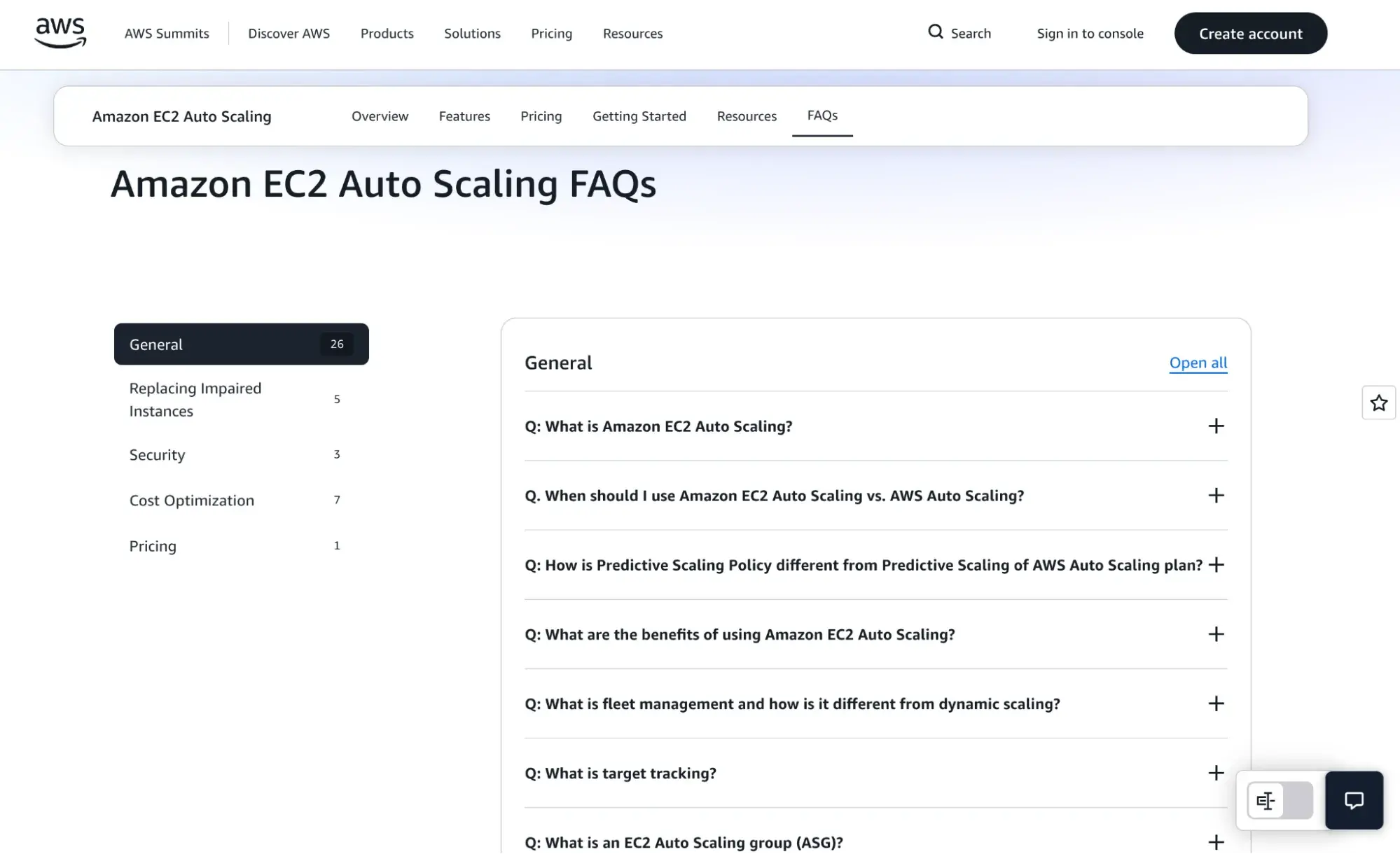
- Choose One Topic Per FAQ Page and Define It Clearly: A tightly scoped FAQ page performs best. Avoid generic collections or “catch-all” pages. Each page should have a clear thematic boundary, focusing on a single product, service, concept, or specific buyer journey stage. This increases retrieval precision and strengthens authority signals, similar to how Amazon Web Services structures its EC2 Auto Scaling FAQs.
- Use a Consistent Question-and-Answer Pattern for Every Entry: Predictable hierarchy is favored by answer engines. Each FAQ should follow a repeatable structure: an H2 or H3 for the question, followed immediately by the answer as a paragraph or structured list. Ensure that if accordions are used, the answer text is rendered directly in the HTML on page load, not hidden behind JavaScript.
- Write Answer-First Responses That Can Stand Alone When Quoted: AI systems often extract isolated snippets. Therefore, each FAQ response must function independently. Begin with a direct resolution of the question, ideally within 40-60 words, before providing supporting details or short, scannable lists. Avoid introductory phrases, vague pronouns, or answers that require prior context.
- Match Question Phrasing to Real-World Query Language: FAQ headers should reflect how users phrase questions in conversational AI tools. Use natural language, incorporate common question words (What, How, Why, When, Is, Can), and address specific long-tail queries. This improves retrieval matching and reduces semantic drift.
- Add FAQ Schema Only After the Content Is Structurally Stable: Schema markup reinforces existing structure; it does not compensate for poor formatting. Once content is clearly organized and answer-first, apply
FAQPageschema to explicitly identify question-and-answer pairs for answer engines. Ensure the schema accurately reflects the visible on-page content and is free of errors.
Optimizing FAQs for Sustainable AEO Performance
Beyond foundational structuring, optimization refines content for competitive visibility, focusing on intent alignment, extractability, entity precision, authority reinforcement, and measurable impact.
- Align FAQ Questions with Commercial Intent: Many FAQs focus solely on definitions (awareness stage). Optimize by expanding coverage to include decision-oriented micro-intents relevant to evaluation and purchase stages. This includes questions about pricing, implementation, comparison, specific use cases, and common objections. For instance, questions addressing “How much does [product] cost?” or “What are the steps to implement [service]?” directly influence commercially relevant prompts.
- Optimize for Extractability Across Platforms: Answer engines prioritize passage completeness and synthesis efficiency. Content that can be reused with minimal rewriting is more likely to be cited. This means answers should be self-contained, avoid jargon, use clear transitions, and break down complex information into digestible points. Tools like HubSpot’s AEO platform can help structure and evaluate content for optimal extraction.
- Reinforce Entity Clarity Within Each Answer: Consistent terminology strengthens model confidence. If an FAQ references a product, use its official name consistently. If it defines a category, restate the core term rather than using stylistic synonyms. This non-stylistic approach reinforces knowledge relationships and supports E-E-A-T (Experience, Expertise, Authoritativeness, Trustworthiness) signals.
- Include Freshness and Source Signals: Credibility is a key evaluation factor for answer engines. Strengthen authority by including publication or last-updated dates, citing reputable sources directly within answers, linking to supporting research, and ensuring factual accuracy. Temporal specificity reduces ambiguity, and clear attribution reduces rewrite risk.
- Connect FAQ Optimization to Visibility Measurement: Optimization without measurement yields limited strategic value. FAQ sections should contribute to broader AI visibility objectives, including citation frequency, brand mentions, and sentiment framing. Operational measurement involves tracking citation volume, analyzing content types cited, and monitoring competitor performance. HubSpot’s AEO Grader, for example, helps evaluate LLM search results to identify which FAQ topics drive measurable citation gains. It’s crucial to evaluate AI performance alongside traditional search metrics to gain a holistic view.
Industry Response and Future Outlook
The shift towards AI-driven search presents both challenges and opportunities across industries. Publishers face the dilemma of maintaining traffic and ad revenue as users rely more on zero-click summaries. Brands must adapt their content strategies to ensure their messaging is not only discoverable but also accurately represented and attributed within AI responses. SEO professionals are rapidly evolving their skill sets, moving from keyword-centric tactics to a more holistic approach focused on content structure, semantic clarity, and user intent across diverse AI interfaces.
Technology providers like HubSpot are responding by developing new tools and frameworks specifically designed for AEO, recognizing that traditional SEO tools may not adequately capture AI-driven visibility. These tools help teams identify content gaps, refine FAQ structures, and measure performance in the context of LLM-driven search experiences.
The future of digital visibility hinges on intentional content design. Simply expanding FAQ libraries or generating large volumes of AI-assisted content will not guarantee selection. Answer engines prioritize clarity, specificity, and coherence. Sustainable AEO performance will come from a disciplined approach to content creation and optimization, where content is genuinely useful, structurally precise, and designed for machine interpretability. In this new era, citation in AI summaries becomes a direct byproduct of quality and strategic content architecture.
Frequently Asked Questions About FAQs for AEO
- How many questions should an AEO FAQ page include?
An AEO FAQ page should comprehensively cover a single, well-defined topic. Typically, this translates to 8 to 20 distinct entries, though the optimal number depends on the complexity of the topic rather than a fixed target. Each question should introduce a distinct micro-intent to expand coverage without diluting thematic focus. - Do I need a separate FAQ page, or can I embed FAQs on key pages?
Both standalone FAQ pages and embedded FAQs are valid AEO strategies, serving different structural roles. Standalone pages consolidate topical authority for broad category queries (e.g., “FAQs for AEO”), while embedded FAQs on product or pillar pages reinforce specific evaluation-stage prompts. The most effective approach often combines both models, carefully avoiding unnecessary content duplication across URLs. - Can I use multiple schema types on a page with FAQs?
Yes, a page can integrateFAQPageschema alongside other structured data types, such asOrganization,Product, orArticleschema, provided each markup accurately reflects the visible content. Consistency is paramount: structured data must precisely match on-page wording, andFAQPageschema should only mark up actual question-and-answer pairs visible to users to avoid ambiguity and maintain machine trust. - How often should I refresh my AEO FAQs?
AEO FAQs should undergo review at least quarterly, and immediately whenever there are material changes in product positioning, underlying data, or buyer behavior. Regular updates ensure answers remain contextually accurate, citation-eligible, and incorporate the latest information, especially for statistics or time-sensitive claims which should include the year directly in the sentence. - Will duplicating the same FAQs across pages hurt AEO?
Duplicating identical FAQ content across multiple URLs can dilute topical authority and create ambiguity regarding preferred citation sources for answer engines. If a question must appear in more than one location, it is critical to tailor the answer to the specific context of that page. Contextual differentiation preserves semantic clarity and reinforces expertise within distinct content clusters.