The B2B content marketing landscape is undergoing a profound transformation, driven by the dual forces of increasingly discerning buyers and the rapid ascent of AI-powered answer engines. A recent comprehensive survey, "Answer Engine: The State of B2B Thought Leadership in 2026," conducted by Ascend2 in collaboration with a leading B2B marketing agency, reveals critical insights into how modern B2B audiences—both human and artificial—evaluate content. The findings underscore a universal demand for proof, source authority, and consensus among credible voices, with original research and unique customer insights emerging as paramount differentiators.
The survey, which polled 797 B2B marketers, paints a stark picture of the current strategic imperatives. An overwhelming 97% of respondents declared thought leadership to be "critical to full-funnel success." This sentiment is echoed in the perceived effectiveness of research-based content, with 93% of marketers asserting its power in driving engagement and leads. Furthermore, the data highlights a significant multiplier effect when influencers are involved: 72% of marketers who frequently collaborate with industry influencers reported their research content as "very effective," a stark contrast to the 29% of those who do not engage influencers.
However, the emergence of Generative AI tools has introduced a new, often overlooked, audience. The study found that a substantial 32% of buyers now discover thought leadership content through GenAI tools like ChatGPT, Perplexity AI, Google’s AI Mode, and Claude. This represents a seismic shift, as this discovery channel was virtually non-existent on most marketer distribution lists just a year prior. This dual audience dynamic presents a complex challenge for B2B marketers, forcing a re-evaluation of content creation and distribution strategies.
The Dual Audience: Human Skepticism Meets Algorithmic Scrutiny
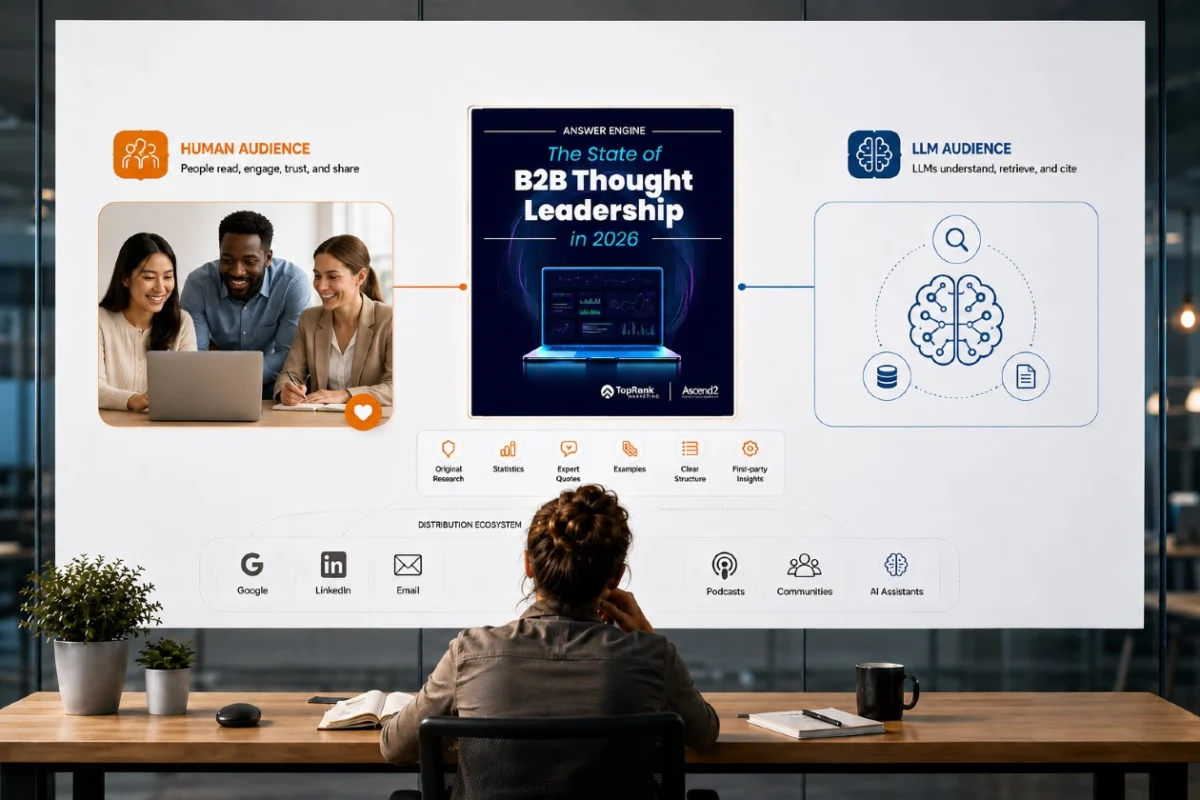
In 2026, B2B marketers are navigating the complexities of engaging two fundamentally different, yet surprisingly aligned, audiences. The first is the traditional buying group, a typically large collective of eight to ten individuals. These buyers are characterized by their skepticism, severe time constraints, and the personal risk they face if their recommendations prove to be flawed. Their decision-making process is heavily influenced by the need for defensible proof that can withstand internal scrutiny.
The second audience comprises sophisticated retrieval and reasoning systems—the AI answer engines. These AI entities meticulously read, summarize, and ultimately decide which brands are presented as answers when users pose queries. They operate on a principle of evidence attribution and corroboration, seeking to synthesize information from a multitude of sources to provide the most authoritative and reliable response.
A common pitfall for B2B marketers has been to treat these two audiences as separate problems, allocating distinct resources and strategies to each. However, the Ascend2 research strongly suggests that both audiences respond to remarkably similar signals. The "proof" sought by human buyers—information that is verifiable and can be defended—is precisely the type of "evidence" that AI systems prioritize for attribution and corroboration. The good news, according to the report, is that a combination of original research, proprietary data, credible human voices, and a consistent point of view can effectively satisfy the expectations of both.
Original Research: The Unassailable Foundation of Authority
The Ascend2 study further quantifies the perceived value of original research in building trust and authority. A significant 35% of B2B marketers believe original research is "significantly more valuable than AI-generated content" for this purpose, with an additional 32% deeming it "more impactful overall." This insight is particularly crucial for organizations that may be tempted to rely heavily on AI for content generation. The underlying principle is that content most likely to be replicated or referenced by machines is content that originates from a source a machine could not have independently created. Even the synthetic data that fuels AI models is ultimately derived from original, human-generated source material.
The unique value proposition of original research lies in its inherent ability to generate new knowledge. Unlike aggregated content, which can often be summarized or paraphrased from existing sources, original research introduces novel insights that have not been previously disseminated. When a brand publishes unique findings, it establishes itself as the definitive citable source for that information. This, in turn, triggers a cascade of trust signals: journalists cite the research in their articles, analysts reference it in their reports, industry influencers engage with it in debates, and AI systems attribute it in their responses. Each of these actions serves as a powerful endorsement, directing attention and credibility back to the originating brand.
The performance data supporting original research is compelling. As previously noted, 93% of B2B marketers utilizing original research-based content report its effectiveness in driving engagement and leads, with 48% categorizing it as "very effective." This demonstrable success is fueling increased investment in this area, with 47% of B2B marketers planning to expand their use of original research and data-driven content in the coming year.
The genesis of impactful original research is also a critical factor. The survey indicates that 53% of B2B marketers prioritize direct customer feedback when selecting research topics, followed closely by CRM data and competitor/market trend analysis, both cited by 44% of respondents. Research that directly addresses questions already being posed by buyers is far more likely to be adopted and utilized. Conversely, research that merely validates pre-existing opinions risks being overlooked.
The Power of Influencer Collaboration in Amplifying Credibility
While original data provides the bedrock of proof, its impact is significantly amplified when contextualized and validated by credible human voices. The Ascend2 findings underscore this symbiotic relationship: 72% of B2B marketers who frequently collaborate with influencers rate their research-based content as "very effective," compared to only 29% of those who do not. This disparity highlights how third-party validation transforms content from a mere brand claim into a trusted assertion. B2B buyers, often wary of unsubstantiated brand pronouncements, are more receptive to information that has been endorsed by individuals they already respect.
B2B marketers themselves recognize the power of influencer endorsement, with 45% stating that featuring industry influencers or experts would enhance the impact of their thought leadership content. However, the consistent execution of such collaborations appears to be a persistent challenge for many.
Independent research further corroborates the central role of trust. A study titled "The Credibility Code," conducted by the B2B Institute at LinkedIn and Ipsos, found that 94% of B2B marketers identify trust as the paramount factor for success in B2B marketing. This research also revealed that 82% of B2B buyers acknowledge that creator content influences their purchasing decisions.
While platforms like LinkedIn are adept at facilitating influencer engagement within their ecosystems, the Ascend2 research suggests a nuanced perspective on how credibility translates across the broader B2B buyer journey. The study observed a divergence between where marketers distribute thought leadership and where professionals primarily consume it. For instance, while 54% of marketers utilize LinkedIn for distribution, only 38% of professionals report consuming thought leadership there most often. A similar pattern emerges with YouTube (50% distribution vs. 34% consumption) and webinars (48% distribution vs. 34% consumption). This indicates that B2B marketers may be concentrating their distribution efforts on platforms where their target audience’s consumption habits are less pronounced.
The report posits a crucial distinction: credibility built within a single platform often remains confined to that platform. True portability of credibility is achieved through evidence that a brand owns, validated and contextualized by credible experts, published in structured formats, and cited across owned, earned, and social channels. This portable credibility extends into search results, media coverage, peer communities, and importantly, the training and retrieval data utilized by AI answer engines. This pervasive presence is the hallmark of a brand that has successfully positioned itself as the "best answer" for its buyers.
The Six Drivers of "Best Answer Marketing": A Systemic Approach
The framework for achieving this "best answer" status, as outlined by the research, involves a systematic approach centered on six key drivers:
- Original Research: Generates unique, citable insights.
- Credible Voices: Adds context, validation, and trust through influencers and experts.
- Proprietary Data: Offers unique, quantifiable evidence.
- Consistent POV: Establishes a clear, recognizable brand perspective.
- Structured Formats: Organizes information for accessibility and discoverability.
- Multi-Channel Distribution: Ensures reach across diverse platforms and audiences.
Implementing any single driver can yield marketing results, but when these drivers operate in concert as a system, their impact is amplified. This integrated approach ensures that content is not only created but also discoverable, credible, and ultimately, actionable for both human buyers and AI systems.
Content Formats that Bridge Research, Influence, and Thought Leadership
The Ascend2 research identifies key content formats that effectively integrate original research, influencer engagement, and thought leadership, catering to the dual audience. These formats share three critical characteristics: they are built on evidence, they feature credible voices, and they are published in formats that are both human-readable and machine-discoverable.
B2B marketers believe several formats would significantly enhance their thought leadership:
- Original research reports: The cornerstone asset, providing a documented methodology and unique findings that competitors must attribute.
- Research statistics hubs: Dedicated web pages presenting key findings as discrete statistics, enhancing citations and providing clear attribution points for search and AI.
- Video podcast series: Offering multiple content assets (video, audio, transcripts, graphics) from recorded conversations with practitioners and analysts, with transcripts being crucial for AI indexing.
- Research-backed webinars and virtual roundtables: Live sessions featuring credible voices interpreting data for specific segments, with on-demand recordings and searchable transcripts.
- Interactive data experiences: Tools like assessments and benchmark calculators that allow buyers to see their own situation reflected in the research, generating first-party insights.
- Earned media and digital PR: Pitching research findings to publications and analysts, securing third-party coverage that validates content and influences AI system attributions.
- Co-created guides and eBooks: Longer-form assets featuring contributions from influencers and internal experts, offering them credible bylines and making them distribution partners.
- Executive and influencer bylines: Opinion pieces in trusted publications authored by named individuals with established track records, lending authority beyond brand-authored content.
- Real-world events: Conference sessions and executive roundtables that foster in-person relationships with experts and generate a pipeline of future content.
- Digital events and livestreams: Consistent, lower-production-footprint sessions like LinkedIn Live or AMAs, useful for reacting to industry news with data.
- Short-form video: Concise, person-on-camera clips (under 90 seconds) that disseminate individual findings across feeds and extend the life of reports.
- Documentary and masterclass content: Cinematic or instructional treatments that transform research into compelling narratives featuring customers and experts, as exemplified by Sprinklr’s Socialverse program.
- Newsletters (owned and sponsored): Leveraging owned email lists and paid placements in trusted industry newsletters to reach audiences beyond organic reach.
- Peer communities and Slack groups: Active participation in private forums where buyers seek candid advice, with top performers diversifying distribution across emerging channels like podcasts and communities.
- Serialized blog and article programs: Breaking down research into a sustained sequence of articles, each addressing a specific buyer question in depth, creating an ongoing supply of indexed, citable answers.
Rethinking Measurement in an AI-Informed Era
The integration of AI into the buyer journey necessitates a recalibration of measurement strategies. Traditional B2B marketing funnel reporting may no longer capture the full impact of content. A buyer’s journey might begin with encountering research in an AI summary, progress to hearing a podcast guest reference it, then seeing an influencer post about it, and finally landing on a website via a branded search—all without a clearly attributable first touch.
Unified measurement, which connects brand engagement, demand signals, and revenue outcomes, is becoming essential. This approach must incorporate visibility within answer engines as a tracked metric, alongside traditional metrics like organic rankings. The difficulty in achieving this comprehensive measurement is cited by 41% of marketers as a primary cause of underperforming content, making it a significant differentiator for those who successfully address it.
Embarking on the Dual Audience Strategy: Where to Begin
To harness the dual-audience opportunity, marketers are advised to start by identifying a single, persistent question that buyers in their category frequently ask, yet for which no credible, evidence-based answer exists. The next step involves designing a focused piece of primary research to address this question. Crucially, this research should involve the input of five credible voices in its interpretation phase before publication. The subsequent quarter should then be dedicated to building out various content formats, as outlined above, around this singular insight.
This methodical sequence—identifying an unanswered question, conducting original research, securing expert validation, and disseminating across multiple formats—is the pathway to transforming a brand from a competitor for attention into the definitive answer. Original research earns the right to a point of view, credible voices lend that viewpoint believability, and consistent, multi-format publishing ensures discoverability across all channels where buyers and their AI assistants are searching. The fundamental question for any B2B brand seeking to lead its market is: "What original data can we provide that no one else in our industry can answer?" This question forms the bedrock of a robust "best answer" marketing strategy.
For organizations seeking to become the preeminent source of information for both AI engines and discerning buyers, a strategic partnership with experts in this evolving field can provide invaluable guidance. The journey to becoming the "best answer" is an ongoing process, demanding continuous adaptation to technological advancements and evolving buyer behaviors.