rifanmuazin
The landscape of data science and local analytical processing has undergone a seismic shift over the last five years, moving from a monolithic reliance on pandas to a diversified ecosystem featuring high-performance engines like Polars and DuckDB. While pandas remains the foundational tool for exploratory data analysis (EDA) and machine learning workflows, the emergence of Polars and DuckDB has introduced new paradigms in memory efficiency, multi-threaded execution, and SQL-native querying. This transition reflects a broader industry trend: the “democratization of high-performance computing,” where data scientists now expect to process multi-gigabyte datasets on local hardware with the speed previously reserved for distributed clusters.
The Chronological Trajectory of Python Data Libraries
To understand the current competition between these tools, one must examine the timeline of their development. The journey began in 2008 when Wes McKinney developed pandas at AQR Capital Management. At the time, pandas was a revolutionary bridge between the statistical capabilities of R and the general-purpose power of Python. It relied heavily on NumPy, adopting a mostly eager execution model that required data to be fully loaded into memory.
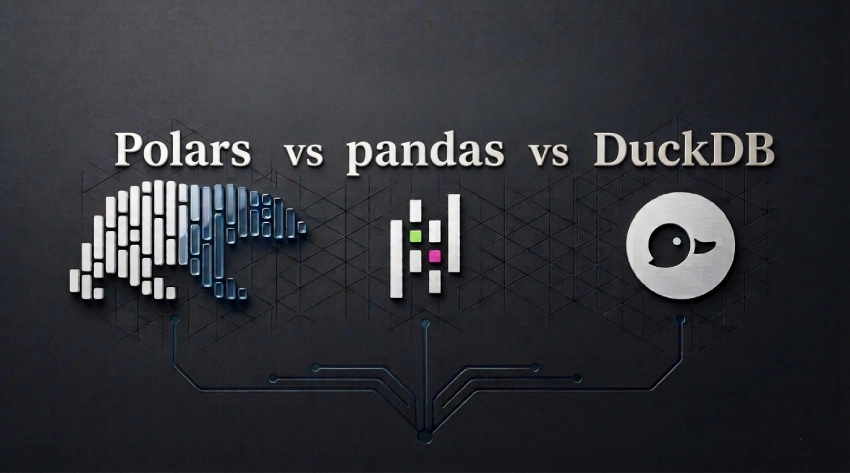
For a decade, pandas had no serious rivals. However, as dataset sizes grew and hardware evolved to include many-core processors, the limitations of pandas—specifically its single-threaded nature and high memory overhead—became apparent. This gap in the market led to the birth of two distinct successors. In 2019, researchers at the Centrum Wiskunde & Informatica (CWI) in the Netherlands introduced DuckDB, designed as an in-process SQL OLAP (Online Analytical Processing) database management system. Shortly thereafter, in 2020, Ritchie Vink released Polars, a DataFrame library written in Rust and built upon the Apache Arrow memory format, specifically designed to leverage modern CPU architectures through parallelism and lazy evaluation.
Architectural Foundations: Eager vs. Lazy vs. SQL-First
The primary differentiator between these three powerhouses lies in their underlying architecture and how they manage execution.
pandas: The Eager Veteran
pandas operates on an “eager execution” model. When a command is issued—such as a filter or a join—it is executed immediately, and a new object is created in memory. While this is intuitive for interactive notebook sessions, it is notoriously memory-inefficient. A common rule of thumb in the industry is that pandas requires five to ten times as much RAM as the size of the dataset being processed. Because it is built on top of NumPy, it is largely restricted by the Python Global Interpreter Lock (GIL), making true multi-threaded parallelism difficult to achieve for many operations.

Polars: The Multi-Threaded Challenger
Polars departs from the pandas model by utilizing Rust and Apache Arrow. Its most significant innovation is the “LazyFrame.” In lazy mode, Polars does not execute commands immediately. Instead, it builds a logical query plan. Before execution, the Polars optimizer analyzes this plan to perform “predicate pushdown” (filtering data as early as possible) and “projection pushdown” (selecting only necessary columns). By the time the collect() command is called, the engine has streamlined the operation to use the least amount of memory and CPU cycles possible. Furthermore, Polars is designed from the ground up for parallelism, distributing workloads across all available CPU cores.
DuckDB: The Embedded Warehouse
DuckDB represents a different philosophy: the “SQLite for Analytics.” It is a vectorized query execution engine, meaning it processes data in batches (vectors) rather than row-by-row or as a single monolithic block. This architecture minimizes CPU cache misses and maximizes throughput. Unlike the other two, DuckDB is a fully-featured SQL database that can run inside a Python process. It can query external files like Parquet, CSV, and JSON directly without an explicit “import” step, effectively treating the local file system as a data warehouse.
Performance Benchmarks and Memory Efficiency
Supporting data from industry-standard benchmarks, such as the H2O.ai Database Benchmark, consistently highlights the performance gap between these tools. In tasks involving large-scale joins and aggregations (datasets exceeding 5GB), Polars and DuckDB frequently outperform pandas by factors of 10x to 50x.
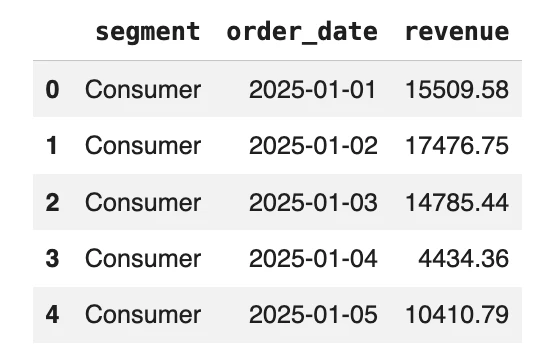
Memory efficiency is where the disparity is most visible. In a scenario involving a 10GB CSV file, a pandas workflow might crash on a machine with 32GB of RAM due to the creation of intermediate objects during a join. In contrast, DuckDB and Polars can often process the same file using “streaming” capabilities, where only chunks of the data are held in memory at any given time. DuckDB, in particular, excels at “larger-than-memory” workloads, utilizing disk-spilling techniques to ensure that queries complete even when the dataset exceeds the physical RAM.
Comparative Workflow: A Practical Execution Scenario
To illustrate these differences, consider a standard data pipeline: loading an orders table (Parquet format) and a customers table (CSV), filtering for completed orders, joining the two, calculating daily revenue by customer segment, and saving the result.
In the pandas approach, the developer loads both files into memory as DataFrames. The join and aggregation are handled via method chaining. While the syntax is familiar to millions of users, the process is entirely eager. If the Parquet file contains 100 million rows, the initial load alone might saturate the system’s memory before the filtering even begins.
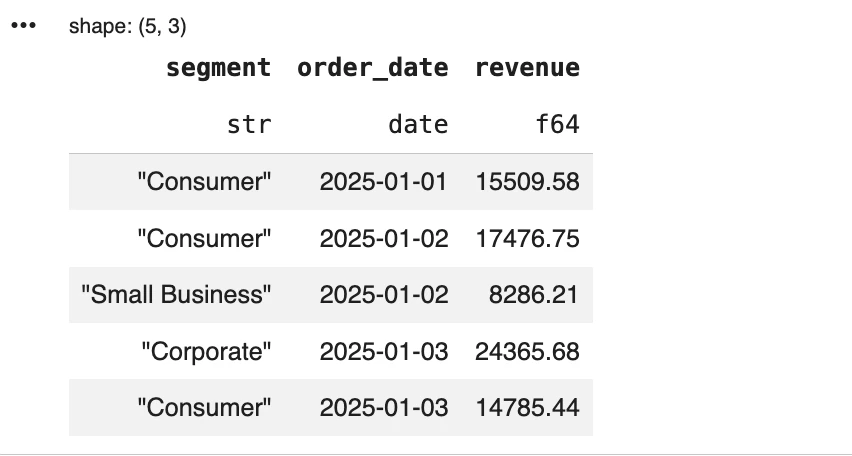
The Polars approach utilizes scan_parquet and scan_csv. These functions do not load the data; they simply point to the files. The developer defines the transformation logic using Polars’ expression API, which is more verbose than pandas but more expressive. The engine optimizes the join, ensuring that only the “complete” status rows are involved in the merge, significantly reducing the computational load.
The DuckDB approach bypasses the DataFrame API entirely in favor of standard SQL. A single SQL statement can read the Parquet and CSV files, perform the join, and aggregate the data. This is particularly advantageous for teams coming from a data engineering or business intelligence background, where SQL is the lingua franca.
Interoperability: The Apache Arrow Bridge
One of the most significant developments in the modern data stack is the high level of interoperability between these tools. This is largely thanks to the Apache Arrow project, which provides a standardized, columnar memory format.
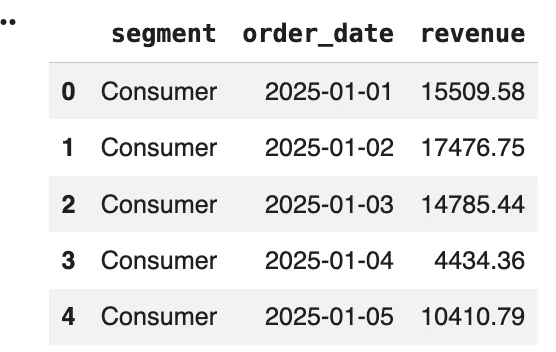
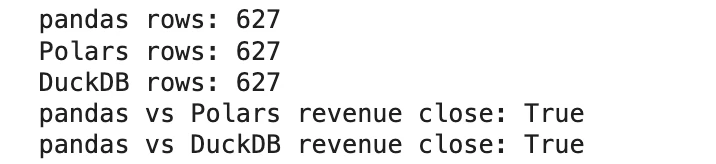
Because Polars is built on Arrow and DuckDB supports Arrow natively, data can be passed between these engines with “zero-copy” overhead. A developer can use DuckDB to perform a complex SQL-based join on massive files on disk, convert the result to a Polars DataFrame for high-speed feature engineering, and finally convert a small summary subset to a pandas DataFrame for plotting with Matplotlib or Seaborn. This hybrid workflow allows users to leverage the specific strengths of each tool without being locked into a single ecosystem.
Industry Implications and Future Outlook
The rise of Polars and DuckDB has profound implications for the field of data engineering. Previously, processing 100GB of data required a distributed computing cluster using Apache Spark or Dask. Today, with the efficiency of DuckDB and Polars, such tasks can often be performed on a single high-end workstation or a medium-sized cloud instance. This reduces infrastructure costs and simplifies the deployment of data pipelines.
Furthermore, the “pandas-compatible” API layer being developed by both Polars and other libraries (like the dataframe-api initiative) suggests a future where the underlying engine is interchangeable. While pandas is unlikely to be replaced entirely due to its massive ecosystem of dependent libraries (Scikit-learn, Statsmodels, etc.), it is increasingly being relegated to the “last mile” of data analysis—the stage where data is small enough to be easily manipulated and visualized.
Conclusion and Decision Matrix
The choice between pandas, Polars, and DuckDB is no longer a matter of which is “best,” but which is most appropriate for the specific constraints of a project.
- pandas remains the optimal choice for smaller datasets (under 1GB), rapid prototyping in notebooks, and workflows that require deep integration with the existing Python machine learning ecosystem.
- Polars is the premier choice for performance-critical ETL pipelines and feature engineering where speed and multi-core utilization are paramount. Its lazy execution and Rust-based core make it the fastest DataFrame-centric tool currently available.
- DuckDB is the ideal solution for SQL-heavy analysis, situations where data is stored in various local file formats, and scenarios where the dataset size exceeds the available RAM.
As the data volume generated by modern applications continues to grow, the shift toward memory-efficient, parallelized, and lazy execution models is inevitable. By integrating these three tools, data professionals can build more resilient, scalable, and cost-effective analytical workflows that maximize the potential of local computing resources.