rifanmuazin
The days when business-to-business (B2B) buyer discovery followed a predictable, linear path are a relic of the past. What was once a relatively contained process of searching, comparing a select few options, and moving forward with a clear understanding of next steps has transformed into a complex, time-delayed, and environmentally diverse journey. Today’s B2B buyers engage with an average of ten distinct channels throughout their decision-making process, according to research from McKinsey & Company. This shift necessitates a fundamental reevaluation of how B2B marketers approach engagement and build lasting trust.
Understanding for these buyers is no longer a singular event. Instead, it is a gradual accumulation, shaped by repeated exposure, diligent comparison, and persistent validation. The critical challenge for marketers lies in discerning when this accumulated understanding translates into buyer confidence, as clear signals are often absent. This evolving dynamic has been a central theme explored by TopRank Marketing on their B2B Marketing Blog, with past discussions delving into how multi-channel discovery is integrated into the Best Answer Marketing framework, how data-driven insights illuminate buyer challenges, how integrated strategies maintain idea coherence, how trust underpins belief, and how experiential content deepens engagement. The core principle emerging from this research is that narratives must now hold together across an extended and fragmented discovery process, moving beyond mere first impressions to demonstrate enduring credibility under repeated scrutiny.
The Dissolution of the Single-Path Funnel
The traditional B2B buyer funnel, often depicted as a neat progression from awareness to consideration to decision, has largely dissolved. Discovery now unfolds fluidly across a multitude of environments, frequently without a discernible starting point. Each of these environments serves a unique purpose, and none can unilaterally dictate the outcome of a complex purchasing decision.

The initial orientation for buyers is often facilitated by AI-driven tools, enabling them to quickly frame their problems. Search engines then become crucial for validation, allowing buyers to cross-reference claims and gather diverse perspectives. Peer-driven platforms introduce invaluable lived experiences, while expert voices and owned brand content assist in evaluating the practical viability of ideas. These interactions are not mutually exclusive; rather, they are additive, each contributing to the buyer’s growing comprehension.
The fundamental intent of buyers—to make sound decisions—remains unchanged. What has evolved is their methodology for mitigating uncertainty. Instead of relying on a single, authoritative source, buyers increasingly triangulate signals across various platforms, seeking consistency before committing to a vendor. In this environment, mere visibility is insufficient. If a brand’s messaging or core ideas shift, contradict themselves, or lose clarity as buyers navigate different channels, buyer confidence erodes. Consequently, multi-channel discovery has shifted from a focus on broad reach to one of continuity, ensuring that the foundational thinking and messaging remain intact wherever buyers seek reassurance.
Research Illuminates the Multi-Channel Discovery Phenomenon
Research, including TopRank Marketing’s own "The State of B2B Thought Leadership in 2026" report, underscores this profound shift in buyer behavior. The study, which surveyed 797 senior B2B marketers, consistently identified fragmentation as a significant challenge. A substantial one-third of respondents reported limited visibility into the performance of their marketing efforts across the entire buyer journey, while another third indicated an over-reliance on a small subset of channels. These findings suggest a disconnect: while marketers acknowledge the proliferation of touchpoints in the buyer’s journey, many lack the strategic architecture to connect these encounters in a cohesive manner.
Furthermore, influence in the B2B space is becoming increasingly distributed. High-performing marketing teams are almost twice as likely to diversify their thought leadership distribution across emerging channels, extending their presence beyond a limited array of established platforms. This includes a more robust utilization of video, podcasts, and peer communities—environments where buyers can revisit ideas, decipher nuance, and validate perspectives over extended periods.
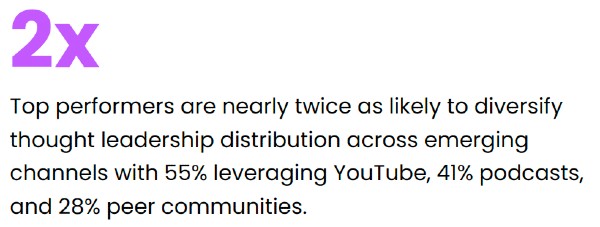
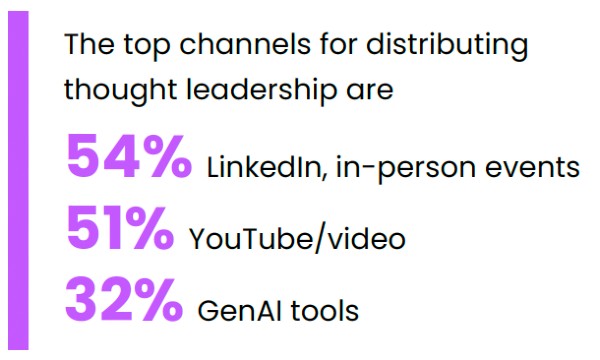
The "State of B2B Thought Leadership in 2026" report also highlights a growing disparity between how B2B marketers deploy their thought leadership content and how buyers actually discover it. While LinkedIn and in-person events remain pivotal channels, video content is ascending in importance. Notably, nearly one-third of buyers now report leveraging Generative AI (GenAI) tools for thought leadership discovery—a channel that a significant portion of marketers still categorize as secondary.
These collective findings point to a critical challenge: the issue is not solely about selecting the "right" channel. It is about ensuring that the underlying brand message and core thinking are presented with unwavering consistency across every platform where buyers engage in validation, comparison, and confidence-building activities.
Buyer Channels as Tools for Uncertainty Reduction
As the discovery process expands across a broader spectrum of environments, B2B buyers begin to assign specific roles to each channel, seeking distinct forms of reassurance. The value of each interaction becomes more apparent when viewed through the lens of risk reduction rather than simply message dissemination.
- AI Tools: Often serve as an initial navigational aid, helping buyers quickly frame problems and identify potential solutions. They provide a broad overview and can accelerate the initial stages of problem definition.
- Search Engines: Act as critical validation hubs, allowing buyers to verify information, compare competing claims, and gather a range of perspectives from diverse sources.
- Peer Communities: Offer indispensable social proof and real-world experience, providing insights into the practical application and long-term implications of solutions from those who have already navigated similar challenges.
- Expert Voices and Brand Content: Provide authoritative analysis, in-depth explanations, and detailed product or service information, enabling buyers to assess the credibility and suitability of offerings in a more structured manner.
The sequence of these interactions can vary significantly among buyers. What remains paramount is the function each touchpoint serves. Buyers are not moving through a rigid process; instead, they are incrementally building confidence. Each channel addresses a specific question or concern, and collectively, these interactions determine whether an idea or solution is perceived as reliable enough to warrant further action.
High-Performing B2B Brands Architect for Multi-Channel Discovery
Leading B2B marketers acknowledge that they do not dictate where buyer discovery takes place. Buyers encounter ideas across diverse platforms, at different times, and often outside of any structured marketing campaign. The marketer’s responsibility, therefore, shifts from achieving channel dominance to cultivating consensus around a consistent brand narrative. This means striving to be the "Best Answer" in a meaningful way, present where buyers are looking, where they place their trust, and where they are most influenced.
Rather than planning channel strategies in isolation, top-performing B2B marketers begin with a clearly articulated point of view and rigorously ensure its substantiation with credible proof wherever buyers are likely to seek confirmation. This involves maintaining alignment in language, proof points, and framing, whether an idea appears in an AI-generated summary, a search engine result, a peer discussion forum, or a comprehensive piece of owned content. This narrative continuity, powered by evidence to build consensus, is a cornerstone of the Best Answer Marketing system and aligns closely with concepts like LinkedIn’s "Buyability."
These results-oriented B2B marketers also understand that repetition is not a redundancy but a reinforcement. Buyers expect to encounter the same core ideas multiple times throughout their journey. When designed intentionally, each subsequent exposure adds context, deepens understanding, and reduces the cognitive load required to build trust.
Most critically, high-performing marketers design their discovery strategies around actual buyer behavior. They anticipate that buyers will compare sources, seek external validation, and revisit information as their decisions evolve. Structuring content and discovery with this inherent buyer behavior in mind benefits not only human decision-makers but also facilitates LLMs in identifying and prioritizing solutions. The objective is not to impose a linear path but to simplify each evaluation point by maintaining a consistent underlying message.
Multi-Channel Discovery Rewards Coherent Narratives
Ultimately, multi-channel discovery does not demand that brands be ubiquitous. It requires them to be consistently reliable wherever buyers choose to look. As discovery increasingly spans AI tools, search engines, online communities, and owned media, the competitive advantage shifts away from mere channel mastery towards narrative coherence. Buyers do not build decision confidence from isolated interactions. They forge it when ideas remain steadfast under scrutiny, when supporting evidence is consistent across all touchpoints, and when the guidance provided feels cumulative and trustworthy.
In this context, the underlying function of multi-channel discovery transcends mere reach. Its primary objective is to build confidence. B2B companies that grasp this principle transition from simply being seen to being believed, establishing themselves as "Best Answer Brands."
To gain a deeper understanding of how to leverage proof for consensus-building and to become a Best Answer Brand, the report "Answer Engine: The State of B2B Thought Leadership in 2026" offers invaluable insights. It details how leading B2B marketers are architecting their strategies for multi-channel discovery and fostering consensus in today’s complex buyer landscape. This comprehensive resource is available for download, providing actionable guidance for navigating the evolving world of B2B buyer engagement.