rifanmuazin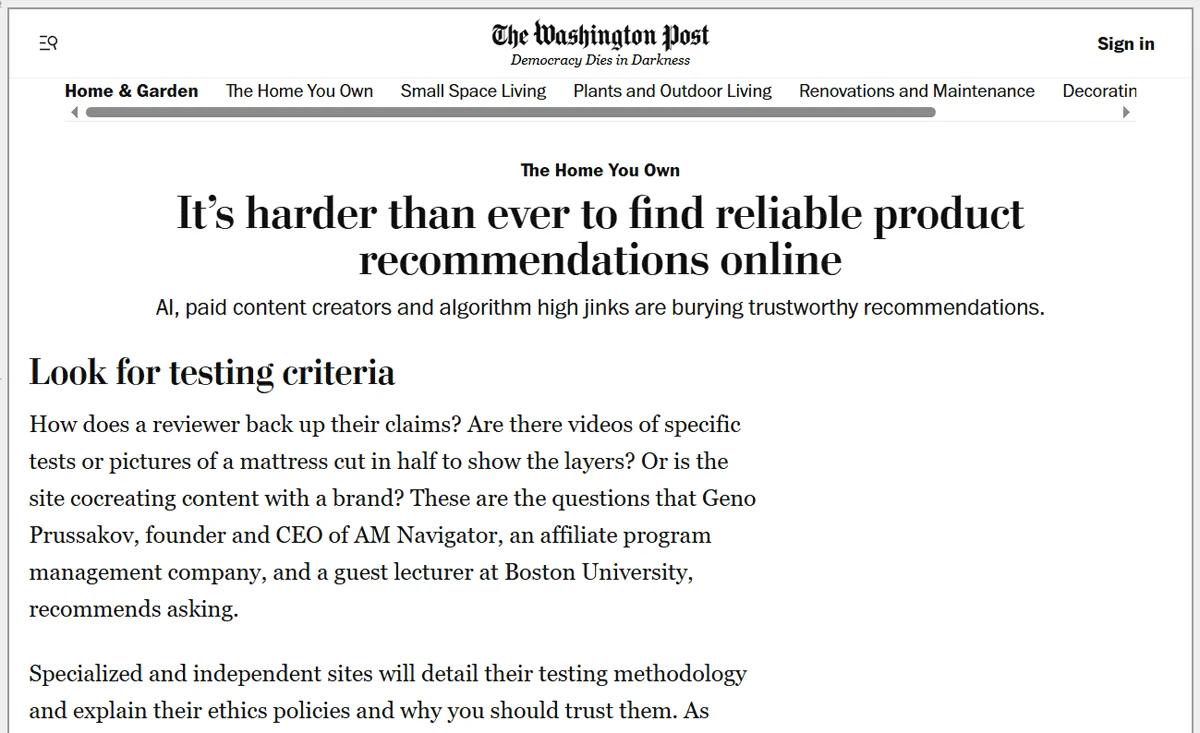
The digital publishing landscape underwent a significant transformation in early 2025 as major media outlets faced increasing scrutiny over the intersection of editorial integrity and affiliate marketing revenue. On January 13, 2025, a report published by The Washington Post highlighted a growing concern among modern consumers: the reliability of product recommendation lists that dominate search engine results. As traditional advertising revenues—such as print subscriptions and display banners—continue to decline, legacy media organizations have increasingly pivoted toward "commerce content" as a primary survival strategy. This shift has turned media authority into a highly liquid asset, where the trust earned over decades of journalism is leveraged to drive affiliate sales. While this business model has stabilized the balance sheets of many newsrooms, it has simultaneously sparked a debate regarding the objectivity of product reviews and the potential for financial incentives to supersede editorial rigor.
The Rise of Commerce Content in Digital Publishing
The transition from traditional journalism to a commerce-centric model did not occur overnight. It is the result of a decades-long erosion of the traditional "walled garden" between editorial departments and advertising sales. In the late 2010s, publications such as The New York Times, with its acquisition of The Wirecutter, and New York Magazine’s launch of The Strategist, demonstrated that high-quality service journalism could be a lucrative revenue stream. By integrating affiliate links—tracking codes that pay the publisher a commission when a reader makes a purchase—media companies found a way to monetize their audience’s intent to buy.
According to industry data from the Performance Marketing Association, the affiliate marketing industry has grown into a multi-billion-dollar ecosystem, with over 80% of publishers now utilizing some form of affiliate revenue. For major media entities, this often involves the creation of dedicated "vetted" or "best of" sections. However, as search engines like Google began prioritizing these high-authority domains in search results, the marketplace became crowded. Consumers searching for simple items, from coffee makers to insurance policies, now find the first page of search results dominated by a handful of media conglomerates. This saturation has led to what some analysts call "authority monetization," where the brand name of a publication is used to validate products that the editorial staff may or may not have extensively tested.
A Chronology of the Monetization Shift
To understand the current state of online product recommendations, one must examine the timeline of how media organizations evolved their revenue strategies:
- 1996–2005: The Early Web Era. Media companies largely relied on digital versions of print ads and early banner advertisements. Affiliate marketing was in its infancy, dominated by niche bloggers and coupon sites.
- 2006–2015: The Rise of Programmatic Advertising. As Google AdSense and programmatic buying took over, publishers saw a "race to the bottom" in ad rates. The need for diversified revenue became urgent.
- 2016: The Wirecutter Landmark. The New York Times acquired The Wirecutter for approximately $30 million. This served as a proof-of-concept for the "commerce content" model, proving that readers would trust a legacy brand’s product suggestions.
- 2017–2023: The Proliferation of "Vetted" Brands. Almost every major publisher, including Forbes, Hearst, and Condé Nast, launched dedicated commerce wings. These departments operate separately from the newsroom but utilize the main site’s SEO authority to rank for high-value commercial keywords.
- 2024–2025: Regulatory and Consumer Pushback. The Federal Trade Commission (FTC) updated its Endorsement Guides to demand clearer disclosures. Simultaneously, major reports, including the January 2025 Washington Post investigation, began questioning whether the "best" products were being chosen based on quality or commission rates.
The Mechanics of Influence: How Recommendations are Formed
The process of generating a product roundup at a major media house is often more complex than a simple endorsement. Industry experts, including Geno Prussakov of AM Navigator, an affiliate marketing consultancy, note that reputable publishers generally employ a multi-layered approach to maintain their reputation. While the financial incentive is present, the long-term value of the brand depends on the accuracy of its recommendations.
Most high-tier media outlets follow four primary protocols when evaluating products. First, they engage in hands-on testing, often utilizing dedicated laboratories or "test kitchens" to put products through standardized stress tests. Second, they consult with subject-matter experts—engineers, doctors, or professional chefs—to add a layer of technical validation. Third, they conduct extensive market research, analyzing thousands of consumer reviews across multiple retail platforms to identify common failure points in products. Finally, they maintain an "editorial firewall," where the writers and editors selecting the products are theoretically insulated from the business development teams that negotiate commission rates with retailers.
Despite these safeguards, the influence of "placement fees" and "EPC" (Earnings Per Click) cannot be ignored. In some instances, if two products are of equal quality, the one offering a higher commission rate or a "flat fee" for a top-three placement may receive the more prominent position. This nuance is often invisible to the average consumer, who sees only a ranked list from a source they trust.

Analytical Implications: The Impact on Consumer Behavior
The implications of this monetization strategy are twofold. On one hand, it provides consumers with a curated list of options in an era of "choice overload." On the other, it creates a "pay-to-play" environment where smaller, potentially superior brands are excluded because they cannot afford the high affiliate commissions or the placement fees demanded by major media agencies.
Data suggests that consumer skepticism is on the rise. A 2024 survey on digital trust indicated that while 60% of consumers still start their shopping journey on search engines, nearly 45% are "wary" of product recommendations found on major news sites, often cross-referencing them with user-generated content on platforms like Reddit or YouTube. This "triangulation" of data has become a necessary skill for the modern digital shopper.
The financial stakes are high for the publishers as well. For many, commerce revenue accounts for 25% to 40% of their total digital income. If consumer trust erodes to the point where "vetted" lists no longer drive sales, the economic foundation of modern digital journalism could be further compromised.
Official Responses and Regulatory Oversight
In response to these concerns, the Federal Trade Commission has increased its oversight of the affiliate industry. The FTC’s updated guidelines require that disclosures be "clear and conspicuous," meaning a small, grayed-out "affiliate disclosure" at the bottom of a page is no longer sufficient. Regulators now expect disclosures to be placed where they are easily noticed by consumers, ideally before they encounter the affiliate links.
Industry bodies have also attempted to self-regulate. Organizations like the Interactive Advertising Bureau (IAB) have released best practices for commerce content, emphasizing the need for transparency in how products are tested and whether any financial relationship exists between the publisher and the manufacturer. However, these guidelines are non-binding, leading to a wide variance in how different media houses handle their recommendations.
Strategies for Consumer Protection
As the line between editorial content and advertising continues to blur, consumers must adopt a more analytical approach to online shopping. Experts suggest several strategies to navigate this landscape effectively:
- Scrutinize Testing Methodology: Consumers should look for detailed explanations of how a product was tested. If a "best of" list does not explain the criteria for selection or show original photography of the product in use, it may be a "synthetic" list compiled from other reviews rather than first-hand experience.
- Identify Redundancy Across Sources: If a specific product appears as the "top pick" across five different, unrelated publications, it may truly be the industry standard. Conversely, if a product only appears on sites owned by the same media conglomerate, it warrants further investigation.
- Evaluate Disclosure Transparency: A reputable publication will be transparent about its affiliate relationships. The absence of a clear disclosure is a significant red flag.
- Cross-Reference with Community Feedback: Utilizing forums and community-driven platforms allows consumers to see unfiltered feedback from long-term users of a product, which can provide a necessary counterpoint to a professional review.
The Future of Media and Commerce
The January 2025 Washington Post feature serves as a pivotal moment for the industry, signaling that the "golden age" of unchecked affiliate growth may be reaching a plateau. As artificial intelligence begins to aggregate these lists and present them directly in search results, the value of the original media recommendation may shift again.
The future of media monetization will likely require a return to radical transparency. For publications to maintain their status as "authorities," they must prove to their audience that their recommendations are not for sale to the highest bidder. The challenge for the next decade will be balancing the undeniable need for revenue with the fragile nature of consumer trust. In an information economy, once trust is liquidated for short-term gain, it is notoriously difficult to rebuild. For now, the "product roundup" remains a staple of the internet, but the savvy consumer is learning to read between the lines of the "buy now" button.