Nana Wu
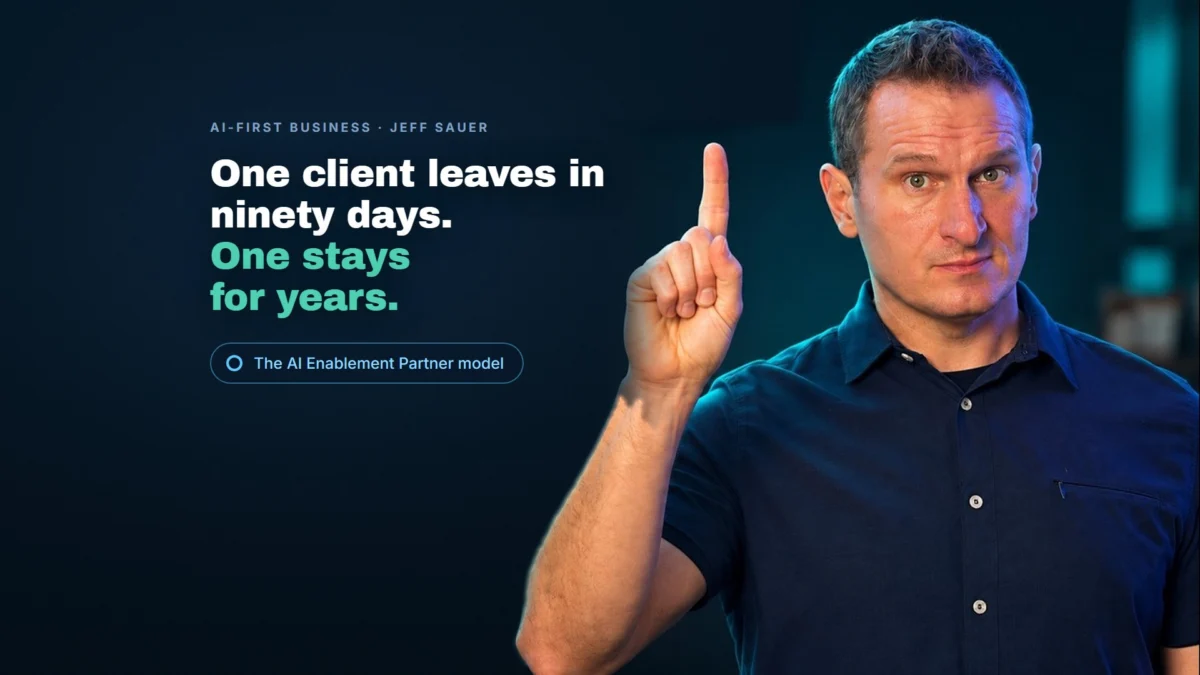
The rapid acceleration of generative artificial intelligence has created a paradoxical challenge for digital service providers: while the demand for AI integration is at an all-time high, the traditional project-based revenue model is proving increasingly unsustainable for long-term growth. Industry data suggests that the "churn and burn" cycle of AI implementation—where consultants deliver a specific automation tool only for the client to terminate the relationship upon delivery—is forcing a strategic pivot toward what experts are calling the AI Enablement Partner model. This shift marks a transition from selling technical hours to providing ongoing strategic accountability in an era where AI models and capabilities change on a weekly basis.
The Structural Volatility of the AI Service Market
The primary driver behind the failure of traditional agency retainers in the AI space is the unprecedented rate of technological depreciation. Unlike traditional search engine optimization (SEO) or social media management, where the underlying platforms remain relatively stable for years, AI infrastructure is built on shifting sands.
According to Jeff Sauer, a digital marketing veteran and agency scale expert who exited an eight-figure firm, the standard maintenance retainer is no longer applicable to AI. "The marketing automation AI system built three months ago may already be the wrong system for today," Sauer noted in a recent analysis of the sector. The deprecation of models—such as the transition from legacy GPT iterations to GPT-4o or the rapid updates to Anthropic’s Claude—means that an AI system is never truly "finished."
This volatility creates a "value gap." Research indicates that approximately 33% of clients who terminate ongoing agency engagements cite a lack of perceived value over time. In the context of AI, if a consultant builds a static automation and then settles into a passive maintenance role, the client quickly perceives the service as a redundant expense. The AI Enablement Partner model addresses this by replacing passive availability with active accountability, ensuring that the client’s AI stack evolves alongside the industry.
Psychographic Segmentation: The DIYer vs. the Enablement Client
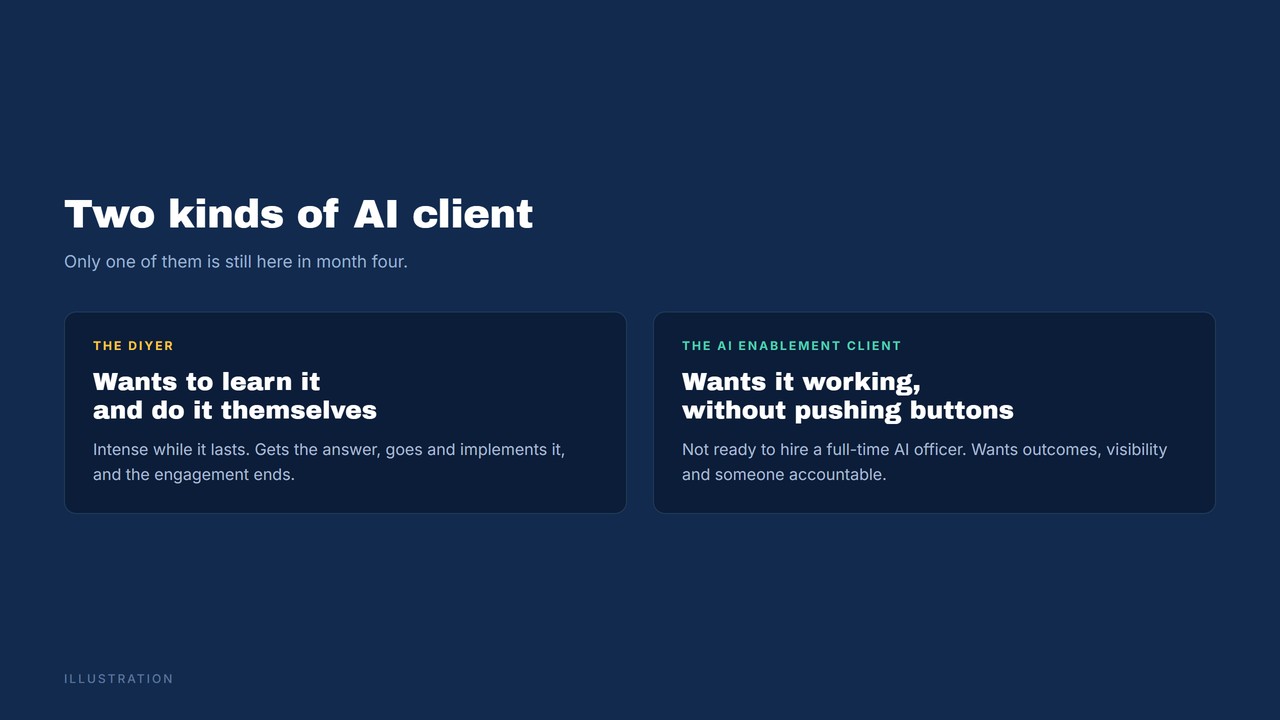
To achieve long-term revenue stability, consultants are being advised to segment their pipelines into two distinct psychographic profiles: the "DIYer" and the "Enablement Client."
The DIYer: The Inspiration-Seeker
The DIYer is a business owner or executive who is personally fascinated by the potential of AI. They often seek a consultant to act as a "muse" or a technical catalyst. Their primary goal is to learn the tools themselves or to have their internal team trained to a point of self-sufficiency.
While these engagements are often high-intensity and provide significant immediate value, they are inherently terminal. Once the DIYer understands the workflow or the prompt engineering required to solve their immediate problem, the consultant becomes obsolete. For a service business, relying solely on DIYers necessitates a constant, aggressive pursuit of new leads to replace departing clients, leading to high acquisition costs and professional burnout.
The Enablement Client: The Outcome-Focused Executive
The Enablement Client recognizes AI as a critical competitive advantage but has no desire to manage the technical execution. They are looking for an outcome—saved time, reduced headcount, or increased output—rather than a skill set.
This client profile is typically wary of the overhead associated with hiring a full-time Chief AI Officer (CAIO), which often commands a salary in the mid-six figures plus benefits. The AI Enablement Partner fills this vacuum by acting as a "fractional" leader. They provide the expertise of a full-time executive at a fraction of the cost, maintaining the system and reporting on its performance without the client ever needing to "push the buttons" themselves.
The 90-Day Implementation Chronology
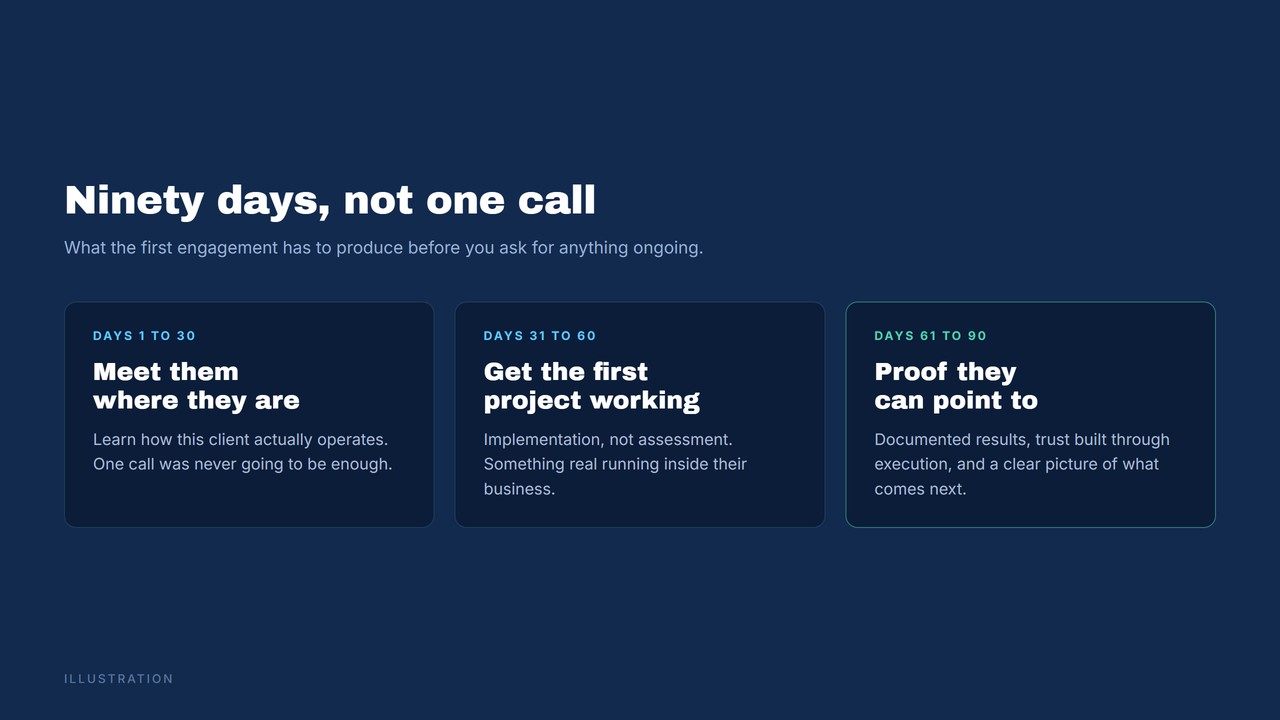
The transition from a one-off project to a long-term partnership requires a structured onboarding process. Industry experts recommend a 90-day engagement arc designed to move the client from skepticism to reliance through tangible execution.
Phase 1: The AI Readiness Audit (Days 1–30)
The first month is dedicated to meeting the client at their current level of digital maturity. This involves auditing existing workflows, identifying bottlenecks that can be solved with automation, and establishing the technical infrastructure. Rather than focusing on high-level strategy, the partner identifies "low-hanging fruit" where AI can provide immediate relief to the team.
Phase 2: The First Functional Implementation (Days 31–60)
The second month focuses on building and launching the first major AI workflow. This is a critical psychological milestone. By moving from theory to a working system—such as an automated CRM lead-scoring tool or an AI-driven content repurposing engine—the partner provides the first "proof of life" for the engagement.
Phase 3: Optimization and Visible Reporting (Days 61–90)
In the final month of the initial arc, the partner focuses on refining the system and, crucially, making the value visible. This involves creating dashboards or reports that quantify the hours saved or the increase in lead volume. By the 90-day mark, the client should have a clear choice: take over the complex maintenance of an evolving system (which they usually don’t want to do) or continue the partnership to scale the results.
Financial Analysis of the Enablement Model
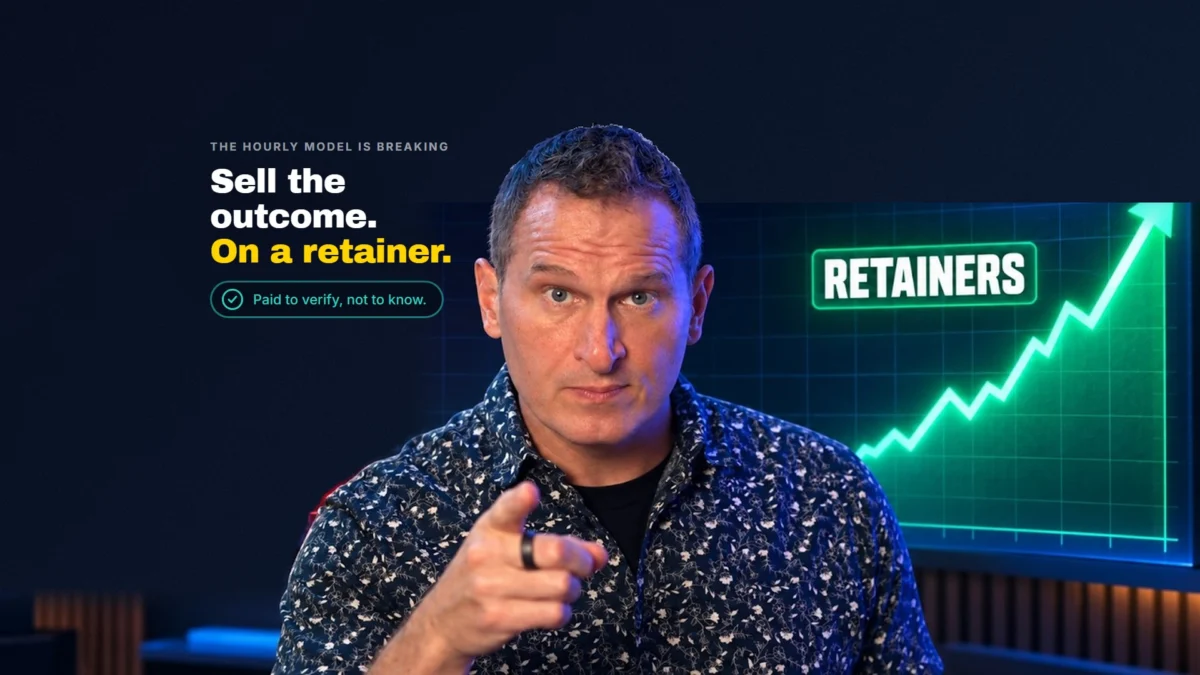
The economics of the AI Enablement Partner model offer a compelling alternative to traditional agency pricing. Because the partner is leveraging AI to do the work that previously required a large team, the profit margins are significantly higher.
Current market rates for fractional AI enablement range from $2,000 to $15,000 per month, depending on the complexity of the organization. A consultant managing a roster of five to ten clients at a median price point of $5,000 per month can generate $300,000 to $600,000 in annual recurring revenue (ARR) with minimal overhead.
| Number of Clients | Monthly Fee | Monthly Revenue | Annual Revenue |
|---|---|---|---|
| 5 | $3,000 | $15,000 | $180,000 |
| 7 | $5,000 | $35,000 | $420,000 |
| 10 | $2,000 | $20,000 | $240,000 |
This model benefits the client by providing a "cost advantage." Projects that once required a $20,000-per-month agency retainer can now be executed through a combination of a fractional partner and AI tools for half the cost, while achieving faster turnaround times.
Broader Implications: The Rise of the "To-Done" List
A significant shift in the consultant-client relationship under this model is the evolution of the "to-do" list into a "to-done" list. In traditional consulting, the professional often leaves the client with a list of recommendations they must implement themselves. In the AI Enablement model, the partner is responsible for the "done" state.
Case studies in the marketing sector show that this creates a compounding effect. For instance, a client may initially hire a partner to build a data dashboard. The insights from that dashboard may reveal a need for a more robust CRM, which the partner then implements. The CRM data may then highlight a need for conversion rate optimization (CRO) on the website. Because each project is built on the AI foundation laid in the previous month, the speed of execution increases over time, making it increasingly difficult for the client to justify switching providers.
Future Outlook and Industry Reactions
The emergence of the AI Enablement Partner coincides with a broader trend toward fractional leadership in the global economy. As companies look to remain lean in an uncertain macroeconomic environment, the ability to "rent" high-level AI expertise rather than "buying" it via full-time hires is becoming an attractive corporate strategy.
Industry analysts suggest that the next two years will see a "great shakeout" among digital agencies. Firms that continue to sell hours and generic AI implementation will likely face commoditization and price wars. Conversely, those who position themselves as accountable partners who stay ahead of the "AI curve" will likely secure the most lucrative and stable contracts.
The long-term upside for consultants is the opportunity for niche specialization. By working through diverse challenges over multiple 90-day cycles, partners often discover specialized applications for AI—such as custom web development or automated supply chain logistics—that define their market position for years to come.
As the AI landscape continues to shift, the message for service providers is clear: the value is no longer in the "build," but in the ongoing enablement of a business that is too busy to keep up with the technology itself. The next ninety days will likely determine which consultants transition into high-value partners and which remain trapped in the cycle of project-based instability.

 Muslim
 Asep Darmawan