

The dynamic and fiercely competitive realm of email marketing demands constant vigilance and adaptation, where merely "good" performance is a perpetually shifting benchmark. The latest DMA (Data & Marketing Association) UK Email Benchmarking Report for 2026, generously sponsored by Validity, provides an indispensable and meticulously detailed analysis of the current state of the channel. This comprehensive report offers critical insights into prevailing industry standards, delineating the pivotal differences that elevate successful email programs to truly exceptional ones, thereby unlocking the substantial revenue growth potential inherent in this vital digital channel.
This year’s report stands out for its robust methodology and unparalleled scope, leveraging aggregated data from six prominent email service providers. This collaborative approach has culminated in the most exhaustive and authoritative overview of email performance across the United Kingdom available to date. For marketers, strategists, and business leaders, the insights contained within this document are not merely statistical observations but actionable intelligence, providing a clear roadmap for enhancing campaign effectiveness and demonstrating tangible return on investment. The full report is accessible for those seeking a deeper dive into the granular data and specific recommendations.
The Positive Trajectory: Headline Numbers and Sectoral Insights
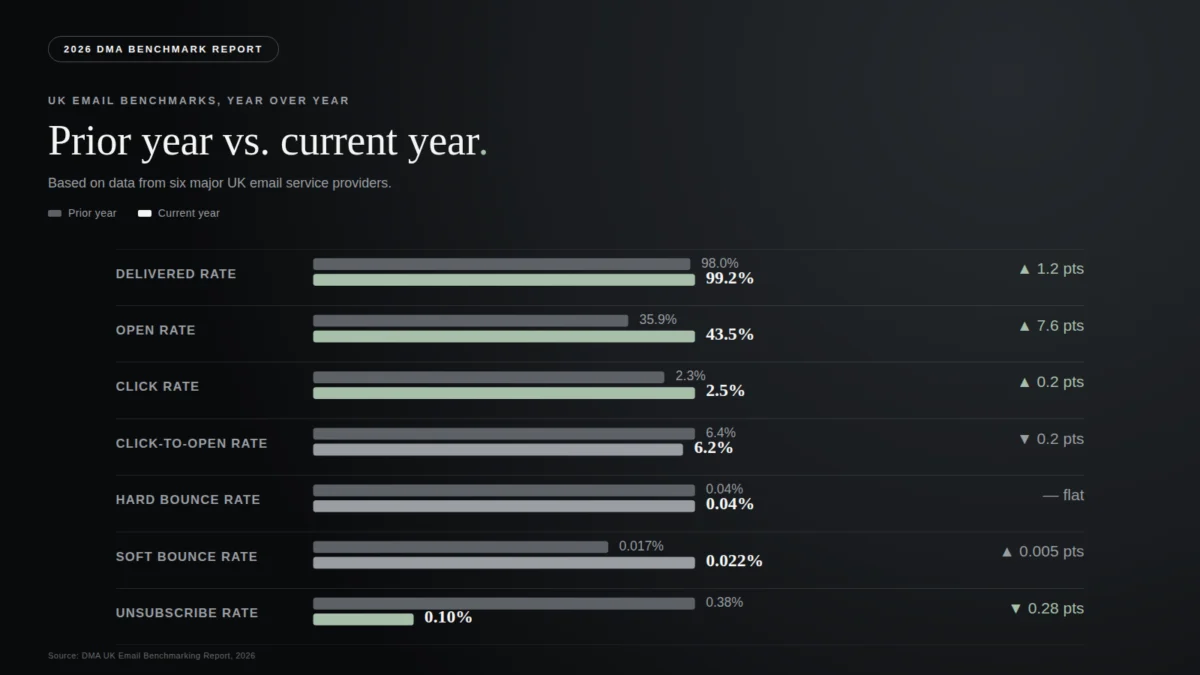
On a macro level, the 2026 report paints an encouraging picture for the email channel, reflecting a generally positive year-over-year trend across key performance indicators. The aggregated data points towards a channel that continues to mature and deliver value, even amidst an increasingly crowded and sophisticated digital marketing ecosystem. This sustained positive trajectory underscores email’s enduring relevance as a direct and highly effective communication medium.
While overall trends are positive, a more granular examination at the sector level reveals significant variances that demand attention. Notably, the retail and travel sectors recorded the lowest click-through rates (CTR), at 1.0 percent and 1.2 percent respectively. This lower engagement in highly competitive consumer-facing industries suggests a need for re-evaluation of content strategies and calls to action, potentially indicating increased user fatigue or the impact of evolving inbox functionalities. In contrast, the Business-to-Business (B2B) sector demonstrated the most remarkable improvement in delivered rates, escalating impressively from 90.7 percent to 95.6 percent. This substantial leap is a clear indicator of enhanced strategic focus within B2B, signifying a sharpened emphasis on sophisticated acquisition techniques, rigorous list hygiene practices, and a commitment to maintaining a high-quality subscriber base. The improvement suggests that B2B marketers are increasingly investing in verifying email addresses, segmenting audiences more effectively, and adhering to best practices to avoid bounces and spam folders, recognizing that a clean list is foundational to effective communication.
These headline figures, while generally positive, serve as more than just a pat on the back for the industry. For revenue-focused leaders, the critical inquiry extends beyond simple metrics to understanding the underlying drivers of these numbers and, crucially, identifying where the most significant opportunities for further optimization and growth reside. The report prompts a deeper dive into the "why" behind the "what," urging marketers to look beyond surface-level statistics to uncover true performance levers.
Delivery is Not Deliverability: The Inbox Placement Imperative
One of the most crucial distinctions highlighted in the report, and often a point of confusion for marketers, is the difference between "delivered rate" and "inbox placement rate" (IPR). A seemingly robust delivered rate of 99.2 percent, while indicating that an email successfully reached the recipient’s mail server, provides no guarantee that it actually landed in the intended inbox. This is where IPR becomes the paramount metric. Inbox placement rate quantifies the percentage of legitimate, permission-based marketing emails that successfully navigate spam filters and other barriers to arrive in the subscriber’s primary inbox. This is the true measure of whether an email investment can convert to revenue, as an email not seen cannot be clicked or acted upon.
Globally, average IPRs hover around 87 percent this year, a sobering statistic implying that approximately one in eight marketing emails, despite being legitimate and permission-based, never reaches its intended destination. The UK average IPR, while historically stronger, has experienced a decline of more than two percentage points, now sitting closer to 91 percent. This decline is attributed to increasingly stringent enforcement of bulk sender requirements by mailbox providers (MBPs). These providers, including industry giants like Microsoft, Google, and Apple, are continuously refining their algorithms and policies to combat spam, protect user privacy, and enhance the inbox experience. Factors such as sender reputation, email authentication protocols (SPF, DKIM, DMARC), content relevance, and engagement metrics all play a critical role in determining inbox placement.
Microsoft, with its substantial market share of roughly 30 percent of UK inboxes (encompassing Outlook, Hotmail, and enterprise Exchange accounts), consistently presents the most challenging environment for email placement. Microsoft’s aggressive filtering mechanisms and enterprise-grade security protocols often lead to higher rates of emails being diverted to junk folders or blocked entirely. For any marketing leader meticulously tracking email ROI, IPR should be the primary metric under scrutiny. A typical sender operating with a 90 percent inbox placement rate immediately stands to gain a double-digit lift in potential revenue simply by improving this single metric, often without needing to allocate additional budget towards content creation, creative design, or audience acquisition. Investing in deliverability tools and expertise can yield substantial, immediate returns by ensuring that marketing messages actually reach their audience.
The Complicated Click Story: AI’s Influence on Engagement
While overall click-through rates have shown only a modest increase, the report uncovers a more profound and complex transformation occurring beneath the surface, largely driven by the pervasive integration of Artificial Intelligence (AI) into daily digital interactions. AI-generated email summaries are becoming increasingly prevalent, surfacing crucial call-to-action links directly within the inbox interface, often before a subscriber has even formally opened the message.
This technological shift presents a dual-edged sword for marketers. On one hand, it can expedite the user journey, potentially driving quicker traffic to landing pages by presenting immediate actionable links. On the other hand, it introduces a significant challenge: senders are now, in essence, ceding the critical "click decision" to an AI’s interpretation of which link or call-to-action is most relevant or important. The AI’s algorithm, not the marketer’s crafted narrative, dictates the primary point of engagement visible at a glance.
This evolving dynamic likely contributes to the seemingly weaker sector numbers observed for retail and travel. It is improbable that these highly sophisticated sectors genuinely experienced a halving of their click performance year-over-year. Instead, a more plausible explanation is that AI summaries and virtual assistants are streamlining the user experience, leading to fewer but potentially higher-intent clicks. Users might be clicking directly on an AI-identified "buy now" or "book trip" link without first engaging with the full email content. This means the real narrative isn’t necessarily one of declining performance but rather an urgent and pressing need for more sophisticated and comprehensive attribution models. Marketers must now adapt their tracking mechanisms to accurately measure these AI-driven interactions, understand their impact on the customer journey, and refine their strategies to ensure their most critical CTAs are easily identifiable and prioritized by these intelligent agents. Without enhanced attribution, the true value of email marketing efforts in this AI-augmented environment risks being significantly underestimated.
The Brand Billboard Effect: Unlocking Value from Inactive Subscribers
A significant revelation from the report addresses a perennial challenge in email marketing: the management of inactive subscriber segments. Virtually every email program harbors a segment of subscribers who have not engaged (opened or clicked) with emails for an extended period, often constituting as much as 50 percent of the total list. Marketers frequently exhibit a natural reluctance to continue mailing to these inactive users, primarily driven by concerns about potential negative impacts on deliverability and sender reputation. The conventional wisdom has often been to suppress or even purge these segments to maintain list hygiene.
However, the report compellingly argues that this reluctance often overlooks a crucial, often underestimated, role of email: its function as a "brand billboard" in the inbox. Even when subscribers do not actively open or click an email, the mere visibility of the sender name and subject line can serve as a powerful, passive brand reinforcement. This subtle exposure maintains brand top-of-mind awareness and can elicit a range of "alternative responses" that are not directly trackable as email engagement metrics. These responses include, but are not limited to, visiting a physical store location, independently checking product reviews online, or navigating directly to the brand’s website through other channels (e.g., search engines, direct URL input).

When these indirect and alternative responses are meticulously factored into the overall revenue equation, the contribution of inactive subscribers becomes surprisingly substantial. The report indicates that these passively engaged segments can account for approximately 25 percent of an email program’s total revenue. This significant contribution is largely driven by brand reputation and recall, rather than direct, measurable email engagement. This finding carries profound implications for list suppression strategies and overall program valuation. It challenges the conventional wisdom that inactive subscribers are merely dead weight. Instead, it suggests that a nuanced approach to segmenting and occasionally re-engaging or simply maintaining visibility with these "brand-aware but unengaged" users could unlock considerable latent value. Marketers must integrate these insights into their overall customer lifetime value (CLV) calculations and develop strategies that acknowledge email’s multifaceted role beyond direct clicks and opens.
Are Opens Still a Useful Metric? Re-evaluating Engagement
The long-standing reliance on open rates as a primary indicator of email engagement is increasingly being questioned and, according to the report, is no longer as useful as it once was. While not entirely obsolete, its utility as a standalone success metric has significantly diminished due to evolving technological landscapes and privacy enhancements.
Zeta Global, a notable contributor to this year’s report, recently published data that starkly illustrates this shift. Their analysis showed unique open rates of 40 percent against a significantly lower "true open" rate of just 11 percent, once mailbox provider inflation and other technical factors were stripped out. This staggering discrepancy implies that roughly three-quarters of recorded opens may not reflect genuine human interaction with the email. The inflated open rates can be attributed to various factors, including email preview panes, security software that pre-fetches images, and, most prominently, privacy features like Apple Mail Privacy Protection (MPP). MPP, introduced by Apple, preloads email content (including tracking pixels) for all users, regardless of whether they actually open the email, thereby artificially inflating open rates for Apple Mail users.
Validity, the report’s sponsor, has observed this phenomenon firsthand. In the first quarter, many of their customers reported considerable drops in Gmail open rates. These declines were primarily explained by changes in Gmail’s image-fetching behavior and general inbox updates, rather than a genuine collapse in subscriber engagement. Crucially, click rates for these same customers remained steady over the identical period, providing strong evidence that subscribers had not disengaged from the content. They were simply being measured differently.
Despite these caveats, open rates still retain some directional value. They remain useful for relative comparisons, such as in A/B testing, where an 80 percent open rate still clearly outperforms a 60 percent open rate for a specific segment under controlled conditions. Furthermore, for Apple-based traffic specifically, an open is only generated when a message has actually achieved inbox placement, making it a proxy for successful delivery to Apple users. However, the overarching recommendation is clear: marketing leaders must cease treating open rate as a standalone, definitive success metric. Its interpretation must be contextualized, and its prominence should yield to more actionable, downstream metrics that reflect true engagement and conversion.
From Testing to Continuous Optimization: The AI-Driven Future
The traditional paradigm of A/B testing, which typically involves isolating and testing one variable at a time over a defined period, is rapidly losing its relevance in the face of exponential advancements in processing power and artificial intelligence. The report highlights a transformative shift towards treating an entire email program as a continuous, dynamic testing environment. In this evolved model, AI algorithms and machine learning capabilities enable the automatic identification and implementation of performance improvements in real-time, eliminating the need for scheduled, sequential test cycles. This allows for constant refinement and optimization, ensuring that campaigns are always performing at their peak potential.
This paradigm shift does not, however, diminish the importance of measurement. Instead, it necessitates a recalibration of what signals are prioritized and tracked. The focus moves beyond simplistic metrics to a more holistic understanding of subscriber behavior and campaign effectiveness. Key signals that should be central to this new measurement framework include:
- Inbox Placement Rates (IPR): The foundational metric ensuring messages reach their destination.
- Click-Through Rates (CTR): Still crucial, but interpreted with a deeper understanding of AI’s influence and requiring advanced attribution.
- Conversion Rates: Tracking actual actions taken after a click, such as purchases, sign-ups, or lead generations.
- Reply Rates: Particularly important for B2B, indicating direct engagement and interest.
- Unsubscribe and Spam Complaint Rates: Negative indicators that signal issues with content relevance, frequency, or list quality.
- Website Traffic from Email: Measuring the direct impact of email campaigns on web visits.
- Time Spent on Content/Page: A qualitative measure of engagement beyond the initial click.
- Customer Lifetime Value (CLV): The long-term revenue generated by a customer, often influenced by consistent email engagement.
- Social Shares and Forwards: Indicating the virality and perceived value of email content.
These diverse signals coalesce to support a newer, more robust Key Performance Indicator (KPI) that warrants presentation to the C-suite: Return on Relationship (RoR). Unlike conventional last-touch attribution models that assign credit solely to the final interaction before a conversion, RoR is designed to track the cumulative impact of ongoing email engagement over time. It encompasses a broader spectrum of interactions, including opens, clicks, repeat purchases, and customer retention. RoR provides a more accurate and profound understanding of whether a sustained history of positive email engagement is effectively building sufficient trust and brand loyalty to make the next message not just opened, but truly valued and acted upon. It shifts the focus from transactional metrics to the long-term strategic value of building enduring customer relationships.
The Bottom Line for Email ROI: Actionable Priorities for Leaders
Translating these critical benchmarks and evolving insights into tangible revenue growth requires strategic focus and a willingness to adapt. For leaders aiming to maximize their email marketing ROI, three overarching priorities emerge from the 2026 DMA UK Email Benchmarking Report:
-
Prioritize Inbox Placement as the Foundational Metric: The absolute first step for any effective email program must be to ensure that messages actually reach the inbox. Marketers must move beyond merely tracking "delivered rates" and actively monitor and optimize their Inbox Placement Rate (IPR). This involves rigorous list hygiene practices, implementing and maintaining robust sender authentication protocols (SPF, DKIM, DMARC), consistently monitoring sender reputation, and understanding the unique filtering nuances of major mailbox providers like Microsoft. Investing in deliverability tools and expertise is not an option but a necessity to secure the foundational element of email marketing success.
-
Rethink Engagement Metrics and Embrace Comprehensive Attribution: The era of relying solely on raw open rates is over. Leaders must adopt a more sophisticated approach to measuring engagement, acknowledging the impact of AI-driven summaries and evolving privacy features. This means focusing on click-through rates with enhanced attribution models that capture AI-mediated interactions, understanding the "brand billboard" effect of passive exposure, and tracking downstream conversions. By embracing multi-touch attribution and analyzing a broader range of signals, marketers can gain a more accurate picture of campaign effectiveness and the true contribution of email to the customer journey.
-
Embrace Continuous Optimization and the Return on Relationship (RoR): The future of email marketing lies in dynamic, AI-assisted continuous optimization rather than static, periodic testing. Leaders should explore and implement technologies that enable real-time adjustments and improvements to email programs. Concurrently, the adoption of Return on Relationship (RoR) as a key performance indicator will provide a holistic view of email’s long-term value. RoR moves beyond immediate transactional metrics to measure the cumulative impact of email on customer loyalty, repeat purchases, and overall brand affinity, offering a more strategic and sustainable framework for evaluating success.
Email remains an incredibly potent channel, capable of driving substantial revenue and fostering deep customer relationships. However, its continued efficacy hinges on a commitment to understanding its evolving landscape, adapting to new technological realities, and focusing on the metrics that truly matter. Programs designed to measure the right things – inbox placement, reply signals, and the strength of customer relationships, rather than just superficial opens and clicks – are the ones that will invariably emerge as the new leaders in subsequent benchmarking reports. Teams leveraging advanced platforms such as Validity Engage are already integrating this philosophy of continuous, AI-assisted optimization into their daily program management, transforming these crucial benchmarks from annual report cards into an ongoing practice of sustained excellence. The future of email marketing success belongs to those who are proactive, data-driven, and relationship-focused.








