The evolving landscape of online retail is being dramatically reshaped by the pervasive integration of artificial intelligence, particularly in how consumers articulate their needs and how marketers can precisely meet them. Traditionally, marketing has revolved around understanding shopper "intent," categorizing it into broad terms like "purchase intent" and "informational intent." These labels have served as the bedrock for targeting potential customers based on their perceived requirements. However, the advent of advanced AI, especially in search and conversational commerce, is injecting an unprecedented level of granularity and sophistication into the concept of intent, opening up vast new avenues for marketers to connect with consumers.
The fundamental shift lies in the nature of consumer queries. Consider the difference between a traditional search engine query and a dialogue with an AI chatbot like Claude, Gemini, or ChatGPT. A conventional search for a coffee grinder might be a succinct "small simple coffee grinder." This brevity, averaging around four words, provides a limited window into the shopper’s true needs. In contrast, a query posed to a conversational AI can be remarkably more detailed and contextual. An apartment dweller seeking a quiet, efficient grinder for pour-over coffee, with minimal mess and limited counter space, might articulate this complex set of requirements in a single, elaborate prompt: "I’m looking for a quiet coffee grinder suitable for a small apartment. It needs to be good for pour-over brewing and easy to clean, without making too much noise in the morning." This extended, descriptive query, which Semrush data suggests can average around 23 words for AI interactions, offers a far richer tapestry of information.
This richer input allows AI to process a deeper understanding of user needs. While both a simple search and a complex AI query might ultimately point towards a conical burr grinder as the optimal solution, the latter query reveals a wealth of unmet needs and specific use-case scenarios. It’s this nuanced detail that presents the significant opportunity for e-commerce marketers. The implications are profound: as AI becomes the primary interface for many consumers discovering and researching products, marketers must adapt their strategies to influence these AI-driven conversations.
The Rise of Product Intent Clusters: A New Paradigm for Content Strategy
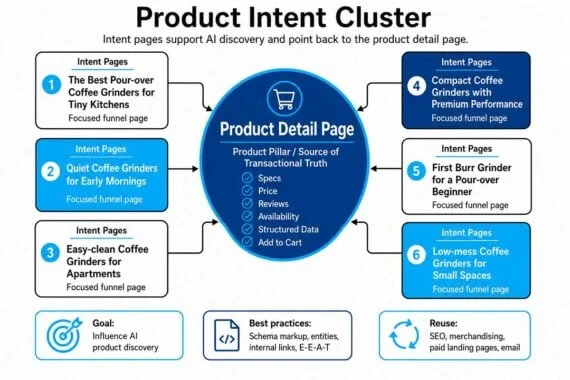
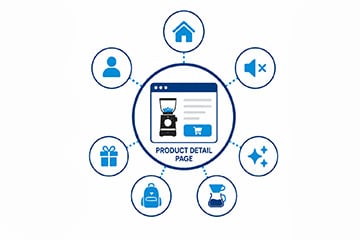
The emerging strategy for effectively engaging with AI-powered search and shopping involves the creation of "product intent clusters." These clusters are not dissimilar in concept to traditional SEO topic clusters, which group related content around a central theme to improve search engine rankings. However, product intent clusters are specifically designed to target information, use cases, and highly specific customer scenarios, all of which collectively guide a shopper towards a particular product. At the heart of each cluster resides the product detail page, serving as the authoritative source for specifications, pricing, reviews, and availability – the ultimate drivers of conversion.
These clusters operate on a hub-and-spoke model. The central hub is the product detail page, which must remain a robust repository of essential purchasing information, meticulously structured for both human readability and machine extractability. The spokes, or supporting content pages, are designed to address the myriad specific intents identified through detailed AI queries. These pages act as educational resources, problem-solvers, and scenario-specific guides. For instance, instead of a generic page on "best pour-over coffee grinders," an intent page within a cluster might be titled "The Best Quiet Coffee Grinders for Tiny Kitchens," directly addressing the detailed requirements of the hypothetical apartment dweller.
The creation of these intent pages is a direct response to the evolving nature of AI interactions. As AI models become more adept at understanding complex natural language, they will increasingly rely on detailed, context-rich content to provide relevant recommendations. E-commerce marketers can proactively influence these AI responses by ensuring their product information is comprehensive, scenario-specific, and linked strategically. This approach mirrors how long-tail keyword optimization previously helped refine organic search rankings, but now applied to the more intricate dialogues facilitated by AI.
Deconstructing the Product Intent Cluster: Beyond Keywords
A well-structured product intent cluster comprises several key components, all designed to comprehensively address a specific shopper scenario and subtly steer them towards a purchase:
- Scenario-Specific Landing Pages: These are the core of the cluster, each meticulously crafted to address a unique customer need or use case. For the coffee grinder example, these might include pages like: "Quiet Coffee Grinders for Early Morning Use," "Compact Coffee Grinders for Small Apartments," "Best Coffee Grinders for Minimalist Kitchens," or "Easy-to-Clean Coffee Grinders for Busy Professionals."
- Problem/Solution Focus: Each page within the cluster should clearly articulate a problem the shopper might be facing and present the product as the ideal solution. This requires deep empathy and understanding of the consumer’s pain points.
- Use Case Demonstrations: Content should go beyond features and highlight how the product functions in real-world scenarios relevant to the specific intent page. This could involve videos, detailed descriptions, or user testimonials.
- Comparative Analysis (Contextualized): While direct comparisons can be tricky, intent pages can subtly highlight how the product excels in the specific context of the page’s focus, without necessarily denigrating competitors. For example, a page on "quiet grinders" might emphasize the low decibel output compared to common grinder types.
- Schema.org Markup and Structured Data: Crucial for AI interpretation, these elements provide machines with clear, organized information about the product and its attributes. This includes product types, features, pricing, availability, and reviews.
- Entity Recognition: Ensuring product attributes and benefits are recognized as distinct entities by AI models is vital for accurate indexing and retrieval.
- Internal Linking Strategy: Seamless navigation between the product detail page and its supporting intent pages, as well as between related intent pages within the cluster, is essential for guiding the user journey and reinforcing the product’s relevance.
- E-E-A-T (Experience, Expertise, Authoritativeness, Trustworthiness): While traditionally applied to SEO, these principles are equally, if not more, important for AI. Content must be demonstrably accurate, well-researched, and attributed to credible sources to gain AI’s trust.
- User-Generated Content Integration: Incorporating relevant reviews, Q&A sections, and testimonials can further bolster the credibility and utility of intent pages, providing AI with authentic user perspectives.
It is critical to emphasize that the product detail page itself should remain focused and not become an unwieldy buying guide. Its primary function is to facilitate a direct purchase decision. However, it can strategically link out to these supporting content pages, thereby enriching the user experience and providing AI with a comprehensive understanding of the product’s value proposition across various contexts.
Navigating Shopping Scenarios with AI-Powered Precision
The effectiveness of product intent clusters hinges on their ability to map directly onto specific shopping scenarios. A query like "best coffee grinders for pour-over" is too broad to be truly actionable for a nuanced AI. A more effective intent page would delve into the user’s specific context, such as "best pour-over coffee grinders for tiny kitchens." This refined query implicitly communicates a set of desires: the need for pour-over quality, limited counter space, a desire for quiet operation, and ease of cleaning.
Each intent page within a cluster should serve as a comprehensive guide, leading the shopper progressively closer to a purchase decision. This involves:
- Defining the Shopper’s Problem: Clearly articulating the specific challenge or need the shopper is trying to address.
- Explaining the Product’s Solution: Demonstrating how the product directly solves that problem.
- Highlighting Key Benefits in Context: Emphasizing the advantages of the product as they pertain to the specific scenario. For example, for a "quiet grinder," the benefit is uninterrupted mornings or not disturbing housemates.
- Providing Actionable Next Steps: Guiding the user towards the product detail page or even directly to a "buy now" option if the intent is overwhelmingly clear.
- Leveraging Visuals: High-quality images and videos that showcase the product in the described scenario can significantly enhance engagement and understanding.
To ensure these intent pages are not only useful for humans but also readily understood and indexed by AI, adherence to traditional SEO best practices, particularly Schema.org structured data markup, is paramount. While the content must be engaging and readable for a human audience, its underlying structure and semantic richness are what empower AI bots to accurately interpret its relevance and value. The goal is to create a vast network of these highly specific intent pages – potentially dozens or even hundreds for a single product – creating a rich, interconnected ecosystem of information that AI can leverage.
The AI Unlock: Democratizing Content Creation for Nuanced Marketing
The true game-changer for product intent clusters is the advent of generative AI. Before this technological leap, the prospect of researching, outlining, writing, optimizing, and meticulously maintaining a multitude of highly specific content pages, such as "the best pour-over coffee grinders for tiny kitchens," was often financially unviable for many e-commerce marketing teams. The labor costs were prohibitive, the potential return on investment too uncertain, and the scope of such an undertaking overwhelming.
Generative AI, however, fundamentally alters this equation. It offers the potential for automated content creation and maintenance at an unprecedented scale. Marketers can now leverage AI to produce a virtually endless supply of high-quality, precisely prompt-engineered intent pages. This automation extends even to the initial discovery of relevant topics. By feeding structured customer feedback, such as support tickets, product reviews, and customer service transcripts, into a generative AI platform, businesses can gain insights into the specific questions, pain points, and nuanced needs of their target audience. The AI can then identify emerging intent patterns and suggest optimal topics for new intent pages.
In essence, when consumers are unsure of their exact needs, they are increasingly turning to generative AI for guidance. Product intent clusters, powered by AI-driven content creation, provide these AI systems with the precise, contextually rich information they need to connect a product with a shopper’s evolving needs and their underlying willingness to purchase. This symbiotic relationship between AI-powered search, nuanced content strategies, and sophisticated marketing automation promises to redefine the future of e-commerce, making hyper-personalized and highly effective marketing accessible to a broader range of businesses. The ability to anticipate and cater to even the most specific shopper desires, facilitated by AI, marks a new era of consumer engagement and conversion optimization.