The rapid adoption of Artificial Intelligence (AI) in marketing departments, initially heralded as a panacea for content creation bottlenecks, is now revealing a significant, often overlooked, cost: the "revision tax." This phenomenon describes the substantial time and resources that marketing leaders and senior reviewers are dedicating to sifting through, editing, and correcting AI-generated content, a task that is paradoxically slowing down workflows and diminishing the very efficiencies AI was meant to provide. While the initial promise of AI centered on faster first drafts and increased output volume, the reality is that the downstream burden of quality control and refinement has become a critical operational challenge, impacting the productivity of top-tier talent and creating a new form of organizational drag.
The genesis of this issue can be traced to the initial business cases for AI implementation. These projections predominantly focused on the upstream benefits: reduced time-to-market for content, increased asset production per capita, and potential cost savings through in-house content generation. What was largely absent from these calculations was the downstream impact – the increased cognitive load and time investment required for human review. As AI tools churn out content at an unprecedented rate, marketing teams are finding that the volume and nature of the output are overwhelming the capacity of their most experienced and trusted reviewers. This creates a bottleneck, as the speed of generation outpaces the speed of critical evaluation, leading to a situation where valuable human expertise is increasingly consumed by the tedious task of refining AI-generated material.
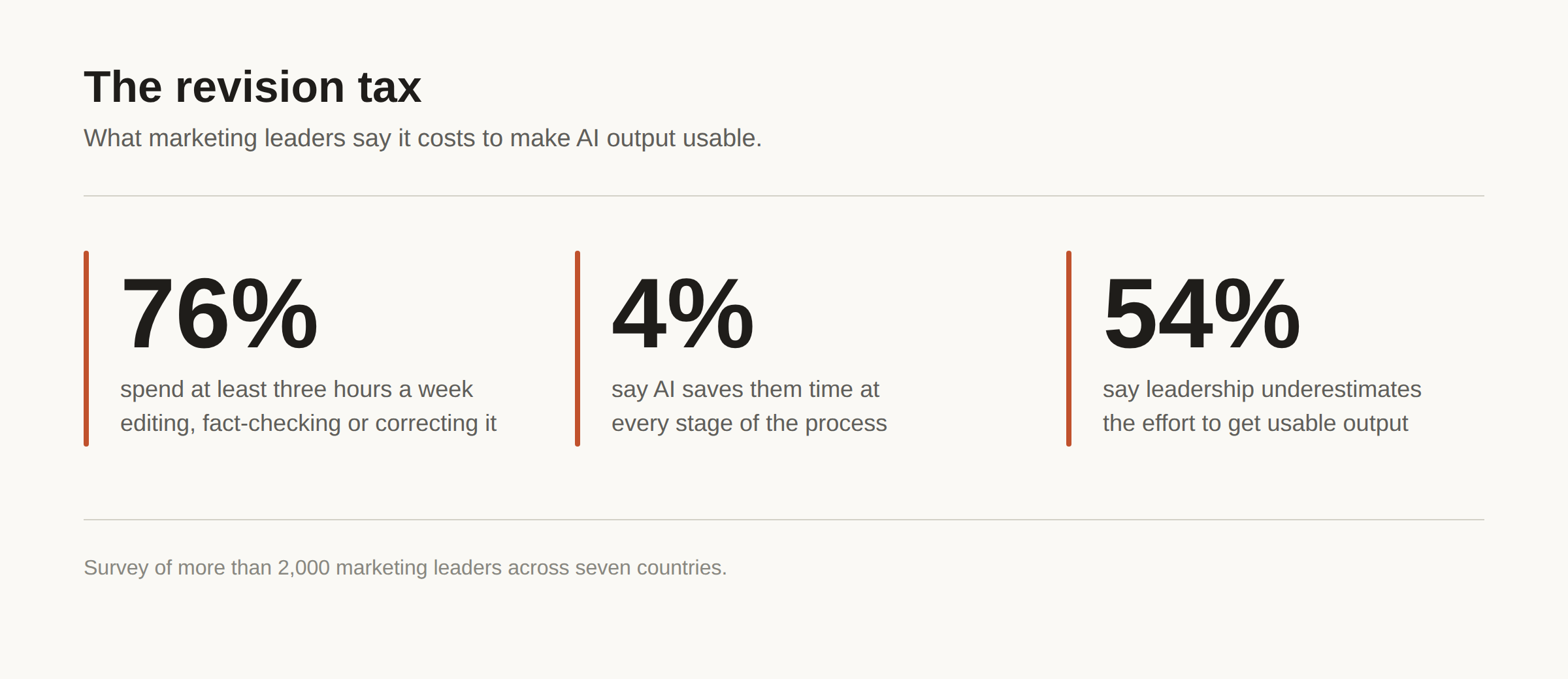
Recent studies have begun to quantify this emergent challenge. A global survey encompassing over 2,000 marketing leaders across seven countries revealed that a staggering 76% of respondents dedicate at least three hours per week to editing, fact-checking, or correcting AI-generated output. Concurrently, only a mere 4% reported that AI consistently saves them time across all stages of the content lifecycle. This data, collected by a company specializing in AI marketing software, lends significant weight to the findings, making it difficult for industry skeptics to dismiss. The survey respondents themselves coined the term "revision tax" to encapsulate this growing burden. Further underscoring the disconnect between perceived and actual AI benefits, 54% of those surveyed indicated that senior leadership often underestimates the genuine effort required to produce usable content from AI tools.
This phenomenon is not confined to marketing. Researchers from Stanford University and BetterUp Labs have provided a more formal definition for the issue: "workslop." This refers to content that appears polished and professionally formatted but lacks substantive insight or original thought, effectively offloading the cognitive heavy lifting back to the recipient. A survey of over 1,000 desk workers indicated that approximately 40% had encountered "workslop" in the preceding month, with each instance costing an estimated two hours of work. Extrapolated across a large enterprise, this inefficiency can translate into significant financial implications, with an estimated monthly cost of $186 per employee, amounting to approximately $9 million annually for a company of 10,000 individuals.
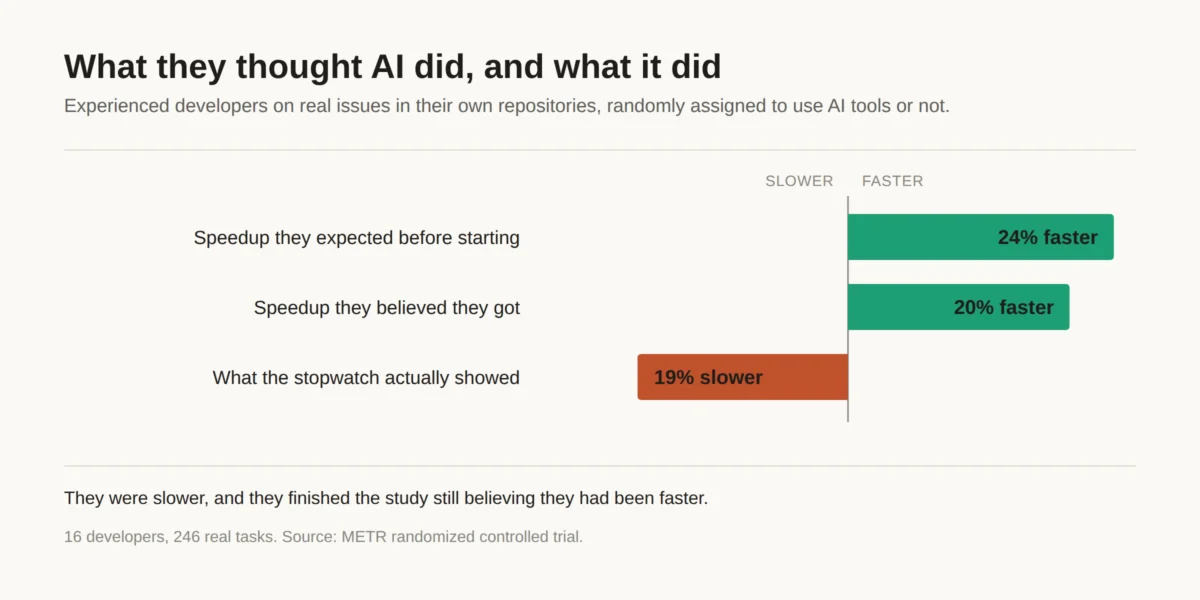
The disconnect between the perceived speed of AI and its actual impact on workflow efficiency was starkly illustrated in a recent randomized study involving experienced software developers. While developers expected AI coding assistants to increase their productivity by roughly 25%, the study found that they actually took 19% longer to complete tasks when using these tools. Perhaps more remarkably, even after experiencing the slowdown, these developers still believed AI had accelerated their work by approximately 20%. This significant disparity highlights a cognitive bias: the immediate, tangible feeling of generated code or text is readily apparent, while the subsequent, less visible, and often outsourced cost of reading, verifying, and refining that output is not adequately accounted for. This omission in the initial AI business case is often attributed to the fact that the individuals generating the content are not always the ones bearing the cost of its review.
The impact of this imbalance is particularly acute in marketing departments, where the volume of AI-generated content can quickly overwhelm review capacities. Consider a team of eight individuals, each producing four AI-generated documents daily – content they might not have even attempted previously. If all this output funnels towards one or two senior reviewers, the bottleneck becomes immense. Operational disciplines consistently demonstrate that accelerating processes upstream of a constraint only serves to lengthen the queue downstream. Marketing, it appears, is continuously rediscovering this fundamental principle. The most senior, most trusted reviewers, those whose critical judgment is most valuable, are becoming the choke points, their roles inadvertently complicated by the AI programs intended to support them.
This situation can lead to the emergence of "hollow experts" – individuals who can produce a remarkable volume of work but lack a deep understanding or the ability to elaborate on its substance. This is a direct pathway to scaling mediocrity. The analogy of a calculator user versus a long-division practitioner is pertinent here. While a calculator user might be faster, their reliance on the tool does not negate the need for them to understand the underlying mathematical principles. Similarly, the user of AI tools must retain the critical thinking and comprehension skills to validate and contextualize the generated output. When writing, which is fundamentally an extension of thinking, is outsourced without proper human oversight, the risk of producing superficially polished but substantively weak content increases dramatically, particularly for strategic documents that require nuanced understanding and foresight.
Addressing this "revision tax" requires a strategic re-evaluation of AI implementation, moving beyond simply optimizing for content generation speed. Several marketing leaders are actively implementing strategies to mitigate this issue without sacrificing the potential benefits of AI:
Reintroducing Accountability at the Source
One of the most effective, albeit direct, strategies involves establishing clear quality control mechanisms at the point of content creation. A marketing leader who has prohibited his team from submitting AI-generated content for his review is essentially enforcing accountability. His directive implies that if the content is not thoroughly reviewed and edited by the original creator before submission, it will not be read by him. This approach directly addresses the accounting problem by ensuring that the cost of review is borne by the individual or team responsible for generating the content. This forces a more considered approach to AI utilization, emphasizing refinement and critical evaluation before dissemination.
Reconciling the ROI Calculation
To build a compelling internal case for AI adoption that accounts for the full picture, organizations must present a unified ROI calculation. This should encompass not only the claimed hours saved in content production but also the actual hours spent by reviewers. Tools like revenue impact calculators, which often focus solely on the upstream production gains, need to be augmented to include a line item for the downstream review effort. This comprehensive approach provides a more accurate financial picture and highlights the true cost-benefit analysis of AI implementation.
Integrating Context Across the Organization
A common issue is that AI-generated content from various departments – sales, product, customer service – often lacks consistent brand voice, positioning, or operational context. When this content lands in marketing for refinement, it requires extensive correction. A proactive solution is to embed essential brand guidelines, positioning, and operational context directly into the AI tools used across the entire company, not just within marketing. This ensures that first drafts, regardless of their origin, are closer to being usable, reducing the downstream editing burden.
Making the Editing Effort Visible
CMOs are increasingly tracking the volume of edits required for content submitted to them. By raising this metric in one-on-one meetings with their teams, leaders can signal the importance of self-review and highlight areas where AI output is consistently falling short. This is not intended as a punitive measure but rather as an indicator of the level of scrutiny and refinement needed before content is passed on. It encourages team members to take greater ownership of the quality of their AI-assisted work.
Prioritizing Pain Points for AI Application
Instead of broadly accelerating all content creation processes, a more effective approach is to first identify and address existing pain points. Leaders are convening their teams to pinpoint processes that are underperforming or causing significant frustration. AI is then strategically applied to solve these specific, well-defined problems. This targeted approach ensures that AI is used to improve areas that genuinely need enhancement, garnering buy-in from stakeholders who are already experiencing the negative consequences of inefficient processes. By starting with existing complaints, the political hurdles of implementing new technology are often reduced.
The Importance of Orchestration
Ultimately, overcoming the "revision tax" is an exercise in organizational orchestration. This involves meticulously designing workflows, defining intake processes, clarifying ownership, and establishing clear communication channels for context. For instance, a 200-person marketing team that had previously struggled with AI implementation successfully restructured its operations. This involved creating a single intake point for all requests, establishing trackable Service Level Agreements (SLAs), and implementing capacity planning that the execution teams could reliably follow. While these operational adjustments may not be glamorous, they are crucial for transforming a team that has merely increased its speed into one that is accelerating the right things.
In an era where AI can produce content at an unprecedented scale, the true differentiator for marketing teams will not be the sheer volume of output, but the ability to consistently deliver defensible, high-quality work. The challenge ahead lies in ensuring that AI serves as a tool to augment human judgment and strategic thinking, rather than a mechanism for scaling mediocrity. The successful integration of AI will depend on recognizing and actively managing the downstream costs of content refinement, thereby empowering marketing leaders and their teams to harness AI’s potential for genuine, sustainable, and strategically sound growth.