

The digital landscape is undergoing a seismic shift, the likes of which haven’t been seen in over two decades. The global rollout of Google’s AI Overviews, coupled with the burgeoning everyday integration of large language models (LLMs) into search behavior, has sent ripples of anxiety through the marketing community. Headlines heralding the "death of SEO," the "collapse of organic traffic," and the "end of the click" have become ubiquitous, painting a picture of an industry in crisis. While some of these pronouncements hold a kernel of truth, many mistake a fundamental evolution in user behavior for the demise of a vital marketing channel. To understand the true impact, a comprehensive analysis of real-world data is crucial, moving beyond isolated anecdotes to grasp the macro trends shaping the future of search.
A robust study analyzing Google Analytics 4 (GA4) data across 54 clients, spanning 19 diverse industries and multiple global markets, offers a critical lens. This research meticulously compared the eight months preceding the widespread adoption of AI Overviews with the eight months following. The goal was to move beyond individual website performance and understand how search behavior is evolving at a portfolio scale, and more importantly, to derive actionable insights for SEO strategies moving forward. The findings confirm that organic traffic is indeed under pressure, but they also illuminate a significant, often overlooked, development: artificial intelligence is fostering a new discovery channel with users exhibiting distinct behaviors compared to traditional search engine visitors. This crucial distinction has profound implications for how marketers define and measure success in the AI-driven era.

The Tangible Impact: Organic Traffic Under Pressure
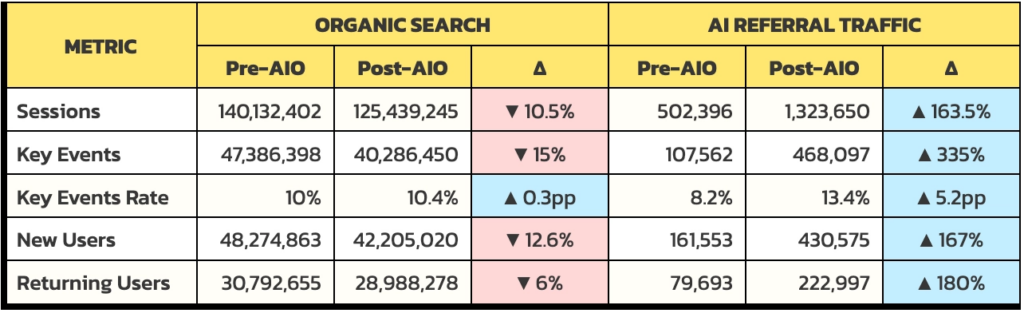
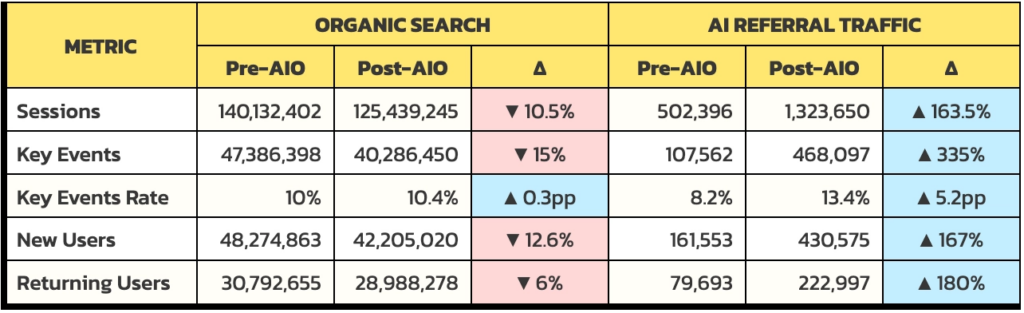
The data presents a clear and compelling narrative: organic traffic is experiencing a noticeable decline. Across the analyzed client portfolio, organic sessions saw a decrease of 10.5%, falling from an average of 140.1 million sessions in the eight months prior to September 2025 to 125.4 million sessions in the subsequent eight months. This trend was remarkably consistent, with a significant majority – 46 out of the 54 clients studied – recording a dip in organic traffic during the same comparative period. The selection of September 2025 as the inflection point for this analysis is rooted in the observation that by this date, approximately 30% of U.S. desktop searches were triggering AI Overviews, marking a significant shift in search engine results pages (SERPs).
This decline is a direct reflection of a fundamental alteration in how individuals engage with search engines. AI-generated answers are increasingly capable of satisfying informational queries directly within the search interface, often obviating the need for users to navigate to external websites. Instead of piecing together information by clicking through multiple links, users are now frequently presented with a synthesized, comprehensive response at the top of the page. As these AI-generated summaries become more sophisticated and complete, fewer searches naturally culminate in a website visit.
It is imperative to clarify that this trend does not signify the obsolescence of Search Engine Optimization (SEO). Rather, it signifies a profound transformation in the user journey from posing a question to visiting a website. While traditional SEO metrics remain valuable for understanding what happens after a user clicks through, they offer a progressively limited view of the growing segment of users whose research begins and concludes within an AI-generated response. This shift necessitates a re-evaluation of what constitutes search success.
The Rise of AI Referral Traffic: A New Discovery Layer
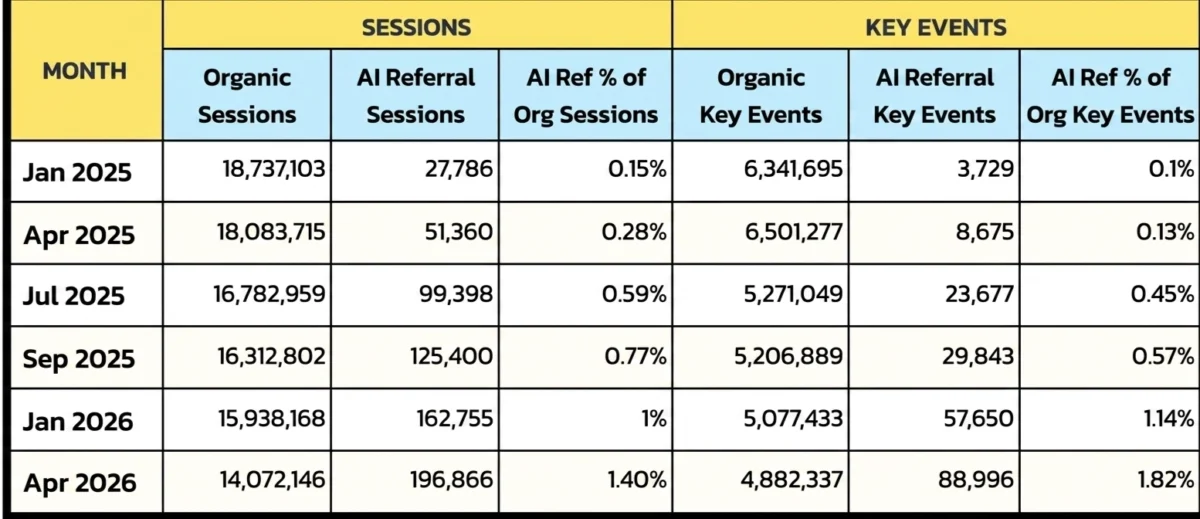
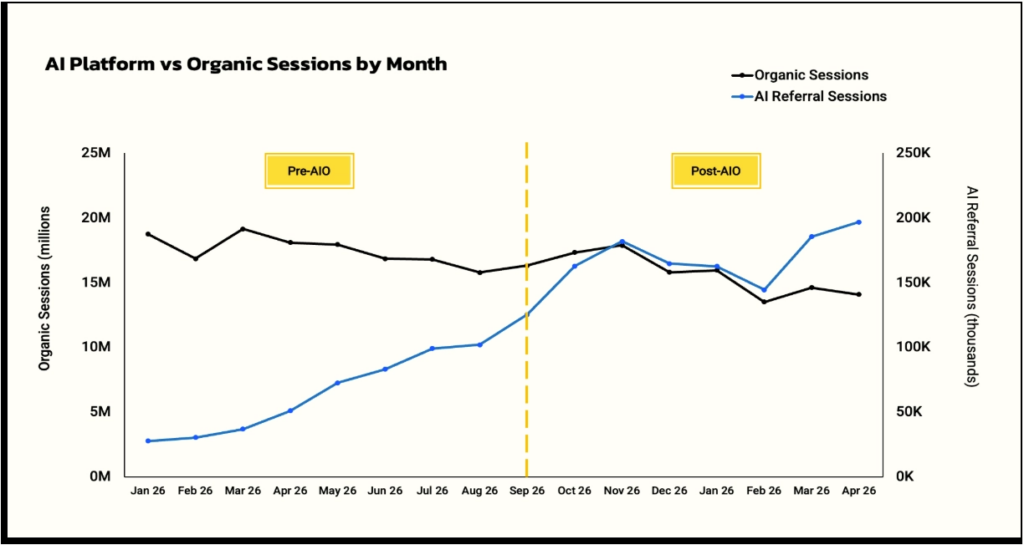
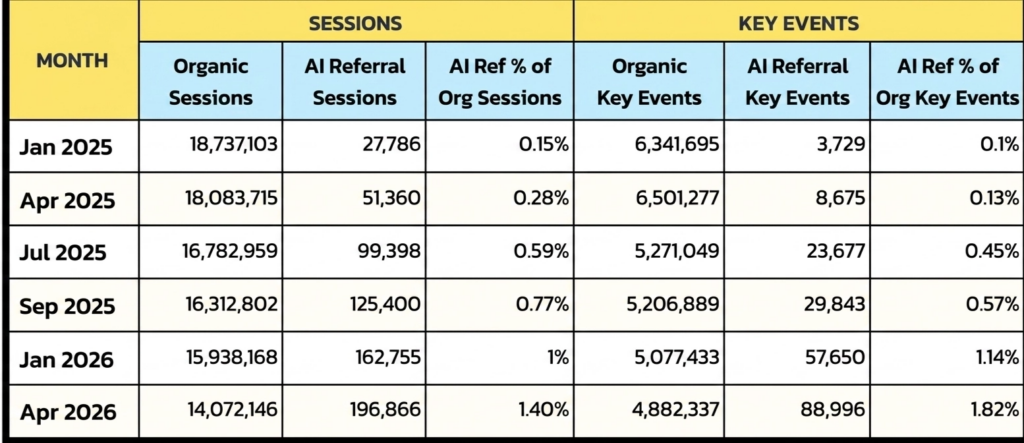
The conversation surrounding the impact of AI on search often becomes oversimplified, particularly concerning the notion that AI referrals are simply replacing lost organic traffic. The reality is more nuanced. AI referral traffic is experiencing explosive growth. Over the same comparative period, sessions originating from AI platforms surged by an astonishing 163%, with AI-driven key events increasing by an even more dramatic 335%.
However, despite this rapid ascent, AI referral traffic, in absolute terms, remains relatively modest. While organic traffic experienced a deficit of nearly 14.7 million sessions across the dataset, AI referrals accounted for an increase of just under 800,000 sessions during the same timeframe. This means that AI referrals are currently offsetting only approximately 5% of the lost organic traffic. This critical distinction highlights that AI platforms are not directly supplanting Google search traffic on a one-to-one basis. Instead, they are emerging as an additional, nascent layer within the broader discovery journey.
For marketers, this underscores the importance of resisting two equally misleading narratives: the first, that SEO is defunct due to declining traffic, and the second, that AI referrals will seamlessly fill the void left by lost clicks. The empirical data supports neither of these conclusions. Search is evolving into a more fragmented ecosystem where brands must strive for visibility not only within traditional search results but also within AI-generated answers. Achieving success in this new paradigm requires a strategic approach that acknowledges and adapts to this distributed discovery model.
Understanding the AI Visitor: A Different Kind of Engagement
While the current volume of AI referral traffic may be smaller, the quality of these visitors represents arguably the most compelling finding of the analysis. Across the post-AI Overview period, users arriving via AI platforms consistently demonstrated higher key event rates compared to those originating from organic search. AI referral traffic achieved a key event rate of 13.4%, a notable increase from the 10.4% recorded for organic search. By April 2026, this divergence had widened further, with AI referrals converting at a rate approximately 1.5 times higher than traditional organic visitors.
This disparity is not necessarily indicative of AI traffic being inherently "better" in a qualitative sense. Instead, it suggests that these users may arrive at websites having already completed a more substantial portion of their research and decision-making process. AI-generated answers appear to be facilitating a deeper understanding of products, enabling more effective comparison of options, and building greater confidence before a user ultimately chooses to click through to a brand’s website.
In essence, AI seems to be influencing not only how users discover brands but also when they choose to engage with them directly. The click is increasingly occurring later in the decision-making funnel, after a significant amount of initial exploratory work has already been undertaken. For marketers, this fundamentally alters the interpretation of performance data. Measuring traffic volume alone provides an increasingly incomplete and potentially misleading picture of overall search performance. The focus must shift towards understanding the user’s journey and the value generated at each stage, including the significant interactions that occur before a click.
The Evolving AI Ecosystem: Not All Platforms Are Created Equal
The growth in AI referrals is also characterized by a dynamic and diversifying mix of platforms. ChatGPT continues to be the dominant source of AI referral traffic within the analyzed dataset, accounting for the vast majority of AI-driven sessions and demonstrating consistent improvement in its key event performance over time. While other platforms, such as Claude, Gemini, and Microsoft Copilot, are also experiencing growth, they are doing so from considerably smaller initial bases.
This observation reinforces a critical point: AI search is not a monolithic entity. Instead, discovery is becoming distributed across a multitude of distinct AI experiences. Each of these platforms possesses its own unique audience behaviors, citation patterns, and referral dynamics. Consequently, optimizing for AI cannot be a singular strategy aimed at one platform. Brands must increasingly focus on ensuring consistent representation and visibility across the broader AI ecosystem, understanding that each AI interface offers a unique touchpoint for potential customers. This necessitates a granular approach to understanding which AI platforms are driving valuable traffic and how to optimize content and presence accordingly.
The Next Frontier: Redefining SEO Measurement in the AI Age
Perhaps the most profound takeaway from this extensive analysis extends beyond the observed trends in declining sessions or burgeoning AI referrals. It lies in the realization that the traditional SEO measurement framework, while still relevant, is no longer sufficient on its own. Standard SEO metrics can effectively track whether traffic volume is increasing or decreasing. However, they fall short in revealing whether a brand is gaining or losing ground within the AI-generated answers themselves – the citations, summaries, and recommendations that often never result in a direct click. This represents a significant measurement gap, making the current analysis, which is exclusively based on GA4 session data, only the first half of a more comprehensive picture.
The crucial missing piece is "AI visibility": the extent to which a brand is mentioned, cited, or recommended across various AI platforms. This also encompasses how third-party coverage, online reviews, video content, and social media engagement contribute to a brand’s presence and perceived authority within the AI landscape. It is entirely possible for a brand to be experiencing a decline in organic sessions while simultaneously increasing its visibility and positive representation within AI-generated answers, or vice versa. Traffic data alone cannot differentiate between these scenarios.
The practical implication for brands and their SEO teams is a fundamental shift in approach. AI referral traffic should no longer be treated as a minor footnote or a rounding error in search reports. Instead, it must be tracked with the same rigor and dedication as any other established marketing channel. This means analyzing its unique sessions, its distinct conversion rates, its evolving platform mix, and monitoring these metrics over time, crucially alongside AI visibility signals. Many teams are already capturing elements of this data. The next essential step is to consolidate these efforts into a consistent, integrated measurement framework. This will enable investment decisions, content development strategies, efforts to strengthen entity data, and the prioritization of third-party authority to be grounded in the reality of where AI platforms are directing attention, rather than solely relying on historical data from where Google search once did. This evolution is not merely an adjustment; it is a necessary adaptation for sustained success in the rapidly transforming world of digital discovery.









