


Email, a steadfast pillar of digital communication, continues to defy predictions of its demise, yet a significant chasm is rapidly forming between organizations that proactively invest in robust measurement, deliverability, and optimization strategies and those that operate on outdated assumptions. This critical insight emerges from Sinch Mailgun’s comprehensive 2026 Email Impact Report, released on April 17, 2026, offering a timely roadmap for email senders navigating the evolving digital landscape in the latter half of the year.
The report, a pivotal annual publication for the industry, is distinguished by its robust methodology, drawing from a global survey encompassing over 1,200 email senders and, uniquely, an analytical deep dive into more than 400 billion real emails transmitted through Sinch Mailgun’s infrastructure throughout 2025. This dual approach provides an unprecedented, data-backed perspective on the state of email marketing and transactional communications, moving beyond self-reported metrics to reveal the true operational benchmarks and challenges. Across its five insightful chapters, the report meticulously examines critical areas including return on investment (ROI), industry-specific benchmarks, the intricate dynamics of deliverability, the accelerating adoption of artificial intelligence (AI), and prevailing investment trends, offering actionable intelligence for marketers and technologists alike.
The Enduring Value of Email: A Call for Evidence-Based Investment
The intrinsic value of email within organizational strategies remains undeniable. A compelling 78% of senders surveyed articulate email’s importance as either "very" or "extremely" high to their respective organizations. This remarkable level of internal consensus is a rare commodity for any marketing channel, underscoring email’s foundational role. However, a significant disconnect persists between this organizational belief and tangible organizational evidence.
Despite email’s perceived importance, fewer than half of senders actively measure the ROI of their email programs. Specifically, only 46% track the ROI of promotional emails, and an even lower 43% do so for transactional communications. This stark reality indicates that a substantial majority of teams are operating on conviction, driven by anecdotal success or historical precedent, rather than concrete data. Such an approach, while perhaps sustainable in a less competitive environment, is increasingly precarious in a landscape where every marketing dollar is scrutinized for its demonstrable return.
For those organizations that do meticulously measure their email ROI, the findings are unequivocally positive, often yielding impressive returns. The report highlights that 60% of senders who track promotional email ROI report returns exceeding $10 for every $1 spent. Even more strikingly, 13% of these senders achieve an ROI greater than $40 for each dollar invested. Similar trends are observed in transactional email, with 62% of measuring senders reporting an ROI above the $10:1 threshold, and 13% also reaching the coveted $40:1 mark. Interestingly, Sinch Mailgun’s research posits that such exceptionally high returns (exceeding $40:1) might, counterintuitively, signal potential underinvestment in email programs. This suggests that businesses achieving such high returns could likely allocate more resources to email and still maintain a robust ROI, thereby expanding their reach and impact even further.
The primary impediment to increasing email investment, as cited by 43% of senders, is budget constraints. Yet, the report shrewdly observes a cyclical problem: securing additional budget is inherently challenging without compelling data to justify the expenditure. Many teams find themselves in a self-perpetuating loop, unable to collect the necessary data to make a strong business case for increased funding. To break this cycle, the report advocates for an intermediate, practical step: beginning with the measurement of revenue per campaign. Even if the initial attribution model isn’t perfectly refined, this foundational metric provides a tangible starting point for demonstrating value and building a data-driven culture that can eventually support more sophisticated ROI tracking.
Benchmarking Reality: Unveiling Performance Across 400 Billion Emails

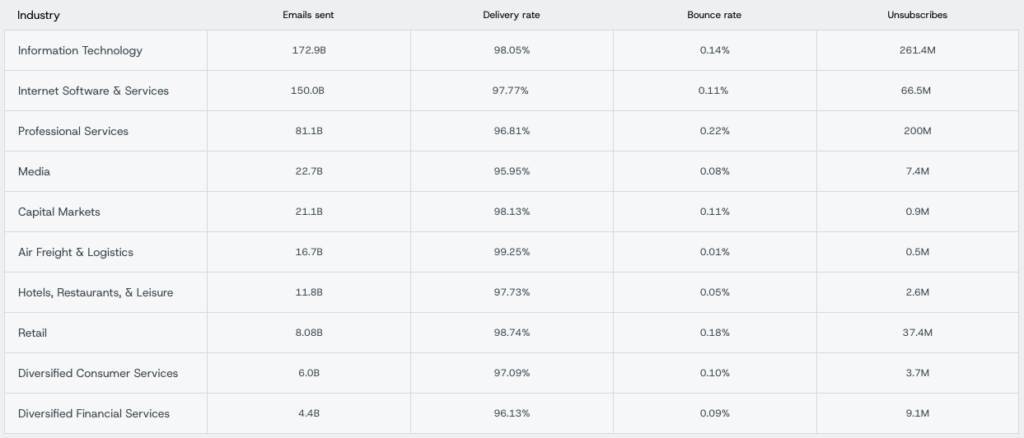
One of the report’s most groundbreaking contributions lies in its departure from conventional, often subjective, benchmark data. Traditionally, industry benchmarks have relied heavily on surveys and self-reported estimates, which can be prone to inaccuracies or aspirational reporting. Chapter 2 of the 2026 Email Impact Report adopts a radically different and more authoritative approach: analyzing real sending data from Sinch Mailgun’s vast infrastructure across the top 10 industries by email volume in 2025. This unprecedented scale of 400 billion emails provides an authentic, granular view of where performance metrics truly stand.
The disparities across industries are illuminating. Air Freight & Logistics consistently leads with an impressive 99.25% delivery rate and a minuscule 0.01% bounce rate. This exceptional performance is largely attributable to the highly transactional nature of their communications, such as shipping confirmations and tracking updates, which are eagerly anticipated and actively desired by recipients. In stark contrast, the Media industry registers the lowest delivery rate among the top 10, at 95.95%. This difference is primarily due to the high volumes and broad promotional audiences characteristic of media companies, which naturally exert downward pressure on deliverability metrics as they contend with more aggressive spam filters and varied subscriber engagement.
However, the report issues a critical caveat: delivery rate alone can be a misleading metric. An email "delivered" to a recipient’s spam or junk folder still technically counts as "delivered" by many email service providers. This nuance underscores the report’s clear recommendation that senders must complement delivery rate tracking with dedicated inbox placement testing. This proactive measure provides a true understanding of where emails are actually landing – whether in the primary inbox, promotions tab, or spam folder – offering a far more accurate gauge of message visibility and potential engagement.
The analysis of unsubscribe rates further highlights the necessity of contextual data. Information Technology, for example, recorded the highest raw number of unsubscribes at 261 million. However, when contextualized against its monumental sending volume of 172.9 billion emails, this translates to a relatively low unsubscribe rate of approximately 0.15%. Conversely, the Retail sector generated 37.4 million unsubscribes on a much smaller volume of 8.08 billion sends, resulting in a significantly higher unsubscribe rate per email. This comparison unequivocally demonstrates that raw unsubscribe volume, without the crucial context of send volume, is an utterly meaningless metric for assessing audience health or content relevance.
Deliverability: Progress in Infrastructure, Stagnation in Understanding
Deliverability, the ability of an email to reach its intended inbox, is universally acknowledged as a cornerstone of email program success, with 89% of senders affirming its importance to their organizations. Encouragingly, 43% of senders report an improvement in their inbox placement over the last 12 months, signaling genuine progress in the underlying email infrastructure. This advancement is largely driven by the significant growth in DMARC (Domain-based Message Authentication, Reporting & Conformance) adoption, spurred by stringent requirements from major email providers like Gmail, Yahoo, and Microsoft. For the first time in Sinch Mailgun’s research history, DMARC enforcement policies (quarantine or reject) are now outpacing passive monitoring, with over half of DMARC adopters actively using these stronger measures to protect their domains from phishing and spoofing. The adoption rates of DMARC have shown a steady increase, rising from 43% in 2023 to 54% in 2024, and reaching 61% in 2025, reflecting a growing industry commitment to email security and authenticity.
Despite these vital infrastructure improvements, a concerning knowledge gap persists among email senders. A substantial 36% of senders claim to monitor their "email deliverability rate," a metric that, as the report correctly points out, does not technically exist. This confusion often conflates the delivery rate (emails accepted by the server, regardless of folder) with true inbox placement (emails reaching the primary inbox). Only a quarter (25%) of senders actively run inbox placement tests to ascertain where their emails are truly landing, leaving a vast majority in the dark about the actual visibility of their communications. Furthermore, a significant 27% of DMARC users are unaware of the specific policy they have implemented for their domain. This indicates a worrying discrepancy: while the tools and protocols designed to enhance email security and deliverability are improving and becoming more widespread, the fundamental literacy and understanding of how to effectively utilize and interpret them have not kept pace. This knowledge deficit represents a critical vulnerability, hindering organizations from fully leveraging the benefits of advanced email authentication and optimization.
AI Adoption: Widespread Experimentation, Uneven Impact
The transformative potential of Artificial Intelligence is undeniably reaching the email marketing sphere, with a striking 79% of senders either currently utilizing or planning to integrate AI into their email programs. However, the report reveals that actual regular, systematic use stands at a modest 27%, indicating that a significant portion of adopters are still in the experimental phase rather than having fully embedded AI into their core workflows.
The most prevalent application of AI is for copy generation, cited by 41% of senders. This is followed by content personalization (36%), dynamic content creation (29%), send time optimization (27%), and data analysis (27%). This pattern illuminates a clear trend: AI delivers its most substantial value when it is deeply integrated into decision-making processes, rather than being confined solely to content production. Teams that leverage AI for sophisticated tasks such as personalization, precise send timing, and comprehensive testing report compounding returns, observing sustained improvements in engagement and conversion metrics. Conversely, teams that restrict AI’s role to more superficial tasks, such as merely drafting subject lines or basic copy, tend to see a far more limited impact on their overall program performance.
A compelling data point underscores this disparity: 54% of senders who have actively implemented AI report that their email programs improved moderately or significantly year-over-year. In stark contrast, only 37% of senders who are not using AI observed similar improvements within the same timeframe. This 17-point performance gap is the clearest signal yet that AI is beginning to stratify email programs into distinct performance tiers, creating a competitive advantage for those who embrace it strategically. While this correlation does not definitively prove causation, the consistent direction of the trend strongly suggests AI’s role as a performance differentiator.
The report also acknowledges that 23% of AI users claim it has not provided any discernible help. This finding is crucial, as it indicates that the tool itself is not the sole determinant of success. Rather, the depth and strategic integration of AI into existing workflows and overarching email strategies are what truly differentiate those who see value from those who do not. Simply adopting AI without a clear understanding of its application and integration points will yield minimal returns.
Future Investment: Prioritizing Engagement and AI Integration
Looking ahead to 2026, the top priorities for email senders are clearly defined. "Taking advantage of AI" and "increasing email engagement" are tied as the foremost strategic objectives, each cited by 40% of senders. This dual focus underscores a collective recognition that leveraging advanced technology is intrinsically linked to fostering deeper, more meaningful interactions with subscribers.
In terms of budgetary allocation, the outlook remains cautiously optimistic. A solid 31% of organizations plan to increase their email investment, reflecting confidence in the channel’s continued efficacy and potential for growth. The largest segment, 48%, intends to maintain their current spending levels, signifying stability rather than stagnation. A smaller, but notable, 7% plan to decrease their email investment, likely representing organizations struggling with ROI measurement or facing broader budget cuts.
The overarching conclusion of Sinch Mailgun’s 2026 Email Impact Report is unequivocal: email works. The extensive data analysis, spanning ROI figures, industry benchmarks, and deliverability trends, robustly supports this assertion. However, the report’s most salient takeaway is that future success will not be uniformly distributed. The email programs poised to truly excel and pull ahead of the competition are those that commit to simultaneous, integrated investment across three critical domains: measurement, deliverability, and optimization.
- Measurement: This involves moving beyond mere conviction to proving ROI with real, attributable data, enabling informed decision-making and justified budget allocation.
- Deliverability: This entails consistently ensuring emails reach the inbox through rigorous authentication protocols (like DMARC), diligent list hygiene, and proactive monitoring of inbox placement, not just delivery rates.
- Optimization: This encompasses the strategic use of advanced tools, particularly AI, alongside continuous A/B testing, to refine content, personalize experiences, and improve performance at scale.
Crucially, none of these essential areas demand a massive upfront budget to initiate. The report emphasizes that even small, consistent investments in these foundational practices will compound over time, yielding exponentially greater returns and establishing a sustainable competitive advantage in the ever-evolving world of email communication. As the digital landscape becomes increasingly crowded and complex, the distinction between data-driven excellence and assumption-based stagnation will only sharpen, making the insights from the 2026 Email Impact Report an indispensable guide for all serious email practitioners.








