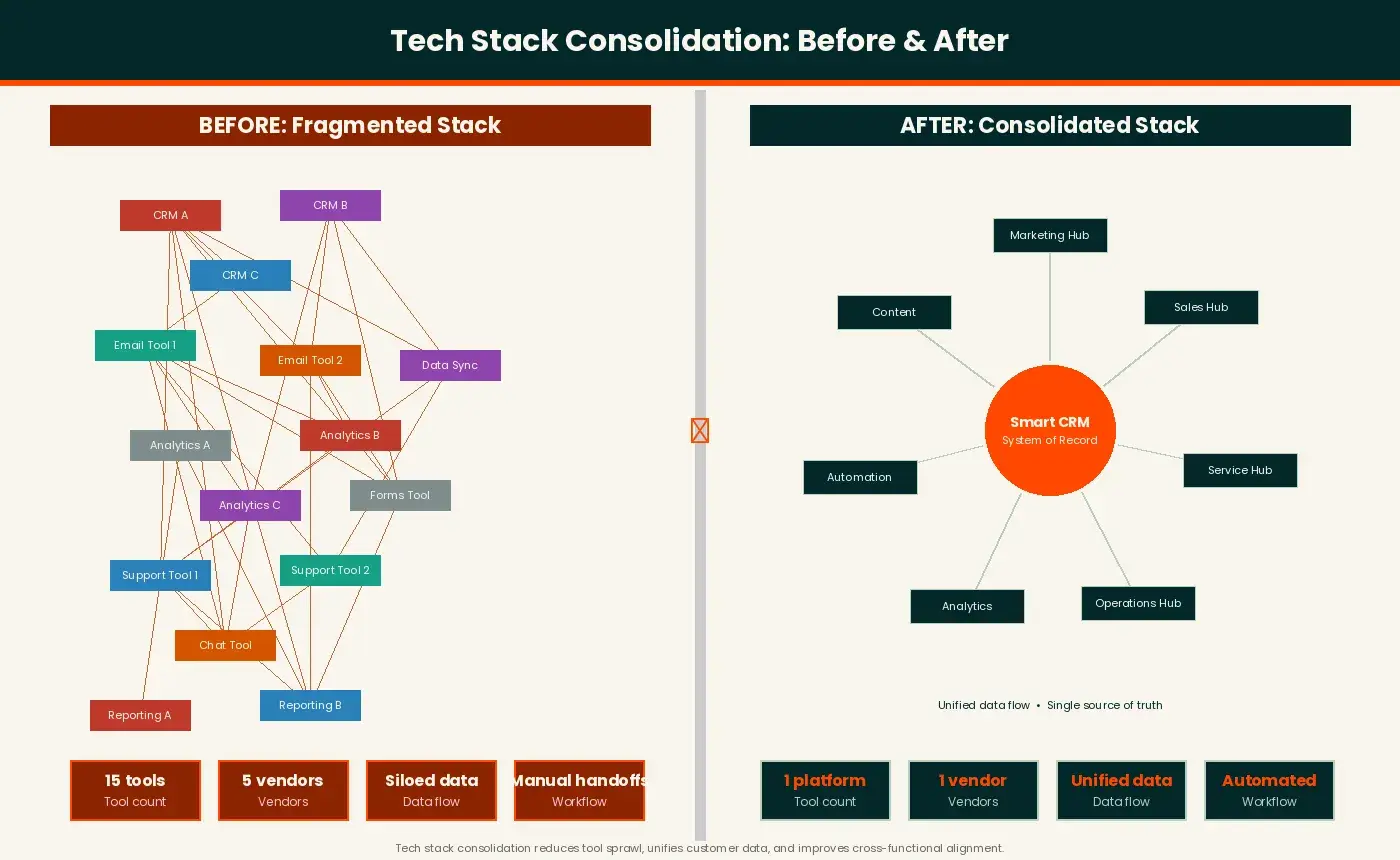
Tech stack consolidation represents a critical strategic initiative for organizations aiming to streamline operations, enhance data integrity, and deliver superior customer experiences by reducing their software footprint and standardizing on a more integrated set of systems. This process extends far beyond mere cost-cutting; it fundamentally re-architects how businesses manage their digital tools to foster seamless data flow, automate intricate customer journeys, and eliminate the pervasive challenge of rebuilding context across disparate departmental functions. At its core, successful consolidation often hinges on establishing a robust Customer Relationship Management (CRM) system as the singular system of record—a centralized platform that houses all customer data, powers essential workflows, and serves as the undisputed source of truth for every team interacting with the customer lifecycle.
The Rise of Tool Sprawl: A Modern Business Challenge
The proliferation of Software-as-a-Service (SaaS) solutions over the past two decades has undeniably revolutionized business operations, offering specialized tools for virtually every function imaginable. While this abundance initially promised unprecedented agility and tailored capabilities, it has inadvertently led to a phenomenon known as "tool sprawl" or "SaaS sprawl." Businesses, in their eagerness to adopt best-of-breed solutions, often accumulate a fragmented collection of applications, many of which overlap in functionality or exist in isolation, creating significant operational friction.
Industry data consistently highlights the scale of this issue. According to a 2023 report by Okta, the average enterprise now deploys 130 SaaS applications, a figure that has steadily climbed year-over-year. Smaller businesses, while using fewer applications, often face a proportionally higher overhead per tool. This unmanaged growth leads to a multitude of challenges:
- Data Silos: Information becomes fragmented across disconnected systems, making it nearly impossible to gain a holistic view of customer interactions or business performance. For instance, marketing data might reside in one platform, sales data in another, and service interactions in a third, leading to inconsistent reporting and conflicting definitions of key metrics like "active customer."
- Integration Debt: The need to connect numerous disparate tools often results in complex, fragile, and costly custom integrations that require constant maintenance. A Gartner survey indicated that IT departments spend a significant portion of their budget on maintaining existing systems rather than innovating.
- Security Vulnerabilities: A larger attack surface is created by an increased number of applications, each requiring its own security protocols, access management, and patching. Shadow IT—unapproved software purchases by individual departments—exacerbates this risk.
- Operational Inefficiencies: Employees waste valuable time toggling between applications, manually transferring data, or attempting to reconcile conflicting information, diverting focus from higher-value, customer-facing activities. This friction directly impacts productivity and employee morale.
- Fragmented Customer Experience: When internal teams lack a unified view of the customer, interactions become disjointed. Customers are often forced to repeat information, leading to frustration and a diminished brand perception.
Gartner’s analysis further underscores that despite the push for consolidation, overall software spending continues to climb. This suggests that the primary returns from consolidation are not merely direct cost reductions, but rather the strategic reinvestment of operational gains—better data quality, faster workflows, fewer integration failures—into enhanced execution and superior customer outcomes.
Strategic Imperatives: Why Consolidation Matters Now
In today’s competitive landscape, tech stack consolidation is no longer a luxury but a strategic imperative that delivers multifaceted benefits across the enterprise:
Unified Customer Data: The Holy Grail
The most profound benefit of consolidation is the creation of a single source of truth for customer data. When a central CRM captures every interaction—from the first website visit to subsequent purchases and service inquiries—teams no longer contend with reconciling disparate data points. This unification enables real-time, accurate reporting, powers intelligent automation across the entire customer lifecycle, and ensures that every customer-facing employee possesses the complete context needed to deliver personalized and effective service.
Enhanced Operational Efficiency Across Departments
- Marketing: A streamlined marketing tech stack minimizes time spent on data discrepancies, allowing teams to focus on campaign strategy and execution. Improved attribution models become possible when all touchpoints feed into one platform, and automation (e.g., nurture sequences, lead scoring) operates seamlessly across the entire funnel.
- Sales: Sales representatives gain a comprehensive 360-degree view of prospects and customers without needing to navigate multiple tools. Pipelines, activity logs, communication sequences, and notes are all accessible in a single location, leading to more informed conversations, shorter sales cycles, and more accurate forecasting based on complete, reliable data.
- Service: Support teams can access the full customer record—including purchase history, past conversations, and open deals—directly within their helpdesk system. This eliminates the need for customers to repeat themselves, accelerates issue resolution, and significantly improves customer satisfaction.
- Operations, Finance, and IT: Vendor consolidation simplifies procurement processes, reduces the overall attack surface for security teams, and allows finance departments to reconcile software spend against actual utilization more effectively. Operations teams can shift their focus from maintaining fragile custom integrations to driving higher-value strategic initiatives.
Strengthened Security and Compliance
By reducing the number of disparate systems and vendors, organizations inherently simplify their security posture. Fewer applications mean fewer points of vulnerability to manage, easier enforcement of consistent security policies, and more straightforward compliance with data protection regulations (like GDPR or CCPA) as customer data is centralized and more easily controlled.

Catalyst for Innovation and Agility
A lean, integrated tech stack provides a more agile foundation for innovation. With fewer interdependencies and cleaner data, businesses can more quickly adopt new technologies, experiment with new strategies, and adapt to evolving market demands. This agility is crucial for maintaining a competitive edge in rapidly changing industries.
Navigating the Consolidation Journey: A Step-by-Step Blueprint
Successful tech stack consolidation requires a systematic, phased approach rather than impulsive tool cancellations. The following steps outline a robust methodology:
Phase 1: Comprehensive Audit and Discovery
The initial, often overlooked, step is a thorough audit of every software tool currently in use. This includes officially sanctioned subscriptions, departmental purchases, and even "shadow IT"—unapproved applications used by individual teams. For each tool, critical information must be documented:
- Owner: Who is responsible for this tool?
- Cost: Licensing fees, maintenance, and associated operational expenses.
- Renewal Date: Critical for strategic timing of retirement or renegotiation.
- Utilization: How actively is the tool used? Are all licensed seats utilized?
- Data Flow: What data enters, exits, or is processed by this tool? What are its dependencies?
- Functionality: What specific business problem does it solve?
- Stakeholders: Which teams rely on it?
Key Artifact: A master tool inventory providing a granular overview of the entire current tech landscape.
Phase 2: Defining the System of Record and Data Governance
Before any tools are selected or retired, a foundational decision must be made: which platform will serve as the system of record for customer data? Typically, this role is assigned to a CRM platform. This choice dictates several crucial aspects:
- Central Data Hub: The CRM becomes the primary repository for contact, company, deal, and ticket data.
- Workflow Orchestrator: It powers core business processes across marketing, sales, and service.
- Source of Truth: It provides the authoritative data for reporting and analytics.
Once the system of record is defined, organizations must establish clear data standards. This includes field naming conventions, lifecycle stage definitions, data quality rules (e.g., deduplication), and integration protocols. These standards are paramount to prevent data degradation during migration and ensure long-term data integrity.
Phase 3: Strategic Selection and Phased Migration
With a clear understanding of the current stack and a defined system of record, teams can begin evaluating each tool against consistent criteria:
- Strategic Alignment: Does it support core business objectives?
- Redundancy: Does its functionality overlap with another tool or the system of record?
- Integration Capability: How well does it integrate with the chosen system of record and other essential tools?
- ROI and Utilization: Does the value it provides justify its cost and complexity?
Tools that do not earn their place should be slated for retirement. Migration plans must be meticulously crafted to avoid disruption. This involves data cleansing, creating comprehensive backup strategies, mapping data fields between old and new systems, and conducting pilot rollouts with smaller teams or specific use cases to identify and resolve issues early.
Phase 4: Empowering Teams and Ensuring Adoption
Consolidation efforts often falter if end-users are not adequately prepared for the change. For each migrated function, comprehensive training is essential. This includes:
- Workflow Documentation: Clear guides for new processes.
- Training Sessions: Interactive workshops and Q&A.
- Support Channels: Dedicated resources for ongoing assistance.
- Feedback Loops: Mechanisms to collect user input and address concerns.
Adoption must be tracked not just by login counts, but by deeper metrics like data completeness, automation trigger rates, and workflow completion rates to confirm successful transition and utilization.
Phase 5: Establishing Sustainable Governance
To prevent the recurrence of tool sprawl within 12-18 months, robust governance mechanisms must be implemented:
- Intake Process: All new software requests, including free trials, must route through a formal intake form covering business case, cost, integration requirements, and existing alternatives.
- Category Ownership: Assign a named owner to each software category (e.g., Marketing Automation, Sales CRM). This owner is responsible for renewals, utilization reviews, and new requests within their domain.
- Renewal-based Review Cadence: Schedule quarterly reviews anchored to major contract renewal windows, flagging low adoption or redundant tools.
- Documented Standards: Maintain a living repository of data standards, integration requirements, and an approved vendor list, integrating them into onboarding processes for new hires in IT, operations, and marketing.
- Living Tool Inventory: Continuously update the master tool inventory with every renewal, purchase, or retirement, serving as the foundational record for ongoing governance.
Voices from the Front Lines: Industry Perspectives
Industry leaders and analysts consistently highlight the strategic importance of tech stack consolidation:

"Many CIOs view tech stack consolidation as a critical initiative not just for cost control, but primarily to enhance cybersecurity posture and simplify IT infrastructure management," states an IT Director at a global manufacturing firm. "Our previous setup was a labyrinth of bespoke integrations; consolidation has drastically reduced our incident tickets and improved overall system stability and performance."
From a financial perspective, CFOs are increasingly looking beyond immediate cost savings. "While direct savings on redundant licenses are a clear win, the real ROI comes from improved operational efficiency and the availability of cleaner, more reliable data for strategic planning and forecasting," notes the Finance Director of a mid-sized tech company. "We’ve seen a measurable reduction in manual data reconciliation, freeing up finance personnel for more analytical work."
Marketing and sales leaders echo these sentiments, emphasizing customer-centric benefits. "Marketing leaders report significant gains in campaign attribution and personalization due to unified customer profiles," explains a Chief Marketing Officer. "And sales teams benefit immensely from a 360-degree customer view, leading to more relevant engagements, shorter sales cycles, and ultimately, improved conversion rates." Similarly, a Head of Customer Service affirms, "Our service representatives can resolve issues faster and more effectively with complete customer context at their fingertips, leading to a noticeable uplift in customer satisfaction scores."
Industry analysts, such as those at Forrester and Gartner, consistently advise businesses to prioritize platform strategies over fragmented tool ecosystems. "Companies that fail to consolidate their tech stacks risk falling behind competitors who leverage integrated platforms for superior customer intelligence and operational agility," warns a leading technology analyst. "The future belongs to those who can unify their data and automate their processes across a cohesive platform."
Addressing the Hurdles: Common Challenges and Mitigation Strategies
While the benefits are clear, tech stack consolidation is not without its challenges. Proactive planning and communication are key to overcoming these hurdles:
- Stakeholder Resistance: Teams often develop deep-seated workflows around existing tools and may resist change.
- Fix: Involve key users early in the process. Clearly articulate the "why" and "what’s in it for them" (e.g., less manual work, better data). Provide extensive training and support.
- Legacy Edge Cases: Some niche tools may cover unique workflows not easily replicated by a core platform.
- Fix: Thoroughly evaluate whether the edge case is a critical business need or a low-utilization anomaly. If critical, integrate it cleanly; otherwise, explore workarounds within the new system or deprioritize.
- Integration Gaps: Assumptions about system compatibility can lead to unexpected custom development needs.
- Fix: Prioritize platforms with open APIs and robust integration marketplaces. Conduct thorough technical due diligence and pilot integrations before full migration.
- Contract Timing: Being locked into long-term contracts for tools slated for retirement can delay consolidation or incur unnecessary costs.
- Fix: Incorporate contract renewal dates into the initial audit. Negotiate early termination clauses or plan migrations to align with contract expiry.
- Dirty Data: Migrating poor-quality data (duplicates, incomplete records) into a new system simply perpetuates the problem.
- Fix: Implement a rigorous data cleansing process before migration. Define clear data quality rules and leverage data deduplication and enrichment tools.
- Missing Alignment with Procurement, Security, and Finance: Excluding these key stakeholders can lead to compliance issues, budget overruns, or security vulnerabilities.
- Fix: Ensure cross-functional representation throughout the consolidation project. Establish clear communication channels and shared objectives from the outset.
The Path Forward: Sustaining a Lean Tech Stack
Preventing SaaS sprawl from re-emerging post-consolidation is as crucial as the initial consolidation itself. This requires embedding disciplined processes into the organizational culture:
- Robust Intake Process: Institute a mandatory, comprehensive intake form for all new software requests, including free trials. This form should require a clear business case, cost analysis, integration requirements, and a check for existing solutions.
- Category Ownership: Designate specific individuals or teams as "owners" for each major software category. These owners are responsible for overseeing tool selection, renewals, utilization reviews, and compliance within their category.
- Renewal-based Review Cadence: Implement a regular review cycle (e.g., quarterly) tied to major contract renewal dates. This ensures proactive evaluation of tool effectiveness, utilization rates, and the ongoing necessity of each application.
- Documented Standards: Create and maintain accessible documentation for data standards, integration requirements, and an approved vendor list. Integrate these standards into employee onboarding and ongoing training programs for IT, operations, and departmental hires.
- Living Tool Inventory: The master tool inventory developed during the audit phase must be a dynamic document, continuously updated with every new purchase, renewal, or retirement. This serves as the authoritative governance record and the baseline for future consolidation cycles.
Broader Implications: A Competitive Edge in the Digital Economy
Beyond immediate operational gains, tech stack consolidation offers profound long-term implications, positioning businesses for sustained growth and competitive advantage:
- Agility and Responsiveness: A streamlined tech environment allows organizations to respond more quickly to market shifts, customer demands, and competitive pressures. New initiatives can be launched faster with less friction.
- Data-Driven Decision Making: With unified, high-quality data, leadership teams gain unprecedented clarity into business performance, customer behavior, and market trends, enabling more informed and strategic decision-making.
- Scalability for Growth: Consolidated platforms are inherently more scalable, capable of supporting increased user bases, transaction volumes, and geographic expansion without succumbing to the complexities of a fragmented architecture.
- Foundation for Advanced Analytics and AI: The integrity and accessibility of data stemming from a consolidated stack are prerequisites for successful implementation of advanced analytics, machine learning, and artificial intelligence initiatives. AI models thrive on clean, comprehensive data, making consolidation a foundational step towards leveraging these transformative technologies.
In conclusion, tech stack consolidation is a strategic imperative that transforms an organization’s digital landscape from a patchwork of disparate tools into a cohesive, efficient, and data-rich ecosystem. By prioritizing a unified customer view, streamlining operations, and establishing rigorous governance, businesses can unlock significant efficiencies, enhance customer satisfaction, and build a resilient foundation for future innovation and growth in an increasingly competitive digital economy.