Snapchat has strategically released a new report on civic engagement within its platform, timed ahead of the pivotal U.S. midterm elections in November, making a compelling pitch for increased political advertising expenditure. The study reveals that a substantial nearly 80% of Snapchatters plan to exercise their right to vote, underscoring the platform’s significant influence and potential as a key battleground for political outreach. This data positions Snapchat not merely as a social entertainment application, but as a critical conduit for democratic participation, particularly among the younger demographic often challenging for traditional campaigns to reach.
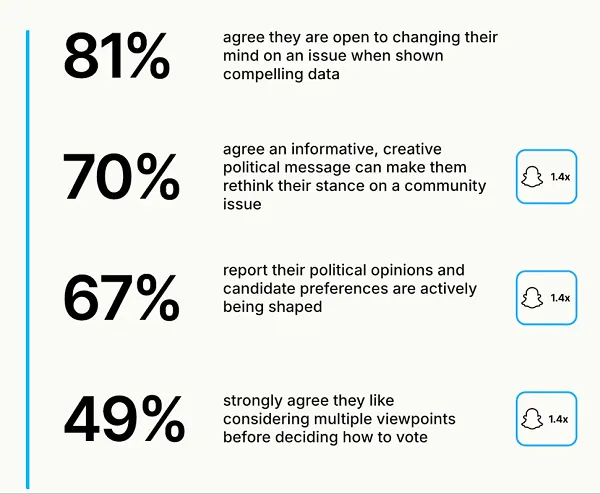
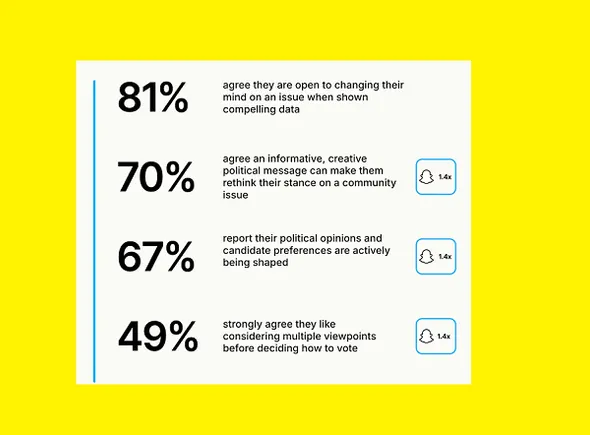
The report, detailed in a blog post for businesses, is based on a comprehensive survey conducted by Alter Agents earlier this year, involving over 1,000 Snapchat users aged between 18 and 45. The findings paint a picture of an increasingly civically aware and active user base, highly receptive to in-app political messaging and cause-based outreach. Snapchatters, as the study suggests, are not only more likely to vote than non-users—1.2 times more likely, to be precise—but also exhibit a unique openness in their political approach. They actively seek out diverse viewpoints before committing to a vote and are notably receptive to changing their positions, presenting a fertile ground for persuasive political communication. This characteristic sets Snapchat users apart in a political landscape often characterized by deep-seated partisan divides, suggesting a demographic open to nuanced arguments rather than rigid ideological adherence.
The Strategic Imperative: Engaging a Pivotal Demographic
The timing of Snapchat’s report is no coincidence, aligning directly with the ramp-up to the 2022 U.S. midterm elections. These elections are historically critical, determining the balance of power in Congress, shaping legislative agendas, and often serving as a referendum on the incumbent presidential administration. For political parties and candidates, securing victory often hinges on mobilizing key demographics, and young voters, while historically less consistent in turnout, represent a substantial and increasingly influential bloc. The youth vote, encompassing Gen Z and younger Millennials, has demonstrated its capacity to sway outcomes in recent election cycles, making platforms that effectively engage this group invaluable.
Engaging younger voters presents a unique set of challenges for political campaigns. Traditional campaign methods, such as direct mail, television ads, and even email, often fail to resonate with a demographic primarily consuming media through digital channels. Social media platforms have, therefore, become indispensable tools for modern political outreach. Snapchat, with its ephemeral content, visual-first approach, and strong community features, has cultivated a user base that is highly engaged and accustomed to digital-native communication styles. The report effectively argues that for campaigns aiming to reach and influence this demographic, ignoring Snapchat would be a significant oversight.
Deep Dive into the Research: Unpacking Snapchatters’ Political Behavior
The Alter Agents study’s methodology, surveying a broad age range from 18 to 45, ensures that its insights capture not just the youngest eligible voters but also a significant segment of the Millennial generation, many of whom are establishing families and careers, making their civic participation increasingly impactful. The consistent finding that nearly 80% of Snapchatters intend to vote in the upcoming midterms stands out when compared to historical youth voter turnout data. For instance, while the 2018 midterms saw a notable surge in youth turnout (ages 18-29) to around 36%—the highest in decades—it still lagged significantly behind older demographics. Snapchat’s reported 78% intention among its users suggests either a highly motivated subset of the youth population or an effective platform for voter mobilization, or likely both. This disparity highlights Snapchat’s potential to significantly boost overall youth participation rates.
The "open-minded" nature of Snapchatters in their political approach is another critical finding. In an era often defined by echo chambers and partisan polarization, the willingness of Snapchat users to seek out diverse viewpoints and even change their positions offers a rare opportunity for political discourse. This characteristic implies that campaigns engaging on Snapchat might find success with nuanced messaging, issue-based arguments, and authentic storytelling rather than relying solely on established partisan rhetoric. For advertisers, this suggests that the platform is not just for reinforcing existing loyalties but for genuinely informing and potentially persuading voters.
Crucially, the study illuminates the potent influence of digital advertising on voter awareness and engagement. A remarkable 80% of respondents indicated that political promotions on the platform had introduced them to candidates and causes they were previously unaware of. Furthermore, 74% reported being more likely to research candidates after encountering their ads on Snapchat. These statistics directly address the platform’s value proposition for political ad spend, demonstrating that ads on Snapchat are not merely seen but actively drive discovery and subsequent engagement. This indicates a high return on investment for political advertisers, transforming passive viewing into active political inquiry and potentially, voter action. The visually rich and interactive ad formats prevalent on Snapchat, such as AR lenses and Story ads, likely contribute to this heightened engagement, making political messages more memorable and actionable than static banners on other platforms.
A Legacy of Civic Action: Snapchat’s Track Record in Voter Registration
Snapchat’s commitment to civic participation is not a recent development but rather a long-standing strategic pillar, predating the current election cycle. The platform has consistently invested in various outreach efforts designed to encourage democratic participation, leveraging its unique technological capabilities and deep understanding of its user base.
The 2018 Midterm Milestone marked a significant turning point. Snapchat actively integrated voter registration tools and prompts directly into its app experience. This proactive approach included features such as registration links within Stories, filters encouraging civic action, and direct messages to users eligible to vote. These efforts bore substantial fruit, with Snapchat reporting that it directly drove over 450,000 people to register to vote for those midterms. This figure was a testament to the platform’s ability to cut through the noise and deliver critical civic information directly to a demographic that might otherwise be harder to reach through traditional channels. The ease of registration, often completed within a few taps, significantly lowered barriers to participation.
Building on this success, Snapchat scaled up its initiatives for the 2020 Presidential Election. Recognizing the immense stakes and the potential for its platform to make an even greater impact, Snapchat intensified its in-app prompts and nudges. These included partnerships with non-partisan organizations to provide accurate voter information, personalized reminders about registration deadlines, and even features like "Friend Check-In" to encourage users to verify their friends’ registration status. The results were even more impressive: Snapchat announced that its efforts led to a staggering 1.2 million new voter registrations. This demonstrated a clear progression in its civic engagement strategy, evolving from simple prompts to more comprehensive voter education and mobilization campaigns, often detailed in its "CitizenSnap" reports. The platform’s ability to integrate these tools seamlessly into the user experience, making civic action feel like a natural part of their digital lives, proved highly effective.
For the 2022 Midterms, while specific new features for voter outreach beyond the current report haven’t been fully detailed, it can be logically inferred that Snapchat will continue to refine and expand upon its proven strategies. This would likely include leveraging augmented reality (AR) filters for election-themed content, partnering with trusted news sources for factual information, and personalized reminders for registration and polling locations. The focus, as indicated by the new report, will be on capitalizing on the "open-minded" nature of its users and the demonstrated effectiveness of digital ads in raising awareness and driving research.
Industry Reactions and Strategic Positioning
The release of this report is likely to elicit a range of reactions from key stakeholders, underscoring Snapchat’s strategic positioning within the digital advertising and civic engagement landscape.
From Snap Inc.’s perspective, leadership would likely emphasize their enduring commitment to fostering civic engagement and empowering young people to participate in democracy. A statement from a hypothetical Snap Inc. spokesperson or executive might read: "Our latest research reaffirms Snapchat’s unique role as a vital platform for civic participation, particularly among the crucial 18-45 demographic. We believe in empowering our community with the tools and information they need to make informed decisions and actively participate in the democratic process. The demonstrated willingness of Snapchatters to seek out diverse viewpoints and engage with political advertising highlights the immense opportunity for campaigns to connect authentically with this influential generation. We are proud of our track record in driving millions of voter registrations and remain dedicated to fostering a responsible and informative environment for political discourse." Such a statement would reinforce the company’s public image as a socially responsible platform while simultaneously highlighting its commercial value to political advertisers.

Political strategists, constantly seeking effective avenues to reach voters, would likely view this data with keen interest. A campaign manager might note: "The Snapchat report confirms what many of us have suspected: this platform is indispensable for reaching younger voters. The high intent to vote, combined with their openness to new information and active engagement with digital ads, presents a powerful opportunity. Traditional media is losing its grip on this demographic, and platforms like Snapchat offer direct, impactful channels. We need to tailor our messaging to be authentic and visually engaging, moving beyond conventional political rhetoric to resonate with how these voters consume information." This perspective would acknowledge Snapchat as a critical part of a multi-platform digital strategy, moving beyond a "nice-to-have" to an essential component.
Civic advocacy groups and non-profits dedicated to increasing voter turnout would likely welcome the report’s findings, viewing them as a positive indicator for democratic health. A representative from a voter registration non-profit might state: "Any data that shows a high propensity for youth voter engagement on platforms they trust is incredibly encouraging. Snapchat’s consistent efforts in voter registration have already demonstrated its capacity to lower barriers to participation. We hope this report encourages more platforms and campaigns to invest in meaningful, accessible civic outreach, while also maintaining vigilance against misinformation and ensuring transparency in political advertising." Their reaction would balance optimism for increased participation with a continued call for platform responsibility.
Broader Implications for Political Campaigns and Democratic Participation
The implications of Snapchat’s report extend far beyond the immediate advertising cycle, touching upon the future of political campaigning and the broader landscape of democratic participation.
For political campaigns, the data necessitates a re-evaluation of digital outreach strategies. Snapchat cannot be treated merely as an auxiliary channel; its unique demographic profile and user behavior demand bespoke content and campaign approaches. Campaigns must move beyond simply repurposing television ads for mobile screens. Instead, they need to invest in native Snapchat content – short, authentic, visually driven narratives that speak to issues relevant to young voters. The emphasis on "open-mindedness" suggests that campaigns that engage in constructive dialogue, offer policy solutions, and demonstrate authenticity will likely outperform those relying on purely adversarial or partisan messaging. The report underscores that issue-based campaigns, tailored to specific concerns of the 18-45 demographic (e.g., climate change, economic opportunity, social justice), are likely to find a highly receptive audience on Snapchat.
From Snapchat’s perspective, this report solidifies its position within the fiercely competitive digital advertising ecosystem. In a market dominated by giants like Meta (Facebook, Instagram) and Google, Snapchat differentiates itself through its unique reach among younger demographics and its proven track record in driving real-world civic action. This distinction makes it an attractive proposition for political advertisers looking to diversify their spend and target specific voter segments effectively. Successfully attracting more political ad revenue would not only boost Snap Inc.’s financials but also reinforce its image as a responsible and impactful social media platform, potentially influencing its overall brand perception and user loyalty.
More broadly, the report offers a hopeful outlook for democratic participation, particularly concerning the historically underrepresented youth vote. If platforms like Snapchat can consistently motivate millions to register and turn out, it could fundamentally alter electoral outcomes and ensure that the voices of younger generations are heard more clearly in the halls of power. The ongoing evolution of digital tools for civic engagement means that future elections could see even higher levels of tech-facilitated participation, potentially leading to a more representative democracy.
However, navigating this digital landscape also presents challenges. While Snapchat has a strong stance against the spread of misinformation, the sheer volume of content and the speed of information dissemination on social platforms always pose risks. Political campaigns must adhere to ethical advertising standards, and platforms bear the responsibility of maintaining content integrity. Ensuring transparency in political advertising and robust content moderation policies will be crucial as digital platforms continue to play an increasingly central role in shaping public discourse and electoral processes. The insights from this Snapchat report provide a critical roadmap for campaigns seeking to engage a vital, influential, and often overlooked segment of the electorate, underscoring the enduring power of digital platforms in shaping the future of democracy.


 Neng Nana
 Nana Muazin