


Published on April 17, 2026, Sinch Mailgun’s 2026 Email Impact Report delivers a comprehensive, data-backed assessment of the global email landscape, highlighting a burgeoning divide between organizations that strategically invest in measurement, deliverability, and optimization, and those that continue to operate on untested assumptions. The report, which draws from a global survey of over 1,200 email senders and an exhaustive analysis of more than 400 billion real emails sent via Sinch Mailgun infrastructure in 2025, serves as a crucial guide for email professionals navigating the complexities of digital communication in the latter half of 2026. Its findings span five critical chapters, delving into the intricacies of Return on Investment (ROI), industry benchmarks, deliverability trends, the adoption and impact of Artificial Intelligence (AI), and evolving investment priorities within the email marketing domain.
The Enduring Power of Email and the ROI Conundrum
Despite the proliferation of new communication channels, email retains its status as an indispensable tool for businesses worldwide. A striking 78% of senders surveyed unequivocally state that email is "very" or "extremely" important to their organizations, underscoring a deep-seated belief in its efficacy. This level of organizational buy-in is a rare commodity for any marketing channel, often hard-won and indicative of email’s consistent performance over decades. However, the report exposes a significant disconnect between this widespread conviction and the tangible evidence supporting it. Fewer than half of email senders actively measure the ROI of their email programs, with only 46% tracking promotional email ROI and a slightly lower 43% for transactional emails. This revelation suggests that a substantial portion of email teams are operating on faith rather than quantifiable data, a precarious position in an increasingly data-centric marketing environment.
For those who do meticulously track their email ROI, the figures are compelling. A robust 60% of senders measuring promotional email ROI report a return exceeding $10 for every $1 spent, with an impressive 13% achieving a return greater than $40 for every dollar invested. Similarly, 62% of senders measuring transactional email ROI witness returns above the $10:1 threshold, and 13% again report returns surpassing $40:1. While these high figures might seem universally positive, Sinch Mailgun’s research introduces a nuanced perspective, suggesting that exceptionally high returns could, in some instances, signal an underinvestment in the email program rather than peak efficiency. This implies that some organizations might be leaving potential revenue on the table by not scaling their highly successful email initiatives.
The most frequently cited obstacle to increasing email investment is budget constraints, identified by 43% of senders. This presents a classic Catch-22 scenario: budgets are difficult to secure without compelling data, yet many teams lack the necessary data to build a persuasive case. The report advocates for an pragmatic intermediate step: initiating tracking with revenue per campaign. Even if the initial attribution model is imperfect, this foundational data provides a starting point for demonstrating value and gradually building a more robust ROI measurement framework, ultimately enabling teams to advocate for greater resource allocation. The broader implication is that the failure to measure ROI isn’t just a technical oversight; it’s a strategic impediment to growth and optimization within the email channel.
Unveiling Real-World Benchmarks: A Deep Dive into 400 Billion Emails
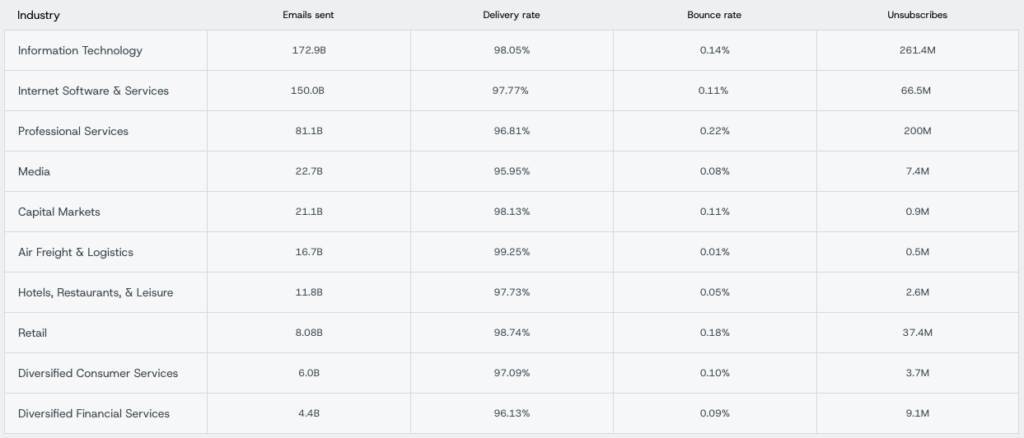
Historically, industry benchmark data for email performance has largely relied on surveys and self-reported estimates, which can introduce biases and inaccuracies. Chapter 2 of the Sinch Mailgun report distinguishes itself by adopting a more empirical approach, leveraging real sending data from its infrastructure across the top 10 industries by volume in 2025. This unprecedented analysis of 400 billion emails provides a granular, authentic look at where the benchmarks truly lie.
The performance metrics vary significantly across industries, reflecting the diverse nature of their email communications. Air Freight & Logistics leads the pack with an exceptional 99.25% delivery rate and a minuscule 0.01% bounce rate. This superior performance is primarily attributed to the high volume of transactional sends—such as shipping confirmations and tracking updates—which are highly anticipated and desired by recipients. In stark contrast, the Media industry registers the lowest delivery rate among the top 10, at 95.95%. This can be explained by the industry’s characteristic high volumes and broad promotional audiences, which naturally exert downward pressure on delivery metrics due to factors like less engaged subscribers or more aggressive spam filtering.

However, the report critically cautions against relying solely on delivery rate as a metric for success. An email "delivered" to the spam folder still technically counts as delivered by the server, yet it fails to achieve its intended purpose. Sinch Mailgun makes a compelling case for senders to pair delivery rate tracking with rigorous inbox placement testing. This combination provides a more accurate understanding of where emails are actually landing, differentiating between mere acceptance by a mail server and successful arrival in the recipient’s primary inbox. The report highlights that only 25% of senders currently conduct inbox placement tests, indicating a widespread gap in understanding true email effectiveness.
The analysis of unsubscribe rates further underscores the necessity of context. Information Technology, for instance, recorded the highest raw number of unsubscribes at 261 million. Yet, when contextualized against its colossal 172.9 billion sends, this translates to a relatively low unsubscribe rate of approximately 0.15%. Conversely, the Retail sector generated 37.4 million unsubscribes from a significantly smaller volume of 8.08 billion sends, resulting in a much higher unsubscribe rate per email. This comparison powerfully illustrates that raw unsubscribe volume, without the crucial context of send volume, is a meaningless metric and can lead to misguided strategic decisions. The report’s empirical benchmarks offer a more reliable standard against which organizations can genuinely assess their performance and identify areas for improvement.
The Paradox of Deliverability: Infrastructure Progress vs. Knowledge Gaps
Deliverability remains a cornerstone of effective email marketing, with 89% of senders recognizing its paramount importance to their organizations. The past 12 months have seen tangible progress, with 43% of senders reporting an improvement in their inbox placement rates. This positive trend is largely driven by significant advancements in email infrastructure, particularly the widespread adoption of DMARC (Domain-based Message Authentication, Reporting, and Conformance).
The report presents compelling data on DMARC adoption growth: from 43% in 2023, it rose to 54% in 2024, and reached 61% in 2025. This surge has been primarily fueled by stricter authentication requirements mandated by major Internet Service Providers (ISPs) like Gmail, Yahoo, and Microsoft, which have increasingly prioritized email security and anti-spoofing measures. For the first time in Sinch Mailgun’s research, DMARC enforcement—through quarantine or reject policies—is outpacing passive monitoring, indicating a maturing approach to email security where organizations are actively preventing unauthorized use of their sending domains.
Despite these infrastructure improvements, a critical knowledge gap persists among senders. A concerning 36% claim to monitor their "email deliverability rate," a metric that, as the report clarifies, does not exist in a meaningful, standardized form. This confusion highlights a fundamental misunderstanding between the email delivery rate (which simply indicates acceptance by a server, regardless of spam folder placement) and true inbox placement (which measures actual arrival in the primary inbox). Alarmingly, only 25% of senders proactively conduct inbox placement tests to ascertain where their emails truly land. Furthermore, 27% of DMARC users are unaware of the specific policy (none, monitor, quarantine, or reject) they have implemented. This dichotomy reveals a troubling paradox: while the tools and protocols for advanced deliverability are improving and becoming more widely adopted, the fundamental literacy and understanding among many email practitioners have not kept pace. This lack of knowledge can lead to a false sense of security and missed opportunities for optimizing email performance, potentially undermining the significant infrastructure investments made.
AI Adoption: Widespread Intent, Uneven Impact
The transformative potential of Artificial Intelligence has not escaped the email marketing sphere. The report indicates a broad intent for AI integration, with 79% of senders either currently using or planning to use AI in their email programs. However, the reality of consistent application lags behind aspiration, as regular AI use stands at a modest 27%. A significant portion of current adopters are still in the experimental phase, exploring AI’s capabilities rather than systematically embedding it into their daily workflows.
The most prevalent application of AI is in copy generation, utilized by 41% of senders, followed by content personalization (36%), dynamic content creation (29%), send time optimization (27%), and data analysis (27%). This pattern reveals a clear trend: AI delivers its most profound value when it is integrated into strategic decision-making processes, extending beyond mere content production. Teams leveraging AI for sophisticated tasks like personalization, optimal send timing, and A/B testing report compounding returns, indicating a deeper and more impactful engagement with the technology. In contrast, teams that limit AI’s role to superficial tasks, such as drafting subject lines, observe only limited impact, reinforcing the idea that the depth of integration dictates the extent of benefit.
The report provides compelling evidence of AI’s burgeoning influence on performance. A significant 54% of senders who have implemented AI report that their email programs improved moderately or significantly year-over-year. This stands in stark contrast to just 37% of senders who are not using AI reporting similar improvements within the same timeframe. This 17-point performance gap serves as the clearest signal yet that AI is beginning to stratify email programs into distinct performance tiers. While the report carefully notes that this does not definitively prove causation, the consistent direction of the data strongly suggests a correlative relationship between AI adoption and enhanced email program performance.
Despite the positive trends, 23% of AI users indicate that the technology has not provided any discernible help. This finding is crucial, as it underscores that the tool itself is not the sole determinant of success. Rather, the difference between those realizing value from AI and those who are not lies in the depth and thoughtfulness of its integration. Superficial or piecemeal adoption of AI, without a clear strategy for embedding it into core decision-making and optimization processes, is unlikely to yield significant returns.
Strategic Investments for the Future of Email
Looking ahead to 2026, the strategic priorities for email marketers are sharply defined. "Taking advantage of AI" and "increasing email engagement" are tied as the top priorities, each cited by 40% of senders, reflecting both the technological imperative and the foundational goal of effective communication. In terms of financial commitment, 31% of organizations plan to increase their email investment, while a substantial 48% intend to maintain their current spending levels. Only a small minority of 7% anticipate decreasing their email investment, underscoring the channel’s perceived value and resilience.
The report’s concluding message is both straightforward and empowering: email works. The extensive data collected across ROI metrics, industry benchmarks, and deliverability trends unequivocally supports this assertion. However, the programs poised to gain a competitive edge are those that commit to simultaneous investment across three critical areas: measurement, deliverability, and optimization.
Measurement involves transitioning from operating on assumptions to proving ROI with real, quantifiable data, enabling informed decision-making and justifying further investment. Deliverability focuses on consistently reaching the inbox through robust authentication protocols (like DMARC), diligent list hygiene, and continuous monitoring of inbox placement. Optimization encompasses leveraging advanced tools, particularly AI, and systematic testing to continually improve performance at scale, refining content, timing, and personalization strategies.
Crucially, Sinch Mailgun emphasizes that none of these areas necessitate a massive budget to initiate. Even small, consistent efforts in these domains can yield significant, compounding returns over time. The future of email marketing is not merely about sending messages, but about intelligent, data-driven, and strategically optimized communication that ensures messages land, engage, and convert, ultimately widening the gap between the leaders and the laggards in the digital landscape.








